-
-
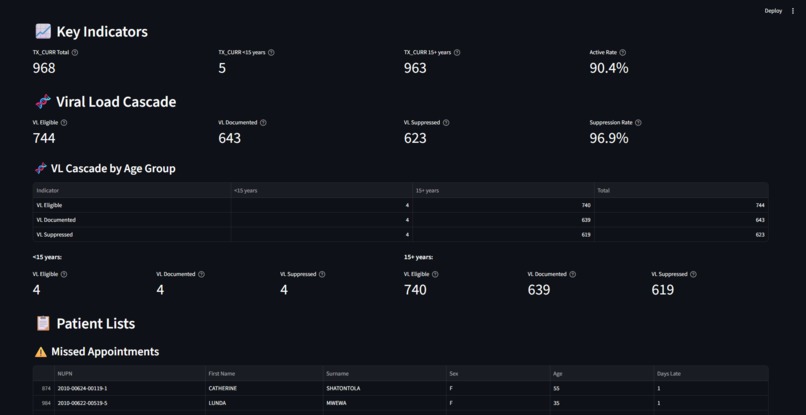
Snapshot of TxLens main screen

Inspiration
Every morning, I work with patient registers exported from SmartCare Pro. To manage programs effectively, I spend hours filtering through spreadsheets to count how many clients are currently active, break them down by age groups, and identify those who are due for lab tests or who have missed their appointments.
This routine is repetitive and prone to human error. I wanted a way to make it faster, more reliable, and easier to share with colleagues. That’s how TxLens was born — a tool designed to give program managers and clinicians a clear view of their daily client numbers and lists at the click of a button.
🌟 What it does
TxLens is a local-first web app that processes SmartCare Pro Excel exports and automates daily HIV program workflows. It:
- Counts active clients and breaks them down by age groups.
- Tracks lab test coverage and results (who’s eligible, tested, suppressed).
- Generates a list of clients due for lab tests.
- Creates missed appointment and follow-up lists for clinicians.
- Exports clean Excel/CSV reports ready for printing or sharing.
🛠️ How we built it
- Python (Pandas + OpenPyXL) for processing and calculations.
- Streamlit for the interactive web interface that runs locally.
- ExcelJS-like logic with OpenPyXL for generating export files.
- Modular architecture separating data loading, indicator calculations, and reporting.
- Dummy SmartCare datasets created to test and demo the tool without exposing real patient data.
⚡ Challenges we ran into
- Data compliance: Medical records must remain in-country, so we couldn’t use cloud hosting. We solved this by running TxLens entirely on
localhost. - Inconsistent files: SmartCare exports don’t always have the same structure. We had to design flexible column validation and error messages.
- Time vs. scope: It was tempting to add advanced features (historical trends, PDFs, more indicators), but we kept the MVP focused and useful.
🏆 Accomplishments that we're proud of
- Turning a manual, error-prone workflow into an automated one.
- Delivering a clean, local-first app that respects healthcare data laws.
- Building a tool that clinicians can immediately use in their daily routines.
- Designing an architecture that’s modular and extendable beyond the hackathon.
📚 What we learned
- How to translate real-world healthcare workflows into software requirements.
- How to use AI-assisted development (Kiro) to accelerate building while keeping code clean and modular.
- How important it is to balance scope and compliance in healthcare projects.
🚀 What’s next for TxLens
- Add trend analysis for long-term program monitoring.
- Support more MER indicators beyond the MVP.
- Build role-based dashboards for different users (program managers, clinicians).
- Explore lightweight, local databases for storing historical data securely.
- Package TxLens into an installer for offline use in facilities.


Log in or sign up for Devpost to join the conversation.