-
-

Wayly's logo
-
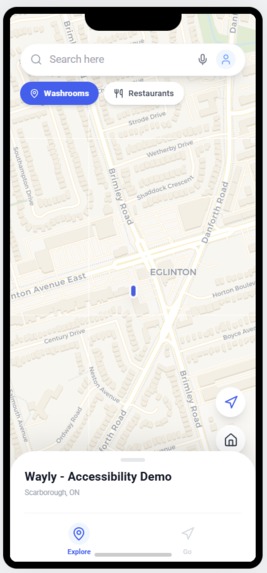
First view of Wayly overlay on Google Maps
-
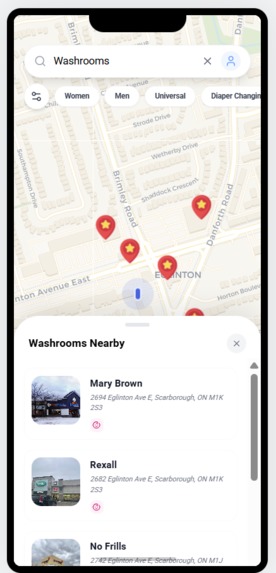
All washrooms available around the location
-
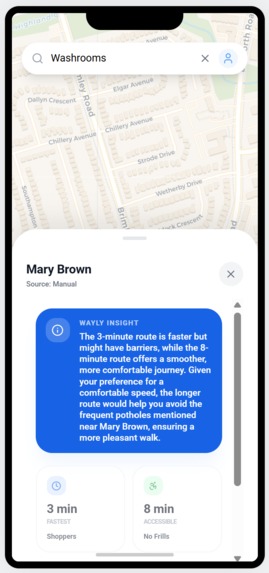
AI-generated insights and route options highlighting the fastest and most accessible paths based on past user feedback
-
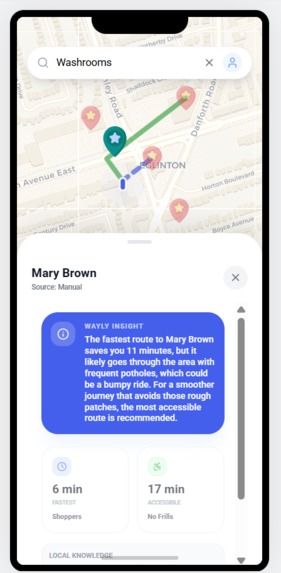
Test case 2, but with more personalization
-


Inspiration
Countless times, when looking for a washroom in an unfamiliar area, we’ve been told: “It’s out of order right now”, “Only customers can use our washrooms”, “Sorry, it’s for employees only”, etc. It’s a frustrating experience on its own, but even more so for people who face challenges when it comes to mobility.
Case in point, one of our team member’s mom has Rheumatoid arthritis (RA), an autoimmune disease that has been affecting 18 million people across the world as of 2019. Symptoms like chronic pain and stiff joints make it challenging to travel from one place to another, and in one vivid memory, our team member recalls having to walk unreasonable distances just in the search for an available restroom.
There are existing tools for finding nearby washrooms, but often, they are out of date or do not consider the process of making it to the location, which is where Wayly comes in handy.
What it does
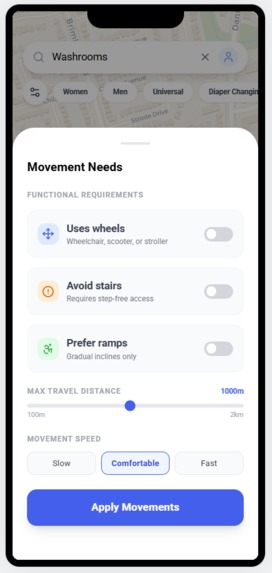
Wayly facilitates the discovery of disability-friendly facilities in the user’s vicinity and helps users to identify the safest and most efficient path towards their destination. Through adapting results based on mobility needs (e.g. avoid stairs, use wheels), Wayly avoids labelling users by mobility status and supports both permanent and temporary accessibility needs.
Features include:
- Distinct icons indicating the location of restrooms
- Wayfinding based on accessibility considerations and additional preferences
- User-provided updates on facility status
How we built it
Using Overpass API, we accessed OpenStreetMap data on restroom locations across Scarborough. With the use of ArcGIS, this was plotted on a map and processed to create a .geojson file.
As we were uncertain as to whether we would be able to have a full prototype working in time for the deadline, we created 2 prototypes using Google AI Studio and our own coding skills, respectively.
Challenges we ran into
With the Google AI Studio prototype, we got a lot of practise with prompt engineering. At times, our prompts were too general, allowing the AI to take a lot of (unwanted) liberties with the design. But when we included too many requirements, some would get lost in the final output. We were able to find a healthy medium, but ultimately found it more effective when we directly made manual revisions to the generated code.
Accomplishments that we're proud of
In our first hackathon together, trying out new technology led to heavy delays and a generally subpar result. Some of us weren’t even confident in our abilities to really write code to build an application. But this time, with more diverse skillsets and an increased awareness of AI tools, we were able to learn new skills with ease and quickly apply them to a problem space that was important to us.
What we learned
Before delving into this topic, we weren’t aware of how much accessibility considerations varied across conditions. From the consideration of potholes for wheelchair users, to the need for good lighting when someone has low vision, there are a myriad of points to consider when picking out the best path to one’s destination. But as the curb cut effect indicates, accommodations for these are not only beneficial for the community of disabled people — they can result in lasting benefits for society as a whole.
What's next for Wayly
Washrooms aren’t the only facilities that are hard to find; breastfeeding rooms, diaper changing tables, pad/tampon dispensers, and more are rarely if ever seen on maps! Future iterations of this app would provide the ability to locate these across a broader range, expanding beyond Scarborough. To ensure the data stays up to date, we’ll also include features like user review and ratings for the facilities.
Built With
- css
- esri
- gemini
- googleaistudio
- html
- javascript
- openai
- ors
- osm-(overpass-api)
- qgis
- typescript
- vite


Log in or sign up for Devpost to join the conversation.