-
-
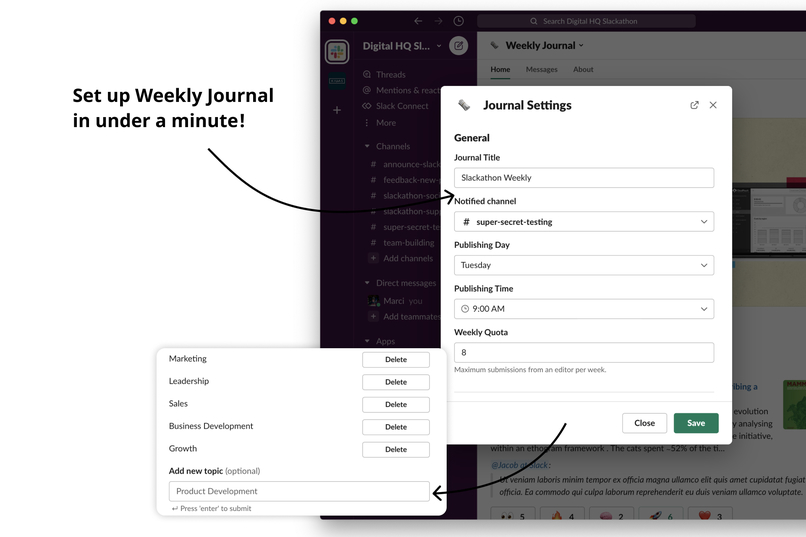
Set up Weekly Journal in under a minute!
-
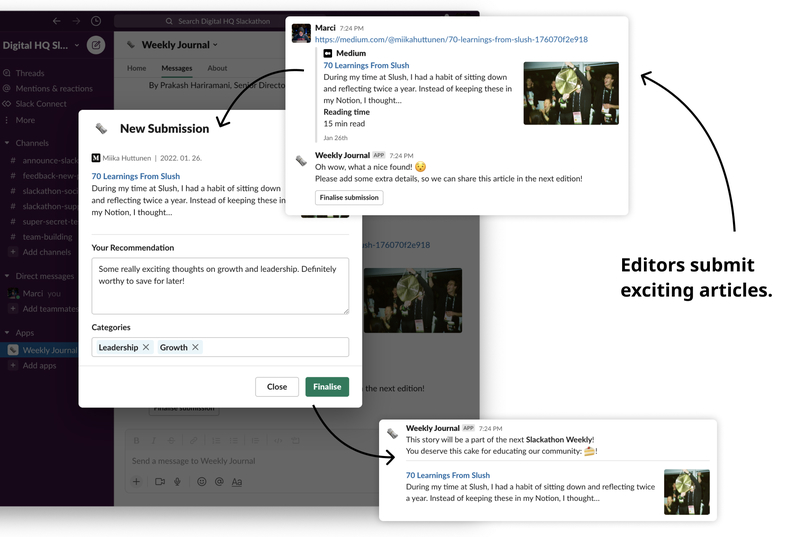
Editors submit exciting articles
-
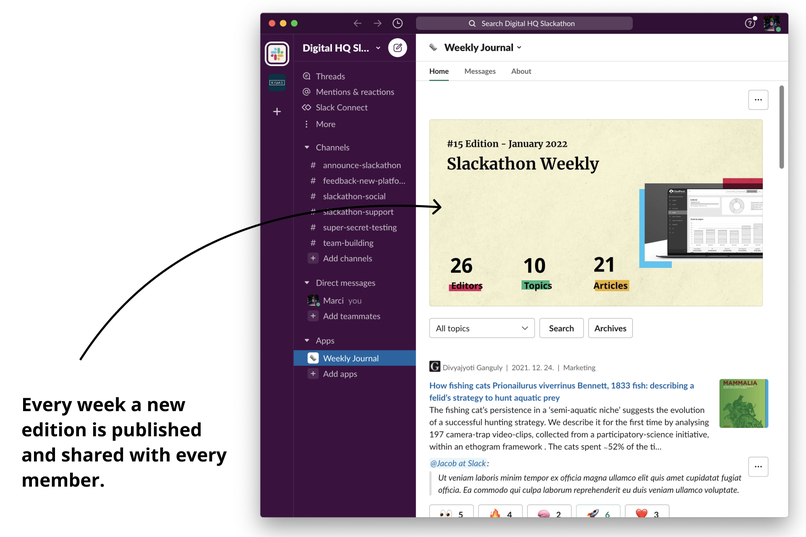
Every week a new edition is published and shared with every member
-
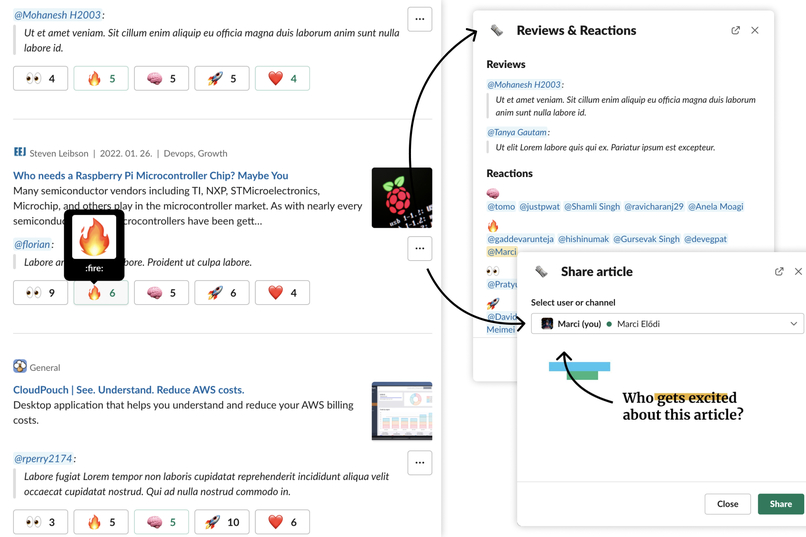
React and share articles
-
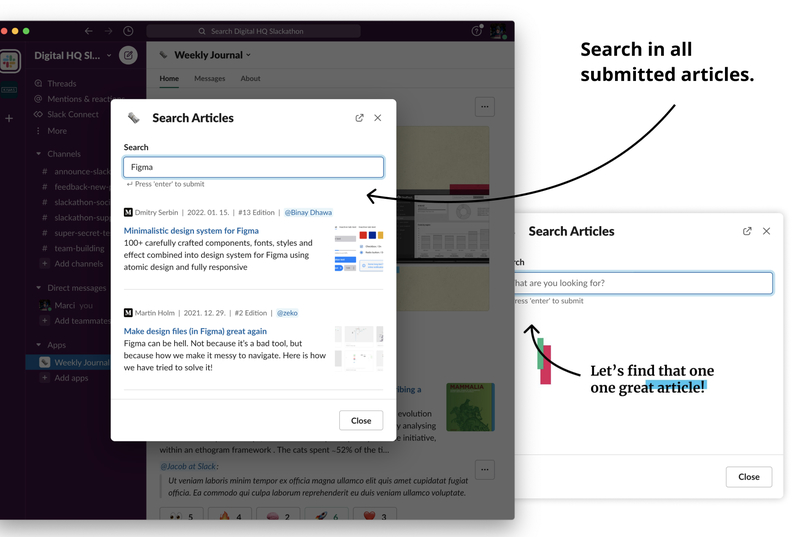
Search in all submitted articles
-
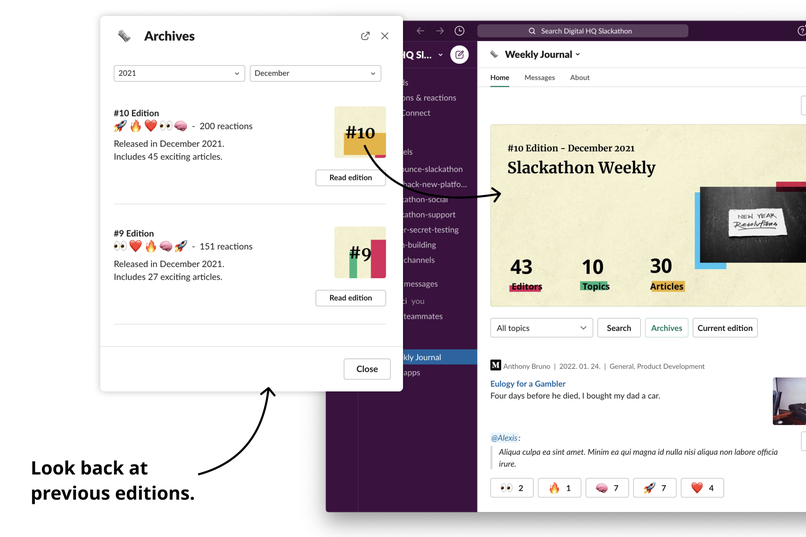
Look back at previous editions
-
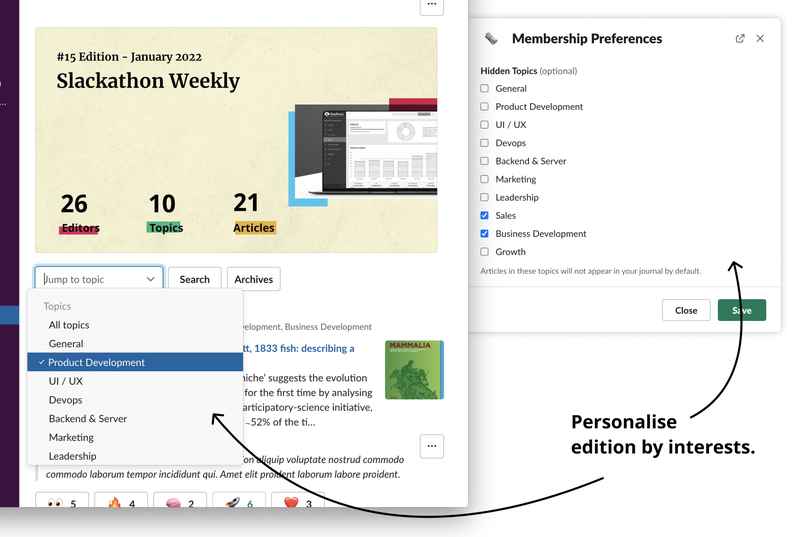
Personalise edition by interests
-
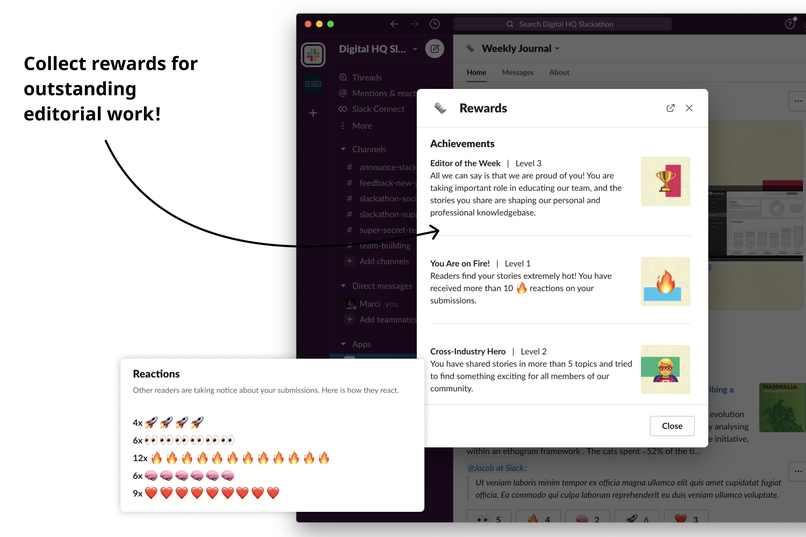
Collect rewards for outstanding editorial work!


Good to know! Weekly Journal is a completely functional Slack application that implements all features mentioned below. Make sure to see for yourself in the demo video. 😉
😯 “I will text you the link”
Studies show that education and knowledge sharing are essential to build well-functioning teams. Communities are built around shared knowledge, and intentionally involving their members in each other’s development, proves to be an effective way in building both personal and professional relationships between them.
However, when we started to interview business owners, HR managers and team members about their best practices in knowledge sharing, we were surprised to hear that there are no best practices. Moreover, there are no practices at all. These were their most common reactions:
- ”We are used to sharing articles with each other wherever we can. Direct messages, in email, tagging each other in Twitter and Linkedin comments, or a Slack channel that seems to fit the topic. The biggest issue is that this usually happens in private messages between team members, leading to information asymmetry if we look at the community as a whole.”
- ”It’s almost impossible to find something from the past, they just get lost between other messages and work-related content. It’s a real shame, I think my coworkers find really valuable stories and it all goes to waste.”
- ”We tried to create a company newsletter for such purposes, but it was too complicated to manage. We gave up eventually.”
- ”One interesting thing about knowledge sharing in a work environment is that members are often interested in topics out of their main professional domain. So this whole thing becomes much more than only improving their work-related skills.”
- ”Usually the main problem is timing. Something gets shared, but it’s just not at the right moment and people will forget about it.”
Is it possible that such an important part of community building remained uncovered by digital products? This problem was worth solving and Slack just provided the perfect platform to do so!
🗞 What's Weekly Journal?
Weekly Journal is a Slack Application that facilitates knowledge sharing between team members and helps the development of communities. Essentially, it transforms a Slack Workspace into an ‘editorial office’, where users become editors by submitting valuable content, and regularly publishing them in their own journal.
This journal will become a knowledge base, that stores the articles in the long term and gives equal access to them for every member of the community.
🧐 What’s included in Weekly Journal?
Our mindset is that an early stage software should include a small set of key features, able to effectively solve the users’ biggest problems. From there, it could be continuously improved according to the users’ feedback. Therefore we designed and developed a prototype that is already fully functional and satisfies the primary user needs.
Setting up the journal
After Weekly Journal was installed in a workspace, there are a few things to set up before it could go live. Just like a real-world journal, it needs a name and a weekly publishing time. The app will send out notifications when a new edition is published, and for that, we have to select a Slack channel as well. To keep the quality of the submitted articles high, it is also possible to define the maximum amount of weekly submissions per editor. Finally, it’s also preferred to define some topics, that will help the structure of the journal.
Making a submission
Editors can submit a new article to the journal by sending the link to the Weekly Journal Slackbot. The application will ask for some additional details: the editor has to write a personal recommendation to the article, and select the related topics. Some verifications have already been implemented to keep the journal organised: articles from previous editions cannot be submitted again, and editors cannot surpass their weekly quota. If everything checks out, the bot will confirm the new submission. It’s that easy!
Alternatively, submissions can be made by a Slack command or a shortcut as well. These features work pretty much the same as sending the link, but they are intended to be used as part of workflows later on.
Publishing journal edition
At the weekly publishing time, the application automatically collects all submitted stories, shapes them into a new journal edition and sends out notifications to the selected channel. The new edition will also get a custom generated cover image to make every edition unique.
Browsing an edition
On the app’s home page we can immediately dive into the new edition where the shared articles are displayed through multiple pages. For every article, a short preview is displayed, together with the editor’s personal recommendation. It might happen that one article has been submitted by multiple editors, in these cases all further recommendations can be viewed in a separate modal.
As the first level of personalisation, each editor can select a group of topics that they are not interested in at all, and by default, articles in these topics will be hidden from the edition. There is also a filter option to show the articles only from selected topics.
Reacting to articles
When we read an article that we like, it’s easy to send the editor our feedback with emoji reactions. The reactions of other readers are also visible to all.
If we know someone who could be particularly interested in the article, it’s also possible to share it with them in a direct message.
Searching and archives
We believe that accessibility is the main benchmark of a knowledge base, therefore we intentionally focused on making all articles available forever. Members can search in the knowledge base by keywords and the application with display all matching articles from the journal’s history.
Another important feature is the journal's archive. Members can browse and open all previous editions, making the Weekly Journal a time-machine for current and newly joined users as well.
Collecting rewards for editorial work
With a little gamification, we also tried to incentivise members to become active editors in the community. Based on the created submissions and the reactions by other readers, the application rewards editors with achievement badges.
Although these are completely virtual at the moment, it could be a good starting point for business owners to reward the most active members with real-world benefits as well.
🛠 How was Weekly Journal built?
The application was created in Node.js with Slack’s Bolt SDK. The backend uses SQLite with Prisma ORM for storing and retrieving the content and configuration of journals. The cover image and the thumbnail of each edition are created with the Canvas API and stored in a Google Cloud bucket.
We paid close attention to the user experience of the application. We designed and developed every feature to cover the user journeys end-to-end, including empty states, error states, help messages and other additional scenarios. These features have been tested with real-world users and improved according to their feedback. Finally, we also took into account issues related to responsiveness, for example handling content of different lengths.
The implementation of some features required advanced patterns and tested the limits of the Bolt SDK. Probably the most complex component is the overview of a journal edition, on the app’s home page. This component is able to load back previous editions, show the included articles through multiple pages, and filter them according to the selected topics, all at the same time. The state management of such a feature challenged us at first, but we successfully overcome all barriers and the result turned out to be just perfect.
😍 “I will publish it in our journal!”
Similarly, with the interviews, we knew that the capabilities of the application had to be tested with real users, so we asked people with previous Slack experience to try out Weekly Journal. Besides a few minor bugs and improvement recommendations, the feedback has been overwhelming.
Although the application is not published yet in production, some teams already wanted to start using it. For them, the simplicity of Weekly Journal was the key benefit. It was super fast to make new submissions and the journal editions were easily accessible. HR managers started to come up with ideas for including Weekly Journal in their personal development programs and integrating it with existing employee benefit solutions.
🚀 What’s next for Weekly Journal?
We are planning to release Weekly Journal in beta mode shortly. We would like to continue our focus on user-centred development and improve the application according to the needs of our users.
Some areas of future developments include detailed analytics about the editors and readers of the journal, more complex permission management, a higher level of personalisation, and options for deeper discussions around the submissions. To set the path for future growth, we also have to improve the flexibility of the application, with multi-language support and similar features.
Built With
- bolt
- google-cloud
- javascript
- node.js
- prisma
- slack
- sqlite


Log in or sign up for Devpost to join the conversation.