-
-
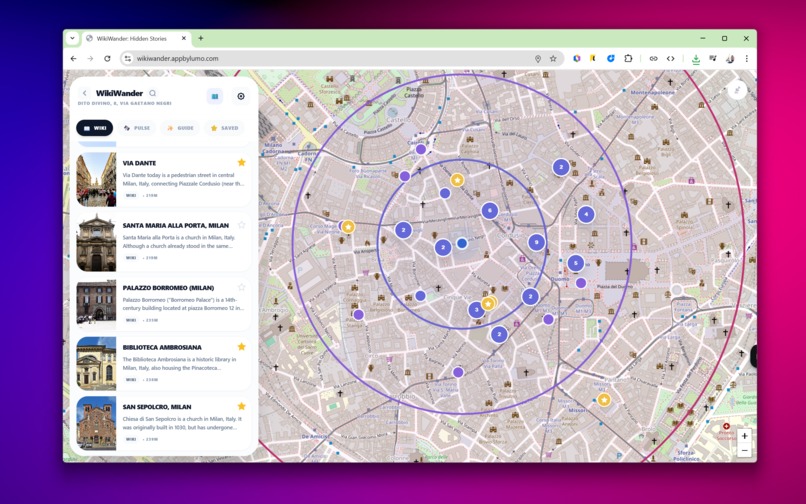
Exploring area with insights from Wikipedia
-
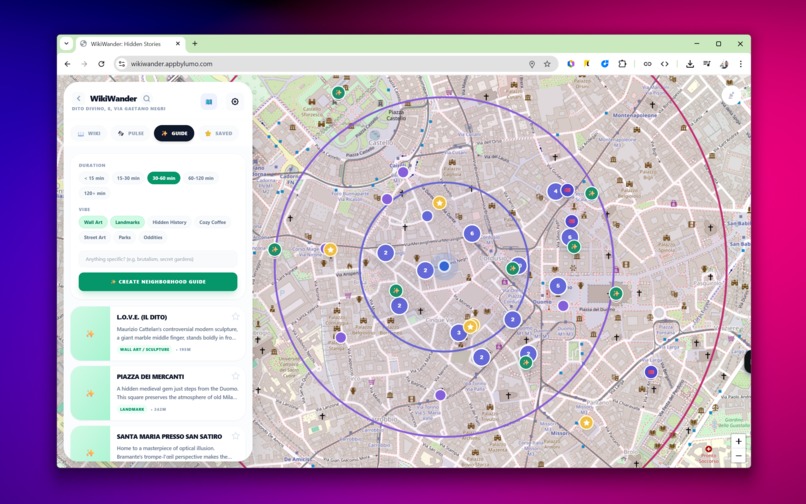
Explore with AI guide finding hidden gems in area
-
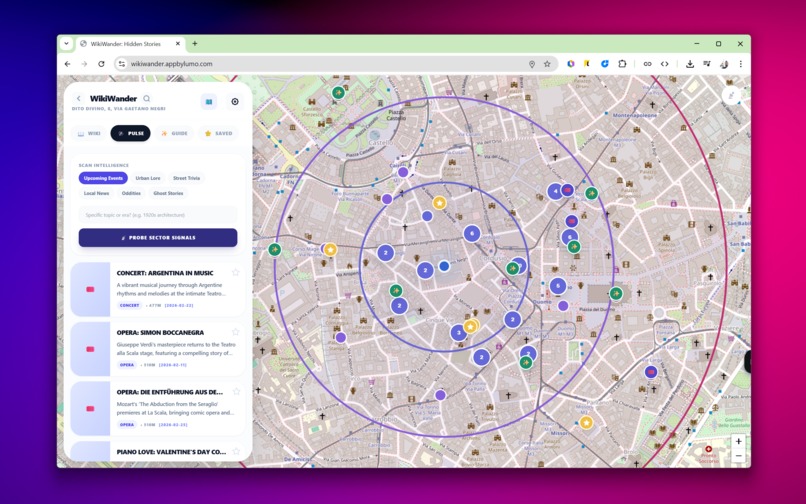
Check local pulse for events and trivia
-

Mark favorite spots to visit
-
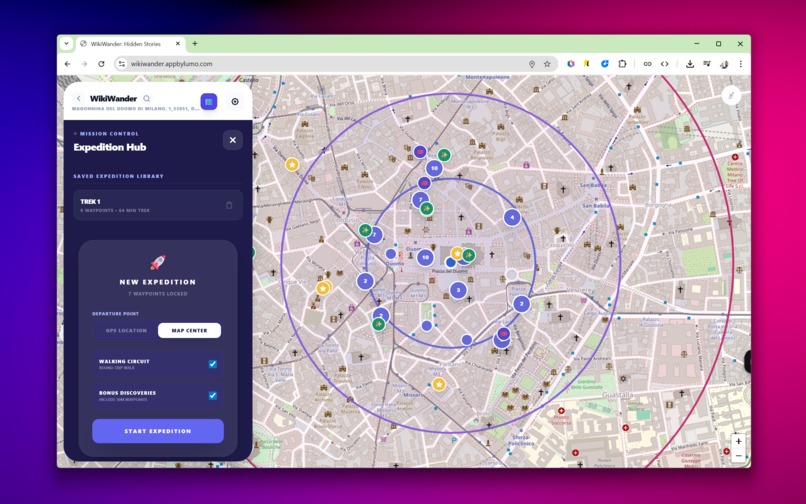
Update some settings and let Gemini pick the route
-
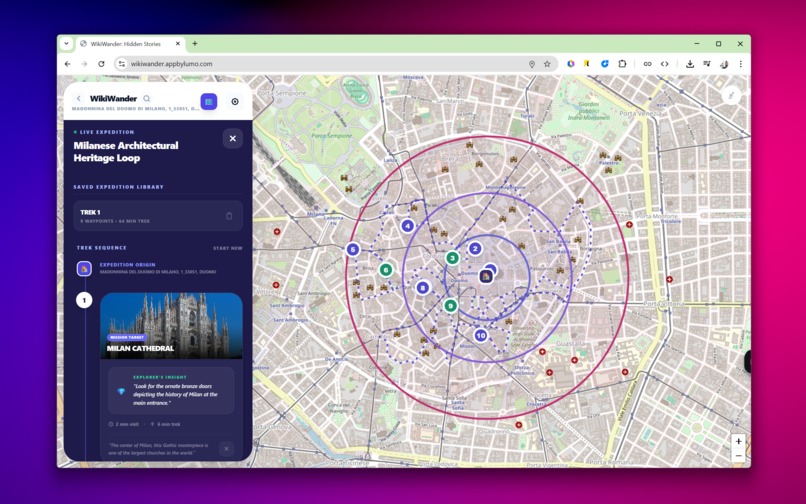
Review the plan
-
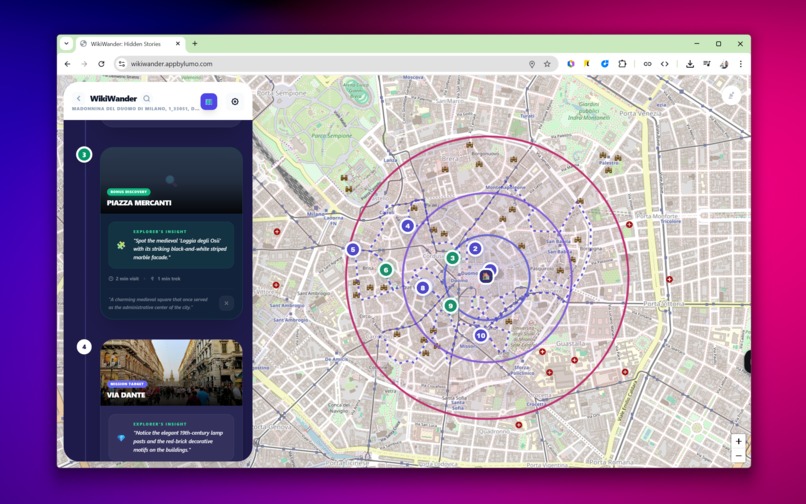
Check the bonus spots along the way
-
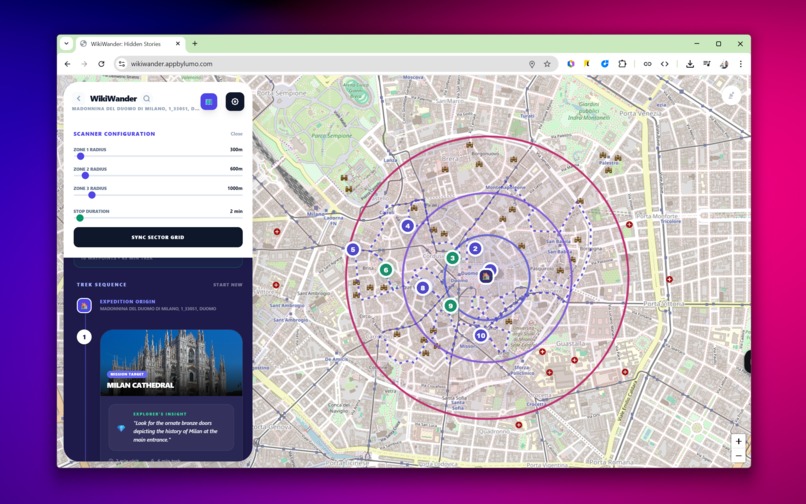
Mange circle radius for discoveries


WikiWander: Your Neighborhood, Rewritten by AI
🧭 The Story
Wikipedia is the greatest map of human knowledge, but for the person walking down a city street, it’s a locked vault. You see a blue plaque or an old statue, but you miss the "soul" of the neighborhood - the eccentric residents, the forgotten scientific breakthroughs, and the local news happening right now.
WikiWander transforms the static Wikipedia map into a living, breathing urban explorer. It doesn't just show you "what" is there; it tells you "why" it matters through an AI-curated lens.
🛠️ What it Does
WikiWander uses your GPS location to establish a "Discovery Grid" across three concentric zones.
- Neighborhood Lore: Analyze 50+ local articles simultaneously to extract hidden connections and urban vibes.
- Pulse Scan: Uses Gemini 3 Pro with Google Search grounding to find real-time events, news, and ghost stories tied to your current sector.
- AI Concierge: A vibe-based guide that suggests spots based on your mood - from "Brutalism" to "Cozy Coffee."
- Expedition Pathfinder: Sequences your favorite spots into an optimal walking tour using Gemini for narrative flow and OSRM for street-accurate walking directions.
🚀 How we built it
WikiWander is a hybrid React application that combines deterministic geo-data with non-deterministic reasoning:
- The Engine: We utilized a dual-model approach. Gemini 3 Pro handles high-reasoning tasks like cross-referencing Wikipedia articles for "Lore" and performing grounded web research for "Pulse." Gemini 3 Flash handles the high-speed sequencing of walking itineraries, ensuring low-latency navigation.
- The Map: Built with Leaflet and MarkerCluster, optimized for mobile-first, one-handed interaction.
- The Routing: We integrated the OSRM (Open Source Routing Machine) walking profile to ensure that our AI-generated tours follow real sidewalks and pedestrian paths, not just straight lines.
- Grounding: Every AI suggestion is grounded via Google Search, ensuring that when the app suggests a local event or a "secret" spot, it actually exists in the real world today.
🧠 Challenges we ran into
- Context Density: Wikipedia entries are long. We had to implement a progressive batching system to feed Gemini the most relevant snippets without hitting token limits, while still maintaining the "big picture" of a neighborhood.
- Geo-Precision: Mapping LLM-generated locations to real coordinates requires strict JSON schema enforcement to ensure the UI doesn't break when rendering markers.
- Mobile Latency: Ensuring the map remains fluid while Gemini is "thinking" about the neighborhood lore required a robust asynchronous state management system.
🏆 Accomplishments that we're proud of
- Successfully "connecting the dots" between seemingly unrelated Wikipedia articles to find unique neighborhood themes.
- Implementing a street-accurate walking router that feels as professional as native map apps.
- Creating a "locked-tool" progression system that encourages users to explore and "discover" items to unlock the Magic Tour and Planner features.
📖 What we learned
We learned that the true power of Gemini 3 isn't just in answering questions, but in synthesizing disparate data points into a cohesive narrative. By grounding the LLM in Wikipedia and Google Search, we turned a "hallucination risk" into a "discovery engine."
🔮 What's next for WikiWander
- AR Integration: Bringing the Wikipedia extracts into an Augmented Reality view.
- Multi-Speaker TTS: Using Gemini's native audio capabilities to provide a hands-free "Podcast" mode of the walking tour.
- Community Lore: Allowing users to contribute their own grounded "secrets" back into the AI's knowledge base.
Built for the Gemini 3 API Global Hackathon. Built in 2–3 days, with most of the time spent fixing regression bugs introduced by AI-generated changes.


Log in or sign up for Devpost to join the conversation.