-
-
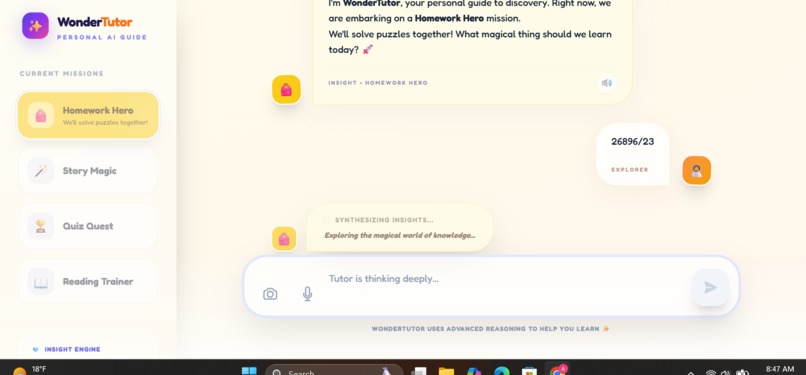
Wonder Tutor as Homework hero
-
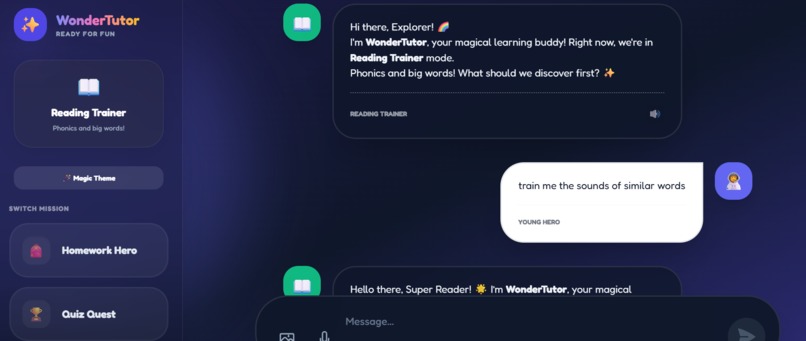
Wonder Tutor as Quiz Quest
-
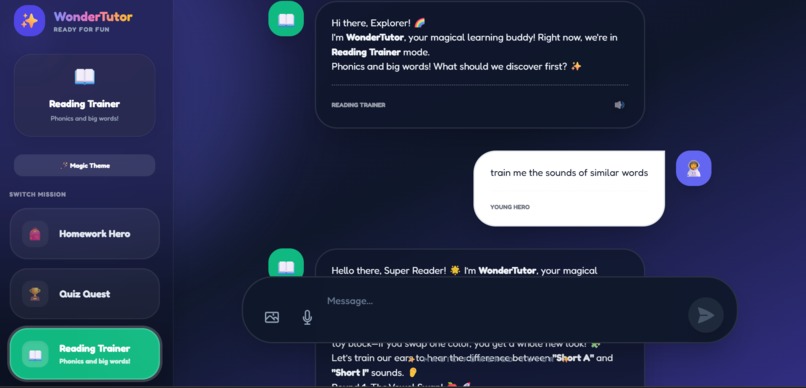
Wonder Tutor as Reading Trainer


Inspiration
I’m a Vibe Coder and a mother of a high schooler, always on the lookout for apps that focus on learning, layering, and mastery.
As AI became a household tool, we noticed a worrying trend: children were using it as a "magic button" to get instant answers. This creates a learning gap where kids finish their work but lose the logic behind it. We were inspired to build WonderTutor AI to flip the script—turning AI from a shortcut into a Socratic partner that encourages curiosity and critical thinking for children aged 6–11, regardless of what language they speak at home.
What it does
"WonderTutor AI is a Socratic learning companion that transforms AI from a 'cheat sheet' into a personal tutor." It does three things standard AI can't:
Scaffolded Tutoring: It refuses to give flat answers. If a child asks for help with Area = l * w, it guides them through the logic step-by-step so they actually learn the concept.
Vision-to-Narrative: It uses computer vision to turn a child's hand-drawn sketches into educational stories, boosting literacy through their own creativity.
Instead of just displaying text, WonderTutor explains words, breaks down meaning, and asks guided questions as the student reads. This ensures learners understand what they are reading, not just pronounce words.
How we built it
I built WonderTutor AI using Gemini 3 Flash, leveraging its multimodal capabilities:
Prompt Engineering: I developed a "Mode-Detection" architecture that allows the AI to pivot its personality based on user intent.
Vision Integration: Using Gemini’s vision features, the app "sees" hand-drawn sketches or worksheets and translates those visual cues into interactive dialogue.
WonderTutor is live at this web address, it runs directly in the browser on desktop, tablet, and mobile, so you don’t need to install anything.
Challenges we ran into
The hardest part was preventing "Answer Leakage." LLMs are designed to be "helpful" and often provide solutions immediately. We had to iterate on our system prompts to ensure the AI would resist giving the final result.For example, when calculating the perimeter of a triangle with sides a, b and c
P = a + b + c
The AI is trained to stop at each step: "I see the sides are 3, 4, and 5. What happens if we add the first two together?"
Accomplishments that we're proud of
WonderTutor AI proves that technology doesn't have to replace the learning process; it can enhance it. By supporting multiple languages and turning math into puzzles, we are making a world-class education accessible to every child.
What we learned
The biggest takeaway was the power of scaffolded instruction. I learned that if you prompt an AI to ask a follow-up question instead of giving an answer, student engagement triples. We also discovered that providing explanations in a child’s native language significantly lowers "learning anxiety," making difficult subjects feel approachable.
What's next for Wonder Tutor
Based on current educational trends for 2026, here are high-impact directions for WonderTutor AI: WonderTutor will evolve into a fully adaptive learning companion that understands how each student thinks, where they struggle, and how they improve over time. Instead of fixed lessons, learners will follow personalized paths shaped by their responses, mistakes, and pace. Future versions will include insight dashboards for parents and educators, showing real understanding instead of raw scores. Additional subjects such as science, critical thinking, and entrepreneurship will be layered in using the same guided-thinking approach.
The long-term vision is simple and uncompromising: WonderTutor will not replace learning, it will teach students how to learn independently.
Built With
- gemini3flash
- googleaistudio
- googlecloudrun
- multimodelprompting
- vibecodingworkflow



Log in or sign up for Devpost to join the conversation.