-
-
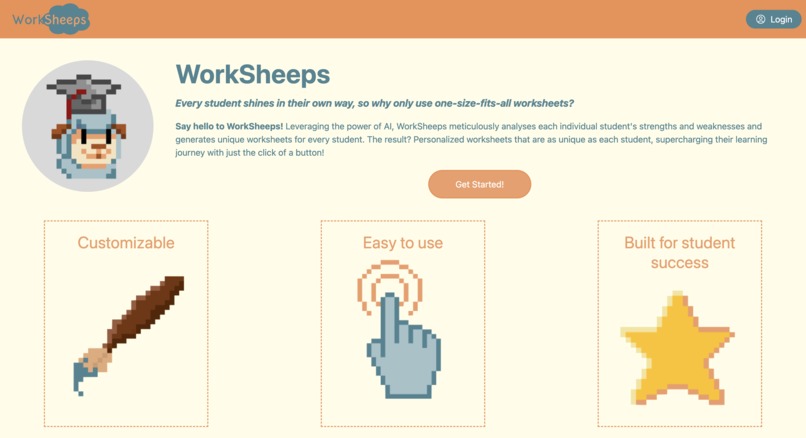
Homepage
-
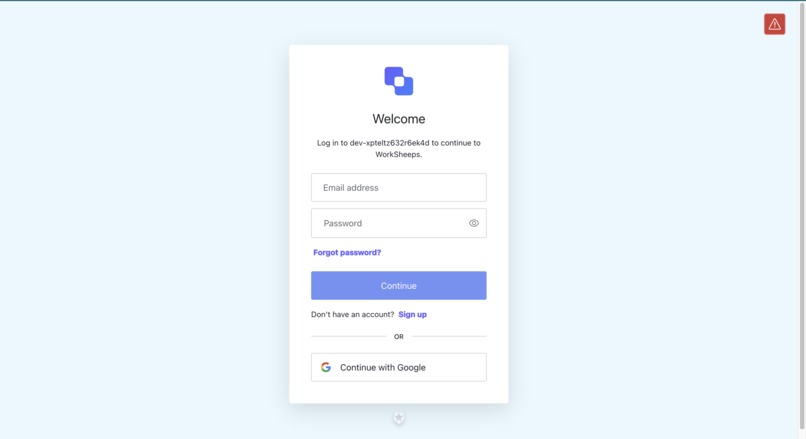
Login using Auth0
-
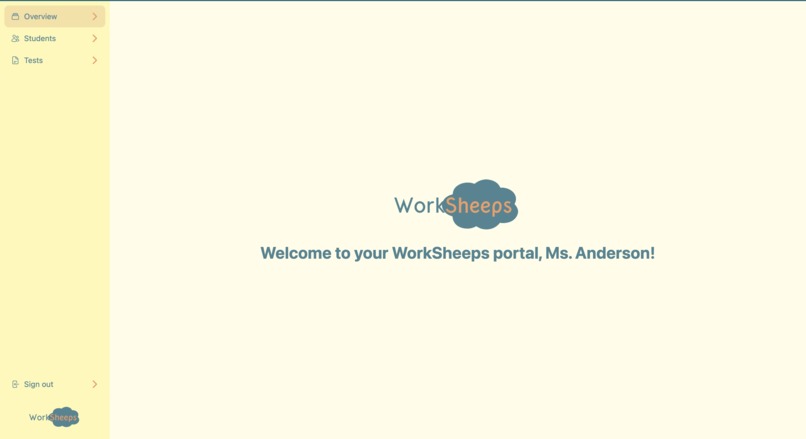
Dashboard
-
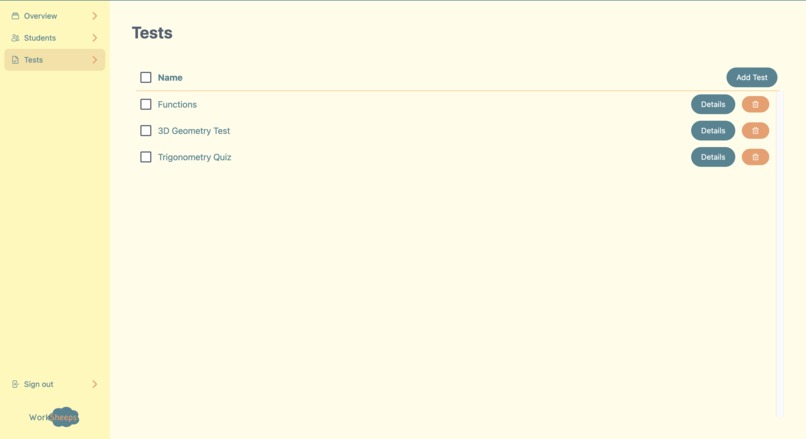
Tests and Grades Page
-
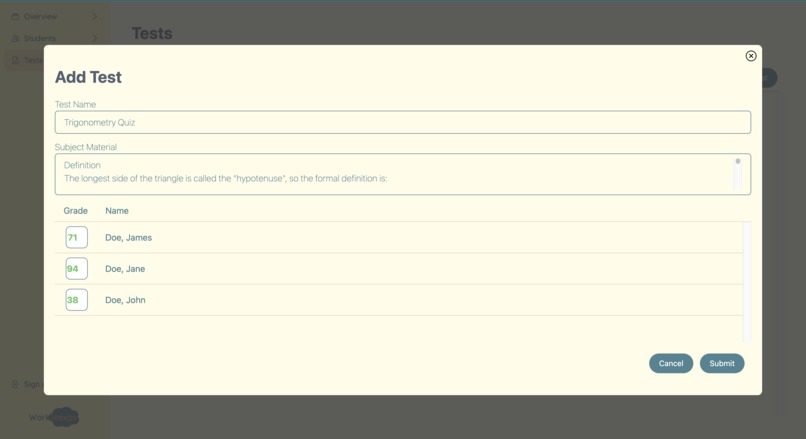
Add Test
-
Added Test
-
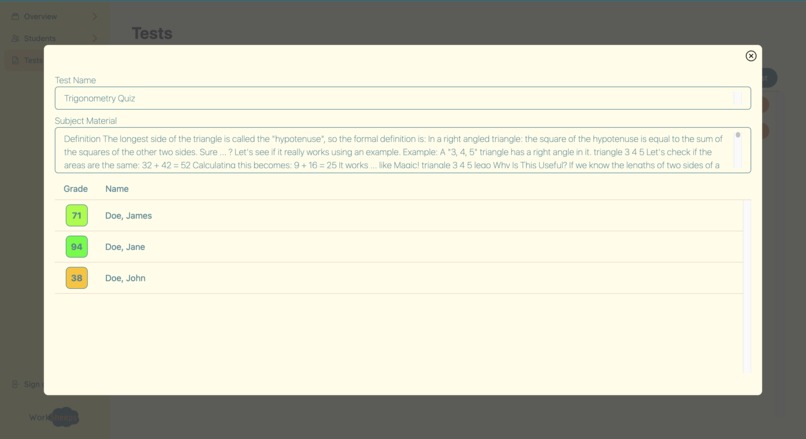
View Test Details
-
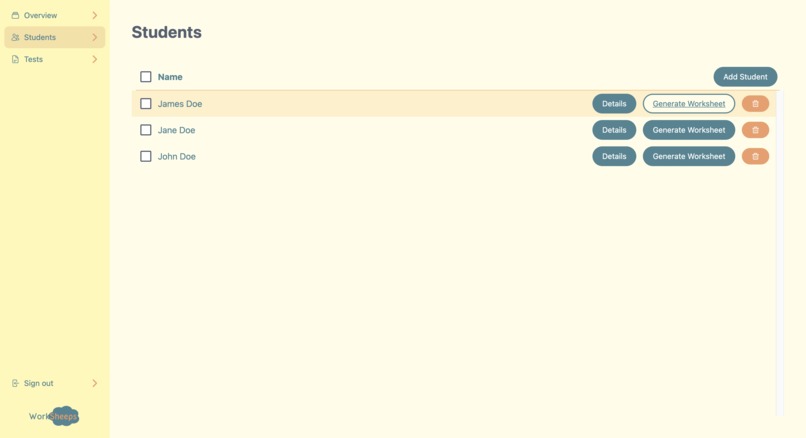
Students Page
-
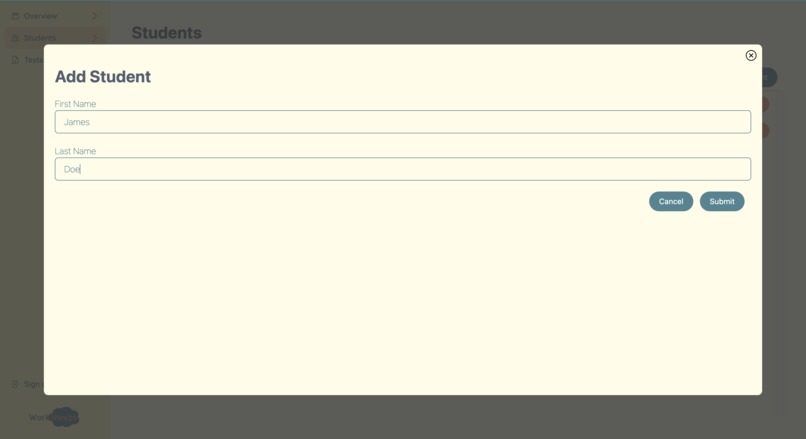
Add Student
-
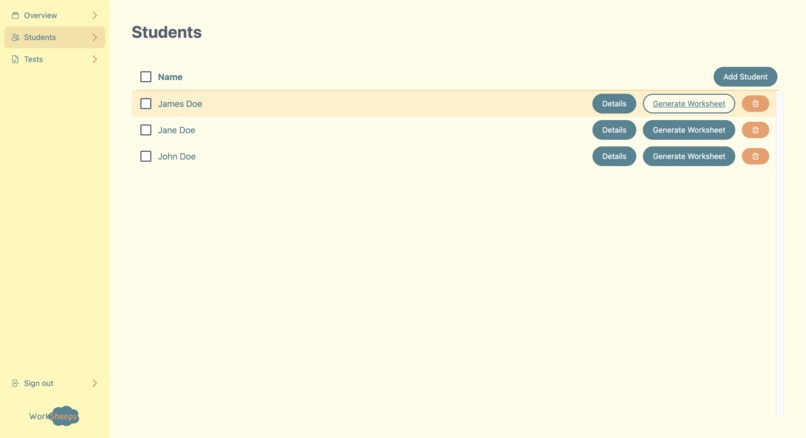
Generate Worksheet on Student Page
-
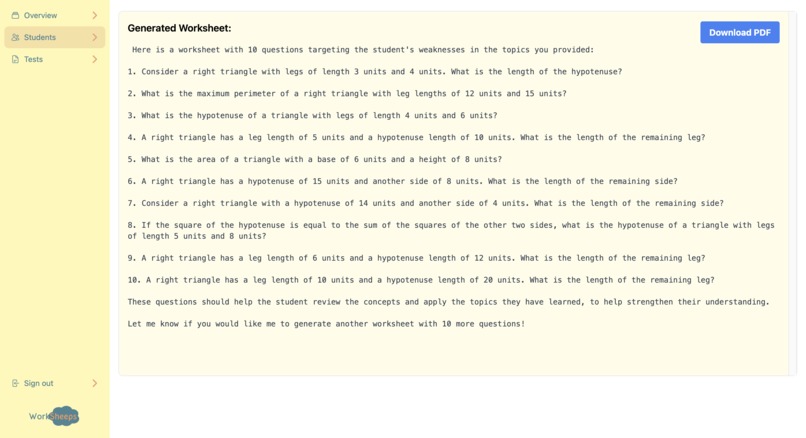
Generated Worksheet to Download


Inspiration
Many of us fondly recall that special teacher or mentor who first ignited our passion, saw the potential within us, and envisioned the individuals we could become. Reflecting on those early years, we recognize the educators who invested genuine care in each student, going above and beyond to cater to their unique needs. Unfortunately, our educators face constraints of time and energy that often make such personalized attention challenging. How can we ensure that every student receives what they need for optimal learning in our modern times? Harnessing the power of technology, we can analyze the progress and performance of each individual student, as well as identify and display their unique abilities, assisting teachers in supporting and connecting with their students. Furthermore, using this data, we can generate customized worksheets tailored for each student. In doing so, we save time for teachers and foster effective learning for students.
What it does
WorkSheeps is a tool for educators to manage student information and create specialized worksheets. Teachers begin by inputting class content for a specific test and record individual student grades into Worksheeps. WorkSheeps first uses AI to interpret student marks across tests to determine their strong and weak points. These strengths and weaknesses are then fed into the Cohere LLM (large language model) to facilitate worksheet generation. With the click of a button, WorkSheeps generates unique worksheets based on the teaching content for each student that targets their largest areas for improvement. Additionally, WorkSheeps compiles and presents comprehensive statistics for each student. This includes an overall performance overview and a detailed breakdown of strengths and weaknesses in various subjects. By seamlessly integrating content input, AI analysis, and automated worksheet generation, WorkSheeps not only simplifies educators' tasks but also ensures that students receive personalized learning materials aligned with their distinct academic needs. WorkSheeps additionally provides valuable statistical insights, empowering educators to refine their teaching strategies effectively and accelerating students' learning.
How we built it
We leveraged a variety of web and AI technologies in order to build this application. Starting with the backend, we used Kintone to create a low-code database, which coupled with a Nodejs/Express application to act as a backend to handle API calls. For the frontend, we used Axios to make calls to the backend, as well as React.js and TailwindCSS for the styling and UI/UX. We also used the Auth0 API for user authentication and storage. Finally, we used a .tech domain for the website deployment, along with Render.com as the hosting service.
Challenges we ran into
A main work in progress throughout this hackathon was the prompt engineering behind using the CoHere API. Of course, in order to use it we needed a functional frontend and backend to parse and send the data to be included in the prompt. Once we had this, it was a matter of experimentation and continuous refinement to settle on a prompt that was concise while also getting us everything that we needed for the app's functionality. We learned a lot about using CoHere API throughout the process and were very happy with the final product. The effort put into the AI part of the project truly ended up paying off!
Accomplishments that we're proud of
There are several things we are proud that we accomplished over the course of this hackathon.
- Successfully integrating various web and AI technologies to create WorkSheeps.
- Overcoming challenges related to prompt engineering with the CoHere API, resulting in a functional and efficient application.
- Developing a user-friendly interface with React.js and TailwindCSS for seamless navigation and interaction.
- Implementing Auth0 API for secure user authentication and storage.
- Deploying the application on a .tech domain using Render.com as the hosting service.
What we learned
There are many things we learned throughout this hackathon that we will be taking forward in our journey as developers:
- Utilizing Kintone for low-code database creation and management.
- Implementing Node.js/Express for backend functionality to handle API calls effectively.
- How to use the CoHere LLM API.
- Enhancing our skills in frontend development with React.js and TailwindCSS.
What's next for WorkSheeps
We are enthusiastic about WorkSheeps’ future and have many ideas. A feature that shows promise is an image scanning system. Instead of manually inputting content and tests, teachers could scan their papers onto WorkSheeps. From there, using image recognition, WorkSheeps could interpret the data needed. This is especially useful for the various assignments that are done and marked on paper. Another interesting possibility is automated feedback integration for the worksheets for a better student experience.
Built With
- auth0
- axios
- chart.js
- cohere
- express.js
- kintone
- node.js
- react
- tailwindcss


Log in or sign up for Devpost to join the conversation.