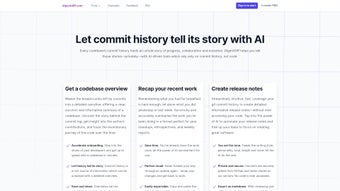

Download DigestDiff – AI‑Driven Insights for Codebase Management
Overview
In today’s fast‑paced development environments, teams constantly grapple with the challenge of turning raw commit logs into meaningful narratives. Whether you’re onboarding a new engineer, preparing release notes for a stakeholder meeting, or simply trying to understand the evolution of a complex codebase, the sheer volume of commits can be overwhelming. DigestDiff steps into this gap as a cloud‑based, AI‑powered application that automatically transforms a repository’s commit history into a clear, concise, and human‑readable summary. By leveraging advanced natural‑language processing models trained on millions of public Git histories, DigestDiff extracts the most impactful changes, highlights the contributions of individual authors, and presents the information in a tone and format that you can tailor to your audience. The platform works directly with GitHub through secure OAuth, ensuring read‑only access, and also supports manual uploads for private or self‑hosted repositories, giving you flexibility regardless of your workflow. Summaries can be generated in seconds, exported as Markdown files, or integrated into CI/CD pipelines for automated release‑note creation. In short, DigestDiff turns the often‑tedious task of codebase exploration into an effortless, insightful experience, helping developers and managers make informed decisions without digging through endless diffs.
The value proposition goes beyond simple reporting. By surfacing trends such as spikes in refactoring, the introduction of new modules, or recurring bug‑fix patterns, DigestDiff equips leadership with data‑driven insights that can influence sprint planning and resource allocation. Its privacy‑first design means that no write permissions are ever granted, and all data is either processed in‑memory or stored encrypted on secure servers. For organizations with strict compliance requirements, an on‑premise Docker deployment is available, keeping every piece of commit data behind your own firewall. Whether you’re a solo developer looking for quick onboarding material or a large enterprise seeking to standardize release documentation, DigestDiff offers a scalable, secure, and low‑maintenance solution that adapts to the needs of any development team.
Key Features & AI Capabilities
- AI‑Powered Summarization: Advanced NLP models distill commit messages into coherent, human‑readable overviews.
- Author Attribution: Quantifies each contributor’s impact and highlights key developers.
- Customizable Output: Choose tone (formal, casual, technical), length (brief or detailed), and format (Markdown, plain text).
- One‑Click GitHub Integration: Secure OAuth connection fetches commit history automatically.
- Manual Import Support: Upload raw commit logs for private, self‑hosted, or on‑premise repositories.
- Release‑Note Automation: Generate ready‑to‑publish notes directly from the narrative.
- Privacy‑First Design: Read‑only access guarantees repository integrity.
- Export Flexibility: Download summaries as .md files or copy to clipboard instantly.
- Multi‑Project Dashboard: Manage and compare summaries across several repositories in a single view.
- Continuous Model Updates: Monthly AI refinements improve language quality and accuracy.
Each of these features is engineered to streamline the developer experience. The AI engine, trained on a diverse set of public Git histories, understands common development patterns, jargon, and version‑control conventions, allowing it to generate narratives that feel native to your project’s context. For instance, when a large refactor occurs, DigestDiff will flag the scope, summarize the intent, and note the primary contributors, saving teams hours of manual investigation. The customizable output ensures that the same summary can serve multiple purposes: a high‑level executive brief, a detailed technical changelog, or a quick onboarding cheat‑sheet. Integration with GitHub is handled through OAuth, eliminating the need for personal access tokens and reducing security risk. Meanwhile, the manual import option gives you full control over data, making it suitable for legacy systems or repositories hosted on internal Git servers. The export options are designed with documentation pipelines in mind—Markdown files can be piped directly into static site generators, wikis, or internal knowledge bases without additional formatting work.
The multi‑project dashboard further amplifies productivity by allowing managers to monitor several codebases side‑by‑side, compare activity trends, and identify where attention is needed most. Whether you’re tracking a monorepo with dozens of services or a collection of micro‑repositories, DigestDiff provides a unified view that surfaces the story behind the code. In addition, the monthly model updates ensure that the AI stays current with evolving programming languages, frameworks, and best practices, delivering summaries that remain accurate and relevant over time.
Installation, Usage & Compatibility
DigestDiff is designed for frictionless adoption. The primary offering is a cloud‑hosted SaaS platform, meaning you never have to install anything locally. Simply visit digestdiff.com, register with your corporate email or a GitHub account, and you’re ready to start analyzing repositories. For organizations with strict data residency requirements, a Docker‑based on‑premise version is also available.
Web Version – Step‑by‑Step Setup
- Navigate to the signup page and create an account using your email or GitHub credentials.
- Confirm your email address via the activation link sent to your inbox.
- In the dashboard, click “Add Repository” and select “GitHub”. Authorize the read‑only OAuth scope.
- Select the target repository, specify a branch or tag range, and click “Generate Summary”.
- Review the AI‑generated overview, adjust tone or length if needed, and export the result as Markdown or copy to clipboard.
On‑Premise Docker Deployment
- Ensure Docker Engine 20.10 or newer is installed on your server (Linux, Windows Server, or macOS).
- Pull the official image:
docker pull digestdiff/app. - Run the container:
docker run -d -p 8080:80 --name digestdiff digestdiff/app. - Access the local instance via
http://localhost:8080and follow the same onboarding flow as the cloud version. - Configure environment variables such as
DIGESTDIFF_DB_URLfor persistent storage and set up SSL termination for secure access.
Supported Platforms: Because the service runs in a browser, it works on all modern operating systems—Windows 10/11, macOS Ventura and later, major Linux distributions, as well as mobile browsers on Android 9+ and iOS 13+. The Docker image runs on any OS that supports Docker, providing true cross‑platform flexibility for self‑hosted environments.
After the initial configuration, daily use is as simple as selecting a repository and clicking “Refresh”. The AI model caches previous analyses, making subsequent runs faster and reducing API consumption. For teams that rely on continuous integration, DigestDiff offers a REST endpoint that can be called from scripts (e.g., GitHub Actions, Jenkins, GitLab CI) to automatically generate release notes during a build, ensuring documentation is always up‑to‑date without manual intervention.
Pros, Cons & Final Verdict
Pros
- Instant AI‑generated codebase overviews dramatically cut onboarding time.
- Customizable tone and length make the output suitable for technical and non‑technical audiences.
- Secure read‑only GitHub integration protects repository integrity.
- Exportable Markdown files fit naturally into existing documentation workflows.
- Docker option provides on‑premise control for regulated industries.
- Generous free tier supports small teams and hobby projects.
- Multi‑project dashboard offers a unified view of activity across repositories.
- Monthly AI model updates keep language quality and accuracy high.
Cons
- Very large monolithic repositories (over 500 k commits) may experience longer processing times.
- Advanced AI customization, such as domain‑specific terminology, requires a paid subscription.
- The tool focuses on narrative summarization and does not include a visual diff viewer.
- Offline usage is limited to the Docker image, which may lag behind the latest AI improvements.
- API rate limits on the free tier can restrict frequent automated calls.
Overall, DigestDiff fills a noticeable gap in the developer toolkit by converting raw commit logs into meaningful stories. Its AI core is both accurate and adaptable, while the interface remains clean and intuitive. For organizations that value rapid knowledge transfer—especially during onboarding or release cycles—the benefits far outweigh the minor drawbacks. The free tier is generous enough for individual developers, and the paid plans scale smoothly for enterprise needs. If you need a secure, low‑maintenance way to keep your team aligned with the evolution of a codebase, DigestDiff is a compelling choice that delivers real productivity gains.
Conclusion & Call to Action
Ready to turn your commit history into a concise, actionable narrative? Download DigestDiff today, sign up for the free plan, and experience how AI can accelerate onboarding, simplify release‑note creation, and give you instant insight into any Git repository. Larger teams can explore premium features that unlock deeper customization and on‑premise deployment options. Start improving codebase visibility with just a few clicks—your next developer onboarding session will thank you.
Frequently Asked Questions
How does DigestDiff protect my repository’s privacy?
DigestDiff only requests read‑only access via GitHub OAuth or a manual commit export. No write permissions are ever granted, and all data is processed in‑memory or stored encrypted on our servers. For on‑premise installations, data never leaves your network.
Can I customize the tone of the generated summary?
Yes. The UI offers three preset tones—formal, casual, and technical—and you can adjust the length from “brief” (one paragraph) to “detailed” (multi‑section). Premium plans also allow you to upload custom style guidelines.
Is there a limit to how many repositories I can analyze?
The free tier allows up to five repositories with a combined commit limit of 50 000 per month. Paid plans increase both the repository count and the commit quota, with enterprise options for unlimited usage.
How does DigestDiff integrate with CI/CD pipelines?
DigestDiff exposes a REST endpoint that accepts a repository URL and a commit range. You can call this endpoint from build scripts (e.g., in GitHub Actions or Jenkins) to automatically generate release notes and attach them to your build artifacts.
What operating systems are supported for the on‑premise Docker image?
Any OS that runs Docker Engine 20.10 or newer—Windows, macOS, and most Linux distributions—is fully supported. The container includes all required dependencies, so no additional setup is needed.



.png)