
Screenshots
App details
- Updated
- June 24, 2025
- Requires
- Chrome
- License
- Full
- Developer
- dstack
- Category
- Web Apps
About Dstack
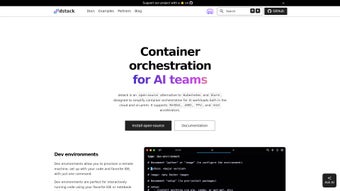
Download Dstack – Open‑Source LLM Development, Deployment & Cloud Management Tool
Introduction
In the rapidly evolving world of large language models (LLMs), the biggest bottleneck is often not the model itself but the surrounding infrastructure that powers training, fine‑tuning, and serving. Developers and data scientists spend countless hours writing custom scripts, juggling cloud credentials, and manually tracking GPU costs. Dstack was built to eradicate those pain points by providing a unified, open‑source platform that automates cloud orchestration, environment provisioning, and cost‑optimization—all while keeping the user experience simple and secure. Whether you are a solo researcher experimenting with GPT‑style transformers, a startup building a SaaS product around conversational AI, or an enterprise MLOps team managing dozens of concurrent experiments, Dstack offers a consistent workflow that works across AWS, Google Cloud, Azure, and even private on‑premise GPU clusters. The tool is released under the permissive Apache 2.0 license, meaning you can use, modify, and distribute it without any licensing fees, even in commercial settings. This article provides a deep dive into Dstack’s core capabilities, walks you through a step‑by‑step installation, and outlines the pros, cons, and frequently asked questions you might have before adopting it for your next LLM project. By the end of this review, you’ll have a clear picture of why Dstack is rapidly becoming the go‑to solution for cost‑effective, secure, and scalable LLM development.
Overview
Dstack is an open‑source software application created to simplify the entire lifecycle of Large Language Model (LLM) projects. Whether you are fine‑tuning a transformer, serving a model via FastAPI, or running massive batch inference jobs, Dstack abstracts away the complexity of cloud resource allocation, GPU pricing, and environment provisioning. The platform supports on‑demand execution across multiple cloud providers—including AWS, GCP, and Azure—so developers can pick the most cost‑effective GPU at the moment of need. Its web‑based dashboard and CLI give you the flexibility to define tasks, launch experiments, and monitor results from a single, intuitive interface. Comprehensive documentation, community‑driven examples, and a growing ecosystem of plugins make Dstack a practical, secure, and free solution for anyone looking to accelerate LLM development without getting locked into a single vendor. By delivering a seamless bridge between local IDEs and remote compute, Dstack enables teams to focus on model quality rather than infrastructure logistics. The platform also integrates with popular observability tools such as Prometheus and Grafana, allowing you to extend monitoring beyond the built‑in dashboards. Security is baked in: all secrets are stored in encrypted vaults, and role‑based access control (RBAC) can be configured for larger teams. Because Dstack is open source, you retain full visibility into how jobs are scheduled, priced, and executed, which is a significant advantage over proprietary SaaS alternatives that often hide cost calculations behind opaque dashboards. In short, Dstack transforms the traditionally cumbersome process of managing LLM workloads into a streamlined, repeatable, and cost‑transparent workflow that can be adopted by developers of any skill level.
Key Features of Dstack
- Multi‑Cloud Orchestration: Dynamically selects the cheapest and most available GPU across AWS, GCP, and Azure, reducing cloud spend by up to 40 %.
- One‑Click Environment Provisioning: Generates reproducible development containers that can be accessed from VS Code, PyCharm, or any local IDE.
- Task Definition Language (TDL): A simple YAML‑based DSL for declaring batch jobs, web services, and streaming inference pipelines.
- FastAPI & vLLM Integration: Built‑in templates for serving LLMs with low‑latency inference using the latest vLLM optimizations.
- Automatic Pricing Alerts: Real‑time notifications when spot‑instance prices drop or when a GPU becomes unavailable.
- Extensible Plugin System: Community‑maintained plugins for data versioning, experiment tracking, and custom authentication.
- Secure Secrets Management: Stores API keys and credentials in encrypted vaults, ensuring that sensitive data never leaks to logs.
- Comprehensive Monitoring Dashboard: Visualizes GPU utilization, job status, and cost breakdowns in real time.
- On‑Premise & Hybrid Support: Treat private GPU clusters as first‑class “cloud” providers via a lightweight Docker endpoint.
- CI/CD Friendly: Native integration with GitHub Actions, GitLab CI, and Azure Pipelines for automated model training and deployment.
These features collectively make Dstack more than just a deployment script; it is a full‑stack platform that empowers developers to iterate quickly, stay within budget, and maintain security best practices. The open‑source nature of the project also guarantees transparency—anyone can audit the code, contribute improvements, or fork the repository to meet unique organizational requirements. Because each feature is designed to be modular, you can start with the basics—such as one‑click provisioning—and gradually adopt advanced capabilities like custom plugins or hybrid cloud orchestration as your workflow matures. The result is a future‑proof toolset that scales with the ambition of your LLM projects, whether you’re training a modest 1‑billion‑parameter model or orchestrating a fleet of 8‑GPU pods for massive inference workloads.
Installation, Usage & Compatibility
Getting started with Dstack is straightforward thanks to its cross‑platform support. The tool runs on Windows, macOS, and Linux, and can be installed via pip or a Docker container for environments where Python package management is restricted. Below is a step‑by‑step guide to install, configure, and launch your first LLM job, followed by a discussion of operating‑system compatibility and best‑practice tips for production deployments.
Step 1: Install Dstack
pip install dstackAlternatively, pull the official Docker image for environments that require isolation from the host Python interpreter:
docker pull dstack/dstack:latestStep 2: Authenticate Cloud Providers
Dstack needs read‑only access to your cloud accounts to query GPU availability and pricing. Run the following commands to link each provider. You can later revoke or rotate credentials from the dashboard if needed.
dstack auth aws --profile my-aws-profiledstack auth gcp --service-account /path/to/key.jsondstack auth azure --subscription-id XXXXX
Step 3: Define a Task with the Task Definition Language
Create a task.yml file describing a fine‑tuning job. The YAML format is intentionally simple, making it easy for newcomers while still offering powerful options for power users.
name: fine-tune-bert
runtime: python3.10
gpu: 1xA100
environment:
  packages:
    - transformers
    - datasets
command: |
  pip install -r requirements.txt
  python scripts/train.py --model bert-base-uncased --epochs 3
Step 4: Launch the Task
Execute the job with a single command. The --cloud auto flag tells Dstack to automatically pick the cheapest available GPU across all linked providers.
dstack run task.yml --cloud autoStep 5: Monitor Progress & Retrieve Results
Open the web dashboard at http://localhost:8080 or use the CLI to check status:
dstack status --task fine-tune-bertWhen the job completes, artifacts such as model checkpoints are automatically uploaded to an S3 bucket (or the equivalent storage service you configured). You can then serve the model using the built‑in FastAPI template:
dstack serve fastapi --model s3://my-bucket/bert-checkpointDstack is compatible with Windows 10/11 (including WSL2), macOS 12+ (Apple Silicon and Intel), and most modern Linux distributions (Ubuntu 20.04+, Debian, Fedora, and CentOS). The Docker image guarantees consistent behavior across environments, making it ideal for both local development and CI/CD pipelines. For on‑premise deployments, simply run the Docker container on your internal GPU nodes and register them as a custom provider in the dashboard.
Best‑Practice Tips for Production
- Enable role‑based access control (RBAC) to restrict who can launch expensive GPU jobs.
- Set budget alerts in the dashboard to receive email or Slack notifications when daily spend exceeds a predefined threshold.
- Leverage the plugin ecosystem to integrate with MLflow for experiment tracking or with DVC for data versioning.
- Export metrics to Prometheus and visualize them in Grafana for organization‑wide observability.
- Use the CI/CD integrations to automatically trigger training pipelines on every pull request merge.
Conclusion – Pros, Cons, Frequently Asked Questions & Call‑to‑Action
Pros
- Completely free and open‑source, eliminating licensing fees.
- Intelligent multi‑cloud GPU selection optimizes cost without manual price hunting.
- Easy integration with popular LLM serving stacks like FastAPI and vLLM.
- One‑click environment provisioning bridges local IDEs and remote compute.
- Strong community support, detailed documentation, and ready‑made examples.
- Built‑in security features such as encrypted secret vaults and RBAC.
- Hybrid and on‑premise support expands flexibility beyond public clouds.
Cons
- Initial cloud authentication setup can be daunting for beginners.
- Advanced customizations may require writing YAML or Python plugins.
- Dashboard UI is functional but not as polished as some commercial SaaS platforms.
- Real‑time pricing data depends on cloud provider APIs, which may experience temporary latency.
Frequently Asked Questions
Is Dstack really free for commercial use?
Yes. Dstack is released under the Apache 2.0 license, which permits unrestricted commercial usage, modification, and distribution.
Can I run Dstack on a private on‑premise GPU cluster?
Absolutely. Dstack supports self‑hosted providers via a simple Docker endpoint, allowing you to treat your internal cluster as just another “cloud” option.
How does Dstack handle secret management?
All credentials are stored in an encrypted vault that integrates with AWS KMS, GCP Secret Manager, or Azure Key Vault. Secrets are injected at runtime and never written to disk.
What kind of monitoring does Dstack provide?
The built‑in dashboard shows GPU utilization, memory consumption, cost per hour, and job status. You can also export metrics to Prometheus or Grafana for advanced observability.
Do I need a deep learning framework pre‑installed?
No. Dstack creates isolated containers based on the runtime you declare (e.g., python3.10). You can install PyTorch, TensorFlow, or any other library inside the task definition.
Call‑to‑Action
Dstack fills a critical gap for teams that want the flexibility of multi‑cloud GPU access without the overhead of manually negotiating spot prices, writing complex Terraform scripts, or managing separate CI pipelines. Its open‑source nature, rich feature set, and strong community make it a compelling choice for both research labs and production‑grade MLOps teams. If you are ready to accelerate your LLM experiments while keeping budgets under control, download Dstack now, spin up your first task, and join the growing community of developers who are redefining how large models are built and served.
Guides & Tutorials
How to install Dstack
- Click the Download button above.
- Once redirected, accept the terms and click Install.
- Wait for the Dstack download to finish on your device.
How to use Dstack
This software is primarily used for its core features described above. Open the app after installation to explore its capabilities.
User Reviews
No reviews yet. Be the first to share your experience.
You may also like
more
3D AI Studio
3D AI Studio Overview 3D AI Studio is a web-based AI-powered tool developed by S...

3D textures by Polycam
Generate Realistic 3D Textures Effortlessly 3D Textures by Polycam is an innovat...

3DAiLY
Customizable 3D Modeling Tool: 3DAiLY 3DAiLY is an online platform that harnesse...

3DFY
Revolutionizing 3D Model Creation: 3DFY Review 3DFY is an AI-powered service, de...

AI Dungeon
AI Dungeon: Deep Learning Text Adventure AI Dungeon is an artificial intelligenc...
Alpha3D
A subscription-based program for Web apps, by alpha3d. Alpha3D is a subscription...
