
Download EditiX – Powerful XML Editor & XSLT Debugger for Mac
Overview
EditiX is a dedicated XML editor and XSLT debugger that has been serving Mac developers since the early 2000s. Designed for professionals who need a reliable, feature‑rich environment for creating, validating, and transforming XML documents, EditiX blends a clean user interface with deep support for standards such as XSLT 1.0/2.0, XQuery, DTD, and W3C schemas. Although the software is offered as a trial version, the full‑featured edition unlocks advanced debugging tools, a visual XPath navigator, and an integrated content assistant that speeds up authoring. The current release, version 5.0, was last updated on 9 June 2006, and it continues to run natively on macOS X and earlier Mac OS releases. Over 1,000 users have downloaded EditiX since its catalog entry in 2006, reflecting its niche but loyal user base among web developers, technical writers, and data engineers who prefer a Mac‑only solution for XML‑centric workflows.
Key Features & Capabilities
- Full‑Featured XML Editing: Syntax highlighting, auto‑completion, and a robust content assistant that suggests tags, attributes, and entity references as you type.
- XSLT Debugger: Step‑through debugging, breakpoint management, and variable inspection for both XSLT 1.0 and 2.0 stylesheets.
- Integrated XQuery Engine: Write, test, and execute XQuery expressions directly within the editor, with real‑time results displayed in a side panel.
- Schema Validation: Validate XML files against DTD, XSD, or W3C schemas with detailed error reporting and quick‑fix suggestions.
- DocBook Support: Specialized tools for authoring DocBook XML, including template insertion and preview rendering.
- Tree‑Based Navigation: Drag‑and‑drop node reordering, filtered tree views, and a searchable outline panel for large documents.
- Cross‑Platform File Handling: Adjusted path handling for Windows platforms (e.g., “a:” drive support) while retaining native macOS performance.
- Whitespace Preservation: Accurate handling of whitespace inside attribute values and element content, ensuring that formatting is never lost during editing.
- Robust Search & Replace: Regular expression support, scope‑limited searches, and preview mode to avoid accidental changes.
- Lightweight Footprint: Requires significantly less disk space than most competing XML editors, making it ideal for older Mac hardware.
Installation & Usage Instructions
Step‑by‑Step Installation
- Download the EditiX trial installer from the official website. The file is provided as a
.dmgpackage optimized for macOS X. - Open the
.dmgfile and drag the EditiX icon into your/Applicationsfolder. - After copying, double‑click the EditiX icon to launch the application. macOS may ask you to confirm that you trust the developer; click “Open”.
- The first launch triggers a brief license agreement screen. Accept the terms to enable the trial period (typically 30 days).
- Optionally, move the application to the Dock for quick access.
Getting Started with a New Project
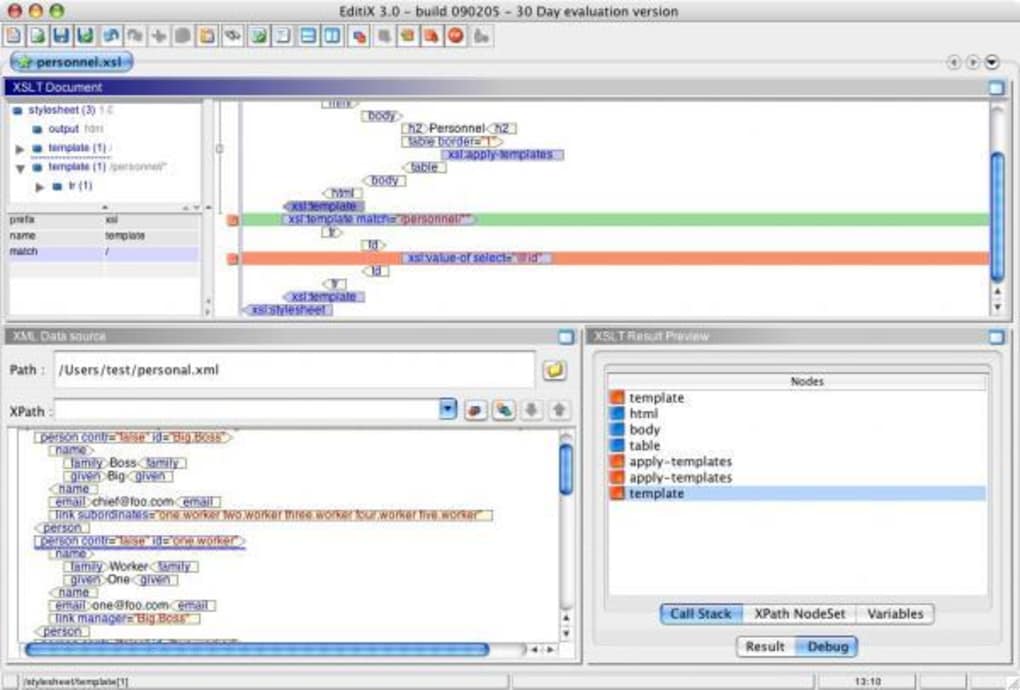
Once EditiX is running, you’ll be greeted by a clean workspace divided into three primary panes: the file explorer on the left, the main editing canvas in the center, and a diagnostics pane at the bottom. To create a new XML file, click File → New → XML Document, choose a template (blank, DocBook, or custom DTD), and start typing. The editor instantly highlights elements, attributes, and namespace prefixes, reducing syntax errors.
For XSLT development, select File → New → XSLT Stylesheet. The built‑in debugger can be launched via the Debug → Start Debugging menu or by pressing ⌘ D. Set breakpoints by clicking in the margin next to a line number, then step through the transformation using the toolbar controls. Variable values appear in the side panel, making it easy to pinpoint logic issues.
The integrated XQuery console is accessed through Tools → XQuery Console. Paste your query, select the source XML file from the drop‑down, and click “Run”. Results are displayed instantly, and you can copy them to the clipboard or export them as a new XML document.
Remember to save your work frequently. EditiX automatically adds recent documents to the “Open Recent” menu, but a known issue (fixed in the 5.0 update) caused an empty entry when a save operation was cancelled. The fix ensures the recent list stays clean and accurate.
Compatibility, Pros & Cons
EditiX is built exclusively for macOS X and earlier Mac OS releases. It runs natively on Intel‑based Macs and on Apple Silicon devices through Rosetta 2 translation. No Windows or Linux versions are available, which makes it a specialized tool for Mac‑centric development teams.
Pros
- Native macOS experience with a responsive UI.
- Comprehensive XSLT debugging features not commonly found in free editors.
- Lightweight installation footprint, ideal for older hardware.
- Excellent support for DocBook and other XML publishing standards.
- Accurate whitespace handling preserves document formatting.
Cons
- Mac‑only availability limits cross‑platform teams.
- Last major update was in 2006, so UI feels dated compared to modern editors.
- Trial version restricts some advanced features to paid users.
- Lack of built‑in Git integration for version control.
- Limited community support due to the niche user base.
Frequently Asked Questions
Is EditiX still supported and receiving updates?
The last official update was released on 9 June 2006 (version 5.0). While the developer has not announced new releases, the software remains functional on modern macOS versions, especially when run under Rosetta 2 on Apple Silicon. Users can still obtain support through the official forum and knowledge base.
Can I use EditiX to edit large XML files (hundreds of MB)?
Yes. EditiX’s tree navigation and incremental loading allow it to handle very large documents without consuming excessive memory. The recent fixes to scrolling and drag‑and‑drop performance further improve usability on big files.
Does EditiX support version control integration?
Out of the box, EditiX does not include built‑in Git or SVN integration. However, you can manage version control externally using command‑line tools or third‑party macOS clients, then open the files in EditiX for editing.
Is the trial version limited in functionality?
The trial version provides full access to most features, including XSLT debugging and XQuery execution, for a limited period (typically 30 days). After the trial expires, you must purchase a license to continue using the advanced tools.
Can EditiX handle Windows‑style file paths?
Yes. Recent updates introduced support for Windows drive letters (e.g., “a:”) when browsing files from a network share. This ensures that cross‑platform teams can reference Windows paths without manual conversion.
Conclusion & Call to Action
EditiX remains a solid choice for Mac developers who need a specialized XML editor with a built‑in XSLT debugger and comprehensive schema validation. Its lightweight design, strong DocBook support, and powerful content assistant make it stand out among the limited Mac‑only options. While the software’s age and lack of cross‑platform versions are notable drawbacks, the core editing and debugging capabilities still hold value for professionals working exclusively on macOS. If you’re searching for a reliable, secure tool to streamline XML authoring and transformation workflows, give EditiX a try today. Download the free trial, explore its feature set, and decide if the full license fits your development pipeline.
Download EditiX NowPros: Native macOS UI, powerful XSLT debugger, lightweight footprint.
Cons: Mac‑only, dated UI, limited version‑control integration.