
Download Feeder – free RSS and podcast feed creator tool
Overview & Key Features
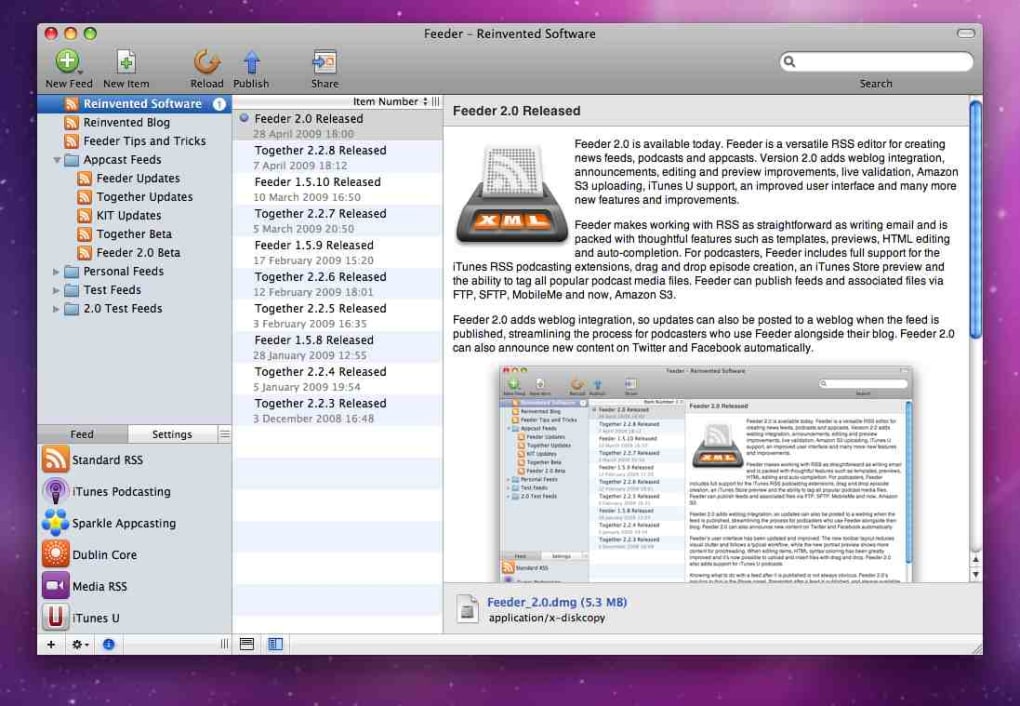
Feeder is a powerful desktop utility that lets anyone – from hobby podcasters to seasoned media producers – create, edit, and publish RSS 2.0 and iTunes‑compatible podcast feeds without writing a single line of XML. Designed with a clean drag‑and‑drop interface, the app automatically tags audio and video files with album artwork, artist information, and genre metadata, supporting popular formats such as MP3, M4A, M4V, and QuickTime MOV. Beyond basic feed generation, Feeder integrates social media publishing, allowing you to push new episode announcements directly to Twitter and Facebook with a single click. The tool also offers secure FTP, FTPS, and SFTP upload options, ensuring that your feed files reach your hosting server safely. While Feeder is not an RSS reader, its publishing capabilities are extensive, covering everything from simple news feeds to fully fledged iTunes podcast series. Recent updates bring support for the newest iTunes podcasting tags, faster SFTP uploads, and minor UI refinements that make the workflow smoother for both beginners and power users.
Feature Highlights
- Create and edit RSS 2.0 feeds with an intuitive drag‑and‑drop editor.
- Full support for iTunes podcast extensions, including episode type, season, and explicit content flags.
- Automatic metadata tagging for MP3, M4A, M4V, and QuickTime files.
- Custom artwork upload – add album covers, episode thumbnails, or brand logos.
- One‑click social media publishing to Twitter and Facebook.
- Secure FTP, FTPS (FTP‑SSL), and SFTP upload with optional TLS encryption.
- Batch import/export of existing RSS feeds for quick migration.
- Built‑in validation tool to catch XML errors before publishing.
- Cross‑platform compatibility with Windows 10/11 and macOS 10.15+.
- Free core version with optional paid add‑ons for advanced analytics.
Installation & Usage Guide
Getting started with Feeder is straightforward. The installer is available as a single .exe for Windows and a .dmg for macOS. After downloading, run the installer and follow the on‑screen prompts – the process typically takes less than three minutes. Once installed, launch Feeder from the desktop shortcut or the Applications folder. The first time you open the app, you’ll be greeted by a brief setup wizard that asks for your preferred language, default export folder, and whether you want to enable automatic updates. Enabling updates is recommended because Feeder frequently receives security patches and new podcasting tag support.
To create a new feed, click the “New Feed” button on the main dashboard. A dialog appears where you can enter basic information such as feed title, description, website URL, and primary category. After saving these details, the main interface switches to a drag‑and‑drop zone. Simply drag your audio or video files into this area; Feeder will automatically read the file’s metadata, suggest album artwork, and populate episode fields like title, duration, and publication date. If you prefer manual control, double‑click any episode row to open the episode editor, where you can edit the title, add a custom summary, or attach a separate image.
When you’re satisfied with the feed content, click “Publish.” Feeder will ask you to choose an upload method – FTP, FTPS, or SFTP – and then prompt for your server credentials. For added security, you can store these credentials in the app’s encrypted vault, which is protected by your operating system’s keychain. After a successful upload, the tool displays a confirmation screen with a direct link to your newly published RSS file. If you enabled social media integration, a final screen lets you compose a tweet or Facebook post that includes the episode title, a short description, and a link back to your feed. Press “Post,” and Feeder handles the rest.
Troubleshooting is also built into the UI. If an upload fails, Feeder shows a detailed error log, indicating whether the issue is a network timeout, authentication problem, or invalid XML. You can then correct the issue and retry without re‑creating the entire feed. Overall, the installation and usage flow is designed to be as frictionless as possible, letting you focus on content creation rather than technical minutiae.
Compatibility, Pros & Cons
Feeder runs natively on Windows 10, Windows 11, and macOS 10.15 (Catalina) or later. The application leverages the .NET framework on Windows and Apple’s Cocoa APIs on macOS, ensuring smooth performance and low system overhead. While there is no official Linux version, many users report success running the Windows installer through Wine, though this setup is not officially supported.
Pros
- Comprehensive RSS and iTunes podcast support out of the box.
- Automatic metadata tagging saves time on large audio libraries.
- Secure upload options (FTP‑SSL, FTPS, SFTP) keep your feed files safe.
- Integrated social media publishing reduces manual posting effort.
- Free core version provides essential features without a subscription.
- Built‑in validation catches common XML errors before they go live.
Cons
- No built‑in WYSIWYG editor for complex HTML descriptions; users must edit raw fields.
- Lacks a native macOS dark‑mode theme (available only on Windows).
- Batch import of existing feeds can be cumbersome for very large catalogs.
- Limited direct analytics; users need third‑party services for listener stats.
- Linux support is unofficial and may require additional configuration.
Frequently Asked Questions
Is Feeder free or do I need to pay for a license?
Feeder offers a completely free core version that includes all essential feed‑creation tools, automatic tagging, and social media publishing. Optional paid add‑ons are available for advanced analytics, bulk‑import automation, and premium support, but they are not required for regular podcast publishing.
Can I use Feeder to host my podcast files?
No. Feeder is a feed‑creation and publishing tool only. You still need a separate hosting provider (e.g., Libsyn, Podbean, or a personal web server) to store the audio files themselves. Feeder uploads the XML feed to your server via FTP/SFTP.
Does Feeder support the latest iTunes podcast tags like season and episode numbers?
Yes. The most recent update added full support for iTunes extensions such as itunes:season, itunes:episode, itunes:episodeType, and explicit content flags. These fields appear in the episode editor and are automatically included in the exported RSS file.
How secure is the FTP upload process?
Feeder supports FTP‑SSL (FTPS) and SFTP, both of which encrypt the connection between your computer and the server. You can choose the protocol that matches your host’s security requirements, ensuring that your feed files are transmitted safely.
Can I edit an existing RSS feed that I previously created with another tool?
Absolutely. Feeder can import any valid RSS 2.0 file. Once imported, you can modify episodes, add new media, update metadata, and re‑publish the feed without losing existing content.
Conclusion & Call to Action
In a landscape where podcasting continues to grow, having a reliable, secure, and easy‑to‑use feed‑generation tool is essential. Feeder delivers on all the core requirements – from automatic tagging of audio files to secure FTP uploads and seamless social media sharing – while remaining completely free for the features most creators need. Although a WYSIWYG editor and native dark mode are missing, these are relatively minor drawbacks compared with the time saved in feed creation and the peace of mind offered by built‑in validation. If you’re looking to launch a new podcast series, update an existing RSS feed, or simply experiment with RSS publishing, Feeder provides a solid foundation without demanding a subscription.
Ready to streamline your podcast publishing workflow? Download Feeder now and start creating professional‑grade RSS feeds in minutes. Enjoy secure uploads, automatic tagging, and effortless social sharing – all from a single, free application.