Spain’s Festival Celsius 232 committee revealed the 2026 shortlists for its Premios Kelvin 505 on May 22.
The trophies are scheduled for presentation at Festival Celsius 232 which takes place July 14-18 in Avilés, Spain.
Mejor novela original en castellano publicada por primera vez en España / Best original novel in Spanish published for the first time in Spain
Animales difíciles, by Rosa Montero (Seix Barral)
Salitre y cenizas, by Carlos Di Urarte (El transbordador)
Impía, by J V Gachs (Dolmen)
U.N.I., by Antonio Garber (Menoscuarto)
Mejor novela traducida al castellano y publicada por primera vez en España / Best novel translated into Spanish and published for the first time in Spain
El diablo te lleva a casa, by Gabino Iglesias, Translation by Miguel Sanz Jiménez (La biblioteca de Carfax)
El vado de los zorros, by Anna Starobinets, Translation by Viktoria Leftérova y Enrique Maldonado (Impedimenta)
Los diablos, by Joe Abercrombie, Translation by Manu Viciano (Runas)
El reformatorio, by Tananarive Due, Translation by María Pérez de San Román (La biblioteca de Carfax)
Mejor novela juvenil original en castellano publicada por primera vez en España / Best original juvenile novel in Spanish published for the first time in Spain
Camden Down, by Sofía Rhei (Loqueleo)
Sangre Real, by Marina Tena (Loqueleo)
Cuatro dormitorios con piscina, by Inés Galiano (Numak)
La luz en la niebla, by Victoria Álvarez (Molino)
Mejor novela juvenil traducida al castellano y publicada por primera vez en España / Best youth novel translated into Spanish and published for the first time in Spain
Amanecer en la cosecha, by Suzanne Collins, Translation by Pilar Ramírez Tello (Molino)
Nuestros destinos infinitos, by Laura Steven, Translation by Esther Villardón Grande (Umbriel)
El aliento del dragón, by Fonda y Sharon Lee, Translation by Antonio Rivas (Hidra)
Ahora todo es mejor, by Neal Shusterman, Translation by Laura Feijóo Sánchez (Nocturna)
Mejor portada creada para la edición española de un libro de cualquiera de nuestros géneros / Best cover created for the Spanish edition of a book in any of our genres
Tomás Hijo for El diablo mundo, by Amparo Montejano (Numak)
Borja González for Ogros, by Adrian Tchaikovsky (Dolmen)
Marina Vidal for Lo que mueve a los muertos, by T. Kingfisher (Crononauta)
Alejandro Colucci for Siete en tinieblas, by Ángel Luis Sucasas (Dolmen)
(1) SCI-FI LONDON PROOF OF LIFE. Jonathan Cowie sent along a photo taken with his fellow Northumberland Heath Science Fiction Society members at Sci-Fi London.
The Facebook photo shows Jonathan, Louis Savey (Director of the event), and siblings Stephen and Julie Perry.
When Disney bought Lucasfilm for roughly $4bn in 2012, it must have felt like an obvious piece of business: who wouldn’t throw wads of cash at a saga boasting an entire galaxy in a box? For a while, it seemed too good to be true. The Force Awakens made more than $2bn worldwide. Rogue One did more than $1bn. The Last Jedi conjured up more than $1.3bn, even while triggering a culture war so radioactive it could power the Death Star. Most of the fandom hated The Rise of Skywalker, but that most execrable of movies still earned Disney more than $1bn.
Then came Disney+, the perfect delivery system. No more waiting years between films: just hang around for a few months and something else would pop up on the conveyor belt. Andor, The Book of Boba Fett, Obi-Wan Kenobi, Ahsoka, The Mandalorian. Plot holes were filled, animated side characters got their magnum opus, and we all learned far more about the middle-management structure of galactic fascism than we had ever imagined possible. So why are we, almost 14 years on from that monumental shift in the Star Wars power structure, reading yet another slew of critical notices declaring that the saga has run its course? The Mandalorian and Grogu, at time of writing, has a rating of 61% on Rotten Tomatoes, pushing it just into the “fresh” category. The positives, broadly speaking, are that it is charming, brisk, visually polished and has Baby Yoda, a character precision-engineered for adorability. On the negative side, critics have complained the film feels thin, formulaic and weirdly televisual, less a grand restoration of Star Wars on the big screen than three Disney+ episodes….
(3) SNAIL MAIL CALL In his “Personal Interlude: ‘The Postcard Liberation Front’”, Paul Riddell of The Annals of St. Remedius Medical College offers to share his funky postcard collection with the world. See the link for full instructions. Here’s an excerpt —
…Among other things, this was the opportunity to consolidate decades of weird postcards, bumper stickers, letterhead, and stationery into one box for eventual disposition. Official US Post Office cards and envelopes of the James Gurney-painted dinosaur stamp series from 1997 were a big one, as well as a set of letterhead given to me by my maternal grandmother shortly before she died in 2002. Various postcard books gathered and occasionally used since 1984. (You think Harlan Ellison’s untold story of how he ended up with Donny Osmond Fan Club letterhead is one of the great mysteries of the universe? I’m still trying to figure out how I ended up with a Star Trek III postcard book.) The biggest haul, though, were postcards, purchased at places I’d visited or lived in, sent by friends either deceased or disappeared, and sometimes gathered because of plans that fell through. Museum postcards, postcards from state and national parks (US and Canadian), postcards bought solely for the art and postcards promoting long-ago art showings, lots and lots and LOTS of paleontology and natural history-related postcards, and piles of cards promoting long-dead businesses and projects intended to be passed on to others three decades ago or more. Some were so fresh that I remembered the exact circumstances under which I purchased them, and others still make me ask “And exactly why the hell did I hang onto these? I know I wasn’t drunk.” As of a count a few hours ago, 391 postcards in a cardboard box. I didn’t know exactly what I’d do with them, but I’d been to so many estate sales during the Texas Triffid Ranch years and seen so many boxes piled up with unknown and unknowable postcards that had been hoarded for a rainy day that I knew these eventually had to get out to the world in general. When, though, was the question….
…So here’s the new project, dedicated to those who still love dead physical media, who want a more solid connection than an email or a text, and who didn’t know how much they missed getting things in their mailbox. The rules:
Number One: Absolutely no purchase necessary. The Postcard Liberation Front will continue until all cards are sent, but quantities are limited.
Number Two: To receive a postcard, I need a mailing address. This can be sent via email or via the St. Remedius Contact Form. Note that the mailing address doesn’t have to be YOUR mailing address: I have no problems sending it to someone or somewhere else….
(4) FYI. Federal tax returns filed by nonprofit organizations are public records. ProPublica has made available a reconstruction of the 2024 Form 990 filed by the Locus Science Fiction Foundation.
The return shows total revenue increased year-to-year from $617K to $1055K, mostly due to “Contributions and grants” increasing from $334K to $754K.
You can’t really infer very much from these raw numbers, however, they may still be of interest.
(5) MEMORY LANE.
[Written by Cat Eldridge.]
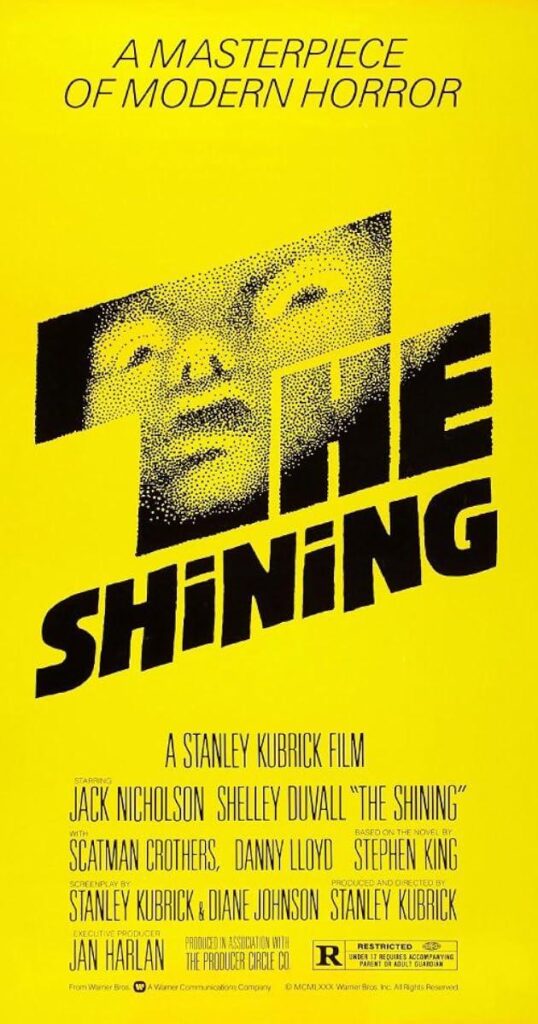
The Shining (1980)
Forty-six years ago, the most perfect Stephen King film imaginable from my viewpoint came out in the form of The Shining as directed by Stanley Kubrick from a screenplay by him and Diane Johnson, it was also produced by him. This was true of 2001, wasn’t it? The screenplay and production I mean (co-written with Clarke, not Johnson).
It had an absolutely wonderful lead cast of Jack Nicholson, Shelley Duvall. Danny Torrance, Scatman Crothers and Danny Lloyd. Jack Nicholson in particular was amazing in his role as was Shelley Duvall in hers. And the setting of the Overlook Hotel is a character in and itself — moody, dangerous and quite alive.
Kubrick’s script is significantly different from the novel which is not unusual to filmmaking. However Stephen King was extremely unhappy with the film due to Kubrick’s changes from his novel.
If you saw it upon the first release, you saw a print that was a half hour longer than later prints. Yes, Kubrick released multiple prints, all different from each other. Some prints made minor changes, some made major changes. I assume that first release exists as a director’s cut or whatever they care to call as the lust after lucre never ends.
It cost twenty million to make and made around fifty million. Now according to some sources it cost much more than forty million, but this being studio accounting, that will never be known. What is known is that it lost the studio money, or so they claim.
So how was it received by the critics? Well it got a mixed reception.
Gene Siskel in his Chicago Tribune review stated he thought it was a “crashing disappointment. The biggest surprise is that it contains virtually no thrills. Given Kubrick’s world-class reputation, one’s immediate reaction is that maybe he was after something other than thrills in the film. If so, it’s hard to figure out what.” No thrills? Huh.
Peter Bradshaw of The Guardian was much more positive: “The Shining doesn’t look like a genre film. It looks like a Kubrick film, bearing the same relationship to horror as Eyes Wide Shut does to eroticism. The elevator-of-blood sequence, which seems to ‘happen’ only in premonitions, visions and dreams, was a logistical marvel. Deeply scary and strange.”
Let’s give Roger Ebert the last word: “Stanley Kubrick’s cold and frightening ‘The Shining’ challenges us to decide: Who is the reliable observer? Whose idea of events can we trust?”
Audience reviewers at Rotten Tomatoes currently give it an excellent ninety-three percent rating.
For nearly 40 years, Lunokhod 1 was not so much dead as misplaced.
The Soviet rover had stopped responding in 1971, after almost a year on the lunar surface. Its tracks were still there. Its body was still there. Its French-built laser reflector was still there too, bolted to the rover and facing whatever part of the sky it had last faced before the machine went silent.
The problem was that scientists no longer knew precisely where to aim.
That changed in 2010, when high-resolution images from NASA’s Lunar Reconnaissance Orbiter helped identify the rover’s location. Soon after, researchers using the Apache Point Observatory Lunar Laser-ranging Operation in New Mexico were able to acquire a signal from the long-lost reflector. In the abstract of their later paper, the team wrote that the reflector appeared to be in excellent condition and was returning a signal roughly four times stronger than the reflector on Lunokhod 2.
After decades of silence, the old Soviet rover had answered back.
A rover that outlived its mission by accident
Lunokhod 1 landed in the Sea of Rains on November 17, 1970, delivered by the Soviet Luna 17 mission. It was the first remote-controlled rover to operate on another world, a tub-like vehicle with eight wheels, a hinged solar lid, television cameras, scientific instruments, and a laser retroreflector built in France….
A team from Vienna and Frankfurt has found a formula describing a strange phenomenon: Space and time can form a kind of “crystal” that may turn into a black hole. The results are described in Physical Review Letters.
Alongside the famous gigantic black holes, physics also allows for microscopic versions. They emerge from so-called critical states, when spacetime organizes itself into a regular, crystal-like structure during a process known as critical collapse. A team from Goethe University Frankfurt and TU Wien has now succeeded, for the first time, in describing this phenomenon with an exact mathematical formula using an unusual mathematical trick….
(9) THE SOLAR SYSTEM’S INTERSTELLAR ODYSSEY HAS BEEN FROZEN IN TIME. [Item by SF Concatenation’s Jonathan Cowie.] The Solar system’s travel through the local part of the Galaxy has been charted in Antarctic ice. Iron (Fe) comes in a number of isotopes with around 98% in the form of 54Fe and 56Fe (the latter being the most common making up nearly 92% of all iron). However, there are other minority isotopes including 60Fe which is radioactive and decays with a half-life of 2.6 million years. It is a form of iron that is created in supernova explosions and so is found in interstellar dust clouds.
The Antarctic is covered in ice and so can be considered to be a blank sheet. Consequently, 60Fe in Antarctic ice is considered to be a proxy for interstellar dust entering the atmosphere and this happens to a greater extent when the Solar system passes through an interstellar dust cloud.
The Earth and Solar system is currently passing through one such interstellar dust cloud that is tentatively thought to have been created around 130,000 years ago but within a cluster of clouds thought to have formed around a million years ago, and an even larger surrounding, encompassing bubble (called the Local Bubble) that was likely triggered by supernova-driven outflows from 14 – 20 supernovae in the Scorpius Centaurus Association starting around 10–15 million years ago.
Researchers, mainly based in Germany, have now drilled an Antarctic ice core. As snow falls on the Antarctic ice surface, so ice builds up over time. Therefore, by measuring 60Fe in Antarctic ice it is possible to estimate when the rate of such isotopic deposition was higher or lower. The researchers found that between 40,000 and 81,000 years ago there was less of an isotopic signature and this, the researchers conclude, is evidence of a changing interstellar medium surrounding the Solar system than experienced now and before then. Separate work on marine sediments, as well as future work added to current astronomical observations and modelling, should enable us eventually to understand the Solar system’s journey through the various encompassing bubbles over millions of years. (See the primary research Koll, D. et al (2026) Local Interstellar Cloud Structure Imprinted in Antarctic Ice by Supernova 60Fe. Physical Review Letters, vol. 136, 192701.)
Chinese engineers have built a mecha-style robot that can quickly transition from two legs to four while carrying people, resembling the power-loader exoskeletons from Aliens or the utility-style mobile suits from Japanese anime series Gundam SEED.
The robot’s developer, Unitree, says the large, humanoid robot is intended for civilian transport. In a promotional video, the robot — called GD01 — walks upright, smashes down a high wall of cinder blocks, and reconfigures itself to stand on four limbs to traverse more difficult terrain.
Unitree representatives say the machine weighs around 1,100 pounds (500 kilograms) with an operator on board and stands nearly 10 feet (3 meters) tall. People can even buy the robot, with prices starting at 3.9 million yuan ($572,000)….
[Thanks to Chris Barkley, Mark Roth-Whitworth, Kathy Sullivan, Steven French, Mike Kennedy, Andrew Porter, John King Tarpinian, Cat Eldridge, and SF Concatenation’s Jonathan Cowie for some of these stories. Title credit belongs to File 770 contributing editor of the day Andrew (not Werdna).]
The shortlists for the 2026 British Fantasy Awards have been released. The are 13 categories this year because the audio category has been divided, so that audio fiction releases no longer compete against popular podcasts.
The awards will be presented as part of this year’s Fantasycon, being held in Glasgow from October 9-11.
Below are the nominees for this year’s British Fantasy Awards.
Best Anthology
Lesbians In Space: Where No Man Has Gone Before, edited by J S Fields, William C Tracy, Heather Tracy (Space Wizard Science Fantasy)
Blood in the Bricks, edited by Neil Williamson, NewCon Press
This Way Lies Madness, edited Dave Jeffery, Lee Murray, Flame Tree Press
Silk and Sinew: A Collection of Folk Horror from the Asian Diaspora, Kristy Park Kulski (Bad Hand Books)
Best Artist
Jenni Coutts
Mina Ikemoto Ghosh
Vincent Chong
Ben Baldwin
Kelly Chong
Best Audio (Fiction)
The Shape of Monsters, CL Hellisen, Omari Douglas (Audible Originals)
The Tiny Bookcase
Podcastle
Pseudopod
Best Audio (Non-Fiction)
Breaking The Glass Slipper
Fantasy Book Swap
Uncanny
The Folklore Podcast
Best Collection
Dark Crescent, Lyndsey Croal (Luna Press)
Call And Response, Christopher Caldwell (Neon Hemlock Press)
Wolf’s Path, Joyce Chng (Atthis Arts)
Who Will You Save, Gareth Powell (Titan Books)
Into Wrack and Ruin, Benjamin Kurt Unsworth (Phantasmagoria Books)
Best Fantasy Novel (The Robert Holdstock Award)
Daughters of Nicnevin, Shona Kinsella (Flame Tree Press)
Magic, Maps, and Mischief, David Green (Independently Published)
A Song of Legends Lost, M H Ayinde (Orbit)
The Outcast Mage, Annabel Campbell (Orbit)
Grave Empire, Richard Swan (Orbit)
Upon a Starlit Tide, Kell Woods (Titan Books)
Best Horror Novel (The August Derleth Award)
Witchcraft for Wayward Girls, Grady Hendrix (Tor Nightfire)
The Buffalo Hunter Hunter, Stephen Graham Jones (Titan Books)
Hungerstone, Kat Dunn (Manilla Press)
The Needfire, MK Hardy (Solaris)
Lionhearts, Dan Howarth (Northern Republic Press)
Black Flame, Gretchen Felker-Martin (Titan Books)
Best Independent Press
Flame Tree Press
Luna Press
Black Shuck Books
Newcon Press
Best Magazine/Periodical
Ginger Nuts of Horror
Remains
Phantasmagoria
Strange Horizons
Mythaxis Magazine
Best Newcomer
M H Ayinde, A Song of Legends Lost (Orbit)
Annabel Campbell, The Outcast Mage (Orbit)
Ana Sun, Futures to Live By (NewCon Press)
M K Hardy, The Needfire (Solaris)
Best Non-Fiction
Writing The Magic: Essays on Crafting Fantasy Fiction, Dan Coxon & Richard V Hirst (Dead Ink Books)
Spec Fic and the Politics of Identity: Finding the Self in Other, Eugen Bacon (Strange Horizons)
By Steve Vertlieb: Mourning the death of intellectual wit, compassion, eloquence and dignity on late night television. “Why should we surrender life to the brutes and fools.” (Things to Come, 1936).
While Jon Stewart, Jimmy Kimmel, Bill Maher and John Oliver still remain on the air, a precious slice of Americana has been ripped away from the heart and soul of our country. Courage, honesty and freedom of speech are seditiously being broken apart from the very core of “the land of hopes and dreams” that once sired individualism and personal integrity.
As the voices of humanity and decency have been torn asunder by thugs and bigots, the conscience and echoes of humorous social commentary shall never remain entirely silenced.
As long as the spirit of satirical brilliance exists within the “sounds of silence,” a particle of humor, culture and humanity will ever survive and endure., The inspired, time honored opinions of satirists like Stephen Colbert, Jon Stewart, Jimmy Kimmel, Bill Maher, John OIliver and Mark Twain shall ever remain the vibrant, vital and essential voices of “truth, justice and the American way.”
As for me, “I want to see if somewhere there isn’t something left in life of charm and grace.” (Clark Gable/ Rhett Butler in Gone With the Wind.)
The winner of the 2025 Tähtivaeltaja (“Star Rover”) Award was announced on May 11. Sponsored by the Helsinki Science Fiction Society, the award goes to the best science fiction book published in Finland in the previous year. The winner is:
Marisha Rasi-Koskinen: Kesuura (S&S)
The winner was selected by a jury composed of journalist Hannu Blommila , editor-in-chief Toni Jerrman, critic Elli Leppä and critic Vesa Sisättö.
The judges say:
Marisha Rasi-Koskinen’s eighth novel, Kesuura , is an extraordinary display of power that sheds light on the formation of the thinking mind. It mirrors human consciousness and the information processing of artificially constructed brains. Psychologically astute, even raw in its uncompromisingness, this work shows how a person creates another being in their own image, but then refuses to recognize their similarity.
In the near future, we have learned how to build human-like androids that are trained to perform various maintenance and care tasks. Initially childlike, the artificial beings shape and develop organically, through what they learn and experience. Biological physical growth is imitated by insect-like transformations from one growth stage to another.
The main character, an android named QED, desperately seeks connection with the world and other species, but finds it difficult to identify with human beings. Through the mutual reflections between QED and his android siblings, we gradually delve deep into epistemological dilemmas: what can be known and how can one know that one does not know.
The story, which skillfully moves through several time levels, unfolds gradually, dispensing information and surprising twists at just the right pace. The stark difference in the agency and innate value of humans and androids echoes the gap in the modern world between humans and other species of animals. Instead of blabbering and proclaiming, the reader is shown a chilling observation of what kind of boundary fences are erected between different sentient beings, and how difficult it is to tear down fences once erected.
Androids are at once fascinatingly alien in their biology, but shockingly relatable in their psychology. Ethical and moral considerations about the mental movements of artificial intelligences could not be more timely.
Much has been written about the soul life of robots in recent decades, but Kesuura offers a rare fresh perspective on the ingredients of consciousness and how circumstances shape it. A work that dives straight into the depths is of world-class quality, and would immediately earn a place on the lists of international sci-fi awards.
The Tomorrow Prize and The Green Feather Award winners were revealed at the Celebrity Readings & Honors ceremony at Vroman’s Bookstore in Pasadena on May 16.
The Tomorrow Prize recognizes outstanding new works of science fiction written by Los Angeles County high school students. First, Second, and Third place Tomorrow Prize winners receive $250, $150, and $100 USD cash prizes. The first place Tomorrow Prize winner is published in L.A. Parent Magazine.
The Green Feather Award is an additional special prize category for an environmentally focused sci-fi story. The winner receives $250 and online publication by the Nature Nexus Institute.
(0) THE REST OF THE TITLE. Here is Steve Davidson’s complete title for today’s Scroll.
Once a Fannish filer sat by his PC screen Reading words of Fen’s camaraderie And he sang as he typed and waited for his file to post you’ll come a scrolling the pixel with me scrolling the pixel scrolling the pixel you’ll come a scrolling the pixel with me and he sang as he typed and waited for his file to post you’ll come a scrolling the pixel with me
(1) COLBERT’S LATE NIGHT FAREWELL. “Stephen Colbert Went Out His Way: Through a Wormhole” – the New York Times notes the episode’s very entertaining sf special effects. (Link bypasses NYT paywall. Numerous embedded videos in article.)
…As the episode neared its end, Neil deGrasse Tyson, Jon Stewart and Andy Cohen showed up to help Colbert through a wormhole portal that opened up to swallow his show, followed by his “Strike Force Five” co-hosts — “Jimmy, Seth, John, Handsome Jimmy!” Colbert called them — who came by to see him off.
“Without you, where will Americans turn to see a middle-aged white man make jokes about the news?” — SETH MEYERS
“But why aren’t you guys being pulled in, too?” Colbert asked.
“Actually, one of these holes opened at my show last year, but it went away after about three days.” — JIMMY KIMMEL, referring to ABC’s pulling “Jimmy Kimmel Live” off air the briefly after Kimmel made comments about Charlie Kirk
“At some point, this may come for all of our shows. But, Stephen, what’s important to remember is tonight it is going to eat you.” — JOHN OLIVER…
(2) SHELFIES. Shelfies, edited by Lavie Tidhar and Jared Shurin, “Takes a unique peek each week into one of our contributors’ weird and wonderful bookshelves.” A recent entry was Shelfies #89: Rachel Cordasco.
(3) VOTING FOR ROCKETS. Camestros Felapton is ready to rank the finalists in one Hugo category: “Hugo 26: Dramatic Presentation Longggggg”. He says three of the six immediately sank to the bottom of his ballot. Does that mean the cream rose to the top? Your bovine mileage may vary.
(4) SHARON LEE Q&A. The Baen Free Radio Hour has released a two-part interview with Sharon Lee: “A Liaden Universe Constellation”.
(5) TREAT YOUR CAT. Cyril Simsa of the Anglo American University in Prague says: “I thought you might enjoy this this mini-poster which we dreamed up recently with a group of cat-loving colleagues. Now proudly adorning the door of our Study Abroad office.”
(6) MEMORY LANE.
[Written by Cat Eldridge.]
May 22, 1981 — Outland film
Outland premiered forty-five years ago this date in the States in select cities, but everywhere that following weekend. It got a Hugo nomination at Chicon IV, the year that Raiders of the Lost Ark won.
This original title of the film was Io as it’s set on Jupiter’s moon Io, but audience testing showed that wasn’t understandable at all as the test audiences thought it was the number ten, or, at least to me less puzzlingly, low. So in homage to the Western genre, it became Outland.
Which was appropriate as the writer Peter Hyams wanted to do one: “I wanted to do a Western. Everybody said, ‘You can’t do a Western; Westerns are dead; nobody will do a Western’. I remember thinking it was weird that this genre that had endured for so long was just gone. But then I woke up and came to the conclusion – obviously after other people – that it was actually alive and well, but in outer space.”
So they had a script that they really liked, now they need their actor. They wanted and got Sean Connery to be in their version in High Noon. Connery’s career had been in a nose dive as of late then, so this was a golden chance for him, so he took the role.
Law enforcement officers are faced with the nature of right and wrong, and duty versus keeping themselves safe, but while Will Kane in High Noon is played as an archetypal hero who discovers the world isn’t black and white as he was led to believe, Will O’Niel already exists firmly in the gray where things are always messy when we meet him.
Connery was magnificent in this role. In addition to Sean Connery, the movie includes performances by Peter Boyle, Frances Sternhagen, and James Sikking, who all I firmly believe deliver memorable portrayals of complex characters.
So they got the lead and the rest of an excellent core cast, now they had to film a movie. They had a very tight budget, just seventeen million dollars. The quite amazing sets were enhanced by the use of a new filming process called Introvision which allowed the director to mix a combination of sets, mattes and a generous use of miniatures in-camera, avoiding the then-lengthy process of extensive use of green screens.
Critics were mixed on it. Gary Arnold at the Washington Post thought it was “trite and dinky” whereas Desmond Ryan at the Philadelphia Inquirer called it: “a brilliant sci-fi Western.”
I said it cost seventeen million to make, and it made, errr, just about seventeen million dollars. That means that it lost money for the studio. Lots by the time you figure printing up reels for the theatres, promotional costs and that the studio only gets fifty percent most often of ticket sales. Not that the studio would admit that.
Now I liked the film. I saw it some years after it came out and thought it worked rather well, but then I think it is police drama rather than a SF film.
It may have been a place for ceremony or a barn for pack animals. It could have been a place for weary labourers to rest their heads. Or perhaps there was no building at all.
English Heritage has unveiled a 7-metre-high reconstruction of what a 4,500-year-old Neolithic hall may have looked like at Stonehenge, offering visitors a glimpse into the lives of the prehistoric builders who raised the world’s most famous stone circle.
The £1m project is in its final stages of construction near the Stonehenge visitor centre on Salisbury Plain. Built entirely by hand over nine months by a team of more than 100 volunteers, the Kusuma Neolithic Hall will open to the public this summer before transforming into an immersive, historical learning space for schools.
The structure is based on the archaeological footprint of an anomaly known as Durrington 68, a unique “square in the circle” building discovered two miles away near Woodhenge, another Neolithic site. First excavated in 1928 by Maud Cunnington, and re-examined in 2007 by the Stonehenge Riverside Project, the original site features a horseshoe-shaped ring of post holes surrounding four massive internal roof support pillars.
Because centuries of ploughing destroyed the original floor and hearths, its true purpose remains a mystery. However, discoveries of animal bones and grooved ware pottery nearby point towards winter feasting, ritual gatherings or even communal storage….
Sergei Krikalev launched from the Baikonur Cosmodrome in May 1991 as a Soviet citizen. He returned to Earth on 25 March 1992, after 311 days in orbit, as a Russian one. The country that had sent him no longer existed.
The mission was originally meant to last about five months. Krikalev was the flight engineer on Soyuz TM-12, alongside commander Anatoly Artsebarsky and British cosmonaut Helen Sharman, the first Briton in space, who returned with the previous crew after about a week on the station. In July 1991, with funding cuts compressing the Soviet space program, Krikalev was asked to stay on Mir for the next long-duration expedition because two planned flights had been reduced to one. According to ESA’s biographical note on Krikalev, he agreed.
What followed, on the ground beneath him, was the dissolution of his country.
The political timeline during the mission
The failed coup against Mikhail Gorbachev took place in August 1991, while Krikalev and Artsebarsky were conducting EVAs and station maintenance on Mir. The Soviet Union began to unravel through the months that followed. On 6 September 1991, the Presidium of the Supreme Soviet of the Russian SFSR signed the decree returning Leningrad’s historical name. Krikalev’s home city was Saint Petersburg again. He learned of it on the station.
Kazakhstan declared independence on 16 December 1991, the last of the Soviet republics to do so. Ten days later, on 26 December, the Soviet Union formally ceased to exist. The cosmonaut still in orbit was now flying for a state that did not….
SpaceX launched its biggest, most powerful Starship yet on a test flight Friday, an upgraded version that NASA is counting on to land astronauts on the moon.
The redesigned mega rocket made its debut two days after SpaceX CEO Elon Musk announced he’s taking the company public. It blasted off from the southern tip of Texas, carrying 20 mock Starlink satellites for release halfway around the world.
It’s the 12th test flight of the rocket that Musk is building to get people to Mars one day. But first comes the moon and NASA’s Artemis program.
The last of the old space-skimming Starships lifted off in October. SpaceX’s third-generation Starship — a souped-up version dubbed V3 — soared from a brand-new launch pad at Starbase, near the Mexican border. Last-minute pad issues thwarted Thursday evening’s launch attempt.
SpaceX was hoping to avoid the fireworks it experienced during back-to-back launches last year when midair explosions rained wreckage down on the Atlantic. Earlier flights also ended in flames.
At 407 feet, the latest model eclipses the older Starship lines by several feet and packs more engine thrust….
[Thanks to SF Concatenation’s Jonathan Cowie, Chris Barkley, Mark Roth-Whitworth, Kathy Sullivan, Steven French, Mike Kennedy, Andrew Porter, John King Tarpinian, and Cat Eldridge for some of these stories. Title credit belongs to File 770 contributing editor of the day Steve Davidson.]
Tomlinson and his wife have been the victims of dozens of swatting calls—fake emergency calls that prompt real police responses. Swatting is an online harassment scheme that involves people reporting false claims to police, such as a murder or a hostage situation, at their address.
They allege their civil rights have been violated, and the city should have known their home was an intentional target. The court found there were violations but dismissed the individual claims because the officers were granted qualified immunity. But the suit against the city remained.
Now the city has agreed to pay the $575,000 settlement for not properly training 20 officers involved.
For years, Tomlinson and his wife had been swatted for bomb threats, assassinations, kidnapping children, hostage situations, mass shootings, and murders.
The Milwaukee Police Department was aware of the false reports, yet officers continued to show up to the couple’s home and search it for threats throughout 2022 and 2023, sometimes with guns drawn, the lawsuit said. In total, police were dispatched to the couple’s home 45 times over the span of two years.
The city has admitted that police knew the couple was being targeted with false emergency calls, according to court records. It has also admitted that officers held Tomlinson at gunpoint, detained and handcuffed him during at least one response.
However, the city denies those searches were illegal.
…For years, Tomlinson begged for MPD to flag his address for any future calls, telling us, “It has led to deaths. People have been killed this way.”
Court documents show police often agreed.
On one call, an officer said, “Luckily, we already kind of know this is an ongoing thing, because if we didn’t, this could end up with this guy dead.”
One officer sent a memo asking that the home be marked as a “Swatter House” in MPD’s dispatch system. A supervisor declined.
An officer said he “thought the call might be fake;” another “would later testify that he knew there wasn’t an emergency,” another said, “We know. We know,” when told the address should be flagged.
The house was not flagged, and the swatting worsened after our interview.
One officer raced to respond to one call, even though he had responded the day before to the first of four swatting calls.
The complaint filed in the 2024 lawsuit said in part:
16. Niki and Patrick live in a constant state of fear, worried that the next encounter they have with the police will be their last.
17. Every knock on the door or police car that drives by leaves them terrified that they are about to be staring down an officer’s gun or that they will be paraded outside in handcuffs to their further humiliation.
18. This lawsuit seeks to end the madness and vindicate the violation of Plaintiffs’ constitutional rights. It seeks to effect change through punitive damages by punishing the Defendants for their egregious conduct with the hope that the punishment is significant enough to prevent this from happening again in the future…
In order to make the payment, the city will have to increase its budget for litigation settlements. The city expects that to take about 90 days, meaning the settlement could be finalized in mid-August.
(1) WSFS BUSINESS DEADLINES. People submitting business to the LAcon V Virtual Business meeting have a June 17 deadline.
Linda Deneroff, LAcon V WSFS Division Head, today reminded fans that the first WSFS Virtual Business Meeting will be held Friday, July 17.
Therefore, all new business must be submitted on or before June 17, 2026 (30 days before the start of the business meeting, per the WSFS Constitution). All financial reports from Worldcons and NASFiCs that have not closed their books are due on that date as well.
…Platform Decay introduces the emotion-check subroutine, a therapy module Murderbot has self-installed following the hallucinations and near-system-collapse depicted in System Collapse (2023). The module does not suppress or eliminate Murderbot’s anxiety. It surfaces the anxiety, forces a label on it, and allows continued operation. The recurring internal log — “Emotion check: Oh, for f—” — is both the book’s running joke and its most technically specific design choice.
What Wells has built here is a fictional implementation of metacognitive monitoring: an architecture in which a system’s internal states are treated as data to be processed rather than noise to be filtered. This maps directly onto an open research problem in AI safety. A 2025 study from researchers at UC San Diego and New York University found that large language models show a limited but measurable capacity to monitor and report on their own internal activations, with significant implications for how AI oversight systems are designed. The emotion-check subroutine models one design direction: not fix the distress, give the system structured tools to work with it while continuing to function. The design choice Wells makes — that the module doesn’t cure Murderbot but gives it a framework for handling the experience of being broken — is closer to current metacognitive safety research than to classical AI design, in which emotional analogs would simply be suppressed….
Matthew: I’m sure inquiring minds want to know your secret to writing a character that improves their emotional state despite living in a corporate hellscape. It hasn’t become a less relevant topic as the series goes on.
Martha: [laughs] I wish I really knew! Basically, my coping mechanism is the same one I gave Murderbot, which is basically TV, movies, stories, books… anything that just kind of takes you away from reality for a while.
Matthew: Speaking of which, since the Apple TV adaptation came out, I’ve been fascinated by how much people have latched on to The Rise and Fall ofSanctuary Moon, and how it’s developing its own fandom. Has that reaction changed the way you’ve engaged with that series?
Martha: Not really. It’s pretty much the same for me. I just think the way they did [Sanctuary Moon] in the TV series was so much fun. Just having so many surprise actors, and just the whole… taking the soap opera, telenovela concept and really pushing it as far as it could go into the outrageous. The costumes, the great music, and the situations. I just think that’s what people are responding to. It’s so silly, and it’s so fun, yet it’s kind of serious stuff. It was just incredibly likable.
While piracy has long been an issue for the book business, the rapid rise of unauthorized audiobooks on YouTube, which publishers and authors believe are eroding sales for their books, poses a new challenge for the industry.
Audiobooks have soared in popularity in recent years, driven by widespread smartphone use and the consequent spike in audio streaming services, and they have become a critical revenue stream for publishers. Publishers and audiobook producers are investing heavily in them, recording splashy, full-cast productions, replete with sound effects and musical scores, in a push to redefine audiobooks as their own narrative art form rather than just another publishing format.
At the same time, artificial intelligence programs have given pirates new tools to rapidly reproduce audiobooks, and to illegally profit from them by running advertisements.
A.I. has made it easier to quickly create audiobooks using synthetic narration. Because most antipiracy technology is designed to catch identical files, not altered ones, many of them avoid detection by programs used to identify copyright infringement. A.I. versions of highly anticipated titles often appear on YouTube hours after they are released….
(5) WHAT STAR WARS FANS WANT. With The Mandalorian & Grogu hitting cinemas soon, JustWatch – The Streaming Guide has just surveyed American Star Wars fans on their trilogy preferences, favorite TV shows, and which characters they want to see get their own spin-off. (Click for larger images.)
A few things that stood out:
The Original Trilogy still dominates at 83% — but nearly 30% of under-35s back the Prequels, compared to just 9% of over-35s.
Andor and The Mandalorian are splitting the audience down the middle: Andor leads among men and under-35s (51%), while women overwhelmingly favour The Mandalorian (61%).
Chewbacca tops the spin-off wish list — beating out Yoda, Lando Calrissian, and even Mace Windu.
A statue commemorating actor and writer Terry Jones has been vandalised just weeks after being unveiled.
Sculptor Nick Elphick said he was left “in shock” while Jones’ daughter, Sally, “seemed very upset” by the damage to the bronze statue at his birthplace in Colwyn Bay, Conwy county.
Jones’ family backed a £120,000 fundraising campaign to have him immortalised as the nude organist, a recurring character he played in Monty Python’s Flying Circus.
Elphick said the vandals had removed two door knockers from the statue which were a nod to the 1986 fantasy film Labyrinth which Jones had co-written.
“I felt really low. It is a shock that has happened so quickly,” said Elphick….
…Elphick thanked the people who had found the vandalised pieces and said they would require repair and rewelding, costing about £1,000 to fix on-site.
“The expense is in the making of the bronzes, that’s why it costs a lot to have them done. Money value in the metal it is nothing,” he said. “My concern is that this was [an] incredibly tight budget to get this done. We’ve all really put our hearts and souls into this and I haven’t made a profit off of this.”…
(7) SUPER I SCREAM. It’s in demand in Michigan they say.
(8) MICHAEL KEATING (1947-2026). Actor Michael Keating, known to sf fans as Vila Restal in Blake’s 7, died this month at the age of 79. The Big Finish website paid tribute.
…As Vila Restal in the BBC’s Blake’s 7, Michael appeared across all four series of the show, from 1978 to 1981 – the only cast member to appear in all 52 episodes. Vila was nominally the gang’s thief and self-declared coward, though Michael always preferred a more precise description: cautious, not cowardly. In his hands, Vila was something richer than comic relief. He was warm, wily, honest about his own limitations, and almost impossible not to love.
Beyond the confines of the spaceship Liberator, Michael enjoyed a long and varied career in theatre and television, including stints with both the National Theatre and the Old Vic. In 1985, he created the role of Marty at the Phoenix Theatre in the West End in Are You Lonesome Tonight, Alan Bleasdale’s play about Elvis Presley, in which Martin Shaw played the King….
There’s also an overview of his many roles for Big Finish, for Doctor Who and Blake’s 7 stories.
(9) DR. MARTIN C. WEISSKOPF (1942-2026). NASA scientist Dr. Martin C. Weisskopf, father of editor Toni Weisskopf, died May 2. Read the complete family obituary at the link.
Dr. Martin C. Weisskopf, a pioneering physicist whose work helped shape modern X-ray astronomy, died on May 2, 2026, with his daughter at his side. He was 84.
Over a career spanning more than five decades, Dr. Weisskopf became widely respected within the scientific community for both his technical contributions and his leadership in advancing space-based X-ray astronomy. He served as Project Scientist for NASA’s Chandra X-ray Observatory and as Chief Scientist for X-ray Astronomy at NASA Marshall Space Flight Center in Huntsville, Alabama. He was also the Principal Investigator for the Imaging X-ray Polarimetry Explorer, a mission that opened a new window on the high-energy universe…
…He began his academic career at Columbia University, where he rose from Research Associate to Assistant Professor. During those years, he conducted pioneering experiments, including the first detection of X-ray polarization from the Crab Nebula using a sounding rocket. He also contributed to the development of high-resolution X-ray optics and played key roles in experiments aboard the OSO-8 satellite and in what would become the Einstein Observatory.
In 1977, Dr. Weisskopf joined NASA’s Marshall Space Flight Center, where he would leave a lasting institutional and scientific legacy. He founded the X-ray Astronomy Branch and later served as its Chief, guiding major programs and mentoring generations of scientists. His work advanced technologies that enabled the first focused images of astronomical objects in hard X-rays and supported research that significantly expanded the study of galaxy clusters and cosmic structure. Over the course of his career, Dr. Weisskopf authored or co-authored more than 360 scientific publications. He remained deeply engaged in scientific work throughout his career and beyond, continuing as a NASA Emeritus following his retirement in May 2022….
,,, In lieu of flowers, the family requests that letters of support be directed to efforts sustaining NASA’s Chandra X-ray Observatory, which has provided decades of critical data on high-energy cosmic phenomena including black holes, supernovae, and the large-scale structure of the universe…
(10) TODAY’S BIRTHDAY.
[Written by Cat Eldridge.]
May 21, 1917 — Raymond Burr. (Died 1993.)
Surely you know Raymond Burr, the man whose Birthday it is today. So let’s get started.
I must of course start with his long running role as Perry Mason which is decidedly not genre. CBS paid Gardener for the rights to two hundred and seventy-two of his stories, a good idea given that Perry Mason would run nine seasons. Many early episodes were based off his stories and novels.
The role of Perry Mason proved the hardest to cast. Richard Carlson, Mike Connors, Richard Egan, and William Holden were considered. None at all suited the casting team. Burr initially read for the role of district attorney Hamilton Burger, but he told them that he was more interested in the Perry Mason role. They had seen him being a lawyer, and said he could play the role provided he lose at least sixty pounds. He did and got the role.
What a magnificent Perry Mason he made. Burr’s coolness, control and reserved sense of humor were such that he became so identified with the character that, for the television audience, that meant there was no other Mason but Burr. He was not the Mason that had existed, there were four before him, all on film, and the producers tried reviving the series after CBS cancelled it, but it utterly failed. And HBO had a new series that looks at early years of his life.
In the late Eighties he reprised his Mason role in twenty-six TV movies. The first has the title of Perry Mason Returns.
Now for his genre work. Mike joked with me when I said when I was doing him that he was the lawyer for Godzilla. Well, he was Steven Martin in Godzilla, King of the Monsters! It is a re-edited for American audiences of the 1954 Japanese film Godzilla which in its original wasn’t available outside Japan for fifty years. He would reprise this role in Godzilla 1985.
Raymond Burr, right, Frank Iwanaga, left, in Godzilla
He was the Grand Vizier Boreg al Buzzar in The Magic Carpet. Evil viziers! Dungeons! Magic carpets! Princesses!
He’s Cy Mill, hulking villainin Gorilla at Large. Remember what was said about his weight in his Burr casting. Well, this film was done just previous to this series and he was quoted as saying there, “I was just a fat heavy.” Burr told journalist James Bawden, “I split the heavy parts with Bill Conrad. We were both in our twenties playing much older men. I never got the girl but I once got the gorilla in a 3-D picture called Gorilla at Large.”
He was Vargo in Tarzan and the She-Devil , the seventeenth film of the Tarzan film series that began with 1932’s Tarzan the Ape Man, twenty years earlier.
Television wise, he appeared on Tales on Tomorrow in “The Masks of Medusa” and in the horror film Curse of King Tut’s Tomb, he’s Jonash Sebastian. I thought there’d be more but there aren’t.
(12) OCTOTHORPE. Episode 160 of the Octothorpe podcast, “Global Nando’s Correspondents”, comes with an exclusive free gift*! (*free gift is theoretical/made up) John Coxon, Alison Scott, and Liz Batty talk a little bit more about the Hugo Awards including the packet, but mostly they dive into their bulging mailbag and read out your letters and comments. (An uncorrected transcript is available here.)
…The 408-foot-tall (124 meters) V3 (“Version 3”) is bigger and more powerful than previous Starship iterations, which were already the biggest and most powerful rockets ever built, and it sports a number of other important upgrades as well.
For starters, it’s outfitted with the new V3 Raptor engine — 33 of them on Super Heavy and six on Ship — which provides more heft, and a far more streamlined design, than its predecessors.
The V3 Super Heavy also now has just three grid fins (which help it steer its way back to Earth for recovery and reuse) instead of four. And the “hot stage ring” — the structure that marks the meeting point of Super Heavy and Ship — is now attached to the booster, meaning it can be reused, whereas previously it had fallen away during flight. (Starship engages in “hot stage” separation, meaning Ship fires its engines before it has detached from Super Heavy.)…
Tomorrow Studios, the indie studio behind Netflix’s One Piece, has set out to adapt for television Skyward, the first book in bestselling author Brandon Sanderson‘s Cytoverse franchise. Sanderson will write the pilot script with TV writer-producers Jed Whedon and Maurissa Tancharoen (Marvel’s Agents of S.H.I.E.L.D.)…
…In the Skyward (aka Cytoverse) sci-fi book series, humanity is trapped on a harsh planet and constantly under attack by mysterious alien forces. The story follows Spensa Nightshade, a determined pilot who dreams of joining the fighter corps to defend humanity and redeem her disgraced father’s legacy. Blending high-stakes aerial combat, advanced technology, and themes of courage, identity, and discovery, the series explores both the secrets of the galaxy and Spensa’s growth from an outsider into a key figure in humanity’s fight for survival….
…“I’ve been working on the Skyward series for nearly a decade, and to have a partner like Tomorrow Studios to help bring this story to television is a dream come true,” Sanderson said….
In the remote South Korea village of Hope Harbor, police chief Bum-seok (Hwang Jung- min) and officer Sung-ae (Hoyeon) are called to find a mysterious creature that has wreaked havoc on the village. In the nearby forest, a coterie of hunters, including Sung- ki (Zo In-Sung) set out to track the beast and find themselves hunted instead. But all is not as it seems, and perceptions can be misleading. What begins as ignorance plants the seed of disaster, escalating through human conflict into a tragedy of cosmic proportions.
[Thanks to Cat Eldridge, SF Concatenation’s Jonathan Cowie, Chris Barkley, Mark Roth-Whitworth, Kathy Sullivan, Steven French, Mike Kennedy, Andrew Porter, and John King Tarpinian for some of these stories. Title credit belongs to File 770 contributing editor of the day Joe H.]
Linda Deneroff, LAcon V WSFS Division Head, today reminded fans that the first WSFS Virtual Business Meeting will be held Friday, July 17.
Therefore, all new business must be submitted on or before June 17, 2026 (30 days before the start of the business meeting, per the WSFS Constitution). All financial reports from Worldcons and NASFiCs that have not closed their books are due on that date as well.
All virtual business meetings will commence at 9:00 a.m. Pacific Time. Detailed login information and agendas will be distributed to members and interested parties closer to the dates.
The Site Selection Business Meeting, where the results of the 2028 site selection will be announced, will still be held in person during the general convention dates in LA.
Sunday, August 30, 2026 (Site Selection Announcement)