
Download floatz – AI‑Powered Research Assistant, Literature Summarizer & Smart Chat
Why floatz Is a Game‑Changer for Modern Researchers
In the age of information overload, scholars are forced to wade through thousands of papers to extract the few insights that truly matter. The traditional workflow—search, download, read, annotate, cite—can consume entire weeks of a graduate student’s schedule. floatz reimagines that process by turning static PDFs into interactive dialogues, allowing you to ask natural‑language questions and receive AI‑generated answers that are directly linked to peer‑reviewed sources. This shift from passive consumption to active conversation not only accelerates literature discovery but also reduces the cognitive fatigue associated with endless scrolling.
The platform is delivered as a secure, cloud‑based web application, which means you never need to install bulky executables or worry about operating‑system compatibility. Whether you are on a Windows laptop in a campus lab, a macOS desktop in a home office, a Linux workstation in a research institute, or a mobile device running Android or iOS, floatz works the same way through any modern browser that supports WebGL and the latest JavaScript standards. Security is a cornerstone of the service: all data traffic is encrypted with TLS 1.3, files are stored with AES‑256 encryption at rest, and two‑factor authentication is optional for added protection.
Beyond the technical advantages, floatz offers a transparent subscription model that starts with a 7‑day free trial, allowing you to explore the full suite of features without commitment. The trial includes unlimited AI queries, PDF uploads, and library synchronization, giving you a realistic sense of how the tool integrates into daily research routines. In the sections that follow we will examine the platform’s core capabilities, walk through the onboarding process, and weigh the benefits against the costs, so you can decide whether floatz deserves a spot in your scholarly toolkit.
Overview, Core Functionality & System Compatibility
floatz is built around three interlocking modules that together create a seamless research environment: Smart Research Chat, Multitask Mode, and an AI‑enhanced PDF Reader. The Smart Research Chat accepts free‑form queries such as “What are the latest developments in CRISPR delivery?” and returns concise, citation‑backed responses drawn from a curated corpus of PubMed, arXiv, and publisher‑licensed articles. Multitask Mode breaks complex investigations into manageable sub‑questions, enabling you to explore each branch without losing context, and then automatically synthesizes a final overview. The PDF Reader places a chat widget beside any uploaded document, allowing you to ask for summaries, request definitions of technical terms, or pull out specific methodology details in real time.
All three modules share a unified research library where papers can be organized by author, DOI, BibTeX entry, or custom tags. The library syncs instantly across devices, ensuring that the same collection of references is available whether you are working from a desktop in the lab or a tablet on a conference trip. The library also supports bulk import via DOI lists or BibTeX files, and it can export selected entries in APA, MLA, Chicago, or raw BibTeX format for direct ingestion into reference managers such as Zotero or Mendeley.
Because floatz is a pure‑web service, it runs on any operating system that can launch a contemporary browser—Windows 10 or later, macOS 11 (Big Sur) or later, popular Linux distributions, as well as Android 8+ and iOS 13+. No additional plugins, runtimes, or local databases are required, making the tool lightweight and future‑proof. For institutions that require on‑premise deployment, floatz offers an enterprise‑grade option that can be hosted behind a firewall while still leveraging the same AI models, thereby keeping sensitive research data within the organization’s own network.
Key Features, Installation Steps & First‑Use Workflow
Core Features That Drive Research Productivity
- Smart Research Chat: Pose any research‑related question in plain English and receive concise, citation‑linked answers.
- Multitask Mode: Decompose multifaceted problems into sub‑questions, explore each branch, and obtain a synthesized summary.
- AI‑Powered PDF Reader: Upload PDFs and converse with the AI about the content—request summaries, clarify terminology, or extract methods.
- Custom Research Libraries: Tag, sort, and filter papers by author, DOI, BibTeX, or user‑defined categories; libraries sync across all devices.
- Citation Generator: Export references instantly in APA, MLA, Chicago, or BibTeX formats with a single click.
- Real‑Time Collaboration: Share libraries or individual papers with teammates; collaborators can annotate and ask AI questions within the shared space.
- Secure Cloud Sync: All data is encrypted at rest and in transit; optional two‑factor authentication adds an extra layer of protection.
- Monthly Model Updates: The underlying AI is refreshed each month to incorporate the latest scientific literature and improve answer accuracy.
Getting Started: Simple Sign‑Up, Installation & First‑Use Workflow
Because floatz lives in the cloud, the “installation” process consists of creating a secure account and configuring your research library. Follow these steps to get up and running in under ten minutes:
- Visit the Official Site: Open floatz.ai and click the prominent “Get Started” button.
- Create an Account: Register using an academic or professional email address. A verification link will be sent to your inbox; click it to activate your account.
- Select a Plan: Choose the 7‑day free trial for unrestricted access, or pick a monthly/annual subscription if you are ready to commit. All plans include SSL‑protected data handling.
- Configure Your Library: Drag and drop existing PDFs onto the dashboard or paste DOI/BibTeX strings to auto‑populate metadata. Use the tag system to group papers by project, methodology, or any custom label.
- Start a Chat Session: Click the chat icon on the left sidebar. Type a query such as “Summarize the key findings of the 2023 Nature paper on quantum error correction,” and press Enter. The AI will retrieve the article, generate a brief summary, and provide clickable citations.
- Explore Multitask Mode: For complex investigations, activate the multitask icon. The AI will ask you to confirm sub‑questions, allowing you to refine each branch before producing a final integrated overview.
- Collaborate: Invite co‑authors by entering their email addresses. Shared libraries grant them read/write access, and any AI interaction they perform is saved in the shared workspace.
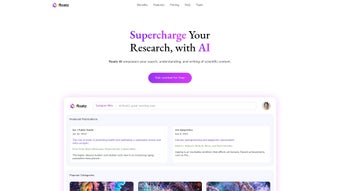
The interface is intentionally minimalist: a vertical navigation panel on the left, a central workspace that dynamically switches between PDF view and chat, and a right sidebar for library management. Keyboard shortcuts such as Ctrl+Shift+F for full‑screen PDF view and Ctrl+Enter for submitting queries accelerate repetitive tasks. Because everything is cloud‑based, you can resume work on any device simply by logging in, with no local configuration required.
Pros & Cons, Frequently Asked Questions & Final Verdict
Pros and Cons – A Balanced Assessment
- Pros
- AI answers are always backed by peer‑reviewed citations, reducing the risk of misinformation.
- One‑click citation export saves hours during manuscript preparation.
- Cross‑platform compatibility eliminates the need for OS‑specific installations.
- Secure cloud sync with optional 2FA protects sensitive research data.
- Monthly model updates keep the knowledge base current with the latest publications.
- Collaboration features streamline teamwork across institutions.
- Web‑based architecture ensures low maintenance and automatic updates.
- Cons
- Subscription cost may be a barrier for students without institutional support.
- Performance depends on internet bandwidth; slower connections can cause noticeable latency.
- Advanced enterprise deployment requires additional IT resources and configuration.
- Occasional inaccuracies in AI‑generated summaries—critical data should always be verified.
- Limited offline functionality; the AI engine requires an active internet connection.
Frequently Asked Questions
Is floatz free to use?
floatz offers a 7‑day free trial with full feature access. After the trial you must select a paid subscription (monthly or annual) to keep using the AI chat and cloud sync. A limited “viewer” mode remains free, allowing PDF reading without AI assistance.
Can I export my library to reference managers like Zotero or Mendeley?
Yes. floatz lets you export selected entries as BibTeX files, which can be imported directly into Zotero, Mendeley, EndNote, or any other manager that supports BibTeX.
How does floatz ensure the scientific accuracy of AI answers?
The AI model is trained on a curated corpus of peer‑reviewed articles from major databases. Every answer includes citation links, allowing you to verify the source instantly. The system also flags statements that lack strong evidence.
Is my data safe when I upload PDFs?
All uploads are encrypted in transit (TLS 1.3) and at rest (AES‑256). You can enable two‑factor authentication, and floatz complies with GDPR, HIPAA, and other relevant data‑privacy regulations.
Can I use floatz offline?
The AI services require an internet connection. However, previously downloaded PDFs remain accessible for reading and manual annotation offline; AI chat functions will resume once you reconnect.
Conclusion – Should You Download floatz?
floatz represents a significant leap forward in how researchers interact with the ever‑growing body of scientific literature. By turning passive PDFs into interactive conversations, it reduces the time spent searching for information, drafting summaries, and formatting citations. Its web‑based, cross‑platform nature, coupled with robust security and collaboration tools, makes it especially appealing for multi‑institution projects and remote teams.
If you are a student or early‑career researcher, the 7‑day free trial provides a risk‑free opportunity to experience the Smart Research Chat and AI PDF Reader. For established labs or institutions, the enterprise deployment option offers the same AI capabilities while keeping data behind your own firewall.
Overall, the productivity gains, citation accuracy, and seamless organization outweigh the subscription cost for most serious scholars. Download floatz today to transform how you discover, understand, and cite scientific knowledge.



.png)