

Matias Gelos
CTO
12 MIN READ
AI augmented reality integrates artificial intelligence with augmented reality to create intelligent, context-aware, and immersive digital experiences. By combining edge AI, sensor fusion, and machine learning, these systems perceive and interpret the physical environment in real time, enabling applications that adapt dynamically to user intent. In 2026, AI-AR technologies will power object recognition, conversational interfaces, and workflow automation across sectors such as education, retail, and industry. Supported by open standards and ethical design, AI augmented reality will transform everyday apps into responsive companions that blend digital intelligence seamlessly with the real world.
The Convergence of AI and AR: A New Era of Everyday Apps
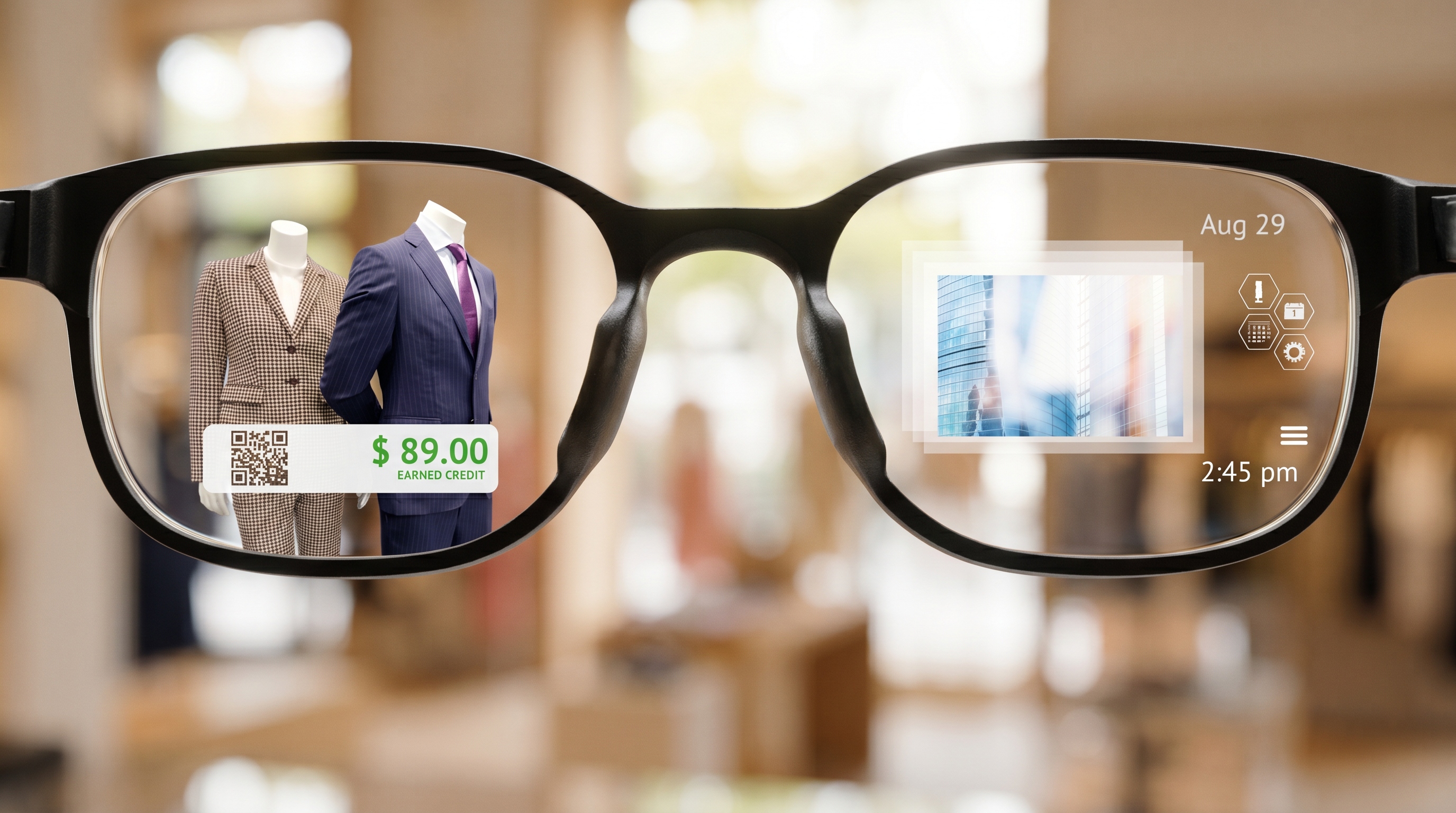
AI augmented reality combines artificial intelligence (AI) with augmented reality (AR) to create smarter, context-aware, and more immersive applications. In 2026, this integration will change how users interact with digital content, blending physical and virtual worlds through spatial computing and mixed reality interfaces. Everyday apps—from navigation to shopping—will evolve into intelligent companions that perceive, interpret, and respond to the user’s environment in real time.
The merging of AI and AR is driven by advances in edge AI, sensor fusion, and machine learning. Edge AI enables on-device processing, reducing latency and improving energy efficiency, while sensor fusion combines data from cameras, LiDAR, and motion sensors to produce accurate spatial awareness. This allows AR apps to deliver smooth real-time rendering and precise object recognition.
Platforms like Google ARCore and Apple’s ARKit provide developers with APIs for motion tracking, environmental understanding, and light estimation. When enhanced by AI, these capabilities allow apps to “see” and “understand” the world around them. Similarly, Microsoft’s documentation describes how AI and AR are merging in enterprise ecosystems through Azure Spatial Anchors and HoloLens integrations.
At Frame Sixty, our team explores this field through projects that combine AI-driven spatial computing and 3D modeling. Whether creating digital twins for industrial design or developing context-aware apps for the Apple Vision Pro, our goal is to make digital experiences more intuitive and responsive.
Key takeaway: The convergence of AI and AR in 2026 will begin a new era where apps don’t just display information—they understand context, anticipate user intent, and adapt intelligently in real time.
Smarter Vision: AI-Powered Object Recognition in AR
AI is changing object recognition in AR by enabling devices to interpret their surroundings with near-human understanding. Through large language models (LLMs) and computer vision, AR apps can identify objects, infer context, and deliver insights directly within the user’s field of view. This turns the camera from a passive sensor into an intelligent interpreter of the world.
For example, when using Apple Vision Pro or Meta Quest 3, granting camera access lets the device analyze the environment and overlay relevant information. You might look at a plant and instantly see care instructions or point at a machine part to view maintenance data. These interactions rely on 3D object tracking, semantic segmentation, and AI inference models trained on large datasets.
By integrating frameworks like Google Lens, OpenCV, and TensorFlow, developers can improve tracking accuracy and object recognition. These tools allow AR apps to process visual data efficiently, classify objects, and generate contextual overlays. On platforms like Meta Quest, this creates mixed-reality experiences where digital content aligns precisely with the physical world.
At Frame Sixty’s 3D model design services, we use these AI techniques to build detailed and responsive models that can be recognized and manipulated in AR environments. Our work in 3D modeling for manufacturing and industrial design ensures that digital assets are optimized for real-time interaction, connecting AI perception with AR visualization.
Real-Time Understanding Through Generative AI
Generative AI advances AR object recognition by not only identifying objects but also generating contextual information about them. Tools from OpenAI’s research hub and NVIDIA Omniverse let developers create digital twins—virtual versions of real-world objects that update dynamically based on sensor input.
An AR app could use a generative model to describe the history of a landmark or show how a piece of furniture looks under different lighting. NVIDIA Omniverse supports real-time rendering and collaboration, allowing multiple users to interact with the same 3D environment. These capabilities are changing industries such as architecture, retail, and education.
Smooth performance depends on balancing latency, energy efficiency, and model inference time. Edge computing helps by running AI models locally on devices like smartphones and AR headsets, reducing reliance on cloud processing. This ensures instant feedback and lowers bandwidth use.
At Frame Sixty’s AI in Virtual Reality Development division, we study how generative AI can enhance AR storytelling and simulation. By combining AI-driven scene understanding with real-time rendering, we create experiences that adapt to user behavior.
Key takeaway: Generative AI turns AR from a reactive tool into an active companion that interprets, explains, and enriches the world around you in real time.
Conversational Interfaces: Talking to Your AR Apps
Conversational AI is becoming central to AI augmented reality, allowing users to talk naturally with their AR environments. In 2026, LLM-based assistants will let users ask questions, issue commands, and receive contextual responses while immersed in AR. These interfaces will make AR apps more accessible and personalized.
Imagine wearing an Apple Vision Pro and asking, “What’s that building?” The system, powered by LLMs and computer vision, identifies the structure and provides historical details or directions. On Microsoft HoloLens, users could request assembly instructions while viewing a 3D model of machinery. These interactions combine natural language processing (NLP), context awareness, and spatial mapping to deliver relevant responses.
At Frame Sixty’s AI Developer division, we design AI-driven personalization systems that adjust conversations based on user behavior and surroundings. A retail AR app, for instance, could change its dialogue depending on whether the user is browsing clothing or electronics, offering tailored recommendations in real time.
Key takeaway: Conversational AI makes AR experiences more natural by enabling dialogue between users and their digital environments.
Workflow Automation Through Voice and Context
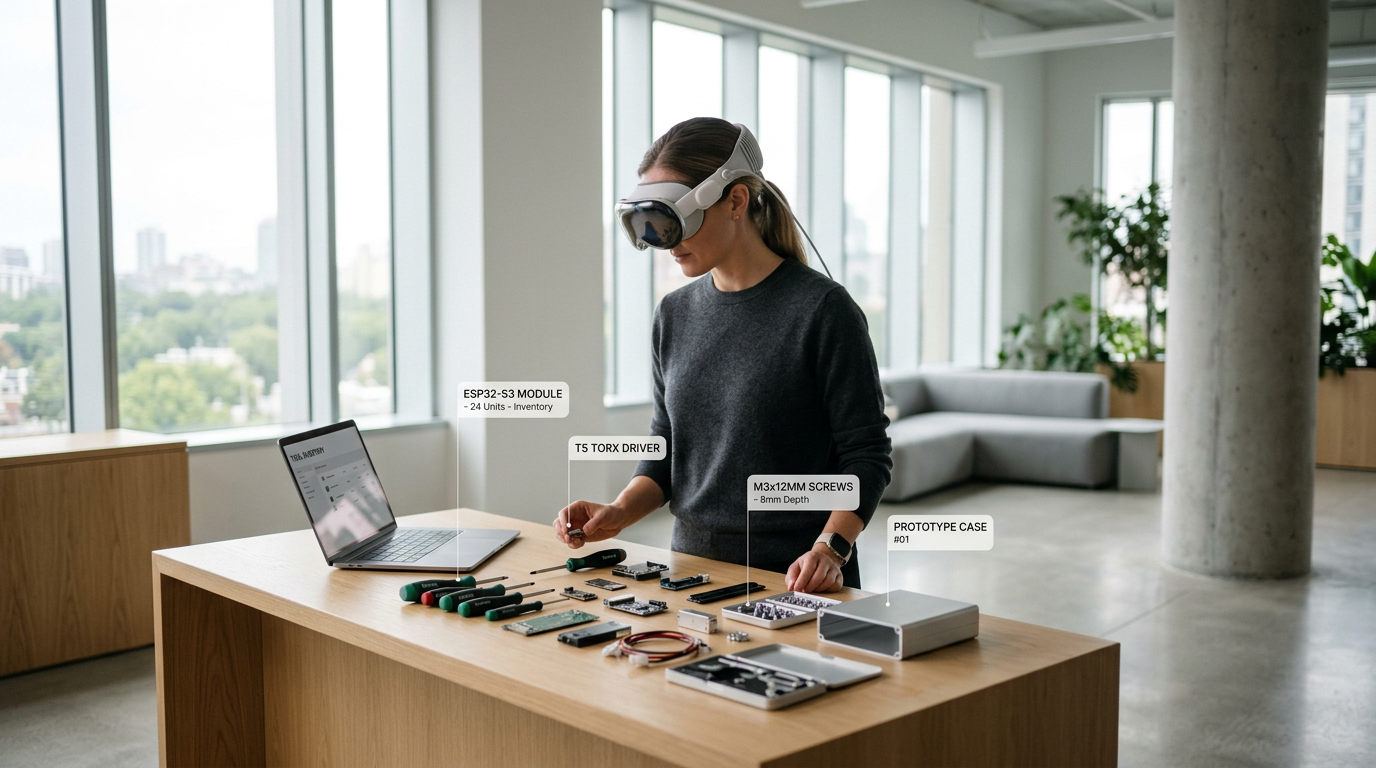
Voice-driven workflows are the next step for AI augmented reality. By combining voice recognition, contextual understanding, and workflow automation, AR apps will guide users through complex tasks. This is particularly useful in manufacturing, healthcare, and education.
Developers can integrate Amazon Web Services (AWS) and Azure Spatial Anchors to coordinate cloud-based AI models that manage these workflows. AWS AR/VR resources provide scalable infrastructure for real-time data processing, while Azure’s spatial mapping ensures accurate environmental anchoring. Together, they allow AR systems to respond dynamically to user input and environmental changes.
An engineer wearing an AR headset could say, “Show me the next step,” and the system would highlight the relevant part of a machine, overlaying instructions. The AI model could detect errors through computer vision and suggest corrections. These capabilities are already being tested in enterprise tools built on Microsoft’s developer ecosystem.
At Frame Sixty’s agentic spatial computing lab, we’re developing prototypes that combine voice interaction with spatial awareness. By mapping user intent to contextual triggers, we create AR workflows that adapt to user needs—whether guiding a training session or assisting in real-time troubleshooting.
Key takeaway: Voice and context-based automation will reshape productivity in AR, turning everyday interactions into intelligent, hands-free experiences.
Transforming Everyday Use Cases
The combination of AI and AR is more than a technical milestone—it’s a practical change. Everyday apps in retail, education, and workplace collaboration are being redesigned through AI-driven personalization, gesture recognition, and real-time rendering. Here’s how these innovations will affect daily life in 2026.
AR Shopping and Retail Experiences
AI-enhanced AR is changing how consumers shop by combining digital convenience with physical engagement. Through gesture recognition and context-aware recommendations, users can visualize products in their space before buying. This reduces uncertainty and increases conversion rates.
Platforms like Snap AR and Niantic Lightship are creating immersive retail experiences where users can virtually try on products or explore interactive store layouts. Pointing your phone at a pair of shoes could trigger an AI overlay showing available sizes, colors, and sustainability details. The AI model learns from user preferences to refine recommendations over time.
Retailers are also adding AI chat models to AR apps, allowing users to ask questions like “Does this come in leather?” or “What’s the price difference between these two models?” The system responds instantly, combining conversational AI with visual context.
At Frame Sixty’s Android App Development Agency, we’ve seen growing demand for AR shopping solutions that use AI-driven personalization. By combining 3D modeling, computer vision, and recommendation algorithms, we help brands create engaging, data-driven retail experiences.
Key takeaway: AI-powered AR shopping will make retail more interactive and efficient, connecting online and in-store experiences.
Education and Training
Education is one of the most promising areas for AI augmented reality. By merging AI-driven content generation with immersive AR environments, learning becomes interactive and adaptive. Students can explore 3D models, conduct virtual experiments, and receive real-time feedback guided by intelligent systems.
Platforms like Unity MARS, Unreal Engine, and Adobe Aero let educators design immersive simulations. A biology student might examine a 3D model of the human heart that responds to voice commands, while an AI assistant explains each part. Metrics such as user engagement, session duration, and learning outcomes can be tracked to personalize instruction.
Generative AI also supports dynamic content creation. Instead of static lessons, AI can generate new scenarios based on student performance, ensuring each learner gets a customized experience.
At Frame Sixty’s AI in Virtual Reality Development division, we build AR training modules for industrial and medical applications. These systems use computer vision to monitor user actions and provide real-time corrections, improving skill acquisition and safety compliance.
Key takeaway: AI-driven AR education turns learning into an interactive, adaptive process where students engage with content in measurable ways.
Workplace Collaboration and Productivity
The workplace of 2026 will rely on AI and AR collaboration tools that connect physical and digital workflows. Through digital twins, mixed reality, and real-time rendering, teams can visualize projects, simulate outcomes, and collaborate across locations as if they were together.
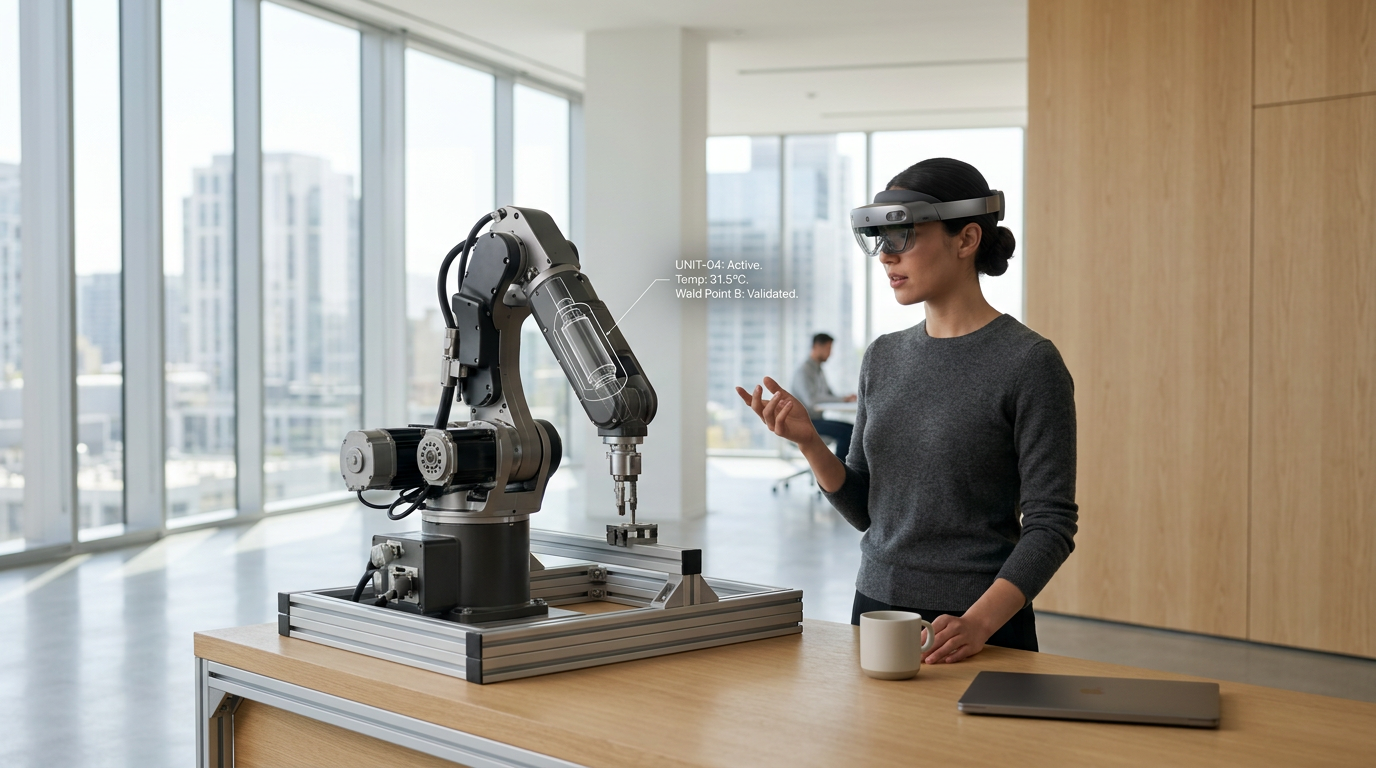
Tools like Microsoft HoloLens, AWS Sumerian, and NVIDIA Omniverse are leading this shift. Engineers can manipulate 3D models in real time, architects can guide clients through virtual buildings, and remote teams can co-edit designs using shared spatial anchors. AI ensures synchronization, context awareness, and predictive insights.
An AI model could analyze a team’s workflow and suggest improvements or detect design conflicts in a 3D model before they occur. These capabilities reduce errors, save time, and enhance creativity.
At Frame Sixty, we help organizations adopt AI-AR collaboration tools that integrate with existing workflows. From industrial design visualization to remote maintenance support, our solutions help teams work more efficiently.
Key takeaway: AI and AR are redefining workplace collaboration by enabling real-time, spatially aware teamwork that overcomes physical distance.
Need help with AI-AR app development?
Frame Sixty is a full-service digital innovation studio specialising in AR/VR, mobile, and web development.
Building the Future: Standards and Developer Ecosystem
The future of AI augmented reality depends on strong standards and developer ecosystems that ensure interoperability, performance, and scalability. Frameworks like WebXR, OpenXR, USDZ, and glTF enable cross-platform AR experiences that run smoothly across devices and systems.
Organizations such as the W3C Immersive Web Working Group and IEEE are developing standards like ISO/IEC 23093 and IEEE P2048 to define best practices for immersive media and AI integration. These standards help keep AR experiences consistent, secure, and accessible.
Developers use tools like ARKit, ARCore, Vuforia, Reality Composer, and Spark AR Studio to build intelligent AR applications. These platforms provide APIs for motion tracking, lighting estimation, and 3D object tracking, which can be enhanced with AI models for object recognition and contextual reasoning.
Cloud providers like AWS and Microsoft Azure are expanding their AR/AI toolkits, offering infrastructure for real-time rendering and data synchronization. McKinsey’s research reports that companies adopting AI-AR ecosystems see up to 40% productivity gains in design and collaboration workflows.
At Frame Sixty’s About Us page, you can learn how we contribute to this growing ecosystem by developing AI-AR prototypes that meet global standards and deliver high performance. We also explore agentic spatial computing to design adaptive environments that respond intelligently to user behavior.
Key takeaway: The growth of AI-AR applications depends on open standards, capable developer tools, and collaborative ecosystems that support innovation and interoperability.
Ethical and Privacy Considerations
As AI augmented reality becomes more common, ethical and privacy concerns must be addressed. Managing camera access, user consent, and data security is essential to maintaining trust in immersive technologies. AR devices constantly capture visual and spatial data, which could reveal personal information if not handled properly.
Developers should use transparent consent mechanisms that inform users when data is collected and how it’s used. This includes managing permissions for camera, microphone, and location access. AI models should process data locally whenever possible to minimize exposure to external servers.
Privacy challenges also arise in context-aware and location-based interactions. For example, an AR navigation app that recognizes nearby landmarks must ensure it doesn’t record private property or personal identifiers. Following ethical guidelines from organizations like IEEE helps developers align with global standards for responsible AI.
At Frame Sixty, we emphasize ethical AI design in all our AR and spatial computing projects. Our practices focus on transparency, user control, and data minimization. By combining edge AI processing with secure cloud infrastructure, we help clients build immersive experiences that respect privacy while advancing innovation.
Key takeaway: Responsible design supports sustainable AI-AR innovation by balancing technological progress with user trust and ethical standards.

Conclusion
The combination of AI and augmented reality will redefine how we interact with technology in 2026 and beyond. From object recognition and conversational interfaces to AI-driven personalization and digital twins, the potential applications are extensive. Everyday apps will evolve into intelligent companions that understand context, anticipate needs, and respond naturally to human behavior.
As standards mature and platforms like ARKit, ARCore, and NVIDIA Omniverse advance, developers will gain powerful tools to create immersive, context-aware experiences. Success will depend on balancing innovation with ethical responsibility, ensuring that privacy, transparency, and inclusivity remain central to design.
At Frame Sixty, we’re focused on building the future of AI-AR applications—from concept to deployment. Whether you’re exploring 3D modeling, spatial computing, or AI-driven AR development, our team can help bring your ideas to life. Ready to create the next generation of intelligent, immersive experiences? Get in touch with our experts at Frame Sixty today.
Key takeaway: The next wave of app innovation will be defined by AI-AR synergy, where intelligence and immersion combine to change how we live, learn, and work.
AI Augmented Reality: Transforming Everyday Apps in 2026
This FAQ explores how AI and augmented reality (AR) will merge to reshape everyday applications by 2026. From smarter object recognition to conversational interfaces and ethical design, discover how AI-AR synergy will redefine digital experiences.
What does “AI augmented reality” mean?
AI augmented reality refers to the integration of artificial intelligence with augmented reality to create intelligent, context-aware, and immersive digital experiences.
How will AI and AR change everyday apps in 2026?
They will make apps smarter and more responsive, allowing them to perceive environments, understand context, and adapt in real time to user needs.
Which industries will benefit most from AI-AR integration?
Retail, education, healthcare, manufacturing, and workplace collaboration will see major transformations through AI-AR applications.
What is spatial computing in the context of AI-AR?
Spatial computing enables digital systems to understand and interact with physical space, forming the foundation for realistic AR experiences.
How does AI improve AR experiences?
AI enhances AR by improving object recognition, personalization, and real-time decision-making, making interactions more intuitive and efficient.
Will AI-AR apps replace traditional mobile apps?
Not entirely, but they will evolve them into intelligent companions that blend digital and physical interactions seamlessly.
What are some examples of AI-AR devices?
Devices like Apple Vision Pro, Microsoft HoloLens, and Meta Quest 3 are leading examples of hardware supporting AI-AR applications.
Why is 2026 considered a turning point for AI-AR?
By 2026, advances in edge AI, generative models, and AR hardware will converge, enabling widespread adoption of intelligent, immersive apps.
What role does edge AI play in AR applications?
Edge AI allows data processing directly on devices, reducing latency and improving energy efficiency for real-time AR performance.
How does sensor fusion enhance AR accuracy?
Sensor fusion combines data from cameras, LiDAR, and motion sensors to create precise spatial awareness and smoother rendering.
What is real-time rendering in AI-AR systems?
Real-time rendering involves generating visuals instantly as users move or interact, ensuring seamless integration of digital and physical content.
How do AI models recognize objects in AR?
They use computer vision and machine learning algorithms trained on large datasets to identify and classify objects in real-world environments.
What frameworks support AI-AR development?
Popular frameworks include ARKit, ARCore, Vuforia, TensorFlow, and NVIDIA Omniverse for building intelligent AR experiences.
How does generative AI contribute to AR?
Generative AI creates contextual content, such as digital twins or dynamic overlays, that adapt to user interactions in real time.
What are digital twins in AI-AR?
Digital twins are virtual replicas of real-world objects that update dynamically using sensor data and AI-driven modeling.
How is latency managed in AI-AR systems?
Latency is minimized through edge computing, optimized inference models, and efficient data synchronization between devices and the cloud.
How can developers start building AI-AR apps?
Developers can use platforms like ARKit, ARCore, and Unity MARS, integrating AI models for perception, tracking, and personalization.
What are the main challenges in implementing AI-AR?
Key challenges include managing data privacy, ensuring real-time performance, and maintaining cross-platform compatibility.
How can AI-AR be used in retail?
In retail, AI-AR enables virtual try-ons, product visualization, and personalized recommendations based on user preferences and context.
What role does AI play in AR education tools?
AI personalizes learning by analyzing student performance and generating adaptive AR content for interactive education.
How is AI-AR improving workplace collaboration?
AI-AR tools allow teams to interact with shared 3D models, simulate designs, and collaborate remotely through spatial computing.
What ethical concerns arise with AI-AR?
Concerns include data privacy, user consent, and responsible use of visual and spatial data captured by AR devices.
How can developers ensure privacy in AI-AR apps?
By processing data locally, using transparent consent mechanisms, and following global ethical standards for AI design.
What standards support AI-AR interoperability?
Standards like OpenXR, WebXR, USDZ, and glTF ensure consistent performance and compatibility across devices and platforms.
