
Download Git2Log – Efficient AI‑Powered Changelog Generator for Windows, Mac, Android & iOS
Overview – Why Git2Log Is a Game‑Changer for Developers
In modern software development, clear communication about what has changed between releases is not a luxury; it is a necessity. Git2Log tackles this challenge head‑on by turning raw git commit data into polished, human‑readable changelogs with the help of artificial intelligence. The web‑based application lives within the ProductLift suite, meaning it not only creates changelogs but also integrates smoothly with feedback collection, road‑mapping, and knowledge‑base tools. This synergy reduces the friction developers often feel when they must manually curate release notes, allowing teams to focus on building features rather than formatting text. Git2Log’s intuitive UI lets you paste a repository URL, select a date range, and instantly receive a structured changelog that includes categorised sections, ticket links, and concise summaries. Because it runs in the browser, there is no need for local installation, and the service is secured with HTTPS encryption, ensuring your commit history stays private. Whether you are a solo coder releasing a small library or part of an enterprise‑scale team delivering multiple micro‑services, Git2Log provides a reliable, repeatable process for documenting change. Its AI engine analyses commit messages, identifies patterns, and groups related changes, delivering a professional‑looking document that can be exported to Markdown, HTML, or PDF. In short, Git2Log streamlines version control documentation, improves stakeholder transparency, and saves countless hours that would otherwise be spent on manual editing.
Core Features – What Sets Git2Log Apart
- AI‑Enhanced Summarisation: Natural‑language processing evaluates commit messages and generates concise, readable summaries.
- Multi‑Format Export: Export changelogs to Markdown, HTML, PDF, or plain text with a single click.
- Customisable Templates: Choose from pre‑built templates or design your own layout to match corporate branding.
- Issue & Pull‑Request Linking: Automatic detection of issue IDs and PR numbers, inserting clickable links to your tracker.
- Version Range Selection: Define start and end tags, dates, or commit hashes to narrow the scope of the generated log.
- Collaboration Hub: Share generated changelogs with teammates, collect comments, and approve before publishing.
- Integration with ProductLift: Seamlessly push changelogs to road‑maps, release notes pages, and knowledge bases.
- Secure Cloud Processing: All data is encrypted in transit and at rest; no local files are stored without user consent.
- Cross‑Platform Compatibility: Works on any modern browser across Windows, macOS, Linux, Android, and iOS devices.
- Free Tier & Affordable Upgrades: Generate up to 5 changelogs per month at no cost; premium plans unlock unlimited usage and advanced AI models.
Each feature has been crafted with the everyday developer in mind. The AI summarisation, for example, reduces the noise that often accompanies commit histories—developers can now focus on the “what” and “why” rather than parsing cryptic messages. Customisable templates mean you can align the look of your changelog with existing documentation standards, preserving visual consistency across your product ecosystem. The integration with issue trackers eliminates the manual step of copying ticket numbers, while the collaboration hub ensures that product managers and QA leads can review and comment on the changelog before it goes live. Whether you need a quick one‑off release note or a repeatable pipeline for continuous delivery, Git2Log’s feature set adapts to both scenarios, delivering a secure, fast, and polished output every time.
Installation & Usage – Getting Started in Minutes
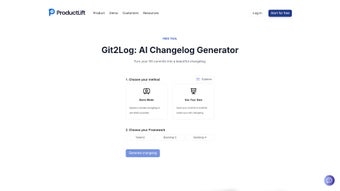
Because Git2Log is a web application, the installation process is virtually non‑existent. To begin, navigate to git2log.productlift.com using any up‑to‑date browser (Chrome, Firefox, Safari, Edge). The first screen prompts you to create a free account or sign in with Google, GitHub, or Microsoft credentials—this single sign‑on step keeps your workflow smooth and secure. Once logged in, click the “New Changelog” button. You will be asked to provide the repository URL (public or private, with a personal access token if needed), select the branch, and specify the range of commits you wish to include. Git2Log automatically fetches the commit history via the GitHub, GitLab, or Bitbucket API, so no manual cloning is required.
After the data is loaded, the AI engine begins analysing each commit. Within seconds, you’ll see a preview pane displaying a structured changelog: headings for “Features,” “Bug Fixes,” “Performance Improvements,” and optional “Breaking Changes.” Each entry includes a short description, the author’s name, and a link to the original commit or issue. If the automatically generated text needs tweaking, inline editing tools let you adjust wording, reorder sections, or add custom notes without leaving the page. When you’re satisfied, choose an export format from the toolbar—Markdown is ideal for GitHub releases, while PDF works well for stakeholder presentations.
For teams that require automation, Git2Log offers a RESTful API and webhook support. By configuring a webhook on your repository, every push can trigger a new changelog generation, which is then stored in a designated folder or posted directly to Slack, Microsoft Teams, or your CI/CD pipeline. Documentation for the API is available in the “Developers” tab, complete with example curl commands and authentication details. In short, whether you prefer a manual click‑through UI or fully automated pipelines, Git2Log adapts to your preferred workflow, making the process of creating accurate, visually appealing changelogs both fast and repeatable.
Compatibility, Pros & Cons, FAQ & Final Thoughts
Git2Log runs entirely in the browser, meaning it is compatible with Windows 10/11, macOS Ventura and later, Linux distributions with a modern desktop environment, as well as mobile platforms such as Android 9+ and iOS 13+. The service supports all major git hosting providers—GitHub, GitLab, Bitbucket, and Azure DevOps—through their public APIs. No additional plugins or extensions are required, and the site adheres to WCAG 2.1 accessibility standards, ensuring a smooth experience for developers with diverse needs.
Pros
- AI‑driven summarisation saves time and reduces manual editing.
- Zero‑install, browser‑based interface works on any device.
- Secure handling of private repositories with encrypted tokens.
- Rich export options (Markdown, HTML, PDF) suit many workflows.
- Free tier available; premium plans are competitively priced.
- Deep integration with ProductLift tools for road‑mapping and documentation.
Cons
- Reliance on internet connection; offline usage is not supported.
- AI summarisation quality depends on the clarity of original commit messages.
- Advanced template customisation requires basic HTML/CSS knowledge.
- Free tier limits to five changelogs per month, which may be restrictive for very active projects.
Frequently Asked Questions
Is Git2Log safe to use with private repositories?
Yes. Git2Log encrypts your personal access tokens and never stores commit data on its servers longer than necessary for processing. All communication occurs over HTTPS, and you can revoke tokens at any time from your git host.
Can I automate changelog generation in my CI/CD pipeline?
Absolutely. Git2Log provides a REST API and webhook triggers that can be called from Jenkins, GitHub Actions, GitLab CI, or Azure Pipelines to generate and publish changelogs automatically after each successful build.
What export formats are supported?
Markdown, HTML, PDF, and plain‑text are available out‑of‑the‑box. You can also copy the raw JSON payload if you need a custom integration.
Does Git2Log work on mobile devices?
Yes. The responsive UI adapts to smartphones and tablets, allowing you to generate, edit, and export changelogs on the go.
How is the free tier priced compared to competitors?
Git2Log offers five free changelog generations per month with no hidden fees. Premium plans start at $9.99 USD per month, which is lower than many comparable AI‑driven documentation tools that charge per user or per generation.
Conclusion – Ready to Streamline Your Release Process?
If you’re looking for a fast, secure, and AI‑enhanced way to keep your stakeholders informed, Git2Log delivers exactly that. Its browser‑based design eliminates the need for complex installations, while the powerful summarisation engine turns chaotic commit logs into clean, publish‑ready documents. By integrating with the broader ProductLift ecosystem, it also helps you tie changelogs directly to road‑maps and knowledge bases, creating a single source of truth for product evolution. Whether you’re a solo developer, a startup, or an enterprise team, the free tier provides enough capacity to test the waters, and the affordable premium plans scale with your needs. Click the button below to create your account, generate your first changelog, and experience the time‑saving benefits of AI‑driven documentation today.
Git2Log impresses with its blend of AI convenience and developer‑centric controls. The UI feels modern, the export options are comprehensive, and the integration with ProductLift makes it a hub for release communication. While offline use is not possible and the free tier has modest limits, the overall value proposition outweighs these minor drawbacks. It is a solid addition to any development workflow that values clarity and efficiency.



.png)