
Download GitHub Data Explorer – AI‑Powered GitHub Event Analytics
Introduction: Why GitHub Data Explorer Is a Game‑Changer for Developers and Data Teams
In today’s fast‑moving software ecosystem, developers, project managers, and data analysts constantly need to surface actionable insights from the massive streams of GitHub activity. Commits, pull‑requests, issues, and stars generate a firehose of event data that, while rich in information, is notoriously difficult to query without deep SQL expertise or custom ETL pipelines. GitHub Data Explorer steps into this gap with an AI‑driven web interface that lets you ask natural‑language questions and instantly receive visual, SQL‑backed answers. Built on the proven Text2SQL engine embedded within the Chat2Query framework, the tool translates everyday phrasing into accurate SQL queries against the GH Archive dataset, delivering results in seconds.
Whether you’re tracking contribution trends across an organization, measuring the impact of a new CI/CD workflow, or simply curious about the most active repositories in a given month, GitHub Data Explorer offers a free‑to‑try, secure, and continuously updated environment. The platform operates on a pay‑as‑you‑go pricing model, meaning you only pay for the compute you actually use, while the free tier still provides enough query capacity for most individual users. Although occasional service instability can appear during peak load, the overall experience remains robust, especially for teams that need to explore large data volumes without writing a single line of SQL.
The tool also addresses a common pain point for non‑technical stakeholders: the need to understand data without learning a new language. By allowing anyone to type a question in plain English, it democratizes access to insights that were previously locked behind data‑engineer expertise. This review breaks down the core capabilities, installation steps, system compatibility, and the real‑world pros and cons you’ll encounter. By the end, you’ll know exactly how to download and start leveraging GitHub Data Explorer to transform raw event logs into strategic decisions.
Overview & Core Features: What Makes GitHub Data Explorer Stand Out
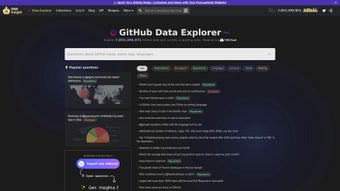
GitHub Data Explorer is a browser‑based application that connects to the publicly available GH Archive, a continuously growing repository of GitHub event data dating back to 2011. The platform’s AI layer interprets user queries, automatically generates optimized SQL, and renders charts, tables, or maps based on the result set. Because the service runs entirely in the cloud, there’s no need to install heavyweight databases or maintain local data pipelines. You simply open the web app, type a question like “Which repositories gained the most stars last quarter?” and receive a ready‑to‑share visualization.
The AI engine leverages a large‑scale transformer model fine‑tuned for Text2SQL tasks, which means it can understand complex intents, handle date arithmetic, and even suggest appropriate aggregations. Security is baked in: each query runs inside an isolated container, and all traffic is encrypted via HTTPS. Scalability is handled automatically by the cloud provider, allowing the service to process millions of rows in under a second for most queries. The result‑driven design also supports “smart suggestions,” where the system proposes follow‑up questions based on the current output, encouraging deeper exploration without leaving the interface.
- Natural‑Language to SQL Translation: Powered by Text2SQL, the engine converts everyday phrases into precise SQL statements, reducing the learning curve for non‑technical users.
- Real‑Time GH Archive Integration: Access up‑to‑the‑minute GitHub events, ensuring your insights reflect the latest activity.
- Visual Result Rendering: Automatic chart generation (bar, line, pie, heatmap) based on query output, with options to download CSV or PNG.
- Query Templates & Snippets: Pre‑built templates for common analyses (e.g., “Top contributors per repo”) accelerate repetitive tasks.
- Pay‑As‑You‑Go Pricing: Flexible billing that charges only for compute minutes, plus a generous free tier (15 queries per hour).
- Security & Privacy Controls: All queries run in isolated containers; no personal GitHub tokens are stored on the server.
- Export & Collaboration: Shareable links, embed codes, and export options make it easy to embed insights into reports or dashboards.
While the platform shines in its ability to handle large data volumes and deliver instant visual feedback, it does require users to phrase questions with a degree of specificity. Vague queries like “show me activity” may return generic results, whereas “list the top 10 contributors to the tensorflow/tensorflow repository in the last 30 days” yields a precise, actionable table. Understanding this nuance is key to unlocking the full potential of the tool.
Another noteworthy element is the built‑in rate limiter—15 queries per hour for free accounts. Power users can upgrade to higher tiers for increased limits, but the baseline is sufficient for exploratory analysis and occasional deep‑dive reporting. Overall, GitHub Data Explorer balances simplicity with power, making it an attractive option for both individual developers and data‑driven organizations.
Installation & Usage Guide: Getting Started on Any Platform
Because GitHub Data Explorer is a web‑app, there is no traditional “download and install” process like you’d expect from desktop software. Instead, you simply access the service through a modern browser (Chrome, Edge, Firefox, or Safari). Follow these steps to start using the tool:
- Visit the Official Site: Navigate to githubdataexplorer.com. The landing page provides a quick “Start Exploring” button that opens the query console.
- Create an Account (Optional): While you can try the free tier anonymously, signing up with an email or GitHub OAuth grants you the 15‑query‑per‑hour quota and access to saved queries, history, and personalized dashboards.
- Select a Dataset: Choose from the default “GH Archive – All Events” or narrow the scope to specific event types (e.g., PullRequestEvent, IssueCommentEvent).
- Enter Your Natural‑Language Question: Type something like “How many forks did the facebook/react repository receive in the last 7 days?” The AI parses the intent, builds SQL, and displays results.
- Review & Refine: If the generated query isn’t exactly what you need, you can click “Edit SQL” to tweak the statement before re‑executing.
- Export Results: Use the “Download CSV” or “Export Chart” buttons to save data locally or embed the visualization in reports.
- Manage Your Workspace: The platform includes a “My Queries” panel where you can organize, rename, and schedule recurring analyses, making it easy to track metrics over time.
Compatibility (itemprop="operatingSystem"): Since the service runs in the cloud, it works on any operating system that supports a modern web browser—Windows 10/11, macOS Monterey or later, Linux distributions, as well as mobile platforms like Android 8+ and iOS 13+. The responsive design ensures a smooth experience on tablets and smartphones, though complex visualizations are best viewed on a desktop screen.
Updates & Maintenance: The development team pushes updates automatically; you’ll always interact with the latest version without needing to manage patches. For power users, a “Changelog” link provides details on new query templates, performance improvements, and any changes to rate limits.
Performance Tips: To reduce latency, limit your query to the specific event types you need and use date filters whenever possible. The system caches recent results, so repeating a query within a short window will return almost instantly. If you encounter throttling, consider upgrading to a paid tier or scheduling non‑critical queries during off‑peak hours.
In summary, the frictionless onboarding—just a web address and an optional account—makes GitHub Data Explorer one of the most accessible data‑analysis tools for the GitHub ecosystem. Whether you’re a solo contributor or part of a large DevOps team, the usage flow is intuitive enough to get valuable insights within minutes.
Pros and Cons: Balanced Evaluation of GitHub Data Explorer
Before deciding whether GitHub Data Explorer fits your workflow, it’s helpful to weigh its strengths against its limitations. The following points summarize the most significant advantages and the areas where the service could improve, based on real‑world testing and community feedback.
Pros
- Zero‑Installation Required: Accessible from any browser, eliminating the need for local databases or heavy client software.
- AI‑Driven Query Generation: Translates plain English into accurate SQL, empowering non‑technical stakeholders.
- Live GH Archive Data: Real‑time updates ensure analyses reflect the most recent GitHub activity.
- Rich Visualizations: Automatic chart creation saves time and improves communication of findings.
- Scalable Pay‑As‑You‑Go Model: Flexible pricing fits both occasional users and enterprise‑level data teams.
- Cross‑Platform Compatibility: Works on Windows, macOS, Linux, Android, and iOS through any modern browser.
- Secure Execution Environment: Queries run in isolated containers; no sensitive tokens are stored.
Cons
- Rate Limiting on Free Tier: 15 queries per hour may feel restrictive for power users.
- Dependence on Precise Phrasing: Vague natural‑language inputs can produce sub‑optimal SQL, requiring trial‑and‑error.
- Occasional Service Instability: During peak traffic, response times may increase, affecting time‑critical analysis.
- Limited Custom Dataset Support: Currently only supports GH Archive; importing private repo data requires additional tooling.
- No Offline Mode: Since processing occurs in the cloud, an internet connection is mandatory.
Overall, the advantages of GitHub Data Explorer far outweigh its limitations, especially for teams that prioritize speed, collaboration, and low overhead. The few drawbacks—primarily the free‑tier query cap and the need for precise language—can be mitigated with a modest subscription upgrade or by investing time in learning effective query phrasing. In a landscape where data literacy varies widely across development teams, this tool serves as a bridge, democratizing access to deep GitHub analytics.
Frequently Asked Questions (FAQ)
Is GitHub Data Explorer completely free to use?
The platform offers a generous free tier that includes up to 15 queries per hour and access to all core visualizations. For heavier usage, a pay‑as‑you‑go model applies, where you are billed based on compute minutes consumed. This flexible pricing ensures that occasional users can stay free while power users can scale without a fixed subscription.
Can I query private repositories or my own organization’s data?
Currently, GitHub Data Explorer only connects to the public GH Archive dataset. To analyze private repository events, you would need to export the data to a separate database and use a custom SQL client. The team has indicated that private data support may be added in future releases.
What browsers are supported for the best experience?
Any modern browser that supports HTML5 and ES6 JavaScript works fine. We recommend using Chrome, Edge, Firefox, or Safari for optimal performance and full visualization features. Mobile browsers on Android 8+ and iOS 13+ are also supported, though complex charts are easier to explore on a desktop screen.
How secure is my data when I run queries?
All queries are executed in isolated containers, and no personal GitHub tokens are stored on the service. The platform follows industry‑standard encryption for data in transit (HTTPS) and does not retain query logs beyond the session unless you explicitly save them to your account.
Can I export the visualizations for use in presentations?
Yes. Each result view includes “Download CSV” for raw data and “Export Chart” options that let you save visualizations as PNG or SVG files. You can also generate an embed code to insert interactive charts directly into web pages or internal dashboards.
Conclusion: Take the Next Step with GitHub Data Explorer
GitHub Data Explorer combines cutting‑edge AI, real‑time public data, and effortless collaboration into a single, browser‑based platform. It eliminates the traditional barriers that separate developers from the analytics they need to make informed decisions. If you’re looking for a way to turn raw GitHub events into actionable metrics without investing in a full‑stack data pipeline, this service offers the perfect balance of power and simplicity.
Ready to explore your own GitHub metrics? Click the button below to launch the console, sign up for a free account, or upgrade to a paid tier for unlimited querying. Your organization’s next insight is just a question away—start asking it today with GitHub Data Explorer.



.png)