Turn any documentation URL or Google Drive file into a personalized, bite-sized learning course — powered by AI and a live knowledge graph.
Docuer is a full-stack Next.js application that eliminates the "reading docs is a slog" problem. Point it at any documentation site or Google Drive document, and it automatically:
- Crawls and caches the content
- Extracts a topic hierarchy with Gemini 2.0 Flash
- Generates ≤160-word articles tailored to your experience level and goals
- Persists the relationships in Neo4j as a navigable knowledge graph
- Sequences the articles into a personalized learning path with prerequisite enforcement
The result is a TikTok-style swipeable reader backed by a real graph database — not just a reformatted docs page.
Watch the demo on YouTube | Devpost submission
Logo: public/images/logo.png
- Graph-native learning paths — Neo4j stores topic/article nodes with
PREREQUISITE,RELATED_TO, andCOMPLETEDedges; learning paths are generated via weighted Cypher queries (35% difficulty match, 25% interest alignment, 25% goal alignment, 15% importance) and topological sort. - Intelligent deduplication — Documentation is hashed on the source URL and stored once in Supermemory; every user who creates a course from the same URL reuses the cached content, eliminating redundant API calls.
- Two-phase selective crawling — In advanced mode, Firecrawl maps the site, Gemini scores each page against the user's profile, and the user cherry-picks before the full crawl begins — saving time and API budget on large documentation sites.
- Personalization at every layer — A 5-step onboarding captures experience level, learning goals, interests, and time commitment; Gemini uses this profile when generating articles, selecting learning path nodes, and pre-filtering pages.
- Auto-wired knowledge graph — Gemini produces semantic relationships (prerequisites, related topics, importance scores); dangling nodes are automatically connected so the graph is always fully traversable.
- Built-in rate-limit management — A sliding-window queue enforces ≤9 Gemini requests/minute with automatic back-pressure, preventing 429 errors during bulk article generation.
| Use Case | User | Outcome |
|---|---|---|
| Learn a new framework fast | Developer onboarding a new stack | Personalized course from official docs in minutes |
| Turn internal docs into training | Team lead or educator | Bite-sized lessons from Google Drive documents |
| Structured self-study | Student or career-changer | Prerequisite-ordered learning path with quizzes |
| Explore an unfamiliar codebase | Engineer reading architecture docs | Knowledge graph shows topic relationships visually |
- Simple mode — Enter a URL, Firecrawl crawls all pages automatically
- Advanced mode — Two-phase crawl: AI pre-selects relevant pages per your profile; you confirm before processing
- Google Drive import — OAuth connection; browse, select, and import documents directly
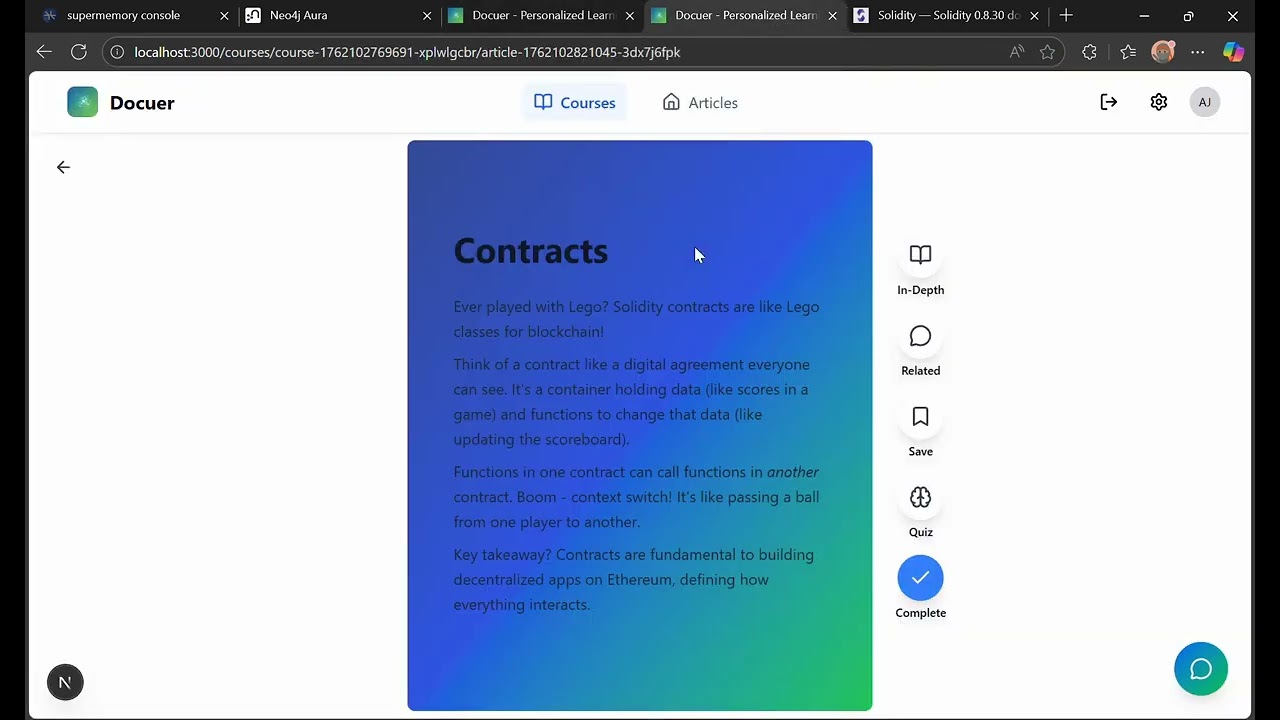
- Swipeable article reader (≤160 words per card, ~45-second reads)
- Auto-generated quizzes — 3 questions per article at easy / medium / hard difficulty with explanations
- AI chatbot for in-context questions and concept clarification
- Prerequisite locking — articles unlock only after dependencies are completed
- Interactive force-directed graph (react-force-graph-2d)
- Color-coded nodes by difficulty and completion state
- Fullscreen exploration mode
- Clickable nodes navigate directly to the article
- Completion percentage, learning streaks, quiz scores
- Behavioral tracking (views, completions, time spent) stored in Supermemory
- Preferred topic and struggle area detection
| Layer | Technology | Purpose |
|---|---|---|
| Framework | Next.js 16 (App Router) | Full-stack routing and API routes |
| UI | React 19 + HeroUI + Tailwind CSS 4 | Component library and styling |
| Animation | Framer Motion | Page transitions and micro-interactions |
| State | Zustand 5 (localStorage persistence) | Client-side course and user state |
| Graph visualization | react-force-graph-2d | Interactive knowledge graph rendering |
| Markdown | react-markdown | Article content rendering |
| AI content | Google Gemini 2.0 Flash | Article gen, topic extraction, quiz gen, path curation |
| Web scraping | Firecrawl | JS-rendered docs crawling and site mapping |
| Knowledge graph DB | Neo4j (AuraDB or local) | Topic/article nodes and learning relationships |
| Memory & analytics | Supermemory | Content caching, user behavior tracking |
| Fallback AI | Cohere Command R | Backup topic extraction |
| Types | TypeScript 5 + Zod | End-to-end type safety and validation |
flowchart TB
    User(["👤 User"])

    subgraph Frontend["Frontend — Next.js App Router"]
        direction LR
        Onboard["Onboarding\n5-step profile setup"]
        CourseUI["Courses Dashboard\ncreate / browse"]
        Reader["Article Reader\nswipeable · ≤160 words"]
        GraphUI["Knowledge Graph\nforce-directed viz"]
        ChatUI["AI Chatbot"]
        AnalyticsUI["Analytics Dashboard\nstreaks · scores · progress"]
    end

    subgraph APILayer["API Layer — Next.js Route Handlers"]
        direction LR
        CreateAPI["/courses/create\n/courses/create-advanced"]
        PathAPI["/courses/learning-path"]
        ArticleAPI["/articles/*  /quiz/*"]
        ChatAPI["/chat"]
        DriveAPI["/integrations/google-drive/*"]
        AnalyticsAPI["/analytics/user"]
    end

    subgraph AIServices["AI & Ingestion Services"]
        direction TB
        Firecrawl["🕷 Firecrawl\nJS-rendered web scraper\nsite map + selective crawl"]
        Gemini["✨ Gemini 2.0 Flash\ntopic extraction · article gen\nquiz gen · path curation\nchat responses"]
        Cohere["🔁 Cohere Command R\nfallback topic extraction"]
        GDrive["📁 Google Drive\nOAuth import"]
    end

    subgraph Storage["Storage Layer"]
        direction TB
        Neo4j[("🔵 Neo4j\nCourse · Topic · Article nodes\nPREREQUISITE · RELATED_TO\nCOMPLETED edges")]
        Supermemory[("🟣 Supermemory\ndoc_{hash} shared cache\nuser behavior events\nprofile + Drive metadata")]
    end

    User --> Frontend
    Frontend --> APILayer

    CreateAPI -- "1 crawl docs" --> Firecrawl
    CreateAPI -- "2 check/store cache" --> Supermemory
    Firecrawl -- "raw pages" --> Supermemory
    CreateAPI -- "3 extract topics" --> Gemini
    CreateAPI -- "fallback extraction" --> Cohere
    CreateAPI -- "4 build graph" --> Neo4j
    DriveAPI -- "import files" --> GDrive
    DriveAPI -- "store credentials" --> Supermemory

    PathAPI -- "score articles\ntopo sort" --> Neo4j
    PathAPI -- "filter node set" --> Gemini

    ArticleAPI -- "mark COMPLETED" --> Neo4j
    ArticleAPI -- "log behavior" --> Supermemory
    ArticleAPI -- "generate quiz" --> Gemini

    ChatAPI -- "stream answer" --> Gemini
    AnalyticsAPI -- "read events" --> Supermemory

    style Frontend fill:#dbeafe,stroke:#3b82f6,color:#1e3a5f
    style APILayer fill:#ede9fe,stroke:#7c3aed,color:#2e1065
    style AIServices fill:#dcfce7,stroke:#16a34a,color:#14532d
    style Storage fill:#fef9c3,stroke:#ca8a04,color:#713f12
- Onboarding — User sets experience level, goals, interests, and weekly time commitment (stored in Supermemory user profile).
- Course creation — A documentation URL is hashed; if the hash matches a Supermemory container, cached content is reused. Otherwise Firecrawl crawls the site and stores pages in the shared container.
- Topic extraction — Gemini analyzes cached content and returns a JSON topic hierarchy with prerequisites, related topics, importance scores (0–1), and difficulty tiers.
- Article generation — For each topic, Gemini generates a personalized ≤160-word article. Complexity, examples, and tone are adjusted based on the user's profile fetched from Supermemory.
- Graph construction — Neo4j stores
Course,Topic, andArticlenodes. Prerequisite andRELATED_TOrelationships are created from the Gemini output; dangling nodes are auto-connected. - Learning path — A Cypher query scores articles by profile relevance and topological ordering; Gemini can further filter the node set to 40–70% of total articles for focus.
- Progress tracking — Completing an article creates a
COMPLETEDedge in Neo4j and logs a behavior event in Supermemory for analytics aggregation.
- Node.js ≥ 20
- A Neo4j instance (AuraDB free tier or local Docker)
- API keys: Gemini, Firecrawl, Supermemory (Cohere is optional)
git clone <repository-url>
cd docuer
npm installCreate a .env.local file in the project root:
# Web scraping
FIRECRAWL_API_KEY=your_firecrawl_api_key

# AI content generation (required)
GEMINI_API_KEY=your_gemini_api_key

# Knowledge graph
NEO4J_URI=neo4j+s://your-instance.neo4j.io
NEO4J_USERNAME=neo4j
NEO4J_PASSWORD=your_neo4j_password

# Memory and behavior tracking
SUPERMEMORY_API_KEY=your_supermemory_api_key
SUPERMEMORY_BASE_URL=https://api.supermemory.ai

# Optional fallback AI
COHERE_API_KEY=your_cohere_api_key
Where to get keys:
| Service | Free Tier | Link |
|---|---|---|
| Firecrawl | 500 credits/month | firecrawl.dev |
| Google Gemini | 1,500 req/day (Flash) | aistudio.google.com/apikey |
| Neo4j AuraDB | 200k nodes / 50MB | neo4j.com/cloud/aura-free |
| Supermemory | Check current pricing | supermemory.ai |
docker run --name neo4j \
  -p 7474:7474 -p 7687:7687 \
  -e NEO4J_AUTH=neo4j/your_password \
  neo4j:latest
Then set NEO4J_URI=neo4j://localhost:7687 in .env.local. Indexes and constraints are created automatically on first run.
npm run dev        # http://localhost:3000
npm run build
npm run startnpm run lint
npm run format- Log in (demo accounts:
Alice— beginner,Bob— advanced) - Complete the 5-step onboarding
- Go to Courses → Create New Course
- Enter a documentation URL (e.g.,
https://docs.python.org) - Wait for crawl → topic extraction → article generation → graph build
- Click Create Advanced Course
- Enter URL — Gemini maps the site and pre-selects pages matching your profile
- Review and adjust the selection
- Click Create Course with Selected Pages
- Click Google Drive in the sidebar
- Authenticate via OAuth
- Browse and select documents
- Create a course from the selected files
- Swipe or navigate through ≤160-word articles
- Click the graph icon to explore topic relationships
- Take auto-generated quizzes to unlock progress tracking
- Open the chatbot for instant concept clarification
| Decision | Rationale | Tradeoff |
|---|---|---|
| Neo4j for learning graph | Cypher makes prerequisite traversal and weighted scoring natural; graph models learning relationships directly | Adds operational complexity and a required external service |
| Hash-based Supermemory containers | Multiple users learning from the same docs share one cached copy, cutting crawl costs | Cache invalidation is not yet implemented; stale docs require manual re-crawl |
| Gemini 2.0 Flash as sole AI engine | Consolidates provider surface, simplifies prompt management, and leverages a fast model at low cost | Hard rate limit of 9 req/min; bulk course creation queues and waits |
| ≤160-word article format | Optimized for mobile reading; forces each article to cover exactly one concept | Depth is sacrificed for brevity; complex topics may feel incomplete |
| Two-phase crawling | Prevents over-crawling large doc sites; gives users transparency and control | Adds a step before course creation |
| Zustand with localStorage | Zero-backend state for course/article data keeps the app fast and offline-friendly | State is per-browser; multi-device sync is not supported |
Node types:
| Node | Key Properties |
|---|---|
Course |
id, name, description, sourceUrl, createdAt |
Topic |
id, name, category, importance (0–1), difficulty |
Article |
id, title, content, order, difficulty, estimatedTime, keywords |
User |
id, username, level, goals, interests |
Relationship types:
| Relationship | Direction | Meaning |
|---|---|---|
CONTAINS |
Course→Topic, Topic→Article | Structural ownership |
PREREQUISITE |
Topic→Topic, Article→Article | Must be learned first |
RELATED_TO |
Topic↔Topic | Shares concepts (weighted 0–1) |
ENABLES |
Auto-created reverse of PREREQUISITE |
For reverse traversal |
COMPLETED |
User→Article | Stamped with timestamp, score, timeSpent |
Learning path scoring (Cypher pseudocode):
score = (
  0.35 × difficultyMatch(article.difficulty, user.level)
+ 0.25 × interestMatch(article.keywords, user.interests)
+ 0.25 × goalMatch(article.category, user.goals)
+ 0.15 × article.importance
)
// Ordered by topological sort over PREREQUISITE edges
doc_{hash(url)}              ← shared across all users for same documentation URL
user_{userId}                ← user profile, preferences, behavior
user_{userId}_course_{id}    ← per-course progress and notes
user_{userId}_gdrive_{id}    ← Google Drive connection metadata
This means the first user to process https://docs.python.org pays the crawl and storage cost; every subsequent user reads from the shared container — no redundant API calls.
User Input (URL)
  ↓
Firecrawl — crawl all pages / site-map for two-phase mode
  ↓
Supermemory — cache content in shared doc_{hash} container
  ↓
Gemini 2.0 Flash — extract topic hierarchy (5–15 topics, prerequisites, importance, difficulty)
  ↓
Gemini 2.0 Flash — generate ≤160-word personalized article per topic (profiled to user)
  ↓
Neo4j — create Course/Topic/Article nodes + PREREQUISITE / RELATED_TO edges
  ↓
Zustand Store — hydrate client state
  ↓
UI — course ready
User Profile (level, interests, goals)
  ↓
Neo4j — score articles by relevance (Cypher weighted query)
  ↓
Gemini — optionally filter to 40–70% of articles based on profile
  ↓
Topological sort over PREREQUISITE graph
  ↓
Ordered article sequence → UI
User completes article or quiz
  ↓
Neo4j — create COMPLETED edge (timestamp, score, timeSpent)
  ↓
Supermemory — log behavior event (viewed / completed / quiz_taken)
  ↓
Analytics aggregation from both sources
  ↓
Dashboard — completion %, streaks, quiz scores, preferred topics, struggle areas
- Profile-conditioned prompting across the full pipeline — The user's level, interests, and goals flow from onboarding through Supermemory into every Gemini call: page filtering, topic extraction, article generation, and learning path curation. Most doc-to-course tools apply a single transformation; Docuer personalizes each layer.
- Semantic graph construction via LLM — Rather than relying on structural heuristics (heading depth, link proximity), Gemini infers semantic prerequisites and concept overlap from content meaning. The result is a graph that can surface non-obvious relationships (e.g., "State Variables → State" as a specialization, not just a sibling).
- Shared content cache with zero redundancy — The SHA-based Supermemory container key means the first user to process a documentation URL pays the crawl cost; all subsequent users for the same URL read from cache. This is architecturally simple but meaningfully cost-efficient at scale.
- Topological prerequisite enforcement — Article ordering in the learning path is not just a ranking; it is a topological sort over the directed prerequisite graph, guaranteeing that no article appears before its dependencies.
Docuer was built to solve the friction of learning from raw documentation. The core thesis: documentation is structured knowledge, and a graph database is the right primitive for representing it — not a flat list of pages or a search index. The combination of a graph-native data model, LLM-driven semantic extraction, and per-user personalization is what separates this from a documentation formatter.
Note on authentication: The current version uses prototype authentication with demo accounts. It is not production-ready. See
lib/services/auth.tsfor the replacement points.

