

Download GraphCalc – free Windows calculator and graphing tool
Overview of GraphCalc
GraphCalc is a lightweight, free program designed specifically for Windows users who need a reliable calculator that can also plot basic graphs. First released on Softonic on June 8 th 2011, the application has evolved through several updates and now sits at version 4.0.1. Although it is positioned in the “Calculators & Converters” category, GraphCalc offers more than simple arithmetic; it supports algebraic expressions, function plotting, and unit conversions, making it a handy companion for students, engineers, and casual users alike. The software runs on Windows 98 and later, which means it can be installed on virtually any PC still in operation today, from legacy machines to modern desktops. Its user interface is intentionally uncluttered, prioritising readability and speed over flashy animations. All menus and dialogs are presented in English, and the program is completely free – there are no hidden fees, trial periods, or premium upgrades. This transparency aligns with the developer’s goal of providing an accessible, secure tool that can be downloaded directly from the official site or reputable download portals without worrying about bundled adware.
Because GraphCalc is a native Windows application, it does not require any additional runtime environments such as Java or .NET, which contributes to its fast launch times and low memory footprint. The app is also regularly updated to fix minor bugs and improve compatibility with newer Windows releases, ensuring that users who keep the program up‑to‑date benefit from a stable experience. While the feature set may appear modest compared with heavyweight engineering suites, its simplicity is its greatest strength: users can quickly switch between a scientific calculator mode and a graphing window without navigating through complex toolbars. For anyone looking for a dependable, free calculator that also offers basic graphing capabilities, GraphCalc remains a solid choice in 2025.
Key Features of GraphCalc
- Standard, scientific, and programmer calculator modes.
- Function plotting for up to three equations simultaneously.
- Support for trigonometric, logarithmic, and exponential functions.
- Built‑in unit converter covering length, weight, temperature, and more.
- History log that records the last 50 calculations for easy reference.
- Customizable color scheme for the graphing window.
- Keyboard shortcuts for rapid data entry.
- Export graph as PNG or BMP image.
- Lightweight installer (under 5 MB) and minimal system requirements.
- Free updates and bug‑fix releases.
GraphCalc’s calculator core supports a full scientific repertoire: users can compute factorials, permutations, combinations, and even complex numbers with ease. The graphing module, while not intended for high‑level data analysis, allows you to plot Cartesian functions within a default range of –10 to 10 on both axes, with the ability to zoom in for more precise inspection. The export function is particularly handy for educators who need to embed a quick graph into a slide or PDF without resorting to screen captures. Additionally, the unit converter works offline and covers the most common measurement categories, eliminating the need for a separate conversion app.
From a usability standpoint, GraphCalc shines because every button is clearly labeled, and the layout mimics the familiar design of physical scientific calculators. The program remembers your last used mode, so if you frequently switch between calculation and graphing, you won’t have to navigate through menus each time. Moreover, the application’s lightweight nature means it launches in under two seconds on a typical Windows 10 machine, making it an efficient tool for quick on‑the‑fly calculations during meetings or while studying.
Installation, Usage Instructions, and Compatibility
Getting GraphCalc up and running is straightforward. Follow these steps to download, install, and start using the software:
- Visit the official GraphCalc download page or a trusted source such as Softonic.
- Click the “Download” button – the installer file is named
GraphCalc‑4.0.1‑setup.exeand is approximately 4.7 MB. - Once the file is saved, double‑click to launch the wizard. Windows will prompt you to confirm that you want to run the installer; click “Yes”.
- Read and accept the End‑User License Agreement, then choose an installation folder (the default location works for most users).
- Click “Install”. The process typically completes within a minute on modern hardware.
- After installation, you can start GraphCalc from the Start menu or by double‑clicking the desktop shortcut.
GraphCalc is designed for Windows 98 and later, which includes Windows XP, Vista, 7, 8, 8.1, 10, and 11. The software runs natively on 32‑bit and 64‑bit systems, and because it does not depend on external runtimes, there’s no need to install additional libraries. For users on older hardware, the low memory consumption (under 30 MB RAM) ensures smooth performance even on machines with limited resources.
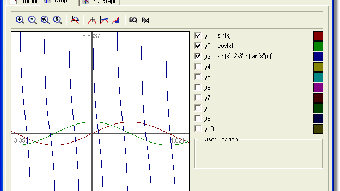
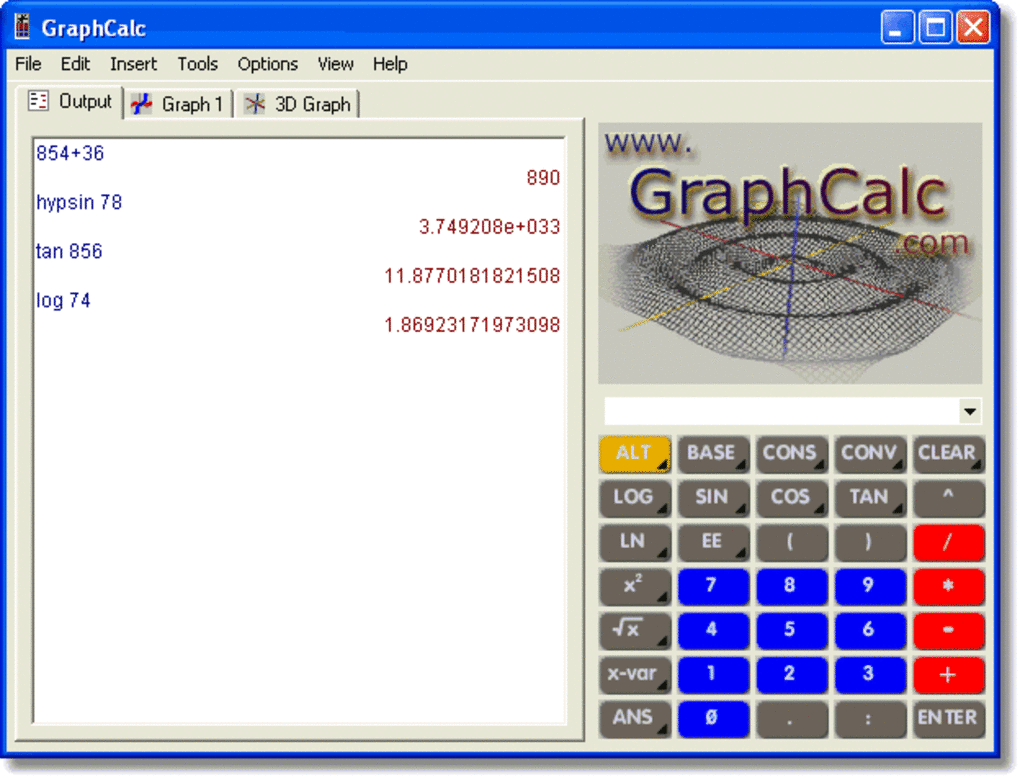
Once launched, the main window presents a calculator keypad on the left and a tabbed interface on the right. To switch to the graphing mode, click the “Graph” tab; you’ll see a blank coordinate plane and a small input bar where you can type an equation (e.g., y = sin(x)). Press “Enter” to render the graph. The toolbar above the graph offers zoom, pan, and export options. If you need to convert units, select the “Converter” tab, choose the category, and enter your value. All calculations are saved automatically in the history pane, which you can clear or export as a text file for record‑keeping.
For power users, GraphCalc supports keyboard shortcuts such as Ctrl + Z for undo, Ctrl + C to copy the current result, and F5 to refresh the graph. These shortcuts speed up workflow and reduce reliance on mouse clicks. If you encounter any issues during installation, the built‑in help file (accessible via the “?” icon) provides troubleshooting tips, and the developer’s support forum remains active for community assistance.
Compatible Operating Systems: Windows 98, Windows 2000, Windows XP, Windows Vista, Windows 7, Windows 8, Windows 8.1, Windows 10, Windows 11 (both 32‑bit and 64‑bit).
Pros & Cons, Frequently Asked Questions, and Final Thoughts
Pros
- Completely free with no hidden charges or ads.
- Runs on virtually any Windows version from 98 onward.
- Lightweight installer and low system resource usage.
- Intuitive interface that mimics a physical scientific calculator.
- Built‑in graphing and unit conversion tools.
- Exportable graph images for presentations and reports.
- Regular updates ensure compatibility with newer Windows releases.
Cons
- Only available in English; no localization for other languages.
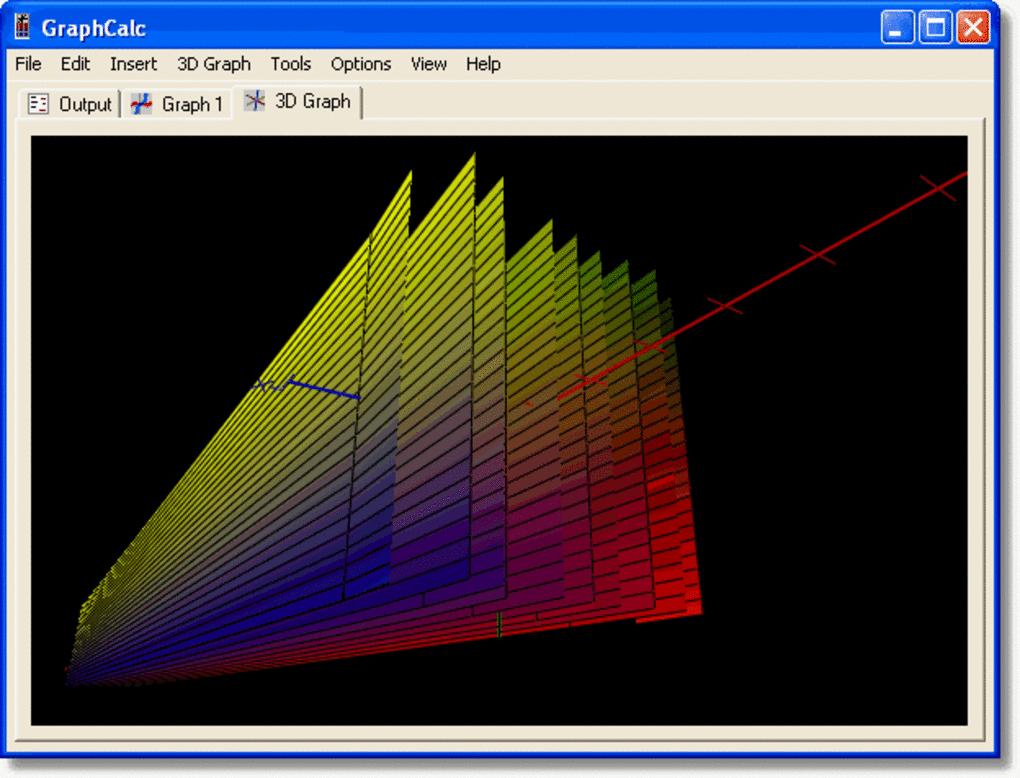
- Lacks advanced graphing features such as 3‑D plots or data import.
- No mobile (Android/iOS) counterpart – Windows‑only.
- Limited customization beyond basic color schemes.
- Help documentation is basic and could use more examples.
Frequently Asked Questions
Is GraphCalc safe to download?
Yes. When downloaded from the official site or reputable portals like Softonic, GraphCalc is free of malware and adware. The installer is digitally signed, and the program does not require an internet connection to function.
Can I use GraphCalc on Windows 11?
Absolutely. GraphCalc is compatible with both 32‑bit and 64‑bit versions of Windows 11. Users report smooth performance after a standard installation.
Does GraphCalc support complex numbers?
Yes. The scientific mode includes operations for complex arithmetic, including addition, subtraction, multiplication, division, and magnitude calculations.
Can I export a graph as a high‑resolution image?
GraphCalc exports graphs in PNG or BMP format at the resolution displayed on screen. For higher‑resolution needs, you can zoom in before exporting.
Is there a way to customize keyboard shortcuts?
The built‑in shortcuts are fixed, but they cover the most common actions. Advanced users can create external macro scripts (e.g., using AutoHotkey) to map additional keys if desired.
Conclusion and Call to Action
Overall, GraphCalc delivers exactly what its name promises: a reliable, free calculator that also offers basic graphing capabilities for Windows users. Its minimalistic design, low system requirements, and absence of hidden fees make it an attractive option for students, hobbyists, and professionals who need a quick calculation tool without the bloat of larger suites. While the lack of multilingual support and advanced graphing features may limit its appeal for power users, the core functionality is solid and dependable. If you’re looking for a free, secure, and easy‑to‑use calculator that runs on virtually any Windows PC, GraphCalc is worth a download today. Click the button below to get the latest version, install it in minutes, and start calculating and graphing with confidence.