While it has become a word, laser used to be an acronym: “light amplification by stimulated emission of radiation”. But there is an even older technology called a maser, which is the same acronym but with light switched out for microwaves. If you’ve never heard of masers, you might be tempted to dismiss them as early proto-lasers that are obsolete. But you’d be wrong! Masers keep showing up in places you’d never expect: radio telescopes, atomic clocks, deep-space tracking, and even some bleeding-edge quantum experiments. And depending on how a few materials and microwave engineering problems shake out, masers might be headed for a second golden age.
Simplistically, the maser is — in one sense — a “lower frequency laser.” Just like a laser, stimulated emission is what makes it work. You prepare a bunch of atoms or molecules in an excited energy state (a population inversion), and then a passing photon of the right frequency triggers them to drop to a lower state while emitting a second photon that matches the first with the same frequency, phase, and direction. Do that in a resonant cavity and you’ve got gain, coherence, and a remarkably clean signal.
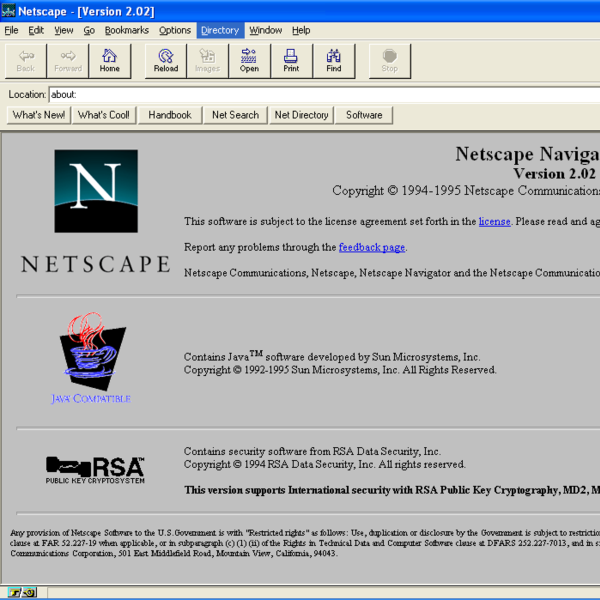
The very concept of the web browser began with a humble piece of software called NCSA Mosaic, all the way back in 1993. It was soon eclipsed by Netscape Navigator, and later Internet Explorer, which became the titans of the 1990s browser market. In turn, they too would falter. Navigator’s dying corpse ended up feeding what would become Mozilla Firefox, and Internet Explorer later morphed into the unexceptional browser known as Edge.
Few of us have had any reason to think about Netscape Navigator since its demise in 2008. And yet, the name lingers on. A zombie from a forgotten age, risen again to haunt us today.
Television is one of those inventions that owes its genesis to more than a single person, so while Baird was by no means the only one inventing in the field, he was the first to demonstrate a working system. With mechanical scanning and just 30 lines, it’s hardly HD or 4K, but it does have the advantage of being within the reach of the constructor.
Perhaps the saddest thing about Baird and his system is that while he was able to attract the interest of the BBC in it, when the time came for dedicated transmissions at a higher resolution, his by then partly mechanical system could not compete and he faded into relative obscurity. Brits instead received EMI’s 405 line system, which persisted until the very start of the 1980s, and eventually the German PAL colour system in the late 1960s.
Carbon fiber (CF) has attained somewhat of a near-mystical appeal in consumer marketing, with it being praised for being stronger than steel while simultaneously being extremely lightweight. This mostly refers to weaved fibers combined with resin into a composite material that is used for everything from car bodies to bike frames. This CF look is so sexy that the typical carbon-fiber composite weave pattern and coloring have been added to products as a purely cosmetic accent.
More recently, chopped carbon fiber (CCF) has been added to the thermoplastics we extrude from our 3D printers. Despite lacking clear evidence of this providing material improvements, the same kind of mysticism persists here as well. Even as evidence emerges of poor integration of these chopped fibers into the thermoplastic matrix, the marketing claims continue unabated.
As with most things, there’s a right way and a wrong way to do it. A recent paper by Sameh Dabees et al. in Composites for example covered the CF surface modifications required for thermoplastic integration with CF.
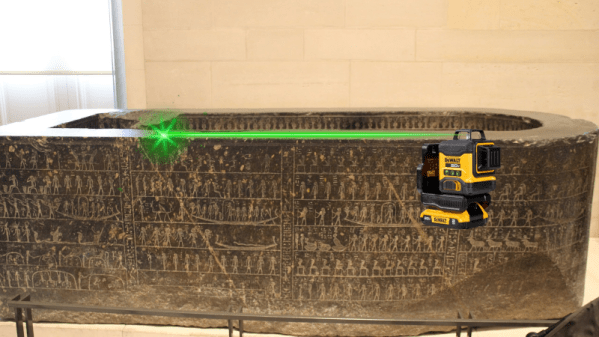
Making a truly flat surface is a modern engineering feat, and not a small one. Even making something straight without reference tools that are already straight is a challenge. However, the ancient Egyptians apparently made very straight, very flat stone work. How did they do it? Probably not alien-supplied CNC machines. [IntoTheMap] explains why it is important and how they may have done it in a recent video you can see below.
The first step is to define flatness, and modern mechanical engineers have taken care of that. If you use 3D printers, you know how hard it is to even get your bed and nozzle “flat” with respect to each other. You’ll almost always have at least a 100 micron variation in the bed distances. The video shows how different levels of flatness require different measurement techniques.
The Great Pyramid’s casing stones have joints measuring 0.5 mm, which is incredible to achieve on such large stones with no modern tools. A stone box in the Pyramid of Seostris II is especially well done and extremely flat, although we can make things flatter today.
The main problem with creating a flat surface is that to do a good job, you need some flat things to start with. However, there is a method from the 19th century that uses three plates and multiple lapping steps to create three very flat plates. In modern times, we use a blue material to indicate raised areas, much as a dentist makes you chomp on a piece of paper to place a crown. There are traces of red ochre on Egyptian stonework that probably served the same purpose.
Lapping large pieces is still a challenge, but moving giant stones at scale appears to have been a solved problem for the Egyptians. Was this the method they used? We don’t know, of course. But it certainly makes sense.
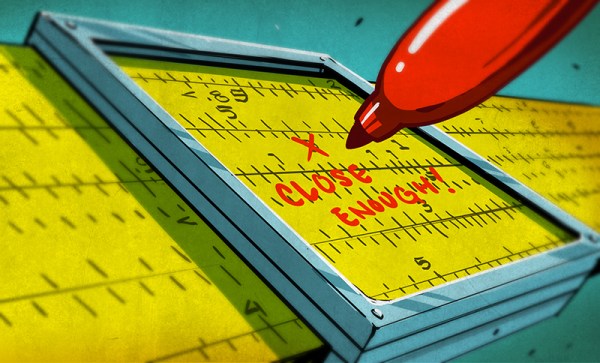
We miss the slide rule. It isn’t so much that we liked getting an inexact answer using a physical moving object. But to successfully use a slide rule, you need to be able to roughly estimate the order of magnitude of your result. The slide rule’s computation of 2.2 divided by 8 is the same as it is for 22/8 or 220/0.08. You have to interpret the answer based on your sense of where the true answer lies. If you’ve ever had some kid at a fast food place enter the wrong numbers into a register and then hand you a ridiculous amount of change, you know what we mean.
Recent press reports highlighted a paper from Nvidia that claimed a data center consuming a gigawatt of power could require half a million tons of copper. If you aren’t an expert on datacenter power distribution and copper, you could take that number at face value. But as [Adam Button] reports, you should probably be suspicious of this number. It is almost certainly a typo. We wouldn’t be surprised if you click on the link and find it fixed, but it caused a big news splash before anyone noticed.
Thought Process
Best estimates of the total copper on the entire planet are about 6.3 billion metric tons. We’ve actually only found a fraction of that and mined even less. Of the 700 million metric tons of copper we actually have in circulation, there is a demand for about 28 million tons a year (some of which is met with recycling, so even less new copper is produced annually).
Simple math tells us that a single data center could, in a year, consume 1.7% of the global copper output. While that could be true, it seems suspicious on its face.
Digging further in, you’ll find the paper mentions 200kg per megawatt. So a gigawatt should be 200,000kg, which is, actually, only 200 metric tons. That’s a far cry from 500,000 tons. We suspect they were rounding up from the 440,000 pounds in 200 metric tons to “up to a half a million pounds,” and then flipped pounds to tons.
There’s little about building spacecraft that anyone would call simple. But there’s at least one element of designing a vehicle that will operate outside the Earth’s atmosphere that’s fairly easier to handle: aerodynamics. That’s because, at the altitude that most satellites operate at, drag can essentially be ignored. Which is why most satellites look like refrigerators with solar panels and high-gain antennas attached jutting out at odd angles.
But for all the advantages that the lack of meaningful drag on a vehicle has, there’s at least one big potential downside. If a spacecraft is orbiting high enough over the Earth that the impact of atmospheric drag is negligible, then the only way that vehicle is coming back down in a reasonable amount of time is if it has the means to reduce its own velocity. Otherwise, it could be stuck in orbit for decades. At a high enough orbit, it could essentially stay up forever.
Launched in 1958, Vanguard 1 is expected to remain in orbit until at least 2198
There was a time when that kind of thing wasn’t a problem. It was just enough to get into space in the first place, and little thought was given to what was going to happen in five or ten years down the road. But today, low Earth orbit is getting crowded. As the cost of launching something into space continues to drop, multiple companies are either planning or actively building their own satellite constellations comprised of thousands of individual spacecraft.
Fortunately, there may be a simple solution to this problem. By putting a satellite into what’s known as a very low Earth orbit (VLEO), a spacecraft will experience enough drag that maintaining its velocity requires constantly firing its thrusters. Naturally this presents its own technical challenges, but the upside is that such an orbit is essentially self-cleaning — should the craft’s propulsion fail, it would fall out of orbit and burn up in months or even weeks. As an added bonus, operating at a lower altitude has other practical advantages, such as allowing for lower latency communication.
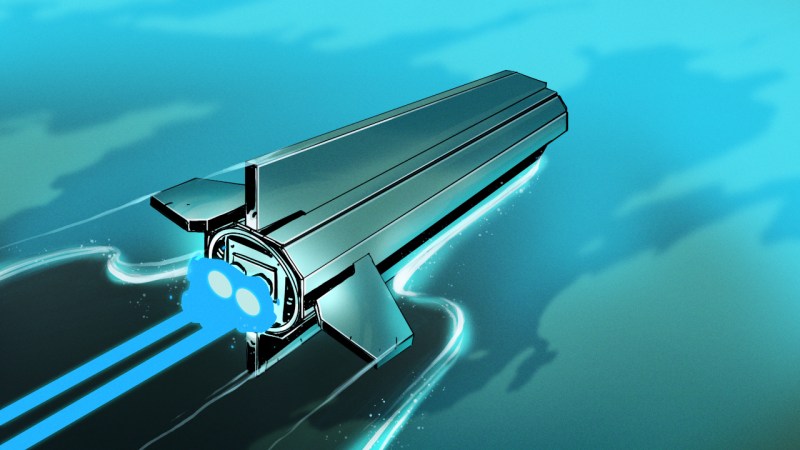
VLEO satellites hold considerable promise, but successfully operating in this unique environment requires certain design considerations. The result are vehicles that look less like the flying refrigerators we’re used to, with a hybrid design that features the sort of aerodynamic considerations more commonly found on aircraft.