Image

Make Your Own ESP32-Based Person Sensor, No Special Hardware Needed

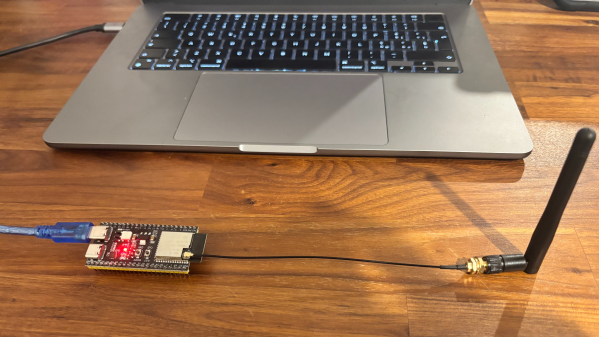
Home automation with high usefulness and low annoyance tends to rely on reliable person sensing, and [francescopace]’s ESPectre shows one way to do that cheaply and easily by leveraging hardware that’s already present on a common dev board.

ImageESPectre is an ESP32-based open source motion detector that detects movement without any cameras or microphones. It works similarly to millimeter-wave (mmWave) radar motion detectors in the sense that when a person moves, wireless signals are altered slightly as a result. ESPectre can detect this disturbance by watching and analyzing the Wi-Fi channel state information (CSI) and doing some very smart math and filtering. It’s cheap, easy to deploy and use, and even integrates with Home Assistant.
Combining a sensor like this with something else like a passive infrared (PIR) motion sensor is one way to get really robust results. But keep in mind that PIR only senses what it can see, whereas ESPectre works on WiFi, which can penetrate walls.

Since ESPectre supports low-cost ESP32 variants and is so simple to get up and running, it might be worth your time to give it a trial run. There’s even a browser-based ghost-dodging game [francescopace] put online that uses an ESPectre board plugged in over USB, which seems like a fun way to get a feel for what it can do.

Image

Electric Lawnmower Gets RC Controls

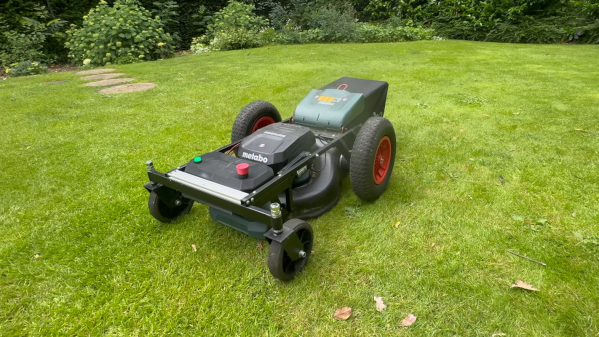
Decades ago, shows like Star Trek, The Jetsons, and Lost in Space promised us a future full of helpful computers and robot assistants. Unfortunately, we haven’t quite gotten our general-purpose helper to do all of our tasks with a simple voice command yet. But if some sweat equity is applied, we can get machines to do specific tasks for us under some situations. [Max Maker] built this remote-controlled lawnmower which at least minimizes the physical labor he needs to do to cut his grass.

The first step in the project was to remove the human interface parts of the push mower and start working on a frame for the various control mechanisms. This includes adding an actuator to raise and lower the mower deck on the fly. Driving the new rear wheels are two wheelchair motors, which allow it to use differential steering, with a set of casters up front for maximum maneuverability. An Arduino Mega sits in a custom enclosure to control everything and receive the RC signals, alongside the mower’s batteries and the motor controllers for the drive wheels.

After some issues with programming, [Max] has an effective remote controlled mower that he can use to mulch leaves or cut grass without getting out of his chair. It would also make an excellent platform if he decides to fully automate it in the future, which is a project that has been done fairly effectively in the past even at much larger scales.

Continue reading “Electric Lawnmower Gets RC Controls”

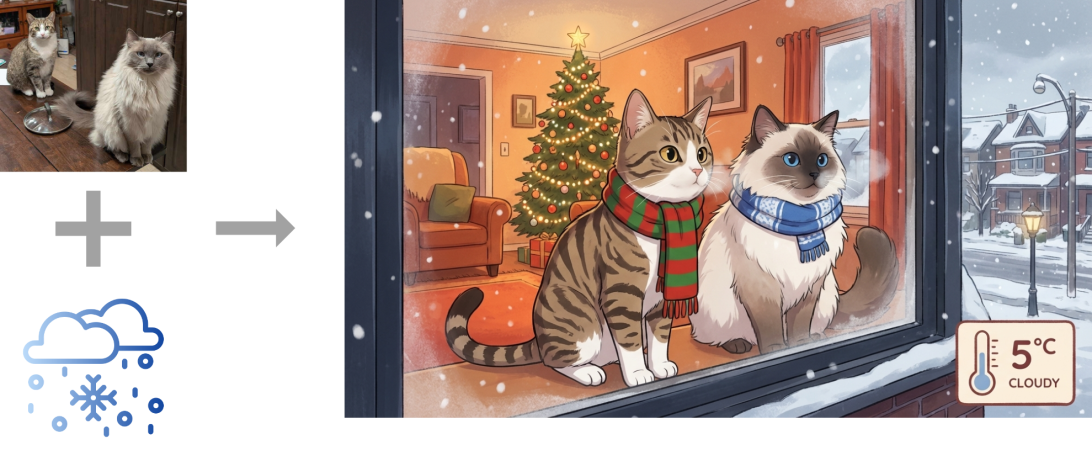
A photo of the cats and the generated image

The Cutest Weather Forecast On E-Ink And ESP32

There’s a famous book that starts: “It is a truth universally acknowledged that a man in possession of a good e-ink display, must be in want of a weather station.” — or something like that, anyway. We’re not English majors. We are, however, major fans of this feline-based e-ink weather display by [Jesse Ward-Bond]. It’s got everything: e-ink, cats, and AI.

Image
The generated image needs a little massaging to look nice on the Spectra6 e-ink display.

AI? Well, it might seem a bit gratuitous for a simple weather display, but [Jesse] wanted something a little more personalized and dynamic than just icons. With that in the design brief, he turned to Google’s Nano Banana API, feeding it the forecast and a description of his cats to automatically generate a cute scene to match the day’s weather.

That turned out to not be enough variety for the old monkey brain, so the superiority of silicon — specifically Gemini–was called upon to write unique daily prompts for Nano Banana using a random style from a list presumably generated by TinyLlama running on a C64. Okay, no, [Jesse] wrote the prompt for Gemini himself. It can’t be LLM’s all the way down, after all. Gemini is also picking the foreground, background, and activity the cats will be doing for maximum neophilia.

Aside from the parts that are obviously on Google servers, this is all integrated in [Jesse]’s Home Assistant server. That server stores the generated image until the ESP32 fetches it. He’s using a reTerminal board from SeedStudio that includes an ESP32-S3 and a Spectra6 colour e-ink display. That display leaves something to be desired in coloration, so on top of dithering the image to match the palette of the display, he’s also got a bit of color-correction in place to make it really pop.

If you’re interested in replicating this feline forecast, [Jesse] has shared the code on GitHub, but it comes with a warning: cuteness isn’t free. That is to say, the tokens for the API calls to generate these images aren’t free; [Jesse] estimates that when the sign-up bonus is used up, it should cost about fourteen cents a pop at current rates. Worth it? That’s a personal choice. Some might prefer saving their pennies and checking the forecast on something more physical, while others might prefer the retro touch only a CRT can provide. 

Image

The Best Robot Mop System: Flat, Spinning, Or Roller?

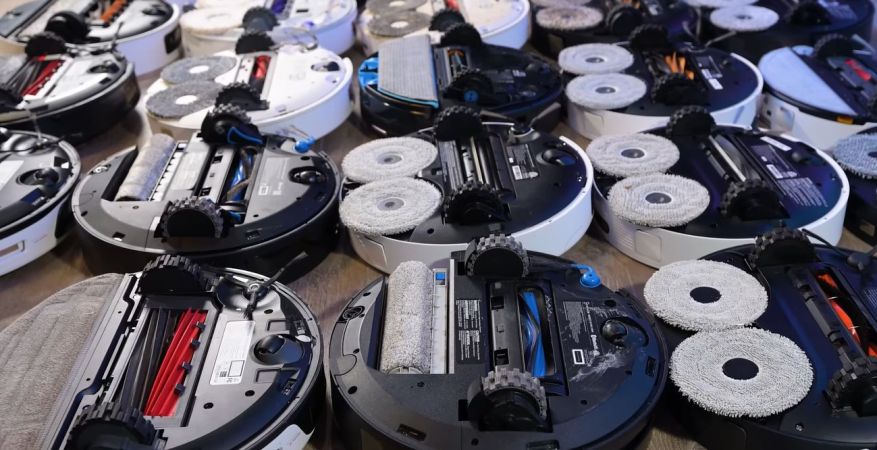
When it comes to designing a mopping robot, there are a number of approaches you can pick from, including just having the movement of the robot push the soggy mop over the floor, having spinning pads, or even a big spinning roller. But what difference does it make? Recently the [Vacuum Wars] channel ran a comparison to find out the answer.

The two spinning pad design is interesting, because it allows for the bot to move closer to objects or walls, and the base station doesn’t need the active scrubber that the simple static pad requires. The weakness of both types of flat mop design is that they are quickly saturated with dirt and moisture, after which they’ll happily smear it over the floor.

The spinning roller is the most complex, with the robot having its own onboard water tank, and a way to extract the dirty water from the mop and store it for disposal in the base station. Theoretically this would be the clear winner, with basically all of them having features like avoiding carpet.

Continue reading “The Best Robot Mop System: Flat, Spinning, Or Roller?”

Image

High-Tech Trailer Brings Water Home

Living without standard utility hookups like electricity, Internet, water, and sewer comes with a whole host of challenges, all of which are most commonly solved by spending lots of money. For electricity, a solar array or a generator is fairly common. The Internet can similarly be accessed via a satellite link if wires aren’t available. For water, most people will drill a well, but that gets similarly expensive. [Cranktown City] recently bought an off-grid home and needed a way to get water to it on a budget, so he built this water trailer instead.

Continue reading “High-Tech Trailer Brings Water Home”

Image

Smart Home? Make It Smart Quarters With This LCARS Dashboard

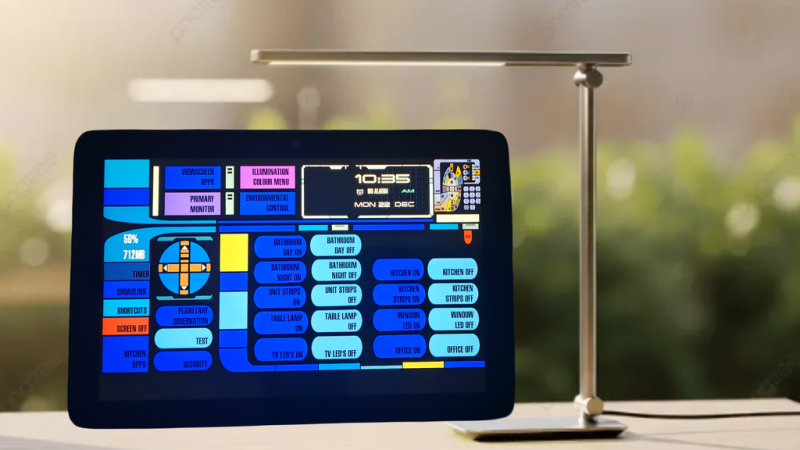
At the risk of starting a controversy: is there anyone who goes to the effort of setting up Home Assistant who wouldn’t really rather be living on the Enterprise-D? If such a person exists, it’s not [steve-gibbs5], who has not only put together a convincing LCARS dashboard on an Android tablet, but has also put together an easy-to-follow Instructable so you can too.

Continue reading “Smart Home? Make It Smart Quarters With This LCARS Dashboard”

The blower and a smaller motor than what's actually driving it.

Electric Snowblower Clears The Way With Hobby Parts

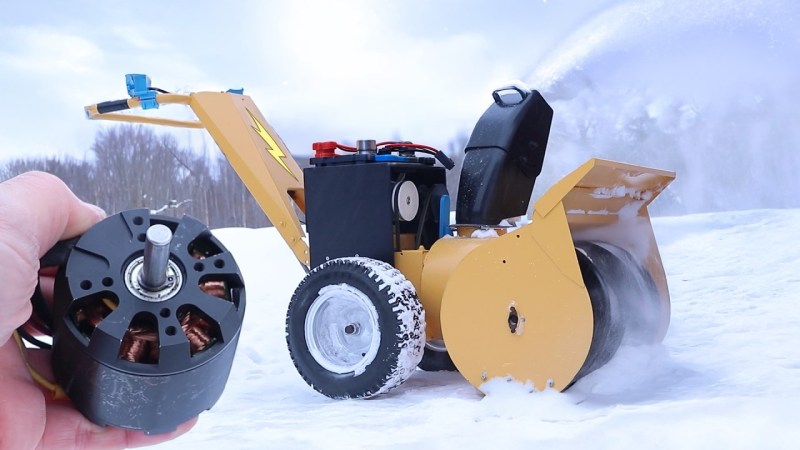
If you live in snow country and own a home, you either have a snowblower or wish you did. The alternatives are either an expensive and potentially unreliable plow service, or back-breaking (and heart-attack inducing) shoveling. [RCLifeOn] was one of those people in the second category, until he decided to do something about it: electrifying a scrap snowblower with a blown engine. 

The usual brushless DC motors and electronic speed controllers [RCLifeOn] has on hand to get his R/C life on with don’t quite have enough oomph to handle both functions of a snowblower. For those of you cursed to live in warmer climes, the modern snowblower is both self-propelled via its twin wheels, and generally has a two-stage powered snow-removal “blower” consisting of an auger to break up the snow and an impeller to blast it out of the machine and many meters off the driveway. On the traditional gas-powered models, these are both powered via belts off the same motor, but that wasn’t going to work.

He kept the belts, and simply used a pair of motors, each with their own ESCs that are controlled via oversized thumb wheels on the handles. The belts couple to the motors with 3D printed pulleys. Belt tension is achieved in the case of the wheels through a simple and sensible shimming arrangement. In the case of the blower motor, he uses a 3D printed adjustable mount to get the appropriate tension. To help it hold long-term (given the issues with creep in 3D prints) he’s got a bearing on a second mount opposite the motor.  It holds up for his demo, which consists of clearing a driveway of 10cm of snow and then plowing through a pile larger than the mouth of the machine. In other words: it works.

The build, as unfortunately common on YouTube, is shy on specific details– but in this case that’s fine. Even if he’d open-sourced everything and posted STEP or STL files, it wouldn’t save much time since you’d pretty well have to re-engineer the build to fit your own snowblower, if you were so inclined. As with many hacks of this nature, the point of sharing it is to show how easy it is and provide the inspiration. As the cartoons used to say, “knowing is half the battle.”

If one was to re-implement this hack, we could not encourage you strongly enough to put in the standard dead-man’s switch, a feature commercial snowblowers share with things like lawnmowers. As annoying as it is to hang onto with frozen fingers, that safety feature is there for a reason.

If your driveway is short, you can save on gas and fuel costs with an extension cord. Or you could just stay inside and do the job by remote control, but that comes with its own pitfalls.

Continue reading “Electric Snowblower Clears The Way With Hobby Parts”