Image

Writing An Optimizing Tensor Compiler From Scratch

Not everyone will write their own optimizing compiler from scratch, but those who do sometimes roll into it during the course of ever-growing project scope creep. People like [Michael Moroz], who wrote up a long and detailed article on the why and how. Specifically, a ‘small library’ involving a few matrix operations for a Unity-based project turned into a static optimizing tensor compiler, called TensorFrost, with a Python front-end and a shader-like syntax, all of which is available on GitHub.

The Python-based front-end implements low-level NumPy-like operations, with development still ongoing. As for why Yet Another Tensor Library had be developed, the reasons were that most of existing libraries are heavily focused on machine learning tasks and scale poorly otherwise, dynamic flow control is hard to implement, and the requirement of writing custom kernels in e.g. CUDA.

Above all [Michael] wanted to use a high-level language instead of pure shader code, and have something that can output graphical data in real-time. Taking the gamble, and leaning on LLVM for some parts, there is now a functional implementation, albeit with still a lot of work ahead.
Image

Need A Curved Plastic Mesh? Print Flat, Curve Later

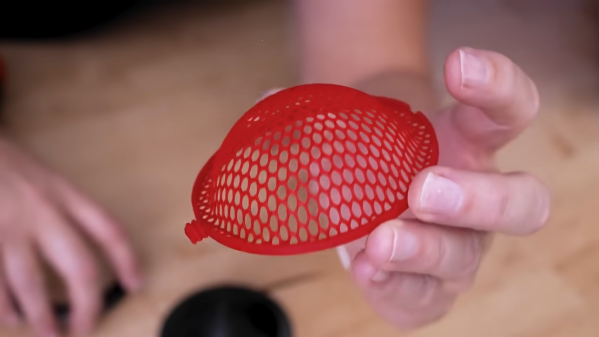
Need a plastic mesh in a custom pattern? 3D print it, no problem. But what if one needs a curved plastic mesh? That’s considerably harder to 3D print, but [Uncle Jessy]’s figured out a simple approach: 3D print the mesh flat, then break out a mold and a heat gun.

Of course, there are a few gotchas, but [Uncle Jessy] shares his tips for getting the most reliable results. The important part is to design and 3D print a mold that represents the final desired shape. Then print the mesh, and fit it into a frame. Heat things up with a heat gun, and press into the mold to deform the mesh while it’s still soft. It’s much easier seen than explained, so take a few moments to check out the video, embedded below the page break.

Image
Custom eye inserts become a breeze.

Because the plastic in a mesh is so thin, [Uncle Jessy] says to keep the heat low and slow. The goal is to have the mesh stretch and deform, not melt.

Speaking of heat, when thermoforming, one usually needs to make the mold out of heat-resistant material. But the thermal mass of a mesh is so small that it really doesn’t matter much — there just isn’t enough heat trapped in the mesh to really damage a mold. As long as the mold is reasonably dense, there’s no need to go overboard with making it heat resistant.

The whole process takes a little practice, but since the meshes are so fast to print and use so little plastic it’s easy to experiment a little.

As for the meshes themselves, a simple way to print a mesh is just to print a disc with no top or bottom layers, only infill. Set the infill pattern to honeycomb, for example, for an easy hexagon mesh. We’ve seen a variant of this “exposed infill” idea used to create a desiccant container, and using it to print a mesh pattern easily is a neat trick, too.

Why might one need to reshape a mesh into a curve? Perhaps to custom-fit a costume piece, or make custom eye inserts for masks, as shown here. In any case, it’s a good technique to keep in the back of one’s mind, and if you put it to good use, drop us a tip!

Continue reading “Need A Curved Plastic Mesh? Print Flat, Curve Later”

Image

Ordering Pizza On Your Sega Dreamcast Is Very Clunky Indeed

If you’re ordering pizza these days, you’re probably using a smartphone app or perhaps still making a regular old phone call. If you’re creative and a little bit tricky, though, you can order pizza right from your Sega Dreamcast. You just need to jump through a few hoops, as demonstrated by [Delux] and [The Dreamcast Junkyard] in the recent past.

You used to be able to order pizza on the Dreamcast natively, all the way back in 1999. However, the modern Domino’s website doesn’t really work on the ancient Dreamcast browser anymore. The simple fact is that web technology has advanced a long way in the last couple of decades, and Sega didn’t exactly spend a lot of time maintaining a browser on a console that died mere months after its rivals hit the market.

Thus, to place a pizza order on the Dreamcast these days, you need to work within its limitations. [Delux] uses the Dreamcast with the Broadband Adapter to access a PC on the local network via the XDP web browser. That PC is hosting Web Rendering Proxy, a tool which converts complicated modern websites into something a simpler machine can parse. From there, it’s a matter of connecting to the Domino’s website, and slowly clicking through the online ordering pages. Between the proxy delay, the Dreamcast’s glacial processing speed, and the clunky Domino’s ordering interface, it takes ages. Never before has adding coupons felt like such a hassle. Still, after 15 minutes of fuss, the order is completed… and a short time later, a hot fresh pizza arrives.

It’s a fun hack, but really it’s the PC running the proxy that’s doing the heavy lifting. In 2026, it’s far more elegant to order a pizza from your Nintendo Wii.

Continue reading “Ordering Pizza On Your Sega Dreamcast Is Very Clunky Indeed”

Image

Do Expensive Filaments Make 3D Printed Wrenches Better?

What filament is strongest? The real answer is “it depends”, but sometimes you have a simple question and you just want a simple answer. Like, which material makes the best 3D printed wrench? [My Tech Fun] printed a bunch of options to find out — including some expensive filaments — and got some interesting insights in the process.

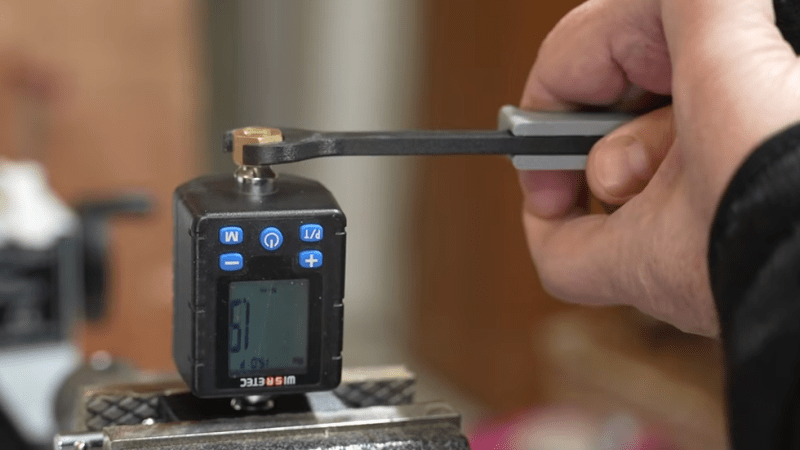
His setup is simple: he printed a bunch of 13 mm open-end wrenches, and tested each one to failure by cranking on a clamped digital torque meter until the wrench failed by breaking, or skipping.

[My Tech Fun] tested a total of eighteen filaments, from regular basic PLA, PETG, ABS and ASA, and a variety of carbon fiber-infused filaments including PPA-CF. TPU is included for fun, and there’s also a wrench printed with continuous carbon fiber, which requires a special printer. More on that in a moment. First, let’s get to the results!

Image
PETG wrench reinforced with continuous carbon fiber. The result is extremely stiff compared to without.

Unsurprisingly, TPU fared the worst at 0.8 nM which is roughly “unscrewing the cap of a water bottle” territory. Top performers included the wrench printed with continuous carbon fiber reinforcement (failing at 3.7 nM) and a couple printed in expensive PPA-CF (high-temperature nylon filament with carbon fiber) topped the list at 4.3 nM. Everything else landed somewhere in between, with plain PLA surprisingly outperforming some CF blends.

The continuous carbon fiber wrench was printed on a FibreSeeker printer, which reinforces a print with solid fibers embedded into the plastic instead of chopped particles, and such prints are noticeably more resistant to bending. Check out our earlier coverage for a closer look at what the FibreSeeker does.

This is a good time to mention that the wrench 3D model used is not at all optimized for best results with 3D printing. But that’s okay; this is really about the filaments, not the wrench.

The wrench model is just a way to test things in a familiar and highly visual, relatable way. You can see each one in action in the video below, and seeing [My Tech Fun] turn the wrenches gives a very good idea of just how much force is involved, with a relatable display of just how strong the different filaments are.

Continue reading “Do Expensive Filaments Make 3D Printed Wrenches Better?”

Image

Hackaday Podcast Episode 355: Person Detectors, Walkie Talkies, Open Smartphones, And A WiFi Traffic Light

Another chilly evening in Western Europe, as Elliot Williams is joined this week by Jenny List to chew the fat over the week’s hacks.

It’s been an auspicious week for anniversaries, with the hundredth since the first demonstration of a working television system in a room above a London coffee shop. John Logie Baird’s mechanically-scanned TV may have ultimately been a dead-end superseded by the all-electronic systems we all know, but the importance of television for the later half of the 20th century and further is beyond question.

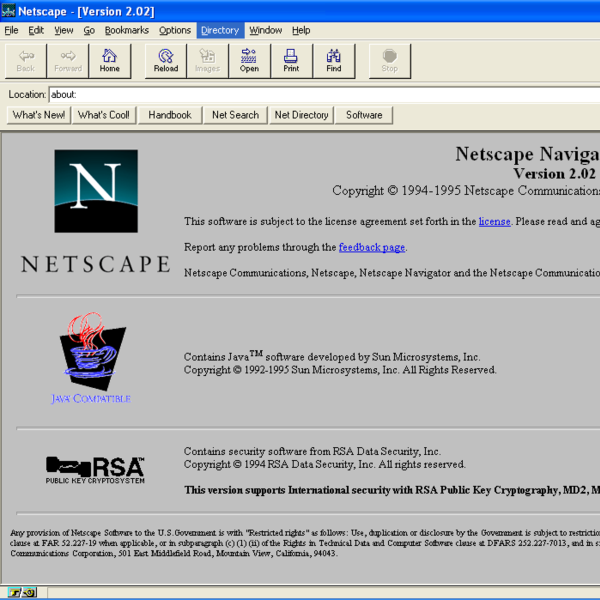
The standout hacks of the week include a very clever use of the ESP32’s WiFi API to detect people moving through a WiFi field, a promising open-source smartphone, another ESP32 project in a comms system for cyclists, more cycling on tensegrity spokes, a clever way to smooth plaster casts, and a light sculpture reflecting Wi-Fi traffic. Then there are a slew of hacks including 3D printed PCBs and gem-cut dichroic prisms, before we move to the can’t-miss articles. There we’re looking at document preservation, and a wallow in internet history with a look at the Netscape brand.

As usual all the links you need can be found below, so listen, and enjoy!

Or download the podcast old-school, with a direct link to the MP3 file in question.

Continue reading “Hackaday Podcast Episode 355: Person Detectors, Walkie Talkies, Open Smartphones, And A WiFi Traffic Light”

Image

Whipping Up A Quick Adapter To Hack The Xbox 360

[Androxilogin] had a problem. An Xbox 360 Slim had shown up in the post, but failed to give much more than a beep when turned on. Disassembly revealed some missing components, but replacing them failed to breathe life into the beleaguered console. Deeper repair was needed, and that would require a special adapter which [Androxilogin] was able to whip up from scratch.

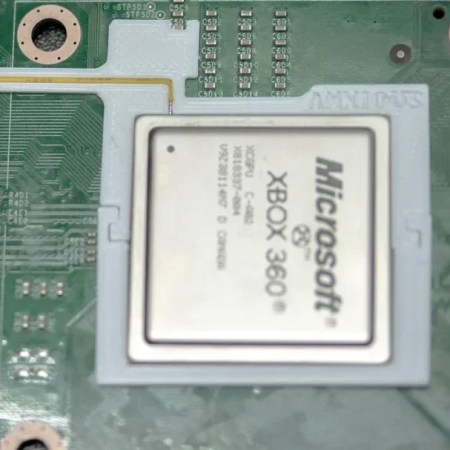
When it comes to the Corona models of the Xbox 360, it’s often necessary to use something called a “post-fix adapter” to do certain diagnostic and repair tasks. These adapters consist of a bracket which wraps around the CPU, and probes the solder ball for the POST_OUT signal which is otherwise difficult to access on the motherboard itself. Adapters are readily available online, and are usually manufactured as a PCB with a protruding contact to make a connection.

For [Androxilogin], though, time was short. Rather than wait for adapters to ship, it was quicker to whip up a custom piece to do the same job. This was achieved with a 3D print which was able to clamp around the CPU, while snugly holding a piece of tinned 30 AWG wire to poke the critical point beneath the chip. After a couple of attempts to get the sizing just right, [Androxilogin] was able to make the necessary connection which enabled installing Xell Loader on to the machine to bring it back to life.

If you’re eager to make your own post-fix adapter, files are available on Printables, with more details over on Reddit to boot. While the Xbox 360 is starting to suffer some awkward symptoms of age. we nevertheless still see a steady stream of hacks come in for this vintage machine. If you’re tackling your own retro console mods, be sure to notify the tipsline.

Image

Building Natural Seawalls To Fight Off The Rising Tide

These days, the conversation around climate change so often focuses on matters of soaring temperatures and extreme weather events. While they no longer dominate the discourse, rising sea levels will nonetheless still be a major issue to face as global average temperatures continue to rise.

This poses unique challenges in coastal areas. Municipalities must figure out how to defend their shorelines, or decide which areas they’re willing to lose. The City of Palo Alto is facing just this challenge, and is building a natural kind of seawall to keep the rising tides at bay.

Continue reading “Building Natural Seawalls To Fight Off The Rising Tide”