Image

Lead Acid Battery Upgraded To Lithium Iron Phosphate

Lithium batteries have taken over as the primary battery chemistry from applications ranging from consumer electronics to electric vehicles and all kinds of other things in between. But the standard lithium ion battery has a few downsides, namely issues operating at temperature extremes. Lead acid solves some of these problems but has much lower energy density, and if you want to split the difference with your own battery you’ll need to build your own lithium iron phosphate (LiFePO4) pack.

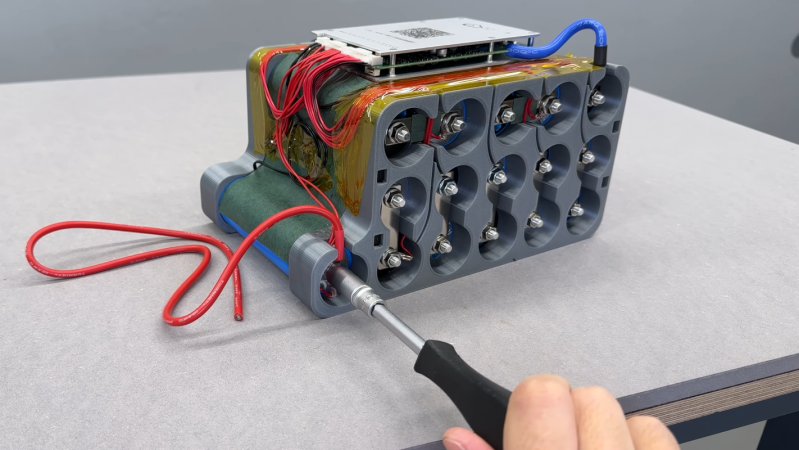
[Well Done Tips] is building this specific type of battery because the lead acid battery in his electric ATV is on the decline. He’s using cylindrical cells that resemble an 18650 battery but are much larger. Beyond the size, though, many of the design principles from building 18650 battery packs are similar, with the exception that these have screw terminals so that bus bars can be easily attached and don’t require spot welding.

With the pack assembled using 3D printed parts, a battery management system is installed with the balance wires cleverly routed through the prints and attached to the bus bars. The only problem [Well Done Tips] had was not realizing that LiFePO4 batteries’ voltages settle a bit after being fully charged, which meant that he didn’t properly calculate the final voltage of his pack and had to add a cell, bringing his original 15S1P battery up to 16S1P and the correct 54V at full charge.

LiFePO4 has a few other upsides compared to lithium ion as well, including that it delivers almost full power until it’s at about 20% charge. It’s not quite as energy dense but compared to the lead-acid battery he was using is a huge improvement, and is one of the reasons we’ve seen them taking over various other EV conversions as well.

Continue reading “Lead Acid Battery Upgraded To Lithium Iron Phosphate”
Image

Flux And Solder Paste Dispenser Looks Good While Doing It

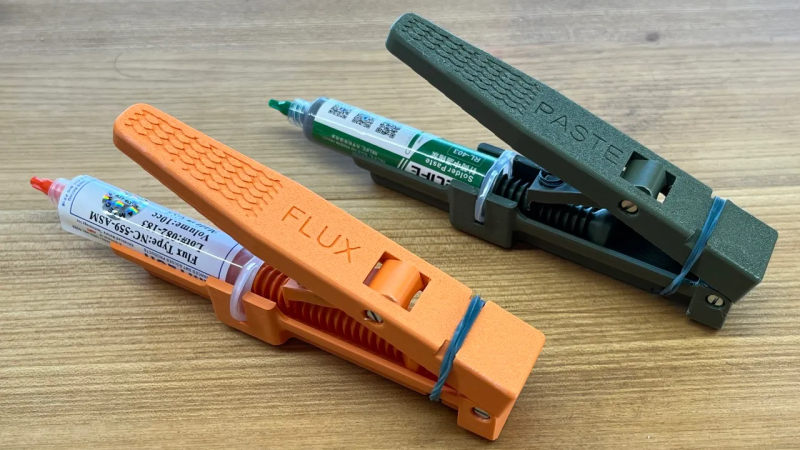
Syringes are pretty ergonomic, but when manually dispensing flux and solder paste it doesn’t take long before one wants a better way. [Elektroarzt]’s flux and solder paste dispenser design uses 3D-printed parts and minimal hardware (mostly M3x20 screws, and an optional spring) to improve handling and control.

Image
The operating principle is very similar to how a hot glue gun feeds a stick of glue.

How does it work? The ratcheting lever mechanism is similar to that of a hot glue gun, where an arm slips into notches in a rod when pressed down, driving it forward and never backward. In the process, a larger lever movement is translated into a shorter plunger travel, enhancing control.

The types of syringes this tool is meant to be used with have a plunger tip or piston (the rubber stopper-looking part, in contact with the liquid) inside the loaded syringe, but no plunger shaft attached to it. This is common with syringes meant to be loaded into tools or machines, and [Elektroarzt]’s tool can be used with any such syringe in a 10 cc size.

It’s an attractive design, and we like the way syringes top-load as well as the way the tool is made to lay flat on a tabletop, with the lever pointed up.

Want truly fine-grained control over your extrusions? Then check out this dispenser which really lets one dial in small amounts. You can also go motorized, and let a small PCB and stepper motor do the work.

Image

EnderSpark: Convert Your Broken Creality FDM Printer Into An EDM Machine!

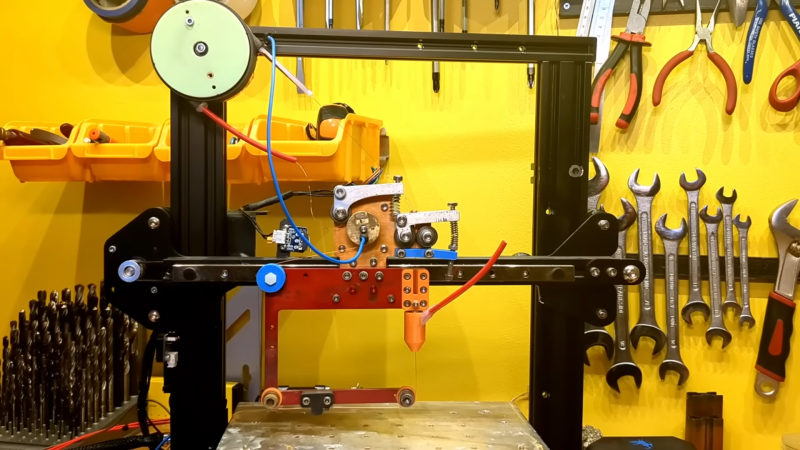
EDM (Electrical Discharge Machining) is one of those specialised manufacturing processes that are traditionally expensive and therefore somewhat underrepresented in the DIY and hacker scenes. It’s with great delight that we present EnderSpark, a solution to not one but two problems. The first problem is how to perform CNC operations on hard-to-machine materials such as hardened metals (without breaking the bank). The second problem is what to do with all those broken and forgotten previous-generation Creality Ender 3D printers we know you have stashed away.

To be honest, there isn’t much to a cheap 3D printer, and once you ditch the bed and extruder assembly, you aren’t left with a lot. Anyway, the first job was to add a 51:1 reduction gearbox between the NEMA 17 motors and the drive pullies, giving the much-needed boost to positional accuracy. Next, the X and Y axes were beefed up with a pair of inexpensive MGN12H linear rails to help them cope with the weight of the water bath.

Continue reading “EnderSpark: Convert Your Broken Creality FDM Printer Into An EDM Machine!”

Image

Print Your Own Standardized Wire Spool Storage

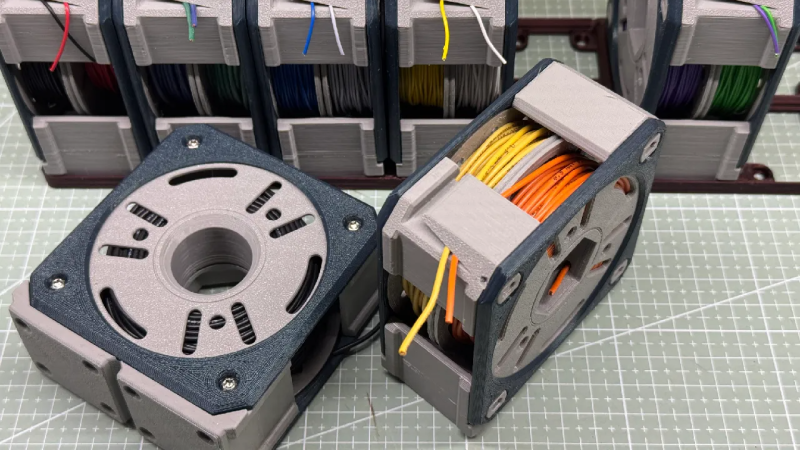
Hardware hackers tend to have loads of hookup wire, and that led [firstgizmo] to design a 3D printable wire and cable spool storage system. As a bonus, it’s Gridfinity-compatible!

Image
The slot to capture loose ends is a nice touch, and the units can be assembled without external hardware.

There are a lot of little design touches we love. For example, we like the little notch into which the wire ends are held, which provides a way to secure the loose ends without any moving parts. Also, while at first glance these holders look like something that goes together with a few screws, they actually require no additional hardware and can be assembled entirely with printed parts. But should one wish to do so, [firstgizmo] has an alternate design that goes together with some M3 bolts instead.

Want to adjust something? The STEP files are included, which we always love to see because it makes modifications to the models so much more accessible. One thing that hasn’t changed over the years is that making engineering-type adjustments to STL files is awful, at best.

If there is one gotcha, it is that one must remove wire from their old spools and re-wind onto the new to use this system. However, [firstgizmo] tries to make that as easy as possible by providing two tools to make re-spooling easier: one for hand-cranking, and one for using a hand drill to do the work for you.

It’s a very thoughtful design, and as mentioned, can also be used with the Gridfinity system, which seems to open organizational floodgates in most people’s minds. Most of us are pinched for storage space, and small improvements in space-saving really, really add up.

Image

3D Printing A Telescope Is Rewarding, Even If Not Always Cheaper

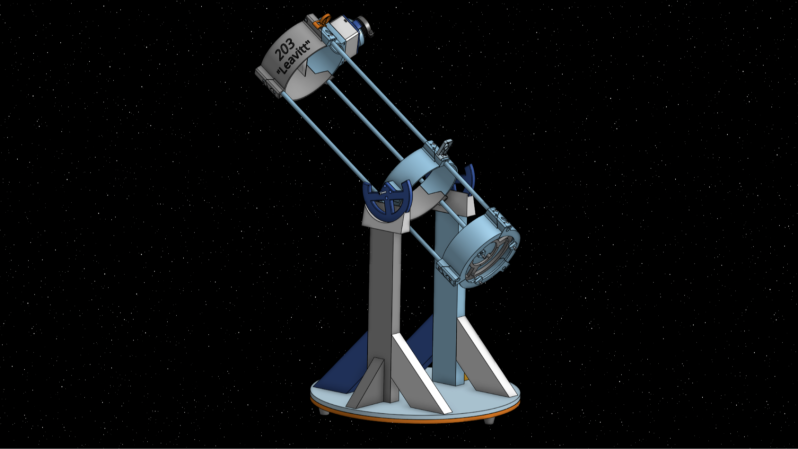
What can one expect from 3D printing an 8″ Newtonian telescope? [Molly Wakeling] shares her thoughts after doing exactly that. The performance was on par with any solid 8″ telescope, but in the end it wasn’t really any cheaper than purchasing a manufactured unit. Does that mean it wasn’t worth it? Not at all!

Image[Molly] makes the excellent observation that the process of printing and building one’s own telescope is highly educational and rewarding. Also, the end result is modular, user-serviceable, and customizable in a way that many commercial offerings can only dream of. It’s a great conversation starter with other enthusiasts, as well!

[Molly] printed the 203 Leavitt design (3d models available on Printables) which is an 8″ Newtonian telescope. This telescope design uses a concave parabolic mirror (a significant part of the expense) at the back of the tube to gather and focus light, and a small flat mirror near the front of the tube reflects this light to an eyepiece on the side. The wood stand makes things convenient, and we like the elastic tie-down used as a simple way to put tension on the mounts.

Do you find yourself intrigued but would prefer to start a little smaller and cheaper? Good news, because the same designer of the 203 Leavitt has a very similar design we happen to have featured before: the 114 Hadley. It features easily obtainable, lower-cost optics which perform well and can be easily ordered online, making it a great DIY starter telescope.

Image

Print Your Next LED Bezel

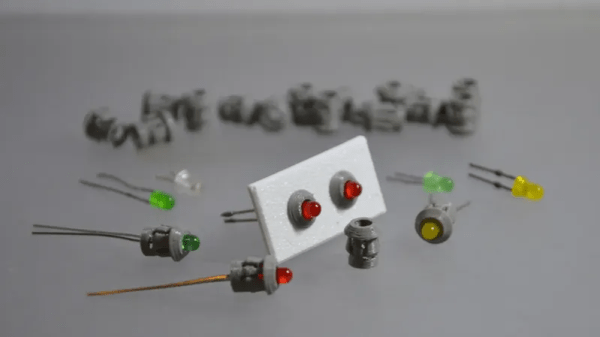
LED bezels (also known as LED panel-mount holders) are great, so how about 3D printing the next ones you need? Sure, they’re inexpensive to purchase and not exactly uncommon. But we all know that when working on a project, one doesn’t always have everything one might need right at hand. At times like that, 3D printing is like a superpower.

Image
Printing a part you find yourself short of can be a lifesaver.

[firstgizmo]’s design is made with 3D printing in mind, and most printers should be able to handle making them. Need something a little different? You’re in luck because the STEP files are provided (something we love to see), which means modifications are just a matter of opening them in your favorite CAD program.

There’s not even any need to export to an STL after making tweaks, because STEP support in slicer programs is now quite common, ever since PrusaSlicer opened that door a few years ago.

Not using 5 mm LEDs, and need some other size? No problem, [firstgizmo] also has 3 mm, 8 mm, and 10 mm versions so that it’s easy to mount those LEDs on a panel. Combined with a tool that turns SVG files into multi-color 3D models, one can even make some panels complete with color and lettering to go with those LEDs. That might be just what’s needed to bring that midnight project to the next level.

Image

Cookie Launcher Makes You Catch Your Own Snack

Holiday cookies are a joy, and to make things a bit more fun, [The Skjegg] created the Cookie Launcher. At the touch of a button, a door opens and the tin launches a cookie (and perhaps a few crumbs) skyward. Catching it is up to the operator, but since the tin can hold up to 40 cookies at once (39 in a magazine and 1 in the launcher), there’s enough to get some practice in.

ImageThe design is a real thing of beauty, from the rotary cookie holder to the ejector. Individual cookies are held in a pan-style magazine that rotates until a tasty disk is lined up with the ejector. The red separators aren’t just for show, either. The little inward protrusion on each one interacts with an optical sensor to ensure the system always knows when things are lined up.

The launcher design is pretty neat, too. There’s a platform that uses two smooth bolts as guides, and elastic bands to store energy. A motor cranks it downward, where it locks into place. The rotary magazine then turns to line up a cookie, which gravity feeds into the launcher by rolling down an incline. When a cookie is in place, a door in the lid opens and the launcher platform releases, sending the cookie skyward.

The original concept for the Cookie Launcher involved voice activation, but training the voice module to trigger on custom Norwegian commands wasn’t very reliable. Luckily, a button is far more obedient. It may be a bit less magical to use, but in our opinion the physicality of a button push meshes perfectly well with the requirement to catch your own cookie.

You can get a good look at the operation and a detailed tour of the insides in the video, embedded below. Thanks to [Rohit] for sending in the tip!

If airborne cookies aren’t your bag, check out one a very different approach to hands-free cookie dispensing.

Continue reading “Cookie Launcher Makes You Catch Your Own Snack”