A man is shown standing in a wooded area, in front of a stone wall, facing toward the camera. To the left of him, on a rock, are a selection of compasses. Further to the left, another scene is shown, of two compasses. One has a brass-colored metal ring around it, and a timer above it reads 00:04:19. A timer above the other reads 01:47:02.

A New Kind Of Inductively-damped Compass

At some point during our primary school careers, most of us probably constructed a simple compass, often by floating a magnetized needle on a cork in a cup of water. The water in such a configuration not only lets the needle spin without friction, but also dampens out (so to speak) the needle’s tendency to swing back and forth across the north-south line. Liquid-filled compasses use the same principle, but even well-made compasses can develop bubbles when exposed to temperature or pressure variations. Rather than accept this unsightly state of affairs, [The Map Reading Company] designed a new kind of liquid-free, inductively-damped compass.

It’s hard to design a compass that settles quickly, even if it uses a strong magnet, because the Earth’s own magnetic field is just so weak, and the stronger the internal magnet is, the more likely it is to be thrown off by nearby magnetic objects. As a result, they tend to swing, overshoot, and oscillate around their final orientation for some time. Most compasses use liquid to damp this, but a few, mostly military compasses, use a conductive baseplate instead: as the magnet moves, it induces eddy currents in the baseplate, which create a weak magnetic field opposing its motion, slowing the magnet down. Inductively-damped compasses don’t get bubbles, but they don’t let you see a map through the baseplate. [The Map Reading Company] dealt with this by making the baseplate transparent and surrounding the compass needle with a ring of high-conductivity copper alloy. This gave him a clear baseplate compass for easy map reading which would never develop bubbles. It’s a simple hack, and should be easy to replicate, but it still seems to be a new design. In fact, [The Map Reading Company] is releasing most of the design to the public domain. Anyone can build this design.

If this prompts your interest in compasses, check out the Earth inductor compass. We’ve also seen a visualization of the eddy currents that damp these oscillations, and even seen them used to drive a bike.

Thanks to [Mel] for the tip!

Series of purple and red mechanisms are stretched from left to right. Almost like arrows pointing right.

Compliant Mechanism Shrinks Instead Of Stretching

Intuitively, you think that everything that you stretch will pull back, but you wouldn’t expect a couple of pieces of plastic to win. Yet, researchers over at [AMOLF] have figured out a way to make a mechanism that will eventually shrink once you pull it enough.

Named “Counter-snapping instabilities”, the mechanism is made out of the main sub-components that act together to stretch a certain amount until a threshold is met. Then the units work together and contract until they’re shorter than their initial length. This is possible by using compliant joints that make up each of the units. We’ve seen a similar concept in robotics.

The picture reads "Excessive vibrations? / It tames them by itself... / ... by switching them off! Bridge undergoing harmonic oscillation about to crumble on the left and mechanisms on the right.

Potentially this may be used as a unidirectional actuator, allowing movement inch by inch. In addition, one application mentioned may be somewhat surprising: damping. If a structure or body is oscillating through a positive feedback loop it may continue till it becomes uncontrollable. If these units are used, after a certain threshold of oscillation the units will lock and retract, therefore stopping further escalation.

Made possible by the wonders of compliant mechanics, these shrinking instabilities show a clever solution to some potential niche applications. If you want to explore the exciting world of compliance further, don’t be scared to check out this easy to print blaster design!

Continue reading “Compliant Mechanism Shrinks Instead Of Stretching”

Image

Dirt Cheap Motor Balancing And Vibration Analysis

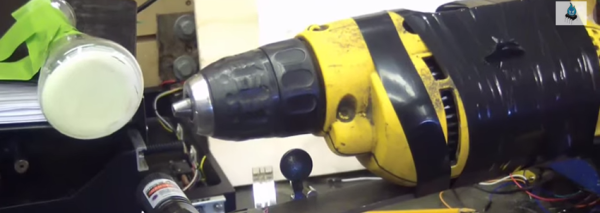
Ever the enterprising hacker and discerning tool aficionado, [Chris] knows the importance of “feel”. As a general rule, cheap tools will shake in your hand because the motors are not well-balanced. He wanted a way to quantify said feel on the cheap, and made a video describing how he was able to determine the damping of a drill using a few items most people have lying around: an earbud, a neodymium magnet, scrap steel, and Audacity.

He’s affixed the body of the drill to a cantilevered piece of scrap steel secured in a vise. The neodymium magnet stuck to the steel interrupts the magnetic field in the earbud, which is held in place with a third hand tool. [Chris] taped the drill’s trigger down and controls its speed a variac. First, [Chris] finds the natural frequency of the system using Audacity’s plot spectrum, and then gets the drill to run at the same speed to induce wobbling at different nodes. As he explains, one need not even use software to show the vibration nodes—a laser attached to the system and aimed at a phosphorescent target will plot the sine wave.

Just for fun, he severely unbalances the drill to find the frequencies at which the system will shake itself apart. Check it out after the break.

Continue reading “Dirt Cheap Motor Balancing And Vibration Analysis”