Hackaday Links Column Banner

Hackaday Links: January 25, 2026

If predictions hold steady, nearly half of the United States will be covered in snow by the time this post goes live, with the Northeast potentially getting buried under more than 18 inches. According to the National Weather Service, the “unusually expansive and long-duration winter storm will bring heavy snow from the central U.S. across the Midwest, Ohio Valley, and through the northeastern U.S. for the remainder of the weekend into Monday.” If that sounds like a fun snow day, they go on to clarify that “crippling to locally catastrophic impacts can be expected”, so keep that in mind. Hopefully you didn’t have any travel plans, as CNBC reported that more than 13,000 flights were canceled as of Friday night. If you’re looking to keep up with the latest developments, we recently came across StormWatch (GitHub repo), a slick open source weather dashboard that’s written entirely in HTML. Stay safe out there, hackers.

Speaking of travel, did you hear about Sebastian Heyneman’s Bogus Journey to Davos? The entrepreneur (or “Tech Bro” to use the parlance of our times) was in town to woo investors attending the World Economic Forum, but ended up spending the night in a Swiss jail cell because the authorities thought he might be a spy. Apparently he had brought along a prototype for the anti-fraud device he was hawking, and mistakenly left it laying on a table while he was rubbing shoulders. It was picked up by security guards and found to contain a very spooky ESP32 development board, so naturally he was whisked off for interrogation. A search of his hotel room uncovered more suspicious equipment, including an electric screwdriver and a soldering iron. Imagine if a child had gotten their hands on them?

Continue reading “Hackaday Links: January 25, 2026”

Image

High-Stakes Fox Hunting: The FCC’s Radio Intelligence Division In World War II

With few exceptions, amateur radio is a notably sedentary pursuit. Yes, some hams will set up in a national or state park for a “Parks on the Air” activation, and particularly energetic operators may climb a mountain for “Summits on the Air,” but most hams spend a lot of time firmly planted in a comfortable chair, spinning the dials in search of distant signals or familiar callsigns to add to their logbook.

There’s another exception to the band-surfing tendencies of hams: fox hunting. Generally undertaken at a field day event, fox hunts pit hams against each other in a search for a small hidden transmitter, using directional antennas and portable receivers to zero in on often faint signals. It’s all in good fun, but fox hunts serve a more serious purpose: they train hams in the finer points of radio direction finding, a skill that can be used to track down everything from manmade noise sources to unlicensed operators. Or, as was done in the 1940s, to ferret out foreign agents using shortwave radio to transmit intelligence overseas.

That was the primary mission of the Radio Intelligence Division, a rapidly assembled organization tasked with protecting the United States by monitoring the airwaves and searching for spies. The RID proved to be remarkably effective during the war years, in part because it drew heavily from the amateur radio community to populate its many field stations, but also because it brought an engineering mindset to the problem of finding needles in a radio haystack.

Continue reading “High-Stakes Fox Hunting: The FCC’s Radio Intelligence Division In World War II”

Illustrated Kristina with an IBM Model M keyboard floating between her hands.

Keebin’ With Kristina: The One With All The Espionage

[Ziddy Makes] describes this cute little guy as a biblically-accurate keyboard. For the unfamiliar, that’s a reference to biblically-accurate angels, which have wings (and sometimes eyes) all over the place. They’re usually pretty scary to behold. Don’t say I didn’t warn you.

A cube keyboard with adorably vibrant pastel keycaps.
Image by [Ziddy Makes] via GitHub
But this? This is the opposite of scary. Sure, there are keys everywhere. But it’s just so darn adorable. You know what? It’s those keycaps.

This 16-key macro cube uses a Pro Micro and a system of PH2 5p ribbon cables to connect the four four-key sisterboards to the main board. A 3D-printed base holds all the boards in place. Out of all the switches in the world, [Ziddy] chose Otemu Blues. Clack!

Although it may take some getting used to, this seems like it would be a fun way to input macros. I can see the case for putting some rubber feet on the bottom, otherwise it might scoot around on the desk. That might be cute, but only the first couple of times, you know?

Continue reading “Keebin’ With Kristina: The One With All The Espionage”

Image

It’s Numbers All The Way Down With This Tape Measure Number Station Antenna

For all their talk of cooperation and shared interests, the nations of the world put an awful lot of effort into spying on each other. All this espionage is an open secret, of course, but some of their activities are so mysterious that no one will confirm or deny that they’re doing it. We’re talking about numbers stations, the super secret shortwave radio stations that broadcast seemingly random strings of numbers for the purpose of… well, your guess is as good as ours.

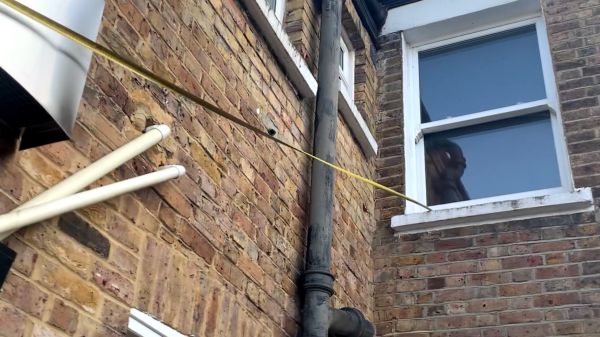
If you want to try to figure out what’s going on for yourself, all you need is a pair of tape measures and a software defined radio (SDR), as [Tom Farnell] demonstrates. Tape measure antennas have a long and proud history in amateur radio and shortwave listening, being a long strip of conductive material rolled up in a convenient package. In this case, [Tom] wanted to receive some well-known numbers stations in the 20- to 30-meter band, and decided that a single 15-meter conductor would do the job. Unlike other tape measure antennas we’ve seen, [Tom] just harvested the blades from two 7.5-meter tape measures, connected them end-to-end, and threw the whole thing out the window in sort of a “sloper” configuration. The other end is connected to an RTL-SDR dongle and a smartphone running what appears to be SDRTouch, which lets him tune directly into the numbers stations.

Copying the transmissions is pretty simple, since they transmit either in voice or Morse; the latter can be automatically decoded on a laptop with suitable software. As for what the long strings of numbers mean, that’ll remain a mystery. If they mean anything at all; we like to think this whole thing is an elaborate plan to get other countries to waste time and resources intercepting truly random numbers that encode nothing meaningful. It would serve them right.

Continue reading “It’s Numbers All The Way Down With This Tape Measure Number Station Antenna”

Image

Circumvent Facial Recognition With Yarn

Knitwear can protect you from a winter chill, but what if it could keep you safe from the prying eyes of Big Brother as well? [Ottilia Westerlund] decided to put her knitting skills to the test for this anti-surveillance sweater.

[Westerlund] explains that “yarn is a programable material” containing FOR loops and other similar programming concepts transmitted as knitting patterns. In the video (after the break) she also explores the history of knitting in espionage using steganography embedded in socks and other knitwear to pass intelligence in unobtrusive ways. This lead to the restriction of shipping handmade knit goods in WWII by the UK government.

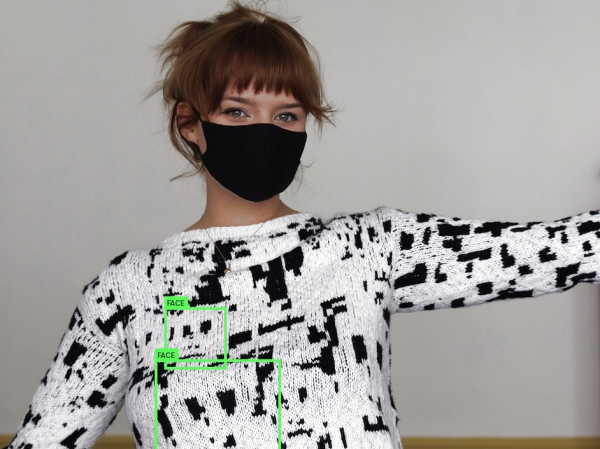
Back in the modern day, [Westerlund] took the Hyperface pattern developed by the Adam Harvey and turned it into a knitting pattern. Designed to circumvent detection by Viola-Jones based facial detection systems, the pattern presents a computer vision system with a number of “faces” to distract it from covered human faces in an image. While the knitted jumper (sweater for us Americans) can confuse certain face detection systems, [Westerlund] crushes our hope of a fuzzy revolution by saying that it is unsuccessful against the increasingly prevalent neural network-based facial detection systems creeping on our day-to-day activities.

The knitting pattern is available if you want to try your hands at it, but [Westerlund] warns it’s a bit of a pain to actually implement. If you want to try knitting and tech mashup, check out this knitting clock or this software to turn 3D models into knitting patterns.

Continue reading “Circumvent Facial Recognition With Yarn”

Image

Recreating One Of History’s Best Known Spy Gadgets

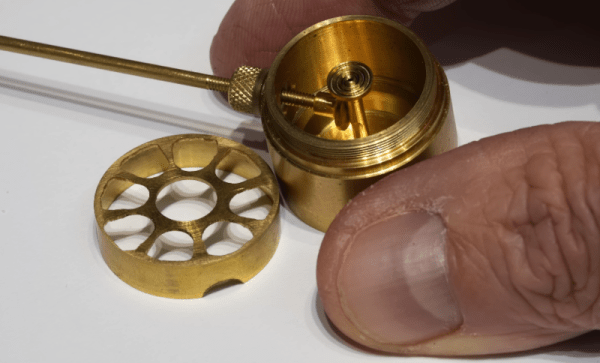
[Machining and Microwaves] got an interesting request. The BBC asked him to duplicate the Great Seal Bug — the device the Russians used to listen covertly to the US ambassador for seven years in 1945. Turns out they’re filming a documentary on the legendary surveillance device and wanted to demonstrate how it worked.

The strange thing about the bug is that it wasn’t directly powered. It was actually a resonant cavity that only worked when it was irradiated with an external RF energy. Most of the video is background about the bug, with quite a few details revealed. We particularly liked the story of using a software defined radio (SDR) to actually make the bug work.

As you might expect, things didn’t go smoothly. Did they ever get results on camera? Watch the video, and you can find out. This is just the first of six videos he plans to make on the topic, and we can’t wait for future videos that cover the machining and more technical details.

We’ve examined the Theremin bug before. There’s a definite cat-and-mouse dynamic between creating bugging devices and detecting them.

Continue reading “Recreating One Of History’s Best Known Spy Gadgets”

Image

Number Stations Gone Wild

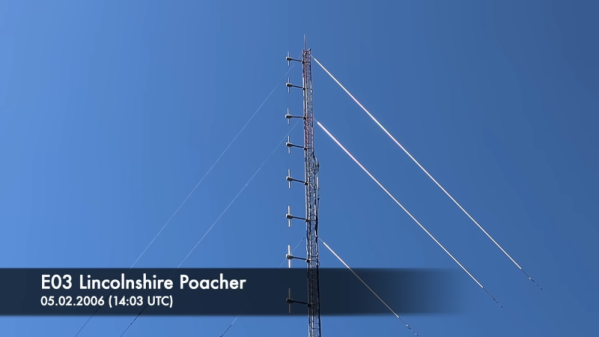
[Ringway Manchester] has an interest in numbers stations. These mysterious stations send presumably coded numbers or other coded information. However, it is rare that anyone claims credit for these stations. Normally they operate with military-like precision, adhering to strict operating schedules and sending out their messages error-free. [Ringway] looks at five times when things didn’t go as planned for these spy stations.

Perhaps it isn’t surprising, however, as machines have likely replaced human operators. That makes them prone to errors when the computers go awry. Many of the errors are ones of frequency, where two number stations wind up transmitting at once. We suppose spies all use the same few frequencies. Some, however, also had computers go haywire and start going through the alphabet which, of course, could have been part of some secret message protocol, but appeared more likely to be a simple mistake.

We were amused, though, to hear the story of a Czech spy station that not only had a licensed call sign but would send QSL cards to people who reported reception. Perhaps they didn’t get the memo about secrecy!

We’ve listened to a few number stations in our time. If you don’t have a suitable antenna, you can always try hunting them online. But don’t expect to catch them making any mistakes.

Continue reading “Number Stations Gone Wild”