Image

Skimming Satellites: On The Edge Of The Atmosphere

There’s little about building spacecraft that anyone would call simple. But there’s at least one element of designing a vehicle that will operate outside the Earth’s atmosphere that’s fairly easier to handle: aerodynamics. That’s because, at the altitude that most satellites operate at, drag can essentially be ignored. Which is why most satellites look like refrigerators with solar panels and high-gain antennas attached jutting out at odd angles.

But for all the advantages that the lack of meaningful drag on a vehicle has, there’s at least one big potential downside. If a spacecraft is orbiting high enough over the Earth that the impact of atmospheric drag is negligible, then the only way that vehicle is coming back down in a reasonable amount of time is if it has the means to reduce its own velocity. Otherwise, it could be stuck in orbit for decades. At a high enough orbit, it could essentially stay up forever.

Image
Launched in 1958, Vanguard 1 is expected to remain in orbit until at least 2198

There was a time when that kind of thing wasn’t a problem. It was just enough to get into space in the first place, and little thought was given to what was going to happen in five or ten years down the road. But today, low Earth orbit is getting crowded. As the cost of launching something into space continues to drop, multiple companies are either planning or actively building their own satellite constellations comprised of thousands of individual spacecraft.

Fortunately, there may be a simple solution to this problem. By putting a satellite into what’s known as a very low Earth orbit (VLEO), a spacecraft will experience enough drag that maintaining its velocity requires constantly firing its thrusters.  Naturally this presents its own technical challenges, but the upside is that such an orbit is essentially self-cleaning — should the craft’s propulsion fail, it would fall out of orbit and burn up in months or even weeks. As an added bonus, operating at a lower altitude has other practical advantages, such as allowing for lower latency communication.

VLEO satellites hold considerable promise, but successfully operating in this unique environment requires certain design considerations. The result are vehicles that look less like the flying refrigerators we’re used to, with a hybrid design that features the sort of aerodynamic considerations more commonly found on aircraft.

Continue reading “Skimming Satellites: On The Edge Of The Atmosphere”
Image

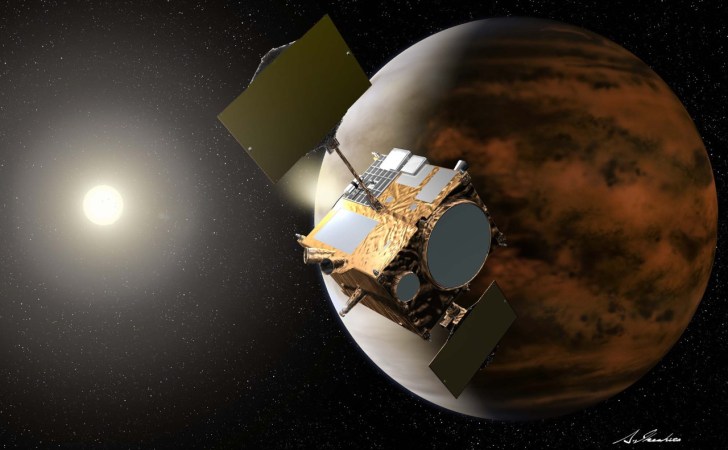
Venus Climate Orbiter Akatsuki’s Mission Has Ended

Japan’s Venus Climate Orbiter Akatsuki was launched on May 21, 2010, and started its active mission in 2015 after an initial orbital insertion failure. Since that time, Akatsuki has continuously observed Venus from orbit until issues began to crop up in 2024 when contact was lost in April of that year due to attitude control issues. Japan’s space agency, JAXA, has now announced that the mission has officially ended on September 18, 2025, after a period of trying to coax the spacecraft back into some level of functionality again.

The Akatsuki spacecraft in 2010 before its launch. (Credit: JAXA)

The Akatsuki spacecraft had six instruments, consisting of cameras covering the visible spectrum, ultraviolet and infrared spectra, as well as an oscillator for radio occultation experiments.

All primary mission goals were successfully completed in April of 2018, but engineers determined Akatsuki was capable of lasting at least another few years. This puts it well past its original design lifespan, and has provided us with much more scientific data than we could have hoped for.

Unfortunately, the shutdown of Akatsuki represents the end of the last active Venus mission, with much uncertainty surrounding any potential upcoming mission to Earth’s near-twin planet. The next potential mission is the Venus Life Finder, as an atmospheric mission penciled in for a 2026 launch. It would take at least until 2028 for a potential orbiter mission to launch, so for the foreseeable future Venus will be left alone, without its artificial moon that has kept it company for a decade.

Image

Japan’s First Commercial Rocket Debuts With A Bang

Though it suffered through decades of naysayers, these days you’d be hard pressed to find anyone who would still argue that the commercialization of space has been anything but a resounding success for the United States. SpaceX has completely disrupted what was a stagnant industry — of the 108 US rocket launches in 2023, 98 of them were performed by the Falcon 9. Even the smaller players, such as Rocket Lab and Blue Origin, are innovating and bringing new technologies to market at a rate which the legacy aerospace companies haven’t been able to achieve since the Space Race.

ImageSo it’s no surprise that other countries are looking to replicate that success. Japan in particular has been following NASA’s playbook by offering lucrative space contracts to major domestic tech companies such as Mitsubishi, Honda, NEC, Toyota, Canon, Kyocera, and Sumitomo. Over the last several years this has resulted in the development of a number spacecraft and missions, such as the Hakuto-R Moon lander. It’s also laid the groundwork for exciting future projects, like the crewed lunar rover Toyota and Honda are jointly developing for the Artemis program.

But so far there’s been a crucial element missing from Japan’s commercial space aspirations, an orbital booster rocket. While the country has state-funded launch vehicles such as the H-IIA and H3 rockets, they come with the usual bureaucracy one would expect from a government program. In comparison, a privately developed and operated booster holds the promise of reduced costs and a higher launch cadence, especially if there are multiple competing vehicles on the market.

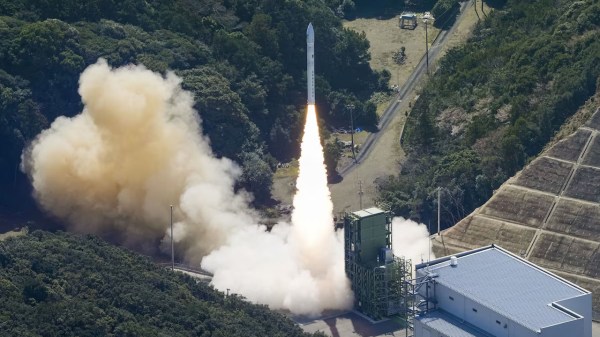
With the recent test flight of Space One’s KAIROS rocket, that final piece of the puzzle may finally be falling into place. While the launch unfortunately failed shortly after liftoff, the fact that the private rocket was able to get off the ground — literally and figuratively — is a promising sign of what’s to come.

Continue reading “Japan’s First Commercial Rocket Debuts With A Bang”

Image

Lunar Rover Is No Toy

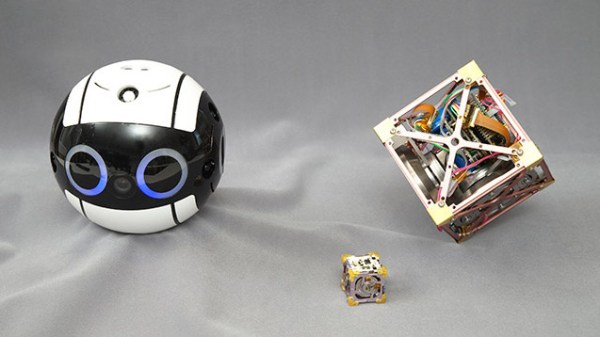
When you think of Tomy — more properly, Takara Tomy — you think of toys and models from Japan. After all, they have made models and toys as iconic as Transformers, Thomas, Jenga, Boggle, and Furby. They also made figures associated with Thunderbirds and Tron, two favorites in our circles. However, their recent design for SORA-Q is no toy. It is a tiny lunar rover designed at the request of JAXA, the Japanese space agency. The New Yorker recently posted about how this little rover came about.

The SORA-Q looks a bit like a modern Star Wars drone or — if it could fly — a training drone from some of the older movies. The rover caught a lift from a SpaceX Falcon 9 towards the moon with the Hakuto-R M1 lander. Another SORA-Q is scheduled to touch down later this year.

Continue reading “Lunar Rover Is No Toy”

Hackaday Links Column Banner

Hackaday Links: January 8, 2023

Something odd is afoot in the mountains around Salt Lake City, Utah, at least according to local media reports of remote radio installations that have been popping up for at least the past year. The installations consist of a large-ish solar panel, a weatherproof box full of batteries — and presumably other electronics, including radios — and a mast bearing at least one antenna. Local officials aren’t quite sure who these remote setups belong to or what they’re intended to do, but the installations obviously represent a huge investment in resources.

The one featured in the story was located near the summit of Twin Peaks, which is about 11,000 feet (3,300 meters) in elevation, which with that much gear was probably a hell of a hike. Plus, the owner took great pains to make sure the site would withstand the weather, with antenna mast guy wires that must have required lugging a pretty big drill up with them. There aren’t any photos of the radios in the enclosure, but one photo shows a 900-MHz LORA antenna, while another shows what appears to be a panel antenna, perhaps pointing toward another site. So maybe a LORA mesh network? Some comments in the Twitter thread show most people are convinced this is a Helium crypto mining rig, but the Helium Explorer doesn’t show any hotspots listed in that area. Either way, the owners are out of luck, since their gear is being removed if it’s on public land.

Continue reading “Hackaday Links: January 8, 2023”

Image

Crowd Funded Jumping Cubes

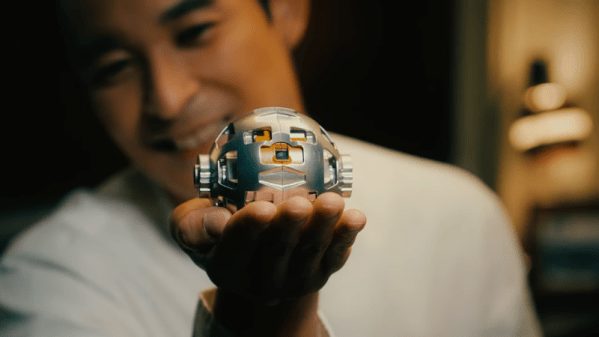
The Japan Aerospace Exploration Agency (JAXA) recently contributed their Int-Ball  technology to a Kickstarter campaign operated by the Japanese electronics manufacturer / distributor Bit Trade One (Japanese site). This technology is based on the Cubli project out of the Swiss Federal Institute of Technology in Zurich (ETH Zurich), which we covered back in 2013. The Cubli-based technology has been appearing in various projects since then, including the Nonlinear Mechatronic Cube in 2016.  Alas, the current JAXA-based “3-Axis Attitude Control Module” project doesn’t have a catchy name — yet.

One interesting application of these jumping cubes, presumably how JAXA got involved with these devices, is a floating video camera that was put to use on board the International Space Station (ISS) in 2017.  The version being offered by the Kickstarter campaign doesn’t include the cameras, and you will need to provide your own a gravity-free environment to duplicate that application.  Instead, they seem to be marketing this for educational uses.  You’d better dig deep in your wallet if you want one — a fully assembled unit requires a pledge of over $5000 ( there is a “some assembly required” kit that can save you about $1000 ).  Most of us won’t be backing this project for that reason alone, but it is nice to see the march of progress of such a cool technology:  from inception to space applications to becoming available to the general public.  Thanks to [Lincoln Uehara] for sending in this tip.

Continue reading “Crowd Funded Jumping Cubes”

Image

Travel To Mercury On Ion Power

Star Trek — as much as we love it — was guilty sometimes of a bit of hyperbole and more than its share of inconsistency. In some episodes, ion drives were advanced technology and in others they were obsolete. Make up your mind!

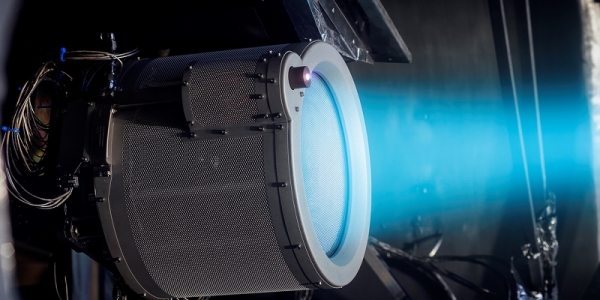
The ESA-JAXA BepiColombo probe is on its way to Mercury riding on four ion thrusters developed by a company called QinetiQ. But unlike the ion drive featured in the infamous “Spock’s Brain” episode, BepiColombo will take over seven years to get to Mercury. That’s because these ion drives are real.

The craft is actually two spacecraft in one with two different Mercury missions. The Mercury planetary orbiter will study the surface while the magnetosphere orbiter will study the little planet’s magnetic field. Check out a video about the mission, below. The second video shows [Neil Wallace] talking about how the ion propulsion — also known as solar electric engines — differ from traditional chemical thrusters.

Continue reading “Travel To Mercury On Ion Power”