Image

This Unlikely Microsoft Prediction Might Just Hit The Mark

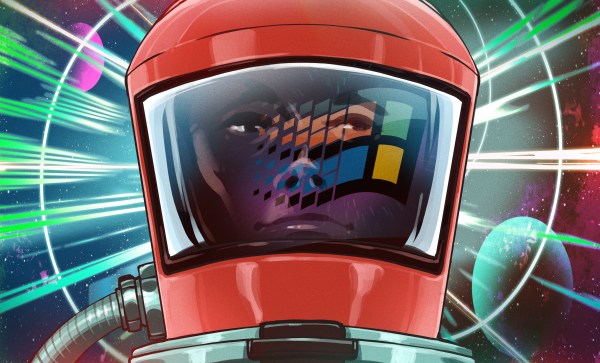
It’s fair to say that there are many people in our community who just love to dunk on Microsoft Windows. It’s an easy win, after all, the dominant player in the PC operating system market has a long history of dunking on free software, and let’s face it, today’s Windows doesn’t offer a good experience. But what might the future hold? [Mason] has an unexpected prediction: that Microsoft will eventually move towards offering a Windows-themed Linux distro instead of a descendant of today’s Windows.

The very idea is sure to cause mirth, but on a little sober reflection, it’s not such a crazy one. Windows 11 is slow and unfriendly, and increasingly it’s losing the position once enjoyed by its ancestors. The desktop (or laptop) PC is no longer the default computing experience, and what to do about that must be a big headache for the Redmond company. Even gaming, once a stronghold for Windows, is being lost to competitors such as Valve’s Steam OS, so it wouldn’t be outlandish for them to wonder whether the old embrace-and-extend strategy could be tried on the Linux desktop.

We do not possess a working crystal ball here at Hackaday, so we’ll hold off hailing a Microsoft desktop Linux. But we have to admit it’s not an impossible future, having seen Apple reinvent their OS in the past using BSD, and even Microsoft bring out a cloud Linux distro. If you can’t wait, you’ll have to make do with a Windows skin, WINE, and the .NET runtime on your current Linux box.
Image

2025: As The Hardware World Turns

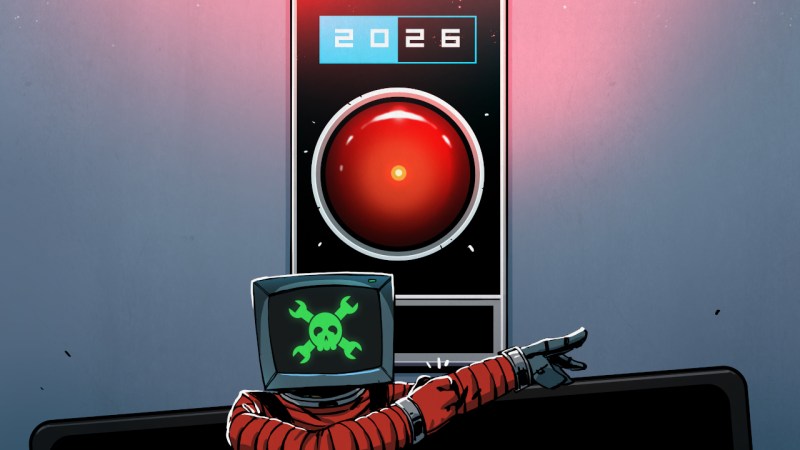
If you’re reading this, that means you’ve successfully made it through 2025! Allow us to be the first to congratulate you — that’s another twelve months of skills learned, projects started, and hacks….hacked. The average Hackaday reader has a thirst for knowledge and an insatiable appetite for new challenges, so we know you’re already eager to take on everything 2026 has to offer.

But before we step too far into the unknown, we’ve found that it helps to take a moment and reflect on where we’ve been. You know how the saying goes: those that don’t learn from history are doomed to repeat it. That whole impending doom bit obviously has a negative connotation, but we like to think the axiom applies for both the lows and highs in life. Sure you should avoid making the same mistake twice, but why not have another go at the stuff that worked? In fact, why not try to make it even better this time?

As such, it’s become a Hackaday tradition to rewind the clock and take a look at some of the most noteworthy stories and trends of the previous year, as seen from our rather unique viewpoint in the maker and hacker world. With a little luck, reviewing the lessons of 2025 can help us prosper in 2026 and beyond.

Continue reading “2025: As The Hardware World Turns”

Image

FPGA Dev Kit Unofficially Brings MSX Standard Back

In the 1980s there were an incredible number of personal computers of all shapes, sizes, and operating system types, and there was very little interoperability. Unlike today’s Windows-Mac duopoly, this era was much more of a free-for-all but that didn’t mean companies like Microsoft weren’t trying to clean up all of this mess. In 1983 they introduced the MSX standard for computers, hoping to coalesce users around a single design. Eventually it became very successful in Japan and saw some use in a few other places but is now relegated to the dustbin of history, but a new FPGA kit unofficially supports this standard.

The kit is called the OneChip Book and, unlike most FPGA kits, includes essentially everything needed to get it up and running including screen, keyboard, and I/O all in a pre-built laptop case. At its core it’s just that: and FPGA kit. But its original intent was to recreate this old 80s computer standard with modern hardware. The only problem is they never asked for permission, and their plans were quickly quashed. The development kit is still available, though, and [electricadventures] goes through the steps to get this computer set up to emulate this unofficially-supported retro spec. He’s also able to get original MSX cartridges running on it when everything is said and done.

Although MSX is relatively unknown in North America and Western Europe, it remains a fairly popular platform for retro computing enthusiasts in much of the rest of the world. We’ve seen a few similar projects related to this computer standard like this MSX-inspired cyberdeck design, but also others that bring new hardware to this old platform.

Continue reading “FPGA Dev Kit Unofficially Brings MSX Standard Back”

Image

Microsoft Open Sources Zork I, II And III

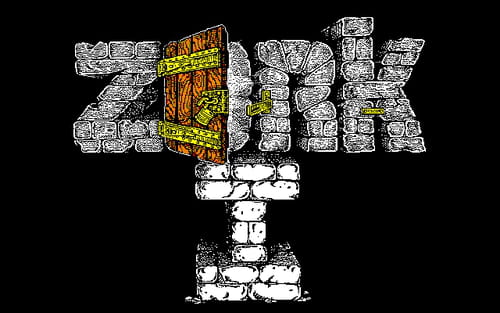
The history of the game Zork is a long and winding one, starting with MUDs and kin on university mainframes – where students entertained themselves in between their studies – and ending with the game being ported to home computers. These being pathetically undersized compared to even a PDP-10 meant that Zork got put to the axe, producing Zork I through III. Originally distributed by Infocom, eventually the process of Microsoft gobbling up game distributors and studios alike meant that Microsoft came to hold the license to these games. Games which are now open source as explained on the Microsoft Open Source blog.

Although the source had found its way onto the Internet previously, it’s now officially distributed under the MIT license, along with accompanying developer documentation. The source code for the three games can be found on GitHub, in separate repositories for Zork I, Zork II and Zork III.

We previously covered Zork’s journey from large systems to home computers, which was helped immensely by the Z-machine platform that the game’s code was ported to. Sadly the original games’s MDL code was a bit much for 8-bit home computers. Regardless of whether you prefer the original PDP-10 or the Z-machine version on a home computer system, both versions are now open sourced, which is a marvelous thing indeed.

Image

Iconic Xbox Prototype Brought To Life

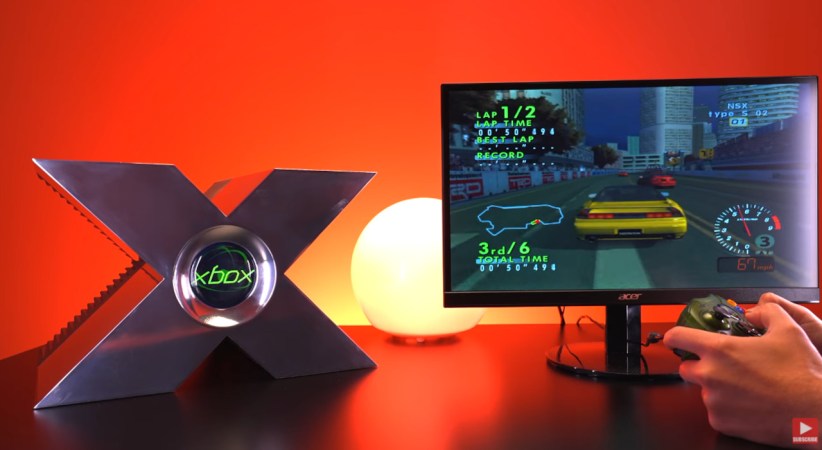
When Microsoft decided they wanted to get into the game console market, they were faced with a problem. Everyone knew them as a company that developed computer software, and there was a concern that consumers wouldn’t understand that their new Xbox console was a separate product from their software division. To make sure they got the message though, Microsoft decided to show off a prototype that nobody could mistake for a desktop computer.

The giant gleaming X that shared the stage with Bill Gates and Seamus Blackley at the 2000 Game Developers Conference became the stuff of legend. We now know the machine wasn’t actually a working Xbox, but at the time, it generated enormous buzz. But could it have been a functional console? That’s what [Tito] of Macho Nacho Productions wanted to find out — and the results are nothing short of spectacular.

Continue reading “Iconic Xbox Prototype Brought To Life”

Image

Microsoft BASIC For 6502 Is Now Open Source

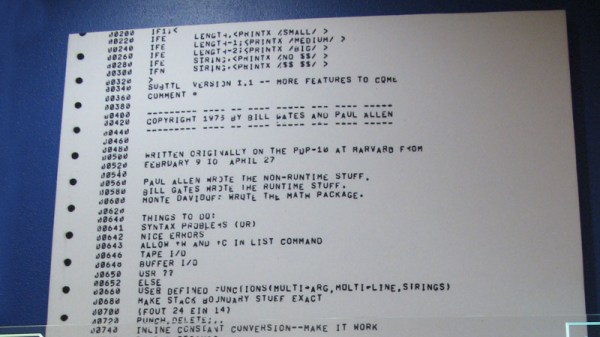
An overriding memory for those who used 8-bit machines back in the day was of using BASIC to program them. Without a disk-based operating system as we would know it today, these systems invariably booted into a BASIC interpreter. In the 1970s the foremost supplier of BASIC interpreters was Microsoft, whose BASIC could be found in Commodore and Apple products among many others. Now we can all legally join in the fun, because the software giant has made version 1.1 of Microsoft BASIC for the 6502 open source under an MIT licence.

This version comes from mid-1978, and supports the Commodore PET as well as the KIM-1 and early Apple models. It won’t be the same as the extended versions found in later home computers such as the Commodore 64, but it still provides plenty of opportunities for retrocomputer enthusiasts to experiment. It’s also not entirely new to the community, because it’s a version that has been doing the rounds unofficially for a long time, but now with any licensing worries cleared up. A neat touch can be found in the GitHub repository, with the dates on the files being 48 years ago.

We look forward to seeing what the community does with this new opportunity, and given that the 50-year-old 6502 is very much still with us we expect some real-hardware projects. Meanwhile this isn’t the first time Microsoft has surprised us with an old product.


Header image: Michael Holley, Public domain.

Image

Rediscovering Microsoft’s Oddball Music Generator From The 1990s

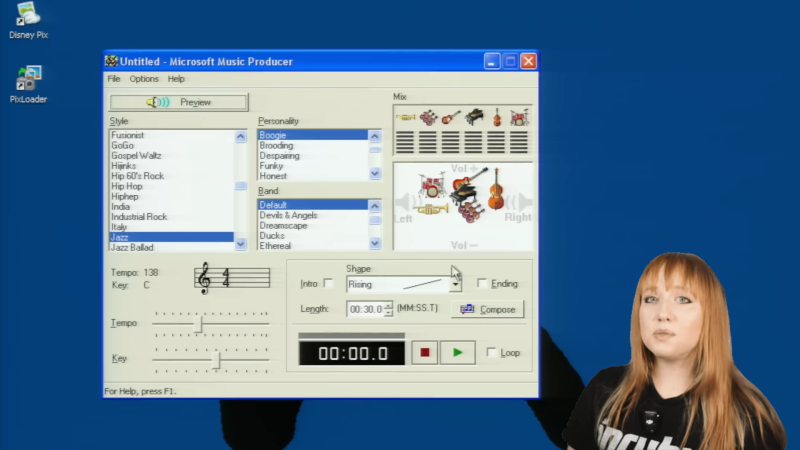
There has been a huge proliferation in AI music creation tools of late, and a corresponding uptick in the number of AI artists appearing on streaming services. Well before the modern neural network revolution, though, there was an earlier tool in this same vein. [harke] tells us all about Microsoft Music Producer 1.0, a forgotten relic from the 1990s.

The software wasn’t ever marketed openly. Instead, it was a part of Microsoft Visual InterDev, a web development package from 1997. It allowed the user to select a style, a personality, and a band to play the song, along with details like key, tempo, and the “shape” of the composition. It would then go ahead and algorithmically generate the music using MIDI instruments and in-built synthesized sounds.

As [harke] demonstrates, there are a huge amounts of genres to choose from. Pick one, and you’ll most likely find it sounds nothing like the contemporary genre it’s supposed to be recreating. The more gamey genres, though, like “Adventure” or “Chase” actually sound pretty okay. The moods are hilariously specific, too — you can have a “noble” song, or a “striving” or “serious” one. [harke] also demonstrates building a full song with the “7AM Illusion” preset, exporting the MIDI, and then adding her own instruments and vocals in a DAW to fill it out. The result is what you’d expect from a composition relying on the Microsoft GS Wavetable synth.

Microsoft might not have cornered the generative music market in the 1990s, but generative AI is making huge waves in the industry today.

Continue reading “Rediscovering Microsoft’s Oddball Music Generator From The 1990s”