Image

Commodore 64 Helps Revive The BBS Days

Before the modern Internet existed, there were still plenty of ways of connecting with other computer users “online”, although many of them might seem completely foreign to those of us in the modern era. One of those systems was the Bulletin Board System, or BBS, which would have been a single computer, often in someone’s home, connected to a single phone line. People accessing the BBS would log in if the line wasn’t busy, leave messages, and quickly log out since the system could only support one user at a time. While perhaps a rose-tinted view, this was a more wholesome and less angsty time than the modern algorithm-driven Internet, and it turns out these systems are making a bit of a comeback as a result.

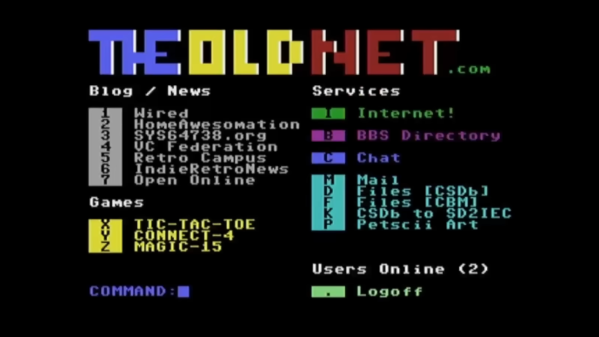
The video by [The Retro Shack] sets up a lot of this history for context, then, towards the end, uses a modern FPGA-based recreation called the Commodore 64 Ultimate to access a BBS called The Old Net, a modern recreation of what these 80s-era BBS systems were like. This involves using a modern networking card that allows the C64 to connect to Wi-Fi access points to get online instead of an old phone modem, and then using a terminal program called CCGMS to connect to the BBS itself. Once there, users can access mail, share files, and even play a few games.

While the video is a very basic illustration of how these BBS systems worked and how to access one, it is notable in that it’s part of a trend of rejecting more modern technology and systems in favor of older ones, where the users had more control. A retro machine like a C64 or Atari is not required either; modern operating systems can access these with the right terminal program, too. A more in-depth guide to the BBS can be found here for those looking to explore, and we’ve also seen other modern BBS systems recently.

Thanks to [Charlie] for the tip!
Continue reading “Commodore 64 Helps Revive The BBS Days”

Image

Dog Plays Chess On ESP32

The ESP32 is s remarkably powerful microcontroller, where its dual-core processor and relatively high clock speed can do some impressive work. But getting this microcontroller designed for embedded systems to do tasks that would generally be given to a much more powerful PC-type computer takes a little bit more willpower. Inspired by his dog, [Folkert] decided to program an ESP32 to play chess, a famously challenging task for computer scientists in the past. He calls this ESP32 chess system Dog.

One of the other major limitations of this platform for a task like this is memory. The ESP32 [Folkert] is using only has 320 kB of RAM, so things like the transposition table have to fit in even less space than that. With modern desktop computers often having 32 or 64 GB, this is a fairly significant challenge, especially for a memory-intensive task like a chess engine. But with the engine running on the microcontroller it’s ready to play, either in text mode or with something that can use the Universal Chess Interface (UCI). A set of LEDs on the board lets the user know what’s going on while gameplay is taking place.

Continue reading “Dog Plays Chess On ESP32”

Image

Remembering CompuServe: The Online Experience Before The World Wide Web

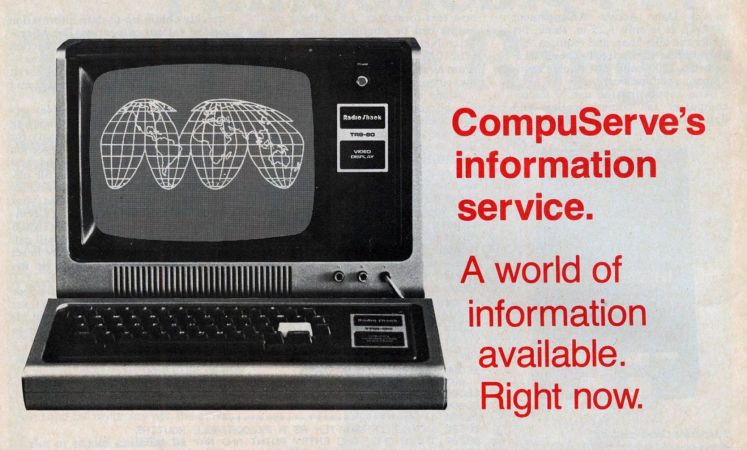
July 1981 cover of CompuServe's magazine.
July 1981 cover of CompuServe’s magazine.

Long before the advent of the Internet and the World Wide Web, there were other ways to go online, with Ohio-based CompuServe being the first to offer a consumer-oriented service on September 24, 1979. In an article by [Michael De Bonis] a listener-submitted question to WOSU’s Curious Cbus is answered, interspersed with recollections of former users of the service. So what was CompuServe’s contribution to society that was so important that the state of Ohio gave historical status to the building that once housed this company?

The history of CompuServe and the consumer-facing services which it would develop started in 1969, when it was a timesharing and remote access service for businesses who wanted to buy some time on the PDP-10s that Golden United Life Insurance as the company’s subsidiary used. CompuServe divested in 1975 to become its own, NASDAQ-listed company. As noted in the article, while selling timeshares to businesses went well, after business hours they would have these big computer systems sitting mostly idly. This was developed by 1979 into a plan to give consumers with their newfangled microcomputers like the TRS-80 access.

Originally called MicroNet and marketed by Radio Shack, the service offered the CompuServe menu to users when they logged in, giving access to features like email, weather, stock quotes, online shipping and booking of airline tickets, as well as online forums and interactive text games.

Later renamed to CompuServe Information Service (CIS), it remained competitive with competitors like AOL and Prodigy until the mid-90s, even buying one competitor called The Source. Ultimately it was the rise of Internet and the WWW that would close the door on this chapter of computing history, even as for CompuServe users this new Internet age would have felt very familiar, indeed.

Image

How Facebook Killed Online Chat

In the early days of the internet, online conversations were an event. The technology was novel, and it was suddenly possible to socialize with a whole bunch of friends at a distance, all at once. No more calling your friends one by one, you could talk to them all at the same time!

Many of us would spend hours on IRC, or pull all-nighters bantering on MSN Messenger or AIM. But then, something happened, and many of us found ourselves having shorter conversations online, if we were having any at all. Thinking back to my younger days, and comparing them with today, I think I’ve figured out what it is that’s changed.

Continue reading “How Facebook Killed Online Chat”

Image

Turn On Sarcasm With The Flip Of A Switch

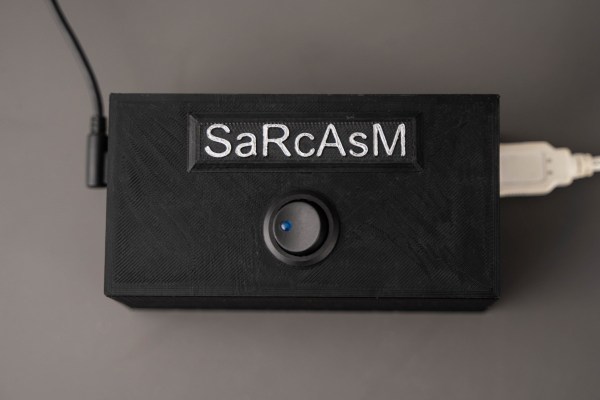
Sarcasm is notoriously difficult to distinguish in online communities. So much, in fact, that a famous internet rule called Poe’s Law is named after the phenomenon. To adapt, users have adopted several methods for indicating implied sarcasm such as the /s tag, but more recently a more obvious sarcasm indicator has appeared that involves random capitalization througout the sarcastic phrase. While this looks much more satisfying than other methods, it is a little cumbersome to type unless you have this sarcasm converter for your keyboard.

The device, built by [Ben S], is based around two Raspberry Pi Pico development boards and sits between a computer and any standard USB keyboard. The first Pi accepts the USB connection from the keyboard and reads all of the inputs before sending what it reads to the second Pi over UART. If the “SaRcAsM” button is pressed, the input text stream is converted to sarcasm by toggling the caps lock key after every keystroke.

For communicating in today’s online world with rapidly changing memes, a device like this is almost necessary for making sure you aren’t misunderstood on whichever popular forum you like to frequent. We don’t know how long this trend will continue, either, but until something else replaces it to more concisely communicate sarcasm we expect it to remain relevant. The build is also a reminder of the various interesting ways that microcontrollers can be programmed to act as keyboards.

Thanks to [ted yapo] for the tip!

Image

The Second Worst CAD Package Ever

A while back, [Heavydeck] remembered stumbling across the worst CAD package ever, which is a schematic editor whose existence was purely intended for use to make quick circuit sketches for documentation, presentations and the like. All good. But, being based on low quality JPEG graphics, which when blown up to projector size on a big screen, they look really rough. After deciding that the original nasty, clunky interface was just nasty and clunky enough, [Heavydeck] then proceeded to reimplement the idea over the course of an afternoon, and came up with Kludge (possibly the second worst CAD package ever) making an actually useful tool even more useful.

You see, whether you make website content, YouTube tutorials, or just need to write technical reports, if you’re in the electronics business, you’re going to need to make high-quality editable schematic images at some point, and Kludge might well solve some problems for you. Kludge lets you do so many things; you can save a schematic, you can load a schematic, you can even export it to an SVG file. Actually, that’s all you can do, but it is actually just enough. Once you’ve got an image as an SVG, you can whack that into Inkscape to add some more details and you’re done. We demonstrate this with the image above, which was not annoying at all to create.

So here’s to Kludging your way around a problem, and hoping that the somewhat limited symbol library may expand a little more in the future!

Image

A Bullet For The Digital You

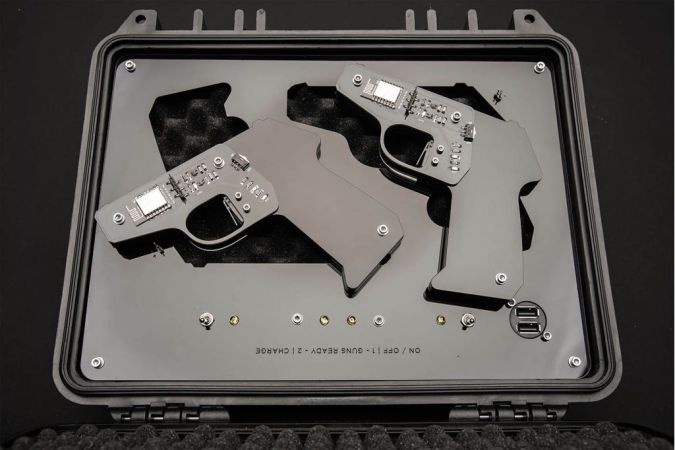
Harkening back to a not-so-distant past where duels settled arguments, [Joris Wegner] put a twist on the idea of quarrels with a gun that damages your online persona rather than your physical one. The controversy of social media is nothing new, but most people today have a large percentage of their lives online. A gun that can destroy your social media by deleting your account feels far more potent than most would like to admit.

At the heart of this build, each gun contains a battery-powered ESP8266 that connects to another ESP8266 in the gun case, which in turn is connected to a computer. When a trigger is pulled, the computer deletes the Facebook account with the credentials stored on the gun. It offers a new look at the importance of one’s social media presence. While the concept of being attacked on social media is nothing new, the idea of digitally dying on social media is perhaps something new. This particular project was put on hold when [Joris] realized that Facebook accounts can be reactivated after 30 days, which renders the gesture less potent.

Playful and interesting twists on the idea of a gun are nothing new here on Hackaday. We’ve seen also [Joris’] work before with a MIDI-controlled video distortion box.