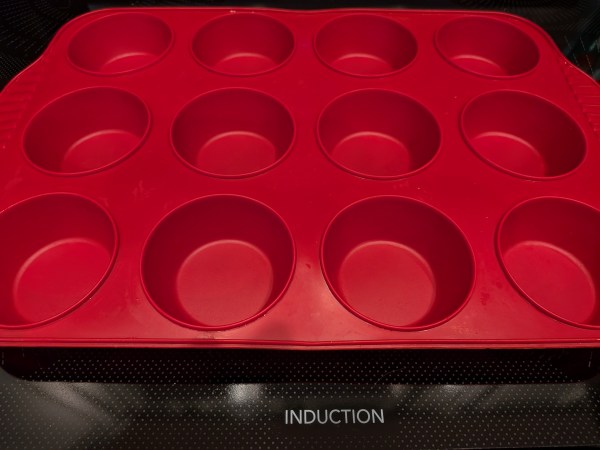
A red silicone cupcake pan sits on a black glass inductive stove cooktop. The word induction is written in white text on the glass of the stove.

Silicone Bakeware Might Be Bad For Your Liver

Silicone bakeware has become a staple in many kitchens due to its flexible, yet temperature-tolerant nature. New research from Canada shows it could be causing trouble for your liver and lungs, however.

The siloxanes that make up silicone bakeware can target “the liver through oral exposure, as well as the liver and lungs through inhalation exposure.” The fat content of the food being baked is also a factor as these compounds are lipophilic, so higher fat foods will absorb more siloxanes than lower fat foods.

Don’t throw out all your silicone yet, though. The researchers say, “the results showed a consistent decreasing trend in migration levels across consecutive weekly baking sessions, with no increase after the seven-month interval.” So, that dingy looking silicone mat you’ve used a hundred times is safer than a brand new, brightly-colored one.

This seems like an example of how glass and (non-heavy) metal are usually the best way to go when handling food. While we’re talking about ovens, do they really need to run a connectivity check? They certainly could be improved with a DIY thermometer or by making a more practical solar-powered example.

Image

This Machine Learning Algorithm Is Meta

Suppose you ran a website releasing many articles per day about various topics, all following a general theme. And suppose that your website allowed for a comments section for discussion on those topics. Unless you are brand new to the Internet, you’ll also imagine that the comments section needs at least a little bit of moderation to filter out spam, off topic, or even toxic comments. If you don’t want to employ any people for this task, you could try this machine learning algorithm instead.

[Ladvien] goes through a general overview of how to set up a convolutional neural network (CNN) which can be programmed to do many things, but this one crawls a web page, gathers data, and also makes decisions regarding that data. In this case, the task is to identify toxic comments but the goal is not to achieve the sharpest sword in the comment moderator’s armory, but to learn more about how CNNs work.

Written in Python, the process outlines the code itself and how it behaves, setting up a small server to host the neural network, and finally creating the webservice. As with any machine learning, you need a reliable dataset to use for training and this one came from Wikipedia comments previously flagged by humans. Trolling nuance is thrown aside, as the example homes in on blatant insults and vulgarity.

While [Ladvien] notes that his guide isn’t meant to be comprehensive, but rather to fill in some gaps that he noticed within other guides like this, we find this to be an interesting read. He also mentioned that, in theory, this tool could be used to predict the number of comments following an article like this very one based on the language in the article. We’ll leave that one as an academic exercise for now, probably.

Image

Detect Elevated Carbon Monoxide (Levels)

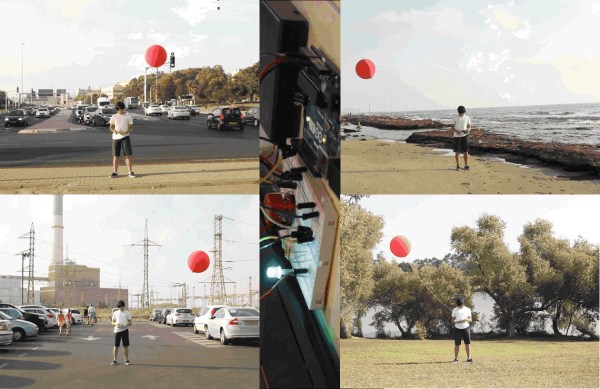
The molar mass of carbon monoxide (CO) is 28.0, and the molar mass of air is 28.8, so CO will rise in an ambient atmosphere. It makes sense to detect it farther from the ground, but getting a tall ladder is not convenient and certainly doesn’t make for fast deployment. What do you do if you don’t care for heights and want to know the CO levels in a gymnasium or a tall foyer? Here to save the day, is the Red Balloon Carbon Monoxide Detector.

Circuit.io generates the diagram and code to operate the CO sensor and turn a healthy green light to a warning red if unsafe levels are detected. The user holds the batteries, Arduino, and light while a red balloon lifts the sensor up to fifteen feet, or approximately five three meters. It is an analog sensor which needs some time to warm up so it pays to be warned about that wire length and startup.

Having a CO sentinel is a wise choice for this odorless gas.

Continue reading “Detect Elevated Carbon Monoxide (Levels)”