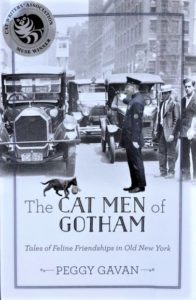


The following story of Old New York features a cat stuck in a tree on West 115th Street, two little boys named Kennedy and Abraham Lincoln, a Harlem police cat named Tom Findlay, a hefty police officer, two spiritual leaders named Father Divine and Sweet Daddy Grace, a Harlem cow pasture, the King Towers (NYCHA housing), a 600-pound fruit salad, a war on rats, and an annual baptism by fire hose.
Yep, this one is not your average cat story. And it’s all true.
Our story begins on Saturday, December 12, 1908. This is the day a well-known neighborhood stray cat called Haggerino the Tramp climbed to the top of a 60-foot tree in the back yard of 24 West 115th Street. I’m not sure what possessed the cat to climb so high, but once he reached the top, he was too scared to come back down.
For two days, Haggerino howled from the top of the tree. Real estate salesman Harris Fine and his son, Julius, who lived in the ornate brownstone at 24 West 115th Street, thought it was a burglar at first. Dr. Isaac Davidson at 22 West 115th Street and other nearby neighbors thought it was a rabid raccoon or someone being murdered. Then they looked up and saw the large white cat in the tree.
While some folks went to their roofs and began throwing old shoes and tomato cans at the cat, Dr. Davidson suggested they call the police squad. When Police Officer Coogan of the 104th Street station arrived (as the press noted, Coogan was not a squad, although he did weigh about 300 pounds), he took one look at the cat and refused to climb the tree. He suggested that the residents call the SPCA.

On Monday morning, two days after Haggerino climbed the tree, a 12-year-old boy named Rollo Kennedy put on his badge from the Junior League of the SPCA and told his mom that it was now his responsibility to rescue the cat. He called for his friend, Abraham Lincoln Selig, also a Junior League badge holder, to join him on his mission to relieve the poor cat of its sufferings.
When the boys arrived at the base of the tree, Rollo told his friend about his plan to rescue the cat: they would ask to borrow the Harlem police station cat, Tom Findlay, who would surely protect and serve a fellow feline. Getting permission from the men to take Tom, the boys placed the cat in a basket and carried him to the tree.
Upon hearing and seeing Haggerino in the tree, Tom Findlay also started to howl. His feline sirens encouraged Haggerino to begin his descent from the tree.
But just as the white cat got a few feet from the ground, Tom leaped up and began hissing. Resisting arrest for causing a public nuisance, Haggerino began wrestling his would-be rescuer.
Rollo watched in sorrow as the male cats jumped over a wall and disappeared down the street, knowing he was responsible for losing Tom Findlay, the pride of the Harlem police. (In 1909, the Harlem police had two police cats named Pete and Claude; I do not know if Tom ever found his way back.)
The Remarkable History of 24 West 115th Street
This concludes the cat story, but if you’re curious about the cows, the spiritual leaders, the war on rats, and the baptism by fire hose, continue on…

The setting of the Harlem cat story took place on the former lands of Adolphus Bussing (b. 1703), a descendent of Arent Harmens Bussing and Susannah Delamater Bussing, who settled in Harlem as part of the Governor Thomas Dongan patent in 1639. Over the course of about 100 years, the Bussing family acquired hundreds of acres of land through purchases and marriages.
Adolphus was the son of Peter Bussing and Rebecca Vermilyea. He had 16 children (3 with his first wife, Maria Myer, and 13 with his second wife, Eva Lubberts), of which only 9 survived into adulthood. When his father died, Adolph received about 200 acres in Harlem, while his two brothers inherited the family property in Fordham Manor.

Fast Forward to Father Divine and Daddy Grace

In the summer of 1933, a woman named Lena Brinson was leasing the three-story brick building at 20 West 115th Street, just two buildings east of the cat incident that took place 25 years earlier.
This building had once been called the Embassy Mansion, where banquets and other events took place. Under Lena’s management, the building served as a meeting house, a restaurant, and dormitories, where Lena sold meals for ten and fifteen cents and sleeping accommodations at one or two dollars per week.
Lena was a devout follower of a shady spiritual leader who called himself Father Major Jealous Divine. Father Divine, who was reportedly the son of freed slaves, was a former odd-jobs man named George Baker. He rose to fame among the Black community during the 1930s after founding the International Peace Mission movement.
Much has been written about Father Divine, whom many believe was a cult leader because he convinced thousands of followers that he was God.
In November 1933, Father Divine accepted an invitation from Lena to speak at one of her meetings. To thank him, Lena offered him an office and an apartment on the top floor of 20 West 115th Street. In this way, the large brick building became generally known as Heaven No. 1, or Father Divine’s Peace Mission Headquarters.
Lena became Divine’s top “Angel” and changed her name to Blessed Purin Heart.


Over the next few years, Father Divine expanded his headquarters to include the brownstones at #22 and #24 West 115th Street. He called these two places his extension heavens or other heavens, where women called “Angels” dressed in white; had names such as Golden Star, Peace Love, Morning Star, Faithful Mary, and Saint Mary Bloom; and oversaw dining and dormitory services.
Father Divine was known for promoting communal living. Unfortunately, police were often called to his heavens for reports of assaults, riots, and overcrowded conditions. Following a reported breakup with Faithful Mary, as well as several mysterious fires that heavily damaged his “extension heavens,” the press reported that Father Divine appeared to be in financial trouble.

In June 1938, a West African evangelist named Bishop Marcelino Manoel da Graca (Charles Manuel Grace) took advantage of Divine’s situation by purchasing 20 West 115th Street–assessed at $38,000–for $20,000 in cash.
Bishop Grace (aka Sweet Daddy Grace) thought he could get an even larger following than Father Divine at his United House of Prayer for All People, which he apparently did: It is estimated that Grace founded hundreds of House of Prayers across the United States and overseas and had more than 500,000 parishioners.
The War on Rats
In 1947, 20 West 115th Street reportedly burned down, forcing Bishop Grace to open a new congregation at 2320 Frederick Douglass Boulevard. That same year, hundreds of tenements between West 112th and 115th Streets were razed, and 2,237 families were evicted to begin excavation for a new housing development called the Stephen Foster Houses. The former “extension heavens” fell victim to this project.

As part of the excavation, crews with the City Housing Authority spread a 600-pound “fruit salad” containing apples, pears, and carrots and a poisonous powder through the cellars of the old tenements on the construction site. A total of 9,000 tenements and warehouses throughout the city were targeted in what the press called a citywide war on rats.
Baptism by Fire Hose
Today the Stephen Foster Houses–renamed the King Towers following Martin Luther King’s death in 1968–take over much of the neighborhood. But the spiritual history of 115th Street continues in the form of an annual baptism by fire hose (Harlem Street Baptism), which started with the United House of Prayer for All People under Bishop Grace.
One can now only wonder if any of these trees in the King Towers complex once held a cat name Haggerino the Tramp captive for two days…