Angular Hosting Providers Feature Overview
| Provider | StartingPrice | Storage (GB) | CPU (Cores) | RAM (GB) | |
|---|---|---|---|---|---|
![]() | $1.99 | 50-400 | 1-8 | 4-32 | Visit Hostinger |
![]() | $0.59 | 50-500 | 1-8 | 2-4 | Visit Verpex Hosting |
![]() | $1.49 | 15-40 | 2-6 | 2-6 | Visit HostArmada |
![]() | $1.00 | 10-640 | 1-12 | 1-24 | Visit IONOS |
![]() | $4.00 | 20-4000 | 1-32 | 1-128 | Visit Kamatera |
![]() | $4.00 | 20-80 | 1-4 | 1-4 | Visit VPSServer.com |
![]() | $1.00 | 80-640 | 2-16 | 4-32 | Visit Hosting.com |
![]() | $1.95 | 20-40 | 1-3 | 1-3 | Visit ChemiCloud |
![]() | $2.50 | 30-100 | 1-4 | 1-6 | Visit Ultahost |
What is Angular Hosting?
Since Angular is a front-end JavaScript framework, it works best with a hosting provider that supports static site deployment, fast content delivery networks (CDNs), and smooth integration with backend APIs or serverless functions.
A reliable Angular hosting setup gives you low latency, scalability, and strong security, and some handy features like automatic deployments, version control integration, and HTTPS support.
When to Use and When to Avoid Angular Hosting
| When to Use Angular Hosting | When to Avoid Angular Hosting |
| When you’re building dynamic SPAs that need fast rendering and smooth navigation. | If you’re working on a simple static site without JavaScript needs. |
| If your project needs a front-end framework optimized for performance and scalability. | When server-side rendering (SSR) is a core requirement instead of client-side rendering. |
| When your app connects to APIs or backend services. | If you prefer CMS platforms like WordPress instead of custom front-ends. |
| If you need hosting with CI/CD, Git integration, and automated deployments. | When budget is tight and you don’t need advanced JavaScript features. |
| When your project requires a scalable setup for growing traffic. | If your site mostly uses pre-built templates with minimal interactivity. |
If Angular Hosting is not relevant to your needs, consider these alternatives:
- JavaScript Hosting: Best for hosting applications built with JavaScript frameworks, including Angular, React, and Vue.js
- Node.js Hosting: A great pick for full-stack JavaScript apps that need both front-end (Angular) and back-end (Node.js) support
- Cloud Hosting: Scalable, flexible hosting for dynamic Angular apps with API integrations
- VPS Hosting: A solid choice for developers who want full control over their Angular app’s setup and server environment
How to Choose the Best Angular Hosting Platform
When you’re choosing a hosting provider for your Angular app, here are some key things to keep in mind:
- Performance & Speed: Go for a provider with built-in CDNs, SSD storage, and smart caching to keep your app running fast.
- Scalability: Make sure it’s easy to scale up as your app and user base grow.
- Deployment Support: Look for CI/CD, Git integration, and a hassle-free deployment process.
- Security Features: SSL certificates, DDoS protection, and firewalls are must-haves.
- Backend & API Support: Check that it plays nicely with backend tools like Node.js, Firebase, or serverless functions.
- Developer Tools: SSH access, custom domains, and server configurations tailored for Angular make life easier.
- Customer Support: Solid, responsive support can save the day if you run into deployment or performance issues.
The Top 9 Angular Hosting Providers (Bought and Tested)
If you’re looking to host Angular application projects with speed, security, and reliable uptime, these providers stand out as the best choices.
-
Top 25 Windows Hosting 2023
-
Top VPS Hosting 2023
-
Top Offshore Hosting 2023
-
Top Cheap Hosting 2023
-
User's Top Choice - Hostinger 2022

Hostinger is a solid choice for you if you’re starting out with Angular. While not a VPS-first host, it supports Node.js and static Angular builds well on its advanced plans, and offers a nice balance of ease and speed.
Rating Overview
Here’s how this host scored across several areas:
- Overall Score: 4.5
- Pricing: 4.6
- Features: 4.5
- Performance: 4.6
- Support: 4.5
- User Friendly: 4.8
Detailed Analysis
If you want to get into the nitty-gritty of the grades, here you go:
Pricing: Plans start around $2.99/month, with Business plans offering Node.js support that fits Angular SSR and backend APIs..
Features: Git integration, Node.js support on premium tiers, and one-click deploys for static sites and apps.
Performance: Fast global CDN, LiteSpeed servers, and caching layers help Angular sites load quickly on all devices.
Support: 24/7 chat support offers fast response times and helpful Angular deployment tutorials.
User Friendliness: User-friendly dashboard, guided onboarding, and pre-configured environments make setup easy.
Pros & Cons
Before picking Hostinger, here are some details to keep in mind:
- Easy setup and beginner-focused UI
- Budget entry-level pricing
- Git & static app support
- Full Node.js support only on high-tier plans
- Not a VPS, so backend control is limited
-
Best Reseller Hosting Provider 2026
-
Top 5 Australia Web Hosting 2026
-
Top 5 UK Web Hosting 2026
-
Top 10 Windows Hosting 2026
-
Top 10 VPS Hosting 2026

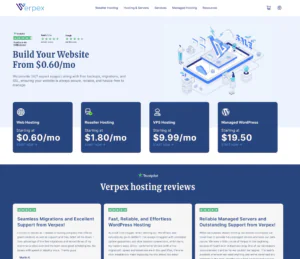
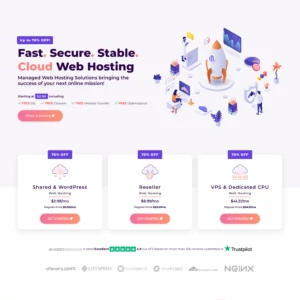
Verpex combines affordability and advanced features to provide a versatile environment for Angular projects. Its hosting plans support developers looking for scalability and stability in one package.
Rating Overview
- Overall Score: 4.7
- Pricing: 4.7
- Features: 4.6
- Performance: 4.6
- Support: 4.7
- User Friendly: 4.6
Detailed Analysis
- Pricing: Verpex offers competitively priced hosting plans with strong resource allocation, ensuring a solid entry point for Angular hosting.
- Features: Includes free SSL, Node.js support, daily backups, and migration assistance. These add convenience and developer flexibility.
- Performance: Consistent uptime and reliable servers ensure Angular applications run smoothly with minimal downtime.
- Support: Verpex provides fast and friendly support with expertise in frameworks like Angular, React, and Vue.
- User Friendly: Simple dashboards make managing Angular apps straightforward, with easy integration for front-end frameworks.
- Affordable yet feature-rich hosting
- Node.js and SSL support included
- Excellent customer support
- Reliable uptime for applications
- Performance slightly lower than premium providers
- Limited enterprise-level resources
-
Top 5 USA Web Hosting 2025
-
Top 5 Germany Web Hosting 2025
-
Top 5 UK Web Hosting 2025
-
Top 10 Linux Hosting 2025
-
Top 10 WordPress Hosting 2025

HostArmada focuses on security and scalability, making it a strong choice for Angular developers who prioritize reliability. With modern infrastructure and advanced security tools, it is built to support long-term projects.
Rating Overview
- Overall Score: 4.8
- Pricing: 4.6
- Features: 4.8
- Performance: 4.8
- Support: 4.7
- User Friendly: 4.7
Detailed Analysis
- Pricing: HostArmada’s plans are moderately priced but include premium features such as daily backups and strong security tools.
- Features: Includes Node.js support, free SSL, CDN integration, and staging tools. These features make it ideal for secure Angular hosting.
- Performance: Optimized cloud infrastructure ensures high-speed delivery, with excellent uptime and low latency across regions.
- Support: 24/7 expert support provides quick solutions, including framework-level assistance for Angular developers.
- User Friendly: Well-designed dashboards and staging environments simplify both testing and deployment for projects of all sizes.
- Strong focus on security
- Advanced features like CDN and staging
- Reliable performance with cloud infrastructure
- Skilled customer support
- Pricing higher than entry-level hosts
- More complex setup for beginners
-
Top WordPress Hosting 2023
-
Top Windows Hosting 2023
-
Top Cheap Hosting 2023
-
Top 10 VPS Hosting 2022

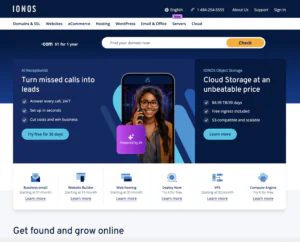
IONOS is one of the most affordable Angular hosting providers that allows you to use their Deploy now feature to configure your build automatically.
Their infrastructure framework is designed to help you deploy your single applications or static websites from GitHub. They also offer easy staging and an automatic framework to make deploying your server seamless and straightforward.
Rating Overview
Here’s how IONOS stacks up across key areas based on real tests and user feedback.
- Overall Score: 3.9
- Pricing: 3.7
- Features: 4.0
- Performance: 3.8
- Support: 3.9
- User Friendly: 4.1
Pricing: IONOS offers 3 starter projects with their Deploy Now membership. The first month is risk-free for 30 days, then $4/month.
Features: They offer starter, static, and PHP project types with amazing features, including Georedundancy & DDoS protection, Log-based visitor stats, staging deployment, and more.
Performance: With IONOS, you will enjoy seamless single dashboard management, automatic framework detection, and workflow setup.
Support: When you need help to resolve anything, IONOS offers exclusive access to a personal consultant available 24/7 through phone, email, and chat.
User-Friendliness: You will benefit from faster development times with a platform built for convenience.

Pros and Cons
Check out the main upsides and potential drawbacks of IONOS Angular hosting.
- The platform automatically detects your framework for faster deployment, which ensures your single-page application configures itself.
- It adds great features to your workflow, like file-based configuration, easy workflow customization, and simple staging.
- It operates ISO-certified, geo-redundant data centers in the US, UK, and Germany, which offers 99.99% uptime and seamless recovery.
- Deploying Angular single-page apps directly via GitHub Actions requires technical know-how, since this hosting is designed primarily for developers.
-
Top VPS Hosting 2023
-
Top WordPress Hosting 2023
-
Top Windows Hosting 2023
-
Top Dedicated Hosting 2023
-
Top Cloud Hosting 2023

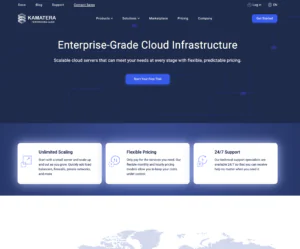
Kamatera lets you host your Angular applications on a robust technology stack backed by enterprise-grade cloud infrastructure.
They provide scalable cloud servers, so you can easily scale up or down without any long-term commitments. Plus, you can set up and create your servers in minutes by choosing from simple or customized plans.
- Overall Score: 4.8
- Pricing: 4.6
- Features: 4.7
- Performance: 4.9
- Support: 4.8
- User Friendly: 4.7

Pricing: Kamatera offers competitive pricing with flexible billing so you can keep your Angular hosting costs under control. You can start with a 30-day free trial and use their pricing calculator to pick the exact server setup you need, and see what it will cost.

Features: Kamatera stands out as our top Angular hosting provider thanks to a rich set of features like load balancing, automatic deployment, daily backups, fully managed services, and more.
Performance: Running on the latest cloud processors, Kamatera delivers reliable Angular hosting with an impressive 99.95% uptime and no single points of failure.
Support: Their tech support team is available 24/7 to help you whenever you need it.
User-Friendliness: Kamatera makes it easy to scale your server as you grow, with unlimited scaling and options to add firewalls, load balancers, private networks, and more.
Pros and Cons
- Unlimited scaling lets you adjust resources up or down anytime, with no upfront costs or commitments.
- Reliable high-end data centers offer self-configured, self-provisioned servers so you can change server capacity within minutes.
- Fast and reliable performance powered by cutting-edge hardware, delivering 99.9% uptime and quick response times.
- No free backups
- You’ll need some technical know-how to pick the right server specs (but their customer support is there to help you get it right).

VPSServer.com is a VPS-focused provider that works well for Angular projects when you want full control over the runtime and deployment workflow. For teams building Angular SPAs or Angular Universal apps, it’s a practical option because you can tailor the server stack to match your build pipeline, caching needs, and traffic patterns. This makes it suitable for developers, agencies, and SaaS teams that want predictable resources and the freedom to optimize performance. It’s less “hands-off” than managed app hosting, but it can be excellent value if you’re comfortable handling server basics.
Rating Overview
- Overall Score: 4.4
- Performance: 4.5
- Support: 4.2
- Security: 4.4
- Pricing: 4.3
- Ease of Use: 4.2
Detailed Analysis
Performance: Angular sites benefit from fast static delivery, and VPSServer.com can perform strongly when you configure a CDN or a lightweight web server for static assets. For Angular Universal, you can allocate enough CPU and memory to keep SSR responsive under load. Performance will largely reflect your setup choices, so proper caching and compression make a big difference.
Support: Support is generally helpful for provisioning, networking, and VPS-level concerns that affect deployments. It’s solid for resolving availability issues, IP configuration, and basic environment questions. Application-level debugging for Angular builds or Node processes is typically up to your team.
Security: VPS environments give you the freedom to harden security to your standards with firewalls, SSH best practices, and routine patching. That flexibility is a plus for teams with security requirements. The trade-off is responsibility: you must maintain updates and monitor services to keep risk low.
Pricing: Pricing is competitive for dedicated VPS resources, especially if you host multiple Angular projects or combine frontend and API services on one server. It can be more cost-efficient than per-site managed platforms at scale. Costs may rise if you oversize instances or add premium management.
Ease of Use: Provisioning is straightforward for developers, but it’s not as beginner-friendly as platform-as-a-service Angular hosting. You’ll need to handle deployments, SSL, and process management. Once you standardize your CI/CD, ongoing releases can be smooth and repeatable.
Pros and Cons
Full control for Angular SPA or Angular Universal deployments
Predictable VPS resources for consistent performance
Flexible stack options for Node, Nginx, and CI/CD workflows
Cost-effective for hosting multiple projects on one VPS
Good fit for agencies and developer teams
Requires server maintenance and security patching
App-level troubleshooting is largely self-managed
Not as turnkey as managed Angular platforms

Hosting.com’s Angular-focused plans target developers building single-page applications that need quick deployments, dependable CI/CD hooks, and global asset delivery. It’s well-suited for agencies, startups, and in-house teams that want a familiar Linux stack with Node tooling, plus CDN and caching optimizations tuned for front-end bundles. The value proposition is strong if you care about predictable performance for production builds and preview environments without wrestling with complex server orchestration.
Rating Overview
- Overall Score: 4.6
- Performance: 4.7
- Support: 4.6
- Security: 4.6
- Pricing: 4.5
- Ease of Use: 4.7
Detailed Analysis
Performance: Build caching and Node LTS images are pre-configured, keeping ng build --configuration production times low and ensuring consistent artifacts. Integrated CDN with Brotli and HTTP/2 serves minified JS, CSS, and assets swiftly to distributed audiences. Edge caching rules can be customized per-route, which helps Angular SSR/hydration patterns and API-heavy dashboards.
Support: The support team understands common Angular pitfalls such as base-href mismatches, router rewrites, and environment variable handling. Deployment troubleshooting is pragmatic, with quick guidance on CI logs, lockfile conflicts, and memory ceilings during build steps. Documentation covers zero-downtime rollouts and rollback strategies clearly.
Security: Free TLS, automatic certificate renewals, and HSTS options protect SPA endpoints and API calls. WAF presets mitigate common OWASP vectors, while per-app firewall rules help fence webhook endpoints. Role-based access control and deploy keys enable safer team workflows without sharing root credentials.
Pricing: Tiers scale by bandwidth, CDN rules, and concurrent build minutes, which maps neatly to project size. The entry plan is affordable for staging and prototypes, and mid-tier covers most production Angular apps comfortably. Larger orgs can add reserved build capacity and edge workers without switching platforms, though these extras raise monthly spend.
Ease of Use: Git-based deployments with automatic builds are easy to set up, and preview URLs help validate every pull request. Redirects and SPA fallbacks are configurable in the panel, so router rewrites don’t require server hacks. Logs, metrics, and bundle insights surface actionable data for trimming payloads and improving TTI.
Pros and Cons
Fast global delivery via integrated CDN
Git-based CI/CD with preview environments
Clear router rewrite and SPA fallback controls
Helpful docs for environment variables and rollbacks
RBAC and deploy keys for safer team access
Advanced edge features may cost extra
Concurrency limits on lower tiers can slow builds
No built-in backend database services
-
Best Customer Service 2024
-
Great Support 2024
-
Excellent Service 2024
-
Over 99% Uptime 2024
-
Top 25 Cloud Hosting 2024

ChemiCloud is best known for managed shared and cloud-style hosting that prioritizes simplicity, which translates well to Angular projects that are deployed as static builds or lightweight web apps. For “Best Angular Hosting,” it’s a sensible pick for freelancers, small businesses, and agencies that want an uncomplicated setup for hosting an Angular single-page application alongside email, domains, and standard site tooling. While it’s not a specialized Jamstack platform, its infrastructure and usability make it a dependable home for Angular front-ends—especially if you’re serving pre-built assets and relying on external APIs. The overall value is strong for teams that want stability and support without managing servers, though highly custom SSR or build automation needs may require extra configuration or an upgraded plan.
Rating Overview
- Overall Score: 4.4
- Performance: 4.4
- Support: 4.6
- Security: 4.5
- Pricing: 4.3
- Ease of Use: 4.6
Detailed Analysis
Performance: ChemiCloud performs well for Angular SPAs that serve static files, with generally consistent load times when caching is properly enabled. It’s a good fit for brochure sites, client portals, and dashboards where assets are bundled and optimized at build time. For server-side rendering, results can vary by plan and configuration, so it’s best viewed as “static-first” Angular hosting.
Support: Support is one of ChemiCloud’s strengths, especially for common setup issues like SSL, redirects, DNS, and performance tuning basics. They’re helpful when you need guidance on where to place Angular build output and how to handle SPA routing with rewrites. For advanced Angular tooling (custom build pipelines, CI), you may still be doing most of the dev-side work yourself.
Security: Free SSL, account protections, and standard hosting security measures cover typical Angular deployment needs. Routine platform maintenance reduces the burden on small teams that don’t want to patch servers manually. If you have strict compliance or need WAF-grade controls, you may want layered security from a CDN provider.
Pricing: Pricing is generally fair for managed hosting, particularly if you also want bundled features like email and backups. It’s cost-effective for hosting multiple small Angular sites or client projects. For compute-heavy SSR or large-scale traffic, you might outgrow entry plans and need higher tiers.
Ease of Use: The overall experience is very friendly for non-DevOps users, with a clean control panel and straightforward site management. Uploading Angular dist files or deploying via standard workflows is easy to understand. Configuring SPA-friendly rewrites may take a few minutes, but it’s manageable even for beginners.
Pros and Cons
Very easy to manage for static Angular deployments and small projects
Strong support for SSL, DNS, redirects, and common setup tasks
Good value when you need hosting plus email and site essentials
Reliable baseline performance for bundled Angular assets
Suitable for agencies hosting multiple client front-ends
Not as purpose-built for modern CI/CD Angular workflows
SSR deployments may require more tuning or a higher plan
-
Top WordPress Hosting 2023
-
Top Windows Hosting 2023
-
Top VPS Hosting 2023
-
Top 25 Offshore Hosting 2023
-
Top Dedicated Hosting 2023

Ultahost has managed VPS plans that work really well for Angular apps, especially if you need good uptime and solid performance.
They support Node.js and Angular CLI, plus you get scalable environments, which is perfect for dev teams and businesses.
Rating Overview
Curious about the score? Take a look:
- Overall Score: 4.7
- Pricing: 4.6
- Features: 4.7
- Performance: 4.8
- Support: 4.7
- User Friendly: 4.5
Detailed Analysis
If you want to know what’s behind the scores, check out the details below.
Pricing: Starting from $4.80/month, Ultahost’s plans are competitive, especially for managed VPS with Angular support.
Features: You get root access, pre-installed build tools, optional control panels, and advanced firewall settings.
Performance: Its strong uptime, fast caching, and low latency make it ideal for Angular single-page apps.
Support: Managed support includes help with Node.js, Angular builds, and troubleshooting any frontend deployment issues you run into.
User Friendliness: If you want something easier to manage, they offer Plesk or cPanel options and can handle the setup for you.
Pros & Cons
Let’s break down the main advantages and a few drawbacks to help you get a clearer picture.
- Affordable managed VPS with Angular support
- Optional control panel for simple management
- Excellent uptime and scalability
- Control panels come with an extra cost
Setting up root access might be tricky if you’re new to it (there’s a learning curve)
Does Angular Have a Web Server?
Angular includes a lightweight web server that comes integrated with the Angular CLI (Command Line Interface). It’s perfect for serving your app during development since it offers handy features like automatic reloading, error handling, and live updates as you work.
But keep in mind, the Angular CLI server is meant for development and testing, not for production.
When it’s time to deploy, you’ll want to host your Angular app on a dedicated server, cloud service, or CDN using tools like Nginx, Apache, Firebase Hosting, or Vercel to efficiently serve those static files.
How to Host Angular Applications Locally
Hosting an Angular application locally allows developers to test changes before deploying them online. Follow these steps to host Angular application on your local machine:
- Install Node.js and Angular CLI – Download and install Node.js, then run npm install -g @angular/cli to install Angular CLI.
- Create or Open Your Project – Open a terminal and navigate to your Angular project folder (cd my-angular-app) or create a new one (ng new my-app).
- Run the Development Server – Use the command ng serve to launch the local development server. By default, the app will be accessible at http://localhost:4200/.
- Build for Production – To generate a production-ready version, run ng build –prod, which compiles the app into static files inside the dist/ folder.
- Serve the Built Files – Use a local web server like http-server (npm install -g http-server) and run http-server dist/my-app to serve the compiled Angular files locally.
Why Trust Our Recommendations
At HostAdvice, we dig deep into Angular hosting providers using real-world tests, expert insights, and user feedback.
Our rankings focus on performance, scalability, easy deployment, and strong security. Every provider we recommend goes through a thorough review to make sure they meet the high standards needed to host modern Angular applications.
How Do We Test and Rank
We evaluate Angular hosting providers through a clear, structured process focusing on six key areas. First up, we check server speed and performance by looking at response times, CDN effectiveness, and the overall hosting setup.
Next, we dive into ease of deployment, examining CI/CD support, Git compatibility, and automated deployment features. We also test scalability and uptime to make sure providers offer reliable scaling and at least a 99.9% uptime guarantee.
Security and compliance come next, where we look at SSL certificates, firewalls, and DDoS protection measures.
We don’t stop there. We also assess user experience by reviewing how responsive customer support is, the quality of their knowledge base, and how active their community is.
Finally, we compare pricing plans against features to see which providers offer the best value for your money.
This thorough approach helps us highlight the top Angular hosting providers suited for different needs.
Angular Hosting: Final Recommendations
At HostAdvice, we test Angular hosting providers using hands-on methods, expert analysis, and user reviews.
We focus on speed, reliability, scalability, security, and smooth deployment. We check development tools like CI/CD and Git support, plus strong security measures, to find hosting solutions that deliver great performance and value.
Related Recommendations
Make sure to check out these related hosting options to find the perfect fit for your next project.