Happy Feast of the Transfiguration 2013

Image

Transfiguration, Kirillo-Belozersk Monastery, Russia (1497)

August 6/19 is the feast of the Transfiguration. Below are links to two articles about the Transfiguration icon. The articles also contain links to sermons and other resources related to the feast.

Transfiguration Icon | The Event and the Process

Who’s in the Transfiguration Icon?

You were transfigured on the Mount, Christ God revealing Your glory to Your disciples, insofar as they could comprehend.
Illuminate us sinners also with Your everlasting light, through the intercessions of the Theotokos.
O Giver of light, glory to You.

+++

Posted in Icons of the Incarnation | Tagged , | Leave a comment

The snakes that venerate icons

Icon of Panagia Fidousa (Virgin of the Snakes)

Icon of Panagia Fidousa (Virgin of the Snakes)

In a tiny Greek village in the south of Kefallonia, a miracle occurs every year after the feast of the Transfiguration (Aug 6). Around the bell-tower of the chapel at Markopoulo, small venomous snakes appear. These snakes crawl around the church, and upon the icons of the Mother of God in an act of apparent veneration. The snakes remain in the confines of the chapel, docile throughout, until the feast of the Dormition (Aug 15), when they disperse and become almost impossible to find on the island. This is a strange miracle, especially given the association of the serpent with Satan, so what is the significance?
Continue reading

Posted in History, Special Icons, The Theotokos | Tagged , , , , | 8 Comments

Irene Chrysovalantou | Quick guide

Saint Irene Chrysovalantou (Ειρήνη Χρυσοβαλάντου)

Saint Irene Chrysovalantou (Ειρήνη Χρυσοβαλάντου)

July 28th is the feast day of our venerable mother Irene of Chrysovalantou. This popular saint was born in Cappadocia during the 9th-century, and gave up the chance of royal marriage to join the Chrysovalantou convent eventually becoming its abbess. She can be recognized in icons by the the presence of some, or all, or the following:

  • The clothing, and sometimes staff, of an abbess (see icon above).
  • Three apples from Paradise, given to St. Irene by a sailor after being instructed by an apparition of St John the Apostle. The apples gave off a divinely sweet aroma, and were shared among the sisters of the convent.
  • Bowing cypress trees, which recall a miracle observed three times by one of the nuns, who saw St Irene levitating during prayer whilst two cypress trees bent down before the abbess. The nun tied scarves to the bowed tips of the trees to prove to the other sisters the miracle had occurred. The scarves are usually shown tied to the trees, and the nun may also be shown spying on the Saint.
  • An angel holding a scroll. This is the guardian angel of St Irene, who appeared to her after she prayed to foreknow the trials of her nun. The angel greeted her saying: “Hail, handmaiden of God, the Lord has sent me that more might be saved through your guidance. I am to remain at your side and disclose the events of the future.”
  • An open scroll held by St Irene, written upon which is some of the preserved teachings and admonishments of the Saint.
  • The Chrysovalantou convent may be shown in the background, especially if the bowing cypress tress are also shown.
  • The inscription of her name: Οσία Ειρήνη Χρυσοβαλάντου (Greek); Saint (or Blessed) Irene Chrysovalantou (English); Святая (Св) Ирина Каппадокийская (Cyrillic); Sfanta (Sf) Irina Hrisovalant (Romanian)
Venerable Irene of Chrysovalantou

Venerable Irene of Chrysovalantou

Brief hagiography of Irene Chrysovolantou

More detailed biography from Mystagogy

+++++

Posted in Quick Guides, The Saints | Tagged , , | 2 Comments

All Saints Icon | The Great Cloud of Witnesses

Image

After Pentecost, remembering the descent of the Holy Spirit, the Church celebrates the Sunday of All Saints. This is fitting, as the Saints are the result of the Holy Spirit being given to the Apostles, the fruits of that “grain of wheat, which fell into the earth and died” (John 12:24).

Continue reading

Posted in History, Iconography, Icons of Christ, The Saints | Tagged , , , , , , , | 5 Comments

The Holy Spirit as a dove in iconography

Fresco of the Throne of Preparation (Bucovina)

A previous post on the Throne of Preparation showed the widespread (in time and location) practice of depicting the Holy Spirit as a dove. The Holy Spirit did descend “as a dove” at the Baptism of Christ, and so naturally we can see a dove representing the Holy Spirit in icons of this event. Yet there is some opposition to the widespread practice of using the dove to symbolize the Holy Spirit in other images, such as on the Throne of Preparation and icons of Pentecost (e.g.: here).

It is true that icons properly deal with what has been divinely revealed, rather than human imagining of divine things in terms of symbols and signs. However, the use of the dove as an easily recognizable symbol of the Holy Spirit’s presence persists in Orthodox iconography, and is based on numerous sources outside of the baptism of Christ.
Continue reading

Posted in Apologia, History, Iconography | Tagged , , , , | 11 Comments

Hetoimasia | The Throne of Preparation

Throne of Preparation, 14th Century, Decani Monastery, Serbia

Throne of Preparation, part of a Fresco of the Last Judgment (1300’s, Serbia)

The Hetoimasia (Gr. ἑτοιμασία, “preparation”), or Throne of Preparation, is one of the most widespread images in iconography, particularly in Orthodox Christianity. It very rarely dominates any composition it is part of, so the image and its significance can be overlooked. In this article, the image and its history is explored through three interpretations of what the Throne represents.
Continue reading

Posted in History, Iconography, Icons of Christ, Special Icons | Tagged , , , , , , , | 7 Comments

Why do the Saints never smile in icons?

Saint Silouan the Athonite

There are over 400 occurrences of the word “joy” in the Bible, most of them referring to what awaits those who become close to God. So why do icons – portraits of people who have been received by Christ into Heaven – show the Saints looking sombre?
Continue reading

Posted in Iconography, The Saints | Tagged , , , , , | 18 Comments

An icon for Whitsun | Pentecost Mosaic of San Marco

Pentecost mosaic in church dome, 12th century

The image above is of the interior of a dome at the 9th-century St Mark’s Basilica in Venice. The mosaic of gold, bronze and other precious materials dates from the 12th century and depicts the descent of the Holy Spirit upon the Apostles at Pentecost.

The mosaic shows what can be achieved by using the architecture of the church building to depict Orthodox iconography without losing any of the teaching contained in the more traditional depictions.
Continue reading

Posted in Iconography, Special Icons, The Saints | Tagged , , , | 9 Comments

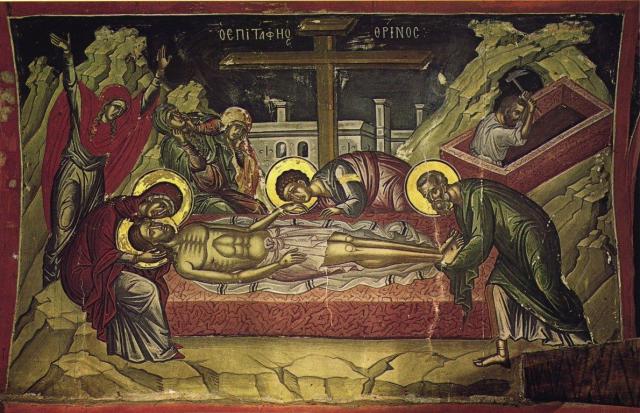
The Epitaphios | Burial of Christ Icon

Epitaphios, from the Stavronikita Monastery, Mt Athos (16th Century)

Epitaphios, from the Stavronikita Monastery, Mt Athos (16th Century)

The Epitaphios (Gr. Επιτάφιος) is a large icon, usually embroidered, that depicts the burial of Christ. The name, epitaphios, literally means “winding-sheet”, and is used in services of Holy (Good) Friday and Holy Saturday to re-present the burial and funeral of Christ. An expanded version of this post, with a gallery of various epitaphios images, will be added here later. In the meantime, I add one of the most well-known icons (actually a fresco) of the epitaphios thrênos; i.e. the Lamentations by the Tomb. I also include some of the hymns from Holy Saturday, which understandably contain much hope mixed with the sorrow of Christ’s passion and death.

By being covered with the dust of the earth,
You renew the nature of mortals, O Creator;
The tomb and the winding-sheet reveal your deepest mystery, O Word;
The noble counsellor renders present the counsel of your eternal Father,
Who renews me in this wondrous way through you.

Glory to You, O God, Glory to You

By your death, you transform that which is mortal;
By your burial, you transform that which is corruptible;
By your divinity, you draw us up from the abyss.
For, that which you assume, you make immortal;
Your flesh, O Master, did not undergo corruption,
And your soul did not remain in Hades where you were a stranger.
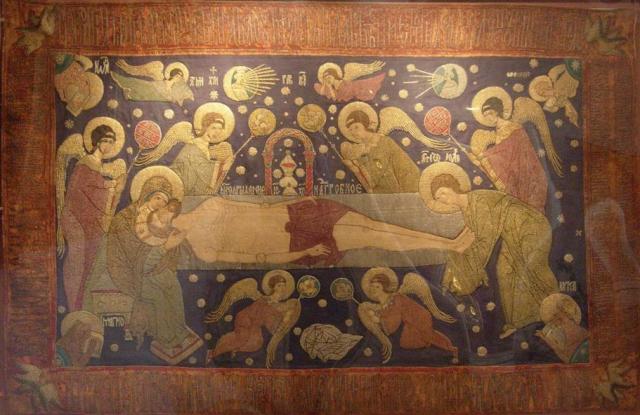
Altar cloth from the Bishop's sacristy of Yaroslav (16th Century)

Altar cloth from the Bishop’s sacristy of Yaroslav (16th Century)

The most holy Temple is destroyed,
But he raises up the fallen tabernacle;
For he who dwells in the highest heaven, the New Adam,
Goes down into Hades to raise up the first Adam.
O youths, bless the Lord;
Praise him, you priests;
And let the whole nation exalt him forever…

…O marvelous wonder!
O goodness and condescension beyond description!
He who dwells in the highest heavens
Accepts burial beneath a sealed rock;
And God himself is treated as a deceiver!
O youths, bless the Lord;
Praise him, you priests;
And let the whole nation exalt him forever.
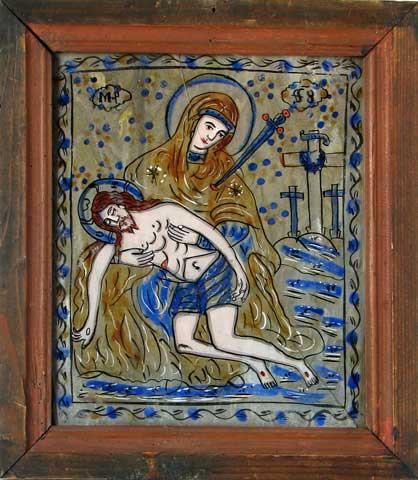
The lamentations of the Mother of God (glass icon, Romania)

The lamentations of the Mother of God (glass icon, Romania)

I conceived you in a wondrous way, O my eternal Son,
And I was happier than all women,
For I did not suffer any pain.
But today I see you lifeless, O my God,
And a sword of sadness pierces me in a most cruel manner;
But arise, O Lord, that I may extol you…

… O Mother, the earth covers me by my own will;
But the guardians of Hades shudder to see me,
Wearing the bloody garment of punishment;
For, on the Cross, I have struck down my enemies;
I shall arise as God, and you shall be exalted…

+++++

Posted in Iconography, Icons of Christ, Icons of the Incarnation, The Theotokos | Tagged , , , , , | 8 Comments

Icons for Holy Tuesday | Parable of the Ten Virgins

This slideshow requires JavaScript.

On Holy Monday Christ’s teaching on the importance of genuine fruitfulness was emphasized. On Holy Tuesday, we are reminded of the importance of remaining watchful. This is illustrated in the Parable of the Ten Virgins (Matt 25:1-13).
Continue reading

Posted in Iconography, Icons of Christ, Icons of the Incarnation | Tagged , , , , , , , | 4 Comments