Bite-sized Insights about
 
Providing you with data-based insights about things happening around you.
Popular Insights
  • Image
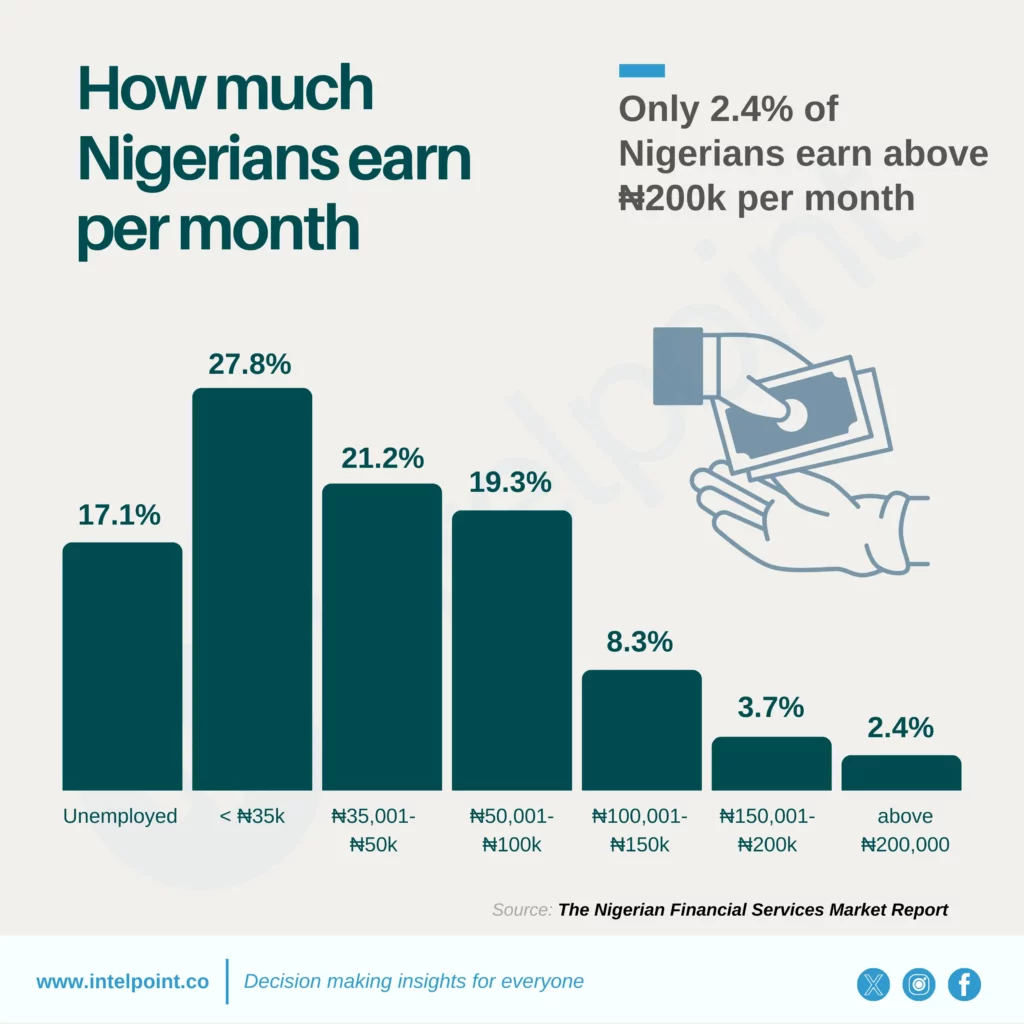
    Only 10% of Nigerians earn above ₦100,000, according to the Nigerian Financial Services Market Report. This aligns with most reports about Nigeria, and it's in sharp contrast to the narratives online.
    See more
    Image

    MTN Nigeria has dominated the country's telecommunications market over the years, accounting for the largest market share. All four operators, apart from 9mobile, recorded a significant increase in their subscriber base between May 2014 and March 2024.

    See more
  • Image

    The 2024 Global Peace Index reveals a decline in peacefulness in 97 countries, the highest since the index began.

    Nigeria is among the nations affected by regional conflicts and rising violence. With a peace index score of 2.91, Nigeria is facing increasing challenges.

    A deteriorating peace score impacts foreign investment and economic stability. Global economic losses due to violence reached $19.1 trillion in 2023.

    See more
    Image

    The FAAC's revenue distribution from 2017 to August 2023 highlights the dominance of Delta, Akwa Ibom, Rivers, and Bayelsa states in allocations. Despite Lagos' economic prominence, it ranked fifth. Here is the distribution of revenue among states between 2017 and August 2023.

    See more
  • A Trend of Adult literacy rates of African countries

    Between 2018 and 2021, adult literacy rates across African nations exhibited significant disparities. Seychelles and South Africa led with literacy rates of 96% and 95%, respectively, indicating a high proportion of literate adults. Conversely, Chad had the lowest literacy rate during this period.

    These statistics underscore the uneven progress in educational attainment across Africa, highlighting the need for targeted interventions to improve literacy in lower-performing nations.

    See more
    Image

    Nigeria was the seventh most populous nation in the world in 2020, with 206.1 million people. Projected to reach a population of 401.3 million by 2050, Nigeria will rank third after India (1st) and China (2nd). According to Institut national d'études démographiques' projections, Nigeria, Ethiopia, DR Congo, Egypt, Tanzania, and Kenya will be among the world’s top 20 most populous countries by 2050.

    See more

  • Image
    Only 10% of Nigerians earn above ₦100,000, according to the Nigerian Financial Services Market Report. This aligns with most reports about Nigeria, and it's in sharp contrast to the narratives online.
    See more
  • Image

    MTN Nigeria has dominated the country's telecommunications market over the years, accounting for the largest market share. All four operators, apart from 9mobile, recorded a significant increase in their subscriber base between May 2014 and March 2024.

    See more
  • Image

    The 2024 Global Peace Index reveals a decline in peacefulness in 97 countries, the highest since the index began.

    Nigeria is among the nations affected by regional conflicts and rising violence. With a peace index score of 2.91, Nigeria is facing increasing challenges.

    A deteriorating peace score impacts foreign investment and economic stability. Global economic losses due to violence reached $19.1 trillion in 2023.
    See more

Other Insights
Image
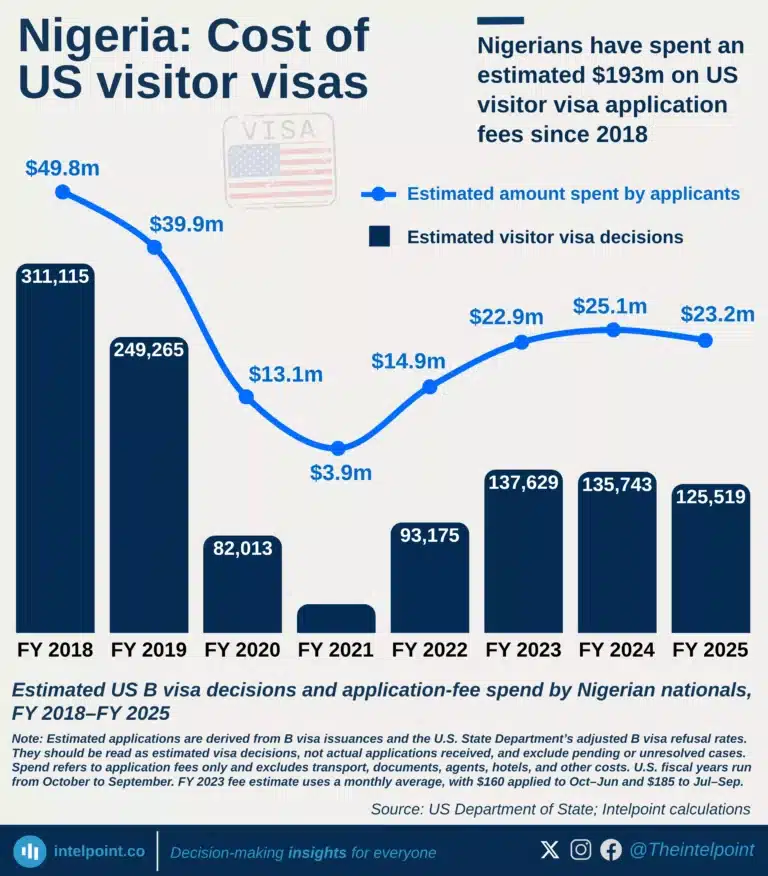
  • Estimated visitor visa fee spending reached $193 million between FY 2018 and FY 2025.
  • Applicants paid the fee whether their visas were approved or refused.
  • Estimated spending peaked at $49.8 million in FY 2018.
  • Spending recovered to $25.1 million in FY 2024 before falling to $23.2 million in FY 2025.
  • The estimates exclude transport, documents, agents, accommodation and other related costs.
See more
Image
 
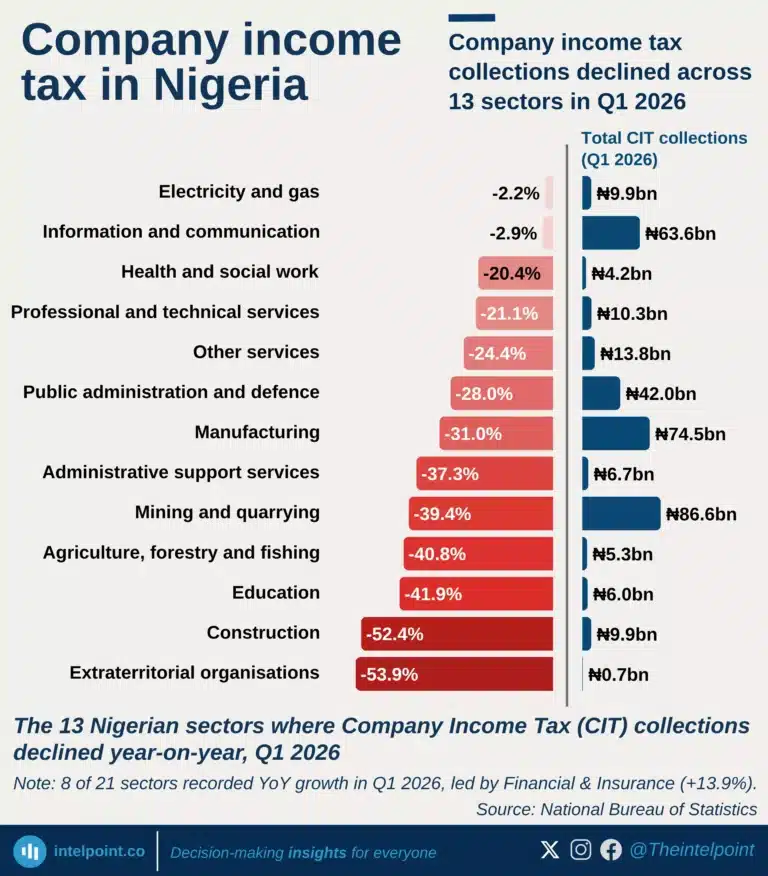
  • Thirteen of Nigeria’s 21 sectors recorded year-on-year declines in CIT collections.
  • Extraterritorial organisations recorded the steepest fall at 53.9%.
  • Construction collections fell by 52.4%, the second-largest decline.
  • Mining and agriculture declined by 39.4% and 40.8%, respectively.
  • Manufacturing still generated ₦74.5 billion despite a 31.0% decline.
See more
Image
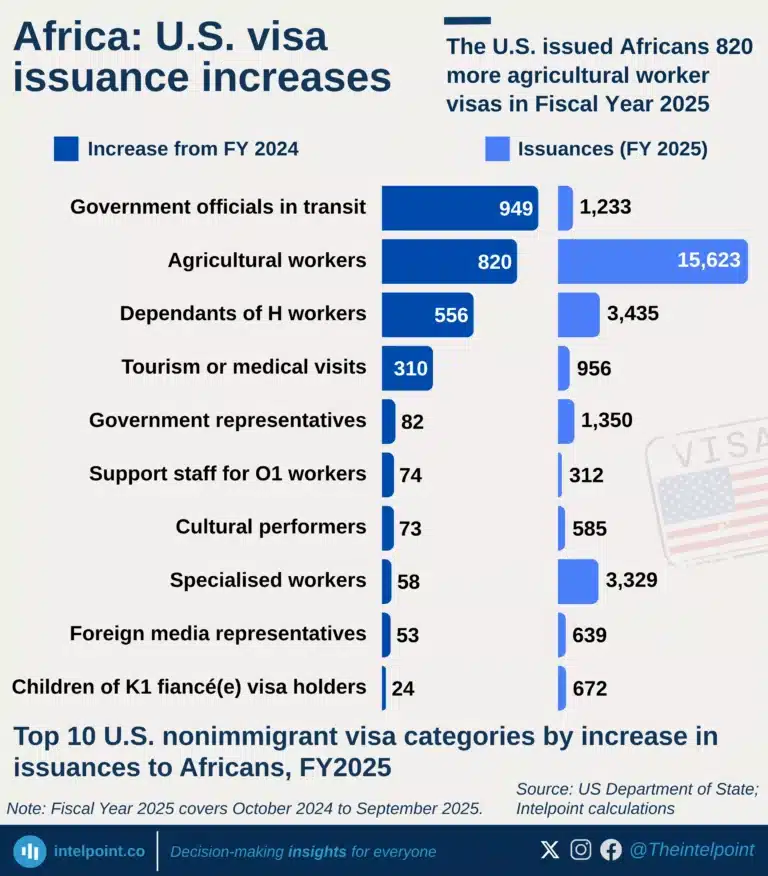
  • U.S. nonimmigrant visa issuances to Africans fell by 23.6% to 413,259.
  • Twenty-five visa categories still recorded increases despite the overall decline.
  • C3 visas posted the largest numerical increase, rising by 949.
  • H2A agricultural worker visas increased by 820 to 15,623.
  • B1/B2 visitor visas recorded the biggest decline, falling by 109,653.
See more
Image
     
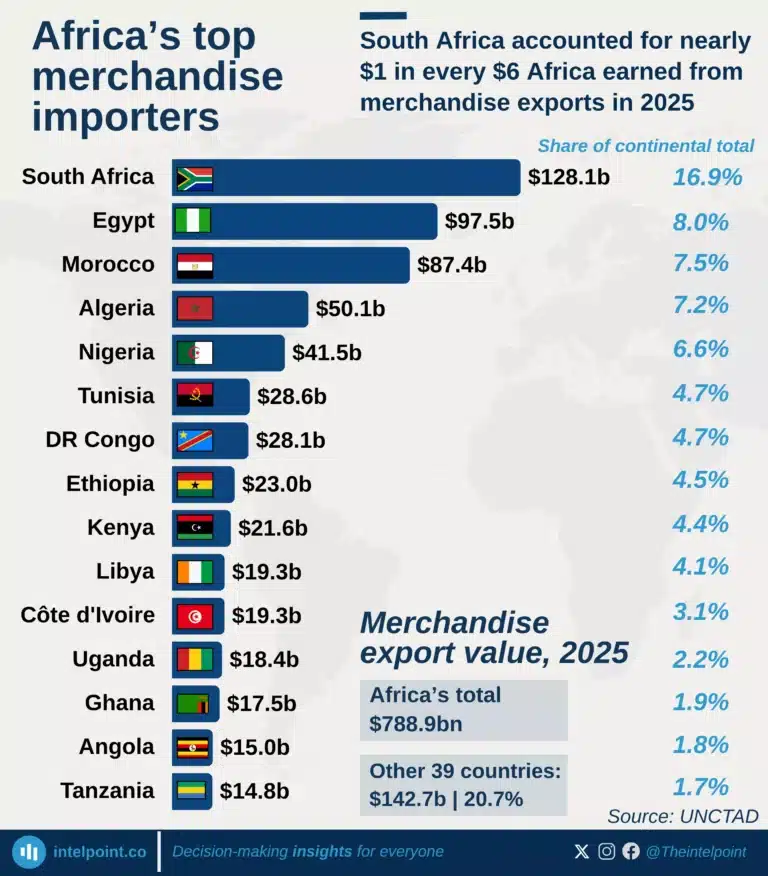
  • Africa’s merchandise exports reached $689.2 billion in 2025.
  • Exports grew by 9.7%, the fastest rate outside Asia.
  • Africa accounted for just 2.6% of global merchandise exports.
  • South Africa led with $116.4 billion, followed by Nigeria and Egypt.
  • The top 15 economies generated 79.3% of Africa’s exports.
See more
Image
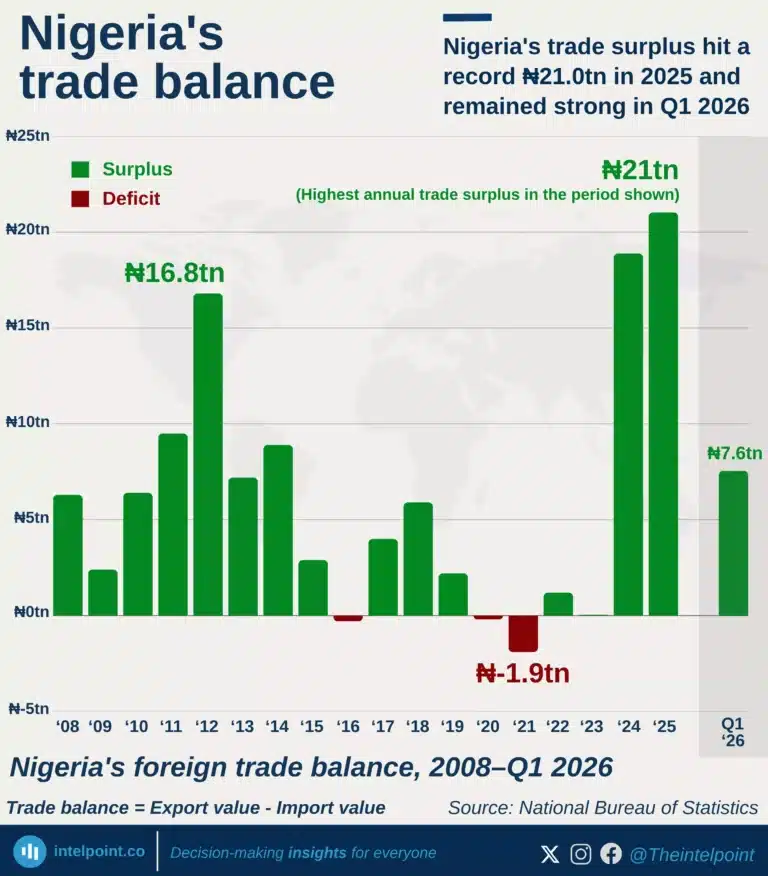
  • Nigeria recorded a ₦21.03 trillion trade surplus in 2025, the highest in the period shown.
  • The trade surplus remained strong at ₦7.55 trillion in Q1 2026.
  • The latest performance marks a sharp recovery from the deficits recorded in 2020 and 2021.
  • Nigeria’s trade balance moved from near zero in 2023 to large surpluses in 2024 and 2025.
See more
Image
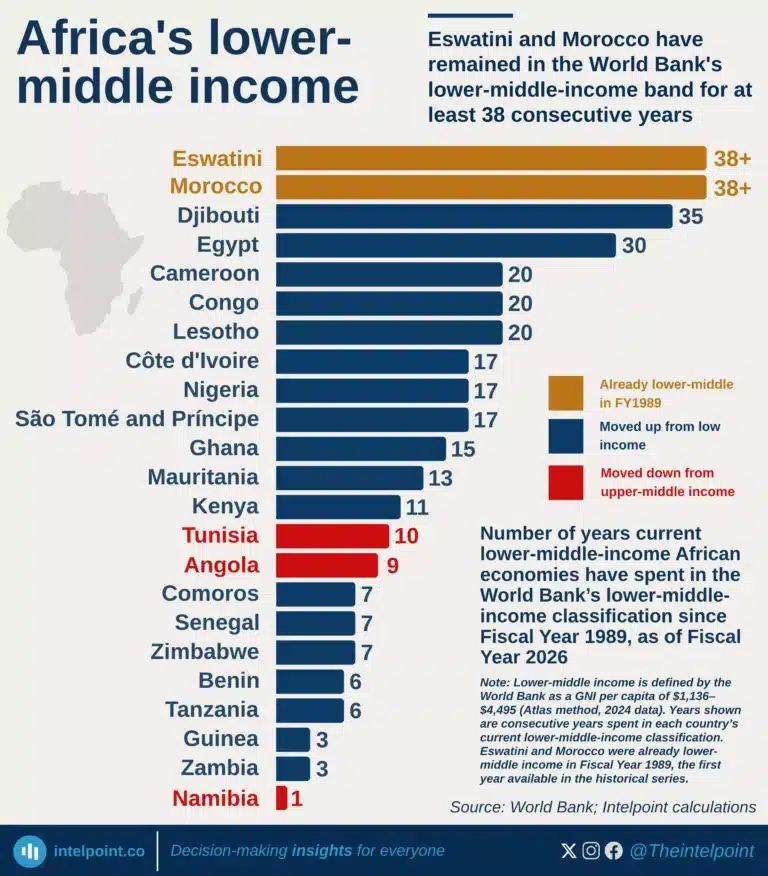
  • Nigeria has remained in the World Bank’s lower-middle-income category for 17 consecutive years.
  • Eswatini and Morocco have spent at least 38 consecutive years in the category, the longest among African countries.
  • Africa has 23 lower-middle-income economies in the World Bank’s Fiscal Year 2026 classification.
  • Tunisia, Angola, and Namibia entered the category after falling from upper-middle-income status.
See more
Image
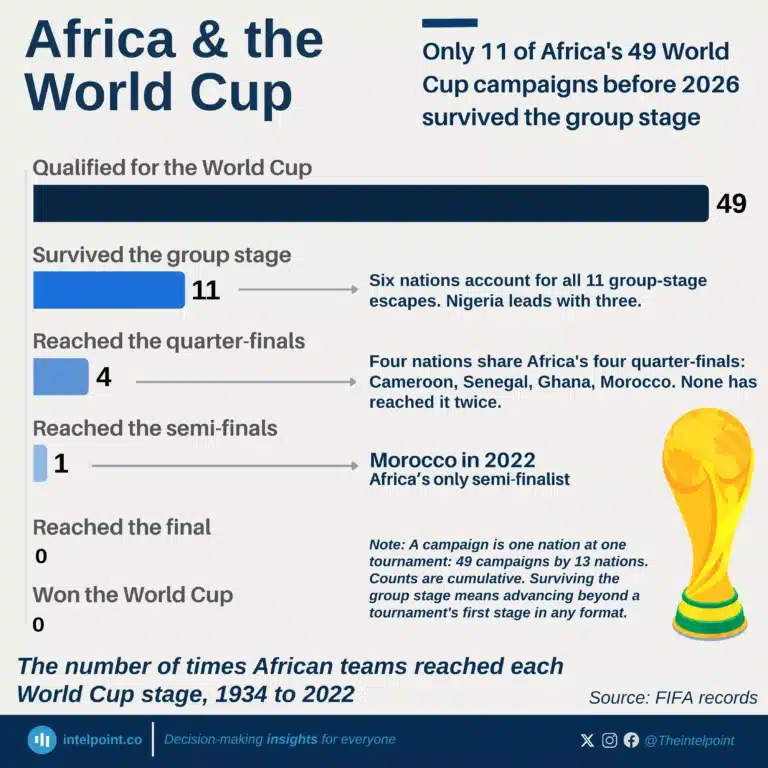
  • African teams have made 49 World Cup appearances, but only 11 campaigns progressed beyond the opening stage.
  • Nigeria leads Africa with three group-stage escapes, despite missing the 2026 tournament.
  • Cameroon, Senegal, Ghana, and Morocco are Africa’s only World Cup quarter-finalists.
  • Morocco remains Africa’s only semi-finalist, while no African team has reached the final.
See more
Image
     
  • A 12.5kg refill is now over 6x costlier than in 2016.
  • The April 2026 price reached ₦22.4k, up from ₦3.7k in January 2016.
  • Prices stayed fairly stable until 2021, then surged sharply.
  • Fresh reports suggest gas prices kept rising after April 2026.
See more
Image
  • South Africa holds 82.9% of global PGM reserves.
  • DRC holds half of global cobalt reserves.
  • South Africa also leads in manganese and chromium.
  • Madagascar holds 8.7% of global graphite reserves.
  • African mineral holders are pushing for more value.
See more
Image
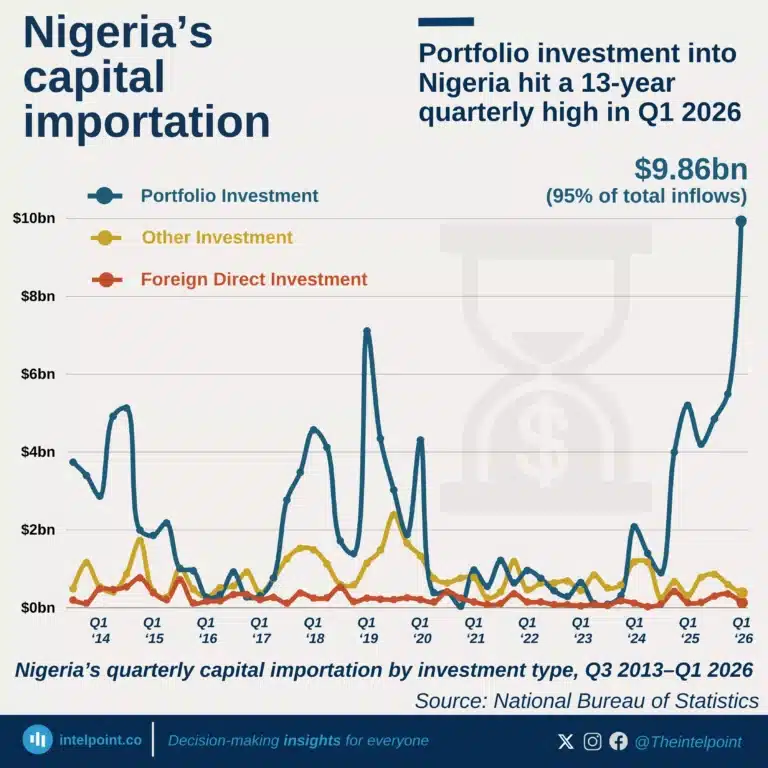
  • Portfolio investment into Nigeria reached $9.86 billion in Q1 2026, the highest quarterly level in 51 quarters.
  • The Q1 2026 portfolio inflow was higher than the previous peak of $7.11 billion recorded in Q1 2019.
  • Portfolio investment accounted for 95% of Nigeria’s total capital importation in Q1 2026.
  • Foreign Direct Investment remained low at $135 million, far below portfolio inflows.
  • Other Investment stood at $374 million, making it the second-largest inflow category in Q1 2026.
See more
Image
     
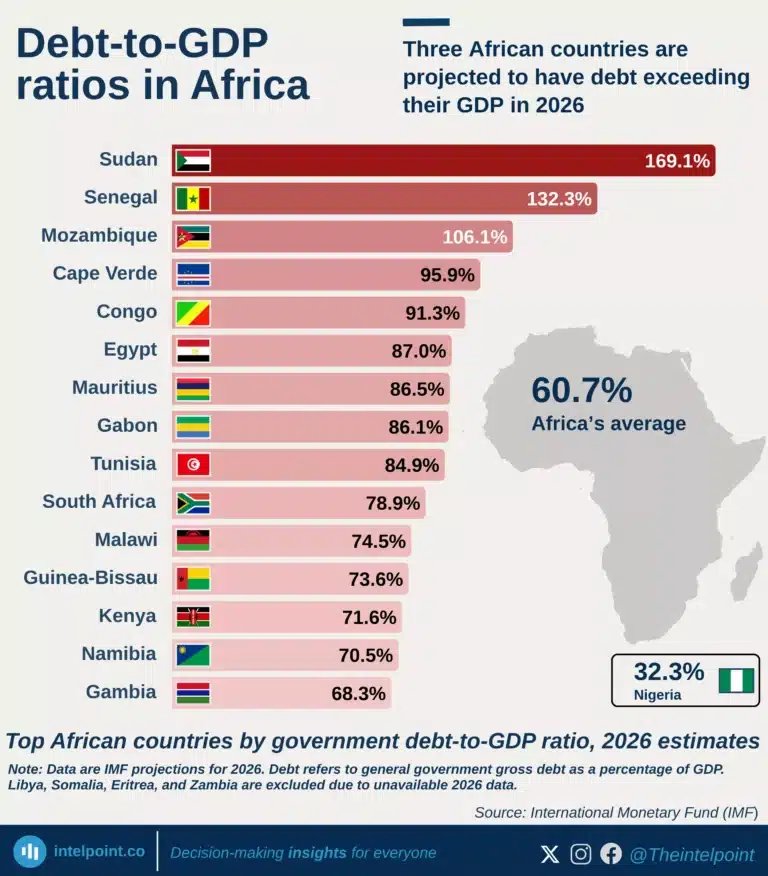
  • Sudan is projected to have Africa’s highest debt-to-GDP ratio in 2026, at 169.1%.
  • Only three African countries are projected to owe more than the size of their economies in 2026.
  • Senegal and Mozambique join Sudan among countries with debt-to-GDP ratios above 100%.
  • Africa’s average government debt-to-GDP ratio is projected at 60.7% in 2026.
  • Nigeria’s projected debt-to-GDP ratio of 32.3% is far below the African average.
See more
Image
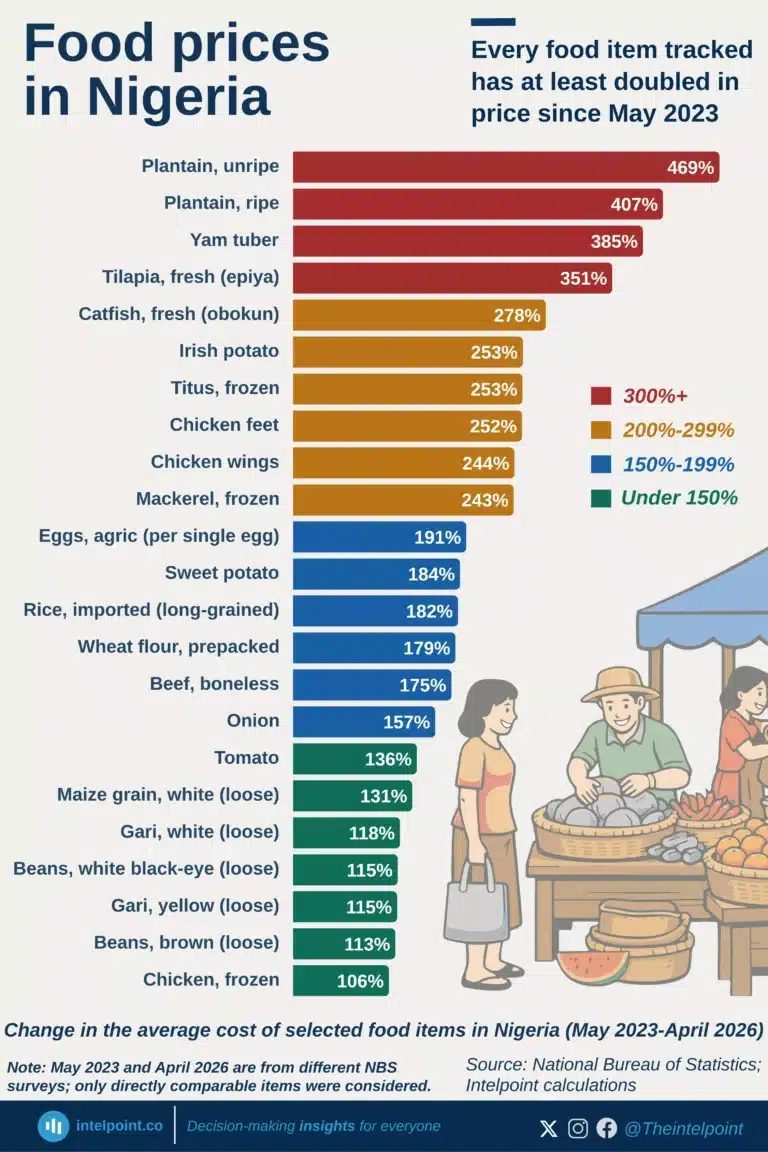
  • Every comparable food item tracked is now at least twice as expensive as it was in May 2023.
  • Nearly half of the selected food items have more than tripled in price since the month before fuel subsidy removal.
  • Unripe plantain recorded the steepest increase, rising by 469% between May 2023 and April 2026.
  • Ripe plantain, yam tuber, and fresh tilapia also saw extreme increases of more than 300%.
  • Even the slowest-rising staples, including frozen chicken, beans, gari, and maize, still more than doubled in price.
See more
1 2 3 128
Image
  • Estimated visitor visa fee spending reached $193 million between FY 2018 and FY 2025.
  • Applicants paid the fee whether their visas were approved or refused.
  • Estimated spending peaked at $49.8 million in FY 2018.
  • Spending recovered to $25.1 million in FY 2024 before falling to $23.2 million in FY 2025.
  • The estimates exclude transport, documents, agents, accommodation and other related costs.
Read more
Image
  • Thirteen of Nigeria’s 21 sectors recorded year-on-year declines in CIT collections.
  • Extraterritorial organisations recorded the steepest fall at 53.9%.
  • Construction collections fell by 52.4%, the second-largest decline.
  • Mining and agriculture declined by 39.4% and 40.8%, respectively.
  • Manufacturing still generated ₦74.5 billion despite a 31.0% decline.
Read more
Image
  • U.S. nonimmigrant visa issuances to Africans fell by 23.6% to 413,259.
  • Twenty-five visa categories still recorded increases despite the overall decline.
  • C3 visas posted the largest numerical increase, rising by 949.
  • H2A agricultural worker visas increased by 820 to 15,623.
  • B1/B2 visitor visas recorded the biggest decline, falling by 109,653.
Read more
Image
  • Africa’s merchandise exports reached $689.2 billion in 2025.
  • Exports grew by 9.7%, the fastest rate outside Asia.
  • Africa accounted for just 2.6% of global merchandise exports.
  • South Africa led with $116.4 billion, followed by Nigeria and Egypt.
  • The top 15 economies generated 79.3% of Africa’s exports.
Read more
Image
  • Nigeria recorded a ₦21.03 trillion trade surplus in 2025, the highest in the period shown.
  • The trade surplus remained strong at ₦7.55 trillion in Q1 2026.
  • The latest performance marks a sharp recovery from the deficits recorded in 2020 and 2021.
  • Nigeria’s trade balance moved from near zero in 2023 to large surpluses in 2024 and 2025.
Read more
Image
  • Nigeria has remained in the World Bank’s lower-middle-income category for 17 consecutive years.
  • Eswatini and Morocco have spent at least 38 consecutive years in the category, the longest among African countries.
  • Africa has 23 lower-middle-income economies in the World Bank’s Fiscal Year 2026 classification.
  • Tunisia, Angola, and Namibia entered the category after falling from upper-middle-income status.
Read more
1 2 3 256

Can’t find what you’re looking for? Please fill the form below
Contact Form Demo
SIGN UP TO OUR NEWSLETTER
Get periodic updates about the African startup space, access to our reports, among others.
Subscribe Here
Subscription Form

Image
A product of Techpoint Africa. All rights reserved