





















I use this book in my HS Python course as a project based approach to fundamental techniques. The kids love the projects and learned a ton! They were way ahead of the rest of the AP classes.

Download the free Kindle app and start reading Kindle books instantly on your smartphone, tablet, or computer - no Kindle device required.
Read instantly on your browser with Kindle for Web.
Using your mobile phone camera - scan the code below and download the Kindle app.

Follow the author
Get new release updates & improved recommendations
Something went wrong. Please try your request again later.
Products related to this item
Page 1 of 1Start over
About the author

Products related to this item
Page 1 of 1Start over
Customers say
Customers find the book's learning material helpful, with one mentioning its project-based approach to fundamental techniques. The code complexity receives mixed feedback.
AI Generated from the text of customer reviews
Select to learn more
6 customers mention learning material, 6 positive, 0 negative
Very good beginners book for learning Python while building projectsRead more
I use this book in my HS Python course as a project based approach to fundamental techniques. The kids love the projects and learned a ton!...Read more
...a good collection for beginners to wet your toes.Read more
...It would be an excellent way to learn this language by working through the examples given, I have bough t a couple of books by this author and he...Read more
5 customers mention code complexity, 3 positive, 2 negative
this is a collection of very simple python projects. good to give you some ideas to start with to design more interesting coding puzzles....Read more
...on the Kindle version, making reading the code of the example programs very difficult. Avoid the digital version. Maybe the print version is better.Read more
The book is a collection of easy to understand algorithms design to teach the reader how to use python to solve everyday problems....Read more
The majority of these projects are very lackluster....Read more

The Big Lab Guide of Small Group Learning Activities.
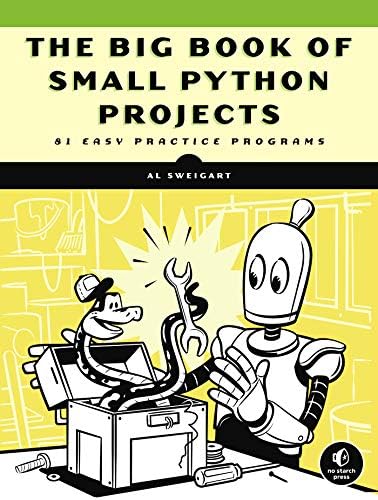
Acquiring programming skills is a difficult task because it has to do directly with the way we think about things, and also because it has many layers of specialization and depth. But it is particularly difficult in the first steps, where you want to turn a set of abstract concepts into solutions to concrete problems. For many, this transition is frustrating because most of the content in the education system is about memorization and repetition. The Big Book of Small Python Projects seeks to help fill that gap for people who are just starting to program by providing examples of small but large enough programs to generate a sense of accomplishment. This is the latest book by Al Sweigart, an author who enjoys great popularity and recognition, on his website inventwithpython.com you can find a good number of books ranging from a book that invites us to learn programming by developing simple video games "Invent Your Own Computer Games with Python" which is already in its fourth edition, to a book of best practices for professionals "Beyond the Basic Stuff with Python". One of his books "Automate Boring Stuff with Python", which has sold around 300 thousand copies on Amazon, is one of those books that anyone would think that someone should have written before, but no one had dared to do it, here we are guided on the basic tasks to work with resources that are common to almost everyone: working on the file system, manipulating office documents, and interacting with Internet resources. Sweigart's formula is consistent and effective: we start by reviewing the solution to the problem, which invites us to think about how everything must work behind the scenes, and then he shows us in greater or lesser detail how this solution was constructed. It is obvious that he is not the inventor of this method nor is he the only one who has used it in programming, other good examples are the books "Dive into Python" by Mark Pilgrim where a similar formula is applied with great success. In "The Big Book" this methodology is applied systematically throughout 81 programs ordered alphabetically, following a brief introduction we find three sections: "The Program in Action" where the author shows an example of program execution, then in "How It Works" he shows us the source code just mentioning implementation details, and "Exploring the Program" where he asks some questions to encourage the reader to deepen the understanding of the program or in some cases, extend it. Most probably the author's intention is not that we advance sequentially from beginning to end, but that among the large number of topics we work on those that call our attention, in this sense it is very useful Appendix A: "Tag Index" where he shows us a classification of the programs based on two systems: by length, and by characteristics. The result is not a book that intends to explain how Python works, or how programs are built, this has already been done by Sweigart in his previous books, especially in "Invent Your Own Computer Games". "The Big Book of Small Python Projects" should be understood more as a guide to lab experiments where you are given directions on an activity that you should do yourself, or perhaps ideally in a group with friends or work/study colleagues. In this sense, it would not be unreasonable for me to see a Wiki or a GitHub repository where people could post observations or variants of the programs. Personally, I have very much enjoyed all his books, and have recommended them all at one time or another. And I am also too close to his pedagogical approach that I have largely incorporated into my work as a teacher to offer an objective viewpoint. There are some implementation details that are not to my liking, such as the use of lowerCamelCase for naming variables, functions and methods, which contradicts the PEP8 that most use, or the preferential use of the format method rather than f-strings, but there is an open invitation here for everyone to adjust it to their liking. Beyond any captious remarks, I recommend this book without reservation, not only for individual reading but also as a basis for various collective activities. For example, as a source of ideas for a programming club or a programming camp, as complementary material for a professional training process, and even as inspiration to study other programming languages, I personally have been using it to study Scala.
Top reviews from the United States
There was a problem filtering reviews. Please reload the page.
- Reviewed in the United States on February 2, 2026Format: Paperback
- Reviewed in the United States on January 30, 2026Format: Paperback
- Reviewed in the United States on November 10, 2025Format: Paperback
- Reviewed in the United States on October 3, 2021Format: Paperback
Acquiring programming skills is a difficult task because it has to do directly with the way we think about things, and also because it has many layers of specialization and depth. But it is particularly difficult in the first steps, where you want to turn a set of abstract concepts into solutions to concrete problems. For many, this transition is frustrating because most of the content in the education system is about memorization and repetition. The Big Book of Small Python Projects seeks to help fill that gap for people who are just starting to program by providing examples of small but large enough programs to generate a sense of accomplishment.
The Big Lab Guide of Small Group Learning Activities.
Reviewed in the United States on October 3, 2021
This is the latest book by Al Sweigart, an author who enjoys great popularity and recognition, on his website inventwithpython.com you can find a good number of books ranging from a book that invites us to learn programming by developing simple video games "Invent Your Own Computer Games with Python" which is already in its fourth edition, to a book of best practices for professionals "Beyond the Basic Stuff with Python". One of his books "Automate Boring Stuff with Python", which has sold around 300 thousand copies on Amazon, is one of those books that anyone would think that someone should have written before, but no one had dared to do it, here we are guided on the basic tasks to work with resources that are common to almost everyone: working on the file system, manipulating office documents, and interacting with Internet resources.
Sweigart's formula is consistent and effective: we start by reviewing the solution to the problem, which invites us to think about how everything must work behind the scenes, and then he shows us in greater or lesser detail how this solution was constructed. It is obvious that he is not the inventor of this method nor is he the only one who has used it in programming, other good examples are the books "Dive into Python" by Mark Pilgrim where a similar formula is applied with great success.
In "The Big Book" this methodology is applied systematically throughout 81 programs ordered alphabetically, following a brief introduction we find three sections: "The Program in Action" where the author shows an example of program execution, then in "How It Works" he shows us the source code just mentioning implementation details, and "Exploring the Program" where he asks some questions to encourage the reader to deepen the understanding of the program or in some cases, extend it. Most probably the author's intention is not that we advance sequentially from beginning to end, but that among the large number of topics we work on those that call our attention, in this sense it is very useful Appendix A: "Tag Index" where he shows us a classification of the programs based on two systems: by length, and by characteristics.
The result is not a book that intends to explain how Python works, or how programs are built, this has already been done by Sweigart in his previous books, especially in "Invent Your Own Computer Games". "The Big Book of Small Python Projects" should be understood more as a guide to lab experiments where you are given directions on an activity that you should do yourself, or perhaps ideally in a group with friends or work/study colleagues. In this sense, it would not be unreasonable for me to see a Wiki or a GitHub repository where people could post observations or variants of the programs.
Personally, I have very much enjoyed all his books, and have recommended them all at one time or another. And I am also too close to his pedagogical approach that I have largely incorporated into my work as a teacher to offer an objective viewpoint. There are some implementation details that are not to my liking, such as the use of lowerCamelCase for naming variables, functions and methods, which contradicts the PEP8 that most use, or the preferential use of the format method rather than f-strings, but there is an open invitation here for everyone to adjust it to their liking. Beyond any captious remarks, I recommend this book without reservation, not only for individual reading but also as a basis for various collective activities. For example, as a source of ideas for a programming club or a programming camp, as complementary material for a professional training process, and even as inspiration to study other programming languages, I personally have been using it to study Scala.
Images in this review


Top reviews from other countries
- GabrielReviewed in Japan on August 7, 2024
Nice
Format: PaperbackVerified Purchase
Good for kids. The print quality is good.GabrielNice
Reviewed in Japan on August 7, 2024
Images in this review
-
Smart AleckReviewed in Turkey on February 7, 2024
Çok güzel bir kitap.Tavsiye ederim.
Format: PaperbackVerified Purchase - UsmanReviewed in Germany on October 7, 2021
Project code doesnt work
Format: KindleVerified Purchase - DAVE DYSONReviewed in the United Kingdom on November 9, 2025
Disappointingly dry—didn’t spark my coding curiosity
Format: KindleVerified Purchase