Review on “Spin Dictators by Sergei Guriev and Daniel Treisman” and notes-and-words.

001_cover_9780691211411.jpg

I have read “Spin Dictators” by Sergei Guriev and Daniel Treisman. My review is below.

Review

The book took me 7 hours 22 minutes to read, that is 442 minutes. \With about 220 pages of readable text (the whole book is almost twice larger, but the rest contains mostly references), this makes it about 2 minutes per page. Not exactly a book for slow reading.

Why is that?

When reading “Spin Dictators”, I couldn’t get rid of a feeling that I had already heard most of the propositions made. Where? In the Russian opposition-leaning media, for the most part, as well as the Western media, mostly left-leaning.

This made me… be critical about the text. I guess I have to give this disclaimer, because to an extent it means that I cannot review the book in an unbiased way. Not because I am pre-disposed to the book, but because I just have had too much exposure to a partisan political agenda.

Does it mean that things said there are a priori false? Not at all, after all, political agendas are sometimes built on genuine understanding, and in the case of “Spin Dictators”, most claims are supported by evidence, even though I haven’t bothered to verify that evidence. However, it did make me approach the text from a critical viewpoint.

So what the authors are saying can be roughly summarised as the following: since the last quarter of the twentieth century, dictatorships are much more based on manipulating and misleading people, rather than on inflicting fear upon them.

The first part of the book defines what a “Spin Dictatorship” is more precisely, and continues to describe its properties, such as its paradigmatic policies to democracy, international relations, propaganda, repression, censorship.

The seconds part of the book tries to establish how those “Spin Dictatorship” appeared, how they might evolve, and how democratic states should work with them.

Overall, this book left me with a feeling of unease. I cannot specify exactly where and why. Those interested may have a look at the notes in the next section of this file.

Perhaps, the most disturbing thought for me is the authors’ firm belief in “international institutions”. After all, international institutions are just institutions, prone to all problems of bureaucratic organisations.

One more thing that bothers me is a really slacky attitude to sovereignty. I mean, naturally, some countries are richer than others. But that approach “do what we tell, and only then we will help you” sounds too fragile to actually work as intended.

Also, they mention that presently countries have about 43% of their economies being used for import-export. This sounds way off from being reasonable. I mean, I like Japanese knives, but do I want to have no domestic knives in a shop nearby? I doubt.

Similarly, I find it hard to believe that “progress” can be achieved by instilling it into people by the more progressive. Something just doesn’t sound right here. Without independence how can there be adulthood?

Continue reading “Review on “Spin Dictators by Sergei Guriev and Daniel Treisman” and notes-and-words.”

Networking for Systems Administrators by Michael W Lucas, a review.

01_cover_networking-for-systems-administrators.jpg

This book review is going to be really short, well, partly because the book itself is short. However, short here does not imply lack of value. I have discovered that the books by Michael W Lucas always seem to play a role that is at the same time very niche, and very valuable. So I have taken writing this review as an opportunity to also reflect on this niche.

Continue reading “Networking for Systems Administrators by Michael W Lucas, a review.”

A short review on “Professional CMake” by Craig Scott.

I have read “Professional CMake” by Craig Scott. This is short review. This time the review is, indeed, going to be short, because I cannot really say that the book was a paradigm-changing read. Nevertheless, I have decided to make reviews on most books I read, and this one is not an exception.

001_book-cover.png

Continue reading “A short review on “Professional CMake” by Craig Scott.”

A review on “Little Soldiers” by Lenora Chu.

Image

001_book-cover-page_y648.jpg

I have gone through the book in the title. I am no saying “have read”, because for quite some time already, since first grasping this trick while conquering Baudrillard’s “Simulacra”, I am getting through a lot of material via listening to Text-to-Speech, rather than reading directly. Not just is it very handy when there is a “sunken” time during which it is not possible to execute tasks that require full concentration. This, however, comes at a price, namely, certain details are perceived differently, compared to reading in a traditional way.

Anyway, I have listened through the book, and it was an enlightening experience, which I would like to share with the world in this short review.

The book tells a story of an American couple with two children living in Shanghai for a few years, who’s elder son had a chance to attend classes in a Chinese kindergarten (as opposed to what typically happens to the expat children in China – they attend foreign-style kindergartens, which are especially plentiful in Shanghai).

The book was especially interesting to me, as I am not an original product of either American, or Chinese culture, so I had a chance to see the story from a third-party perspective.

Continue reading “A review on “Little Soldiers” by Lenora Chu.”

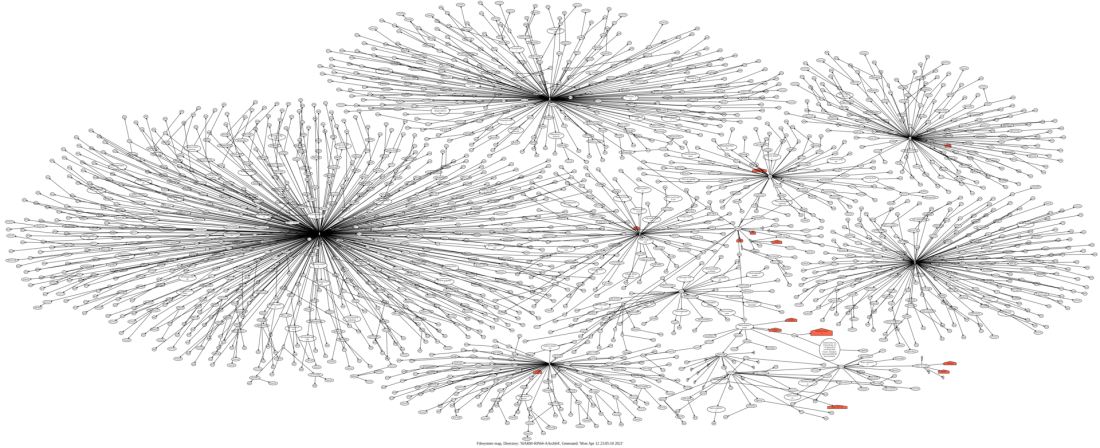
I’ve hacked a simple script for drawing a file system tree as a graph with graphviz. Sounds fun?

Once I realised than a file system tree is like a MindMap…

Here’s the gitlab link: https://gitlab.com/Lockywolf/scsh-xattr-mindmap

Contrary to the name, it is actually in Chibi, not in scsh. I initially thought that scsh would be better due to more exensive posix support, but it turned out to be that Chibi was good enough.

It is a small-ish (500 lines of code) script to generate a graph from your filesystem tree. It accepts a few options (editable directly at the file top) and duplicates quite a lot of the GNU Find functionality, but I didn’t find a way to avoid doing that, as it has to use heuristics in order to prune the tree to a reasonable size.

The resulting image is like this:

2021-04-13_Slarm64-repo-tree.smaller.png

Small, 1Mb

Large, 44Mb

I plotted the Slarm64 (Unofficial Slackware for Raspberry Pi) repository tree, just for the demonstration purposes.

The size of the images above is 1×2.5 metres. It’s large, but my original goal was to plot my whole file system. The ’size=’ parameter is tunable. I think it is reasonable to assume that you need to have at least 4 square centimetres per node, so a graph that large would accommodate about 4000 nodes. In my opinion, 8000 is still possible, but too tight.

With the default settings the script ignores regular files, but traverses symlinks. In theory it also supports hardlinks, but you would need to turn on drawing regular files manually.

I made this script, because I started to feel that I am starting to forget what I have on my hard drive, that has amassed quite a lot of life history for the past 20 years. (Since hard drives became reasonably priced.)

Use-cases and pull requests welcome. One more reason to create this script was to prove that Scheme can be a practical programming language.

Technologically, this code is not terribly advanced, the only trick that may be interesting to programming nerds is having the r7rs module and the main function in the same file (like scsh/scheme48 suggest doing), which requires procedural module analysis.

I had to glue on a couple of C bindings for sys/xattr.h, those are now available at the Snow-Fort repo. Those are Chibi-specific.

Hope you will enjoy it.

Solving SICP

This report is written as a post-mortem of a project that has, perhaps, been the author’s most extensive personal project: creating a complete and comprehensive solution to one of the most famous programming problem sets in the modern computer science curriculum “Structure and Interpretation of Computer Programs”, by Abelson, Sussman, and Sussman (\cite{Abelson1996}).

It measures exactly:

  • How much effort SICP requires (729 hours 19 minutes (over eight months), 292 sessions).
  • How many computer languages it involves (6).
  • How many pieces of software are required (9).
  • How much communication with peers is needed.

It suggests:

  • A practical software-supported task management procedure for solving coursework.
  • Several improvements, on the technical side, to any hard skills teaching process.
  • Several improvements, on the social side, to any kind of teaching process.

The solution is published online (the source code and pdf file):

This report (and the data in the appendix) can be applied immediately as:

  • A single-point estimate of the SICP problem set difficulty.
  • A class handout aimed at increasing students’ motivation to study.
  • A data source for a study of learning patterns among adult professionals aiming for continuing education.
  • An “almost ready” protocol for a convenient problem-set solution procedure, which produces artefacts that can be later used as a student portfolio.
  • An “almost ready”, and “almost convenient” protocol for measuring time consumption of almost any problem set expressible in a digital form.

Additionally, a time-tracking data analysis can be reproduced interactively in the org-mode version of this report. (See: Appendix: Emacs Lisp code for data analysis)

Read full paper

A marvelous sample of chinese propaganda

Image

Yesterday I posted an unremarkable Chinese propaganda poster, I believe, created in order to sweeten for the kids the necessity to go back to school.

As it is school-oriented, of course it is profession-related. That is, it is a manga/tradition Cbhinese scroll stylized depiction of potential professions.

The post received an unexpected amount of attention, so I am publishing an extended version.

The poster

Image

The border guard

Image

The cosmonaut

Image

The banker

Image

The firefighter

Image

The musician and the farmer

Image

The photo reporter

Image

Cultural activist?

Image

Industrial climber

Image

5G Engineer

Image

Cleaning staff

Image

Driver

Image

Digital marketer

Image

Cook

Image

Livestock farmer

Image

Photographer

Image

Flight attendant

Image

Buider

Image

Search-and-Rescue

Image

Doctor

Image

Criminal Lawyer

Image

Banker

Image

Teacher

Image

Police

Image

Logistics

Image

Seller

Image

Public maintenance

Image

Oil-and-gas

Image

Forestry

Image

Civil engineer

Image

Scientist

Image

Courier

Image

Drone pilot

Image

Writer

Image

Advertiser

Image

Programmer

Image