-
Faded Practice for Solving Systems of Linear Equations with Elimination

I start with this warmup from Illustrative Mathematic’s lesson on elimination:

Their materials include a nice example analysis activity as well:

Then I move to faded practice:

Here is Level Two:

Substitute or eliminate? It’s time to start thinking about how to decide:

-
Faded Practice – Substituting to Solve Systems of Linear Equations

First, an estimation warm up to make sure everyone understands what we’re trying to do.

Then, a mistake analysis problem, taken from Algebra by Example:

Now, the faded practice:

And, back to our original question:


-
Completing the Square
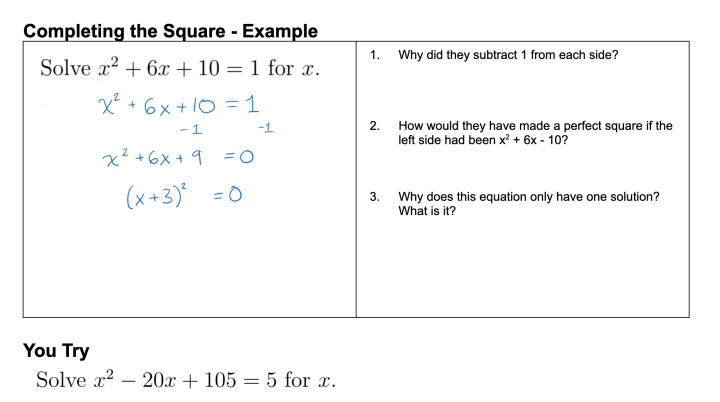
Here’s what I’ve used in class this week, mostly to good effect.


-
Implicit Differentiation Examples
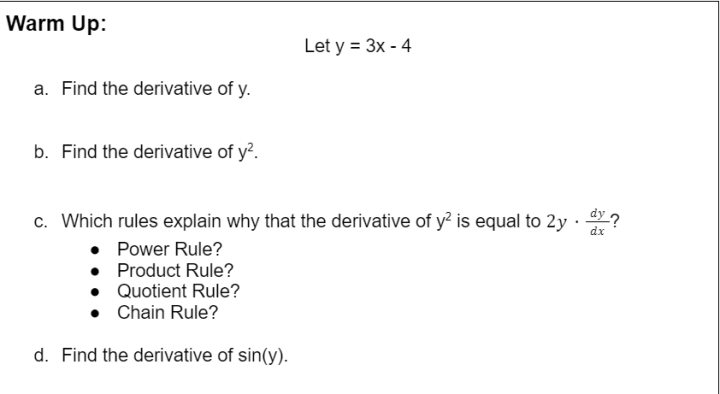
Here are some example-ish tasks I used to introduct implicit differentiation.
First, a warm up, to help students notice and remember relevant things they had already learned about the chain rule:

Then another little warm up, just to understand what the problem we are trying to solve (what is the slope of the circle?) actually is.

Then, the worked example. I left the last step blank and put analysis questions on the side, because I really just wanted to make sure everyone noticed everything. (I wasn’t really trying to get students to articulate a generalization at this stage.)

This was followed by an opportunity to apply this new approach to a new problem.

On a following day, I gave another warm up, again helping students remember things they have already seen in algebra:

It’s product rule time! Here’s a fun little implicitly defined curve:

Same type of example provided again here:

Then we did this comparison between two derivative computations. And then it was time to do more conventional practice.
-
Comparing Explicit and Implicit Differentiation
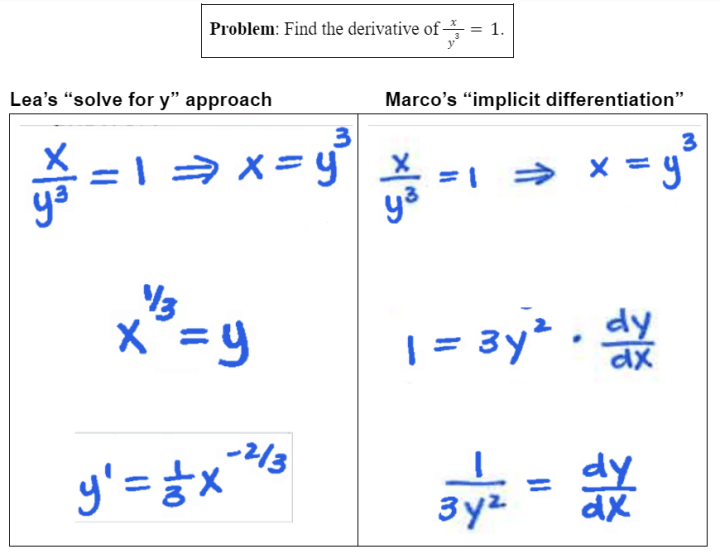
Here was the original problem from Calc Medic:

The thought of comparing two strategies made me think of the Compare & Discuss project from Jon Star, Bethany Rittle-Johnson, and Kelley Durkin. I took the answer key from Calc Medic and rejiggered it into a comparison between two worked out solutions:

Here were the analysis questions I asked, which could probably be improved. Students noticed that both Lea and Marco started by multiplying both sides by y^3. I asked as a follow-up whether Lea and Marco had to perform this step to complete their techniques. (I think Marco could have used the quotient rule. Lea had to put the equation in explicit form.)

I think it’s helpful to see implicit/explicit differentiation side by side. We need to think of implicit differentiation as another technique that does the same sort of thing as our other derivative-finding strategies. People may think comparison is mostly for spotting differences, but it’s also about coming to see deep similarities among those differences.
-
Mistake+Example for finding the distance of a trip
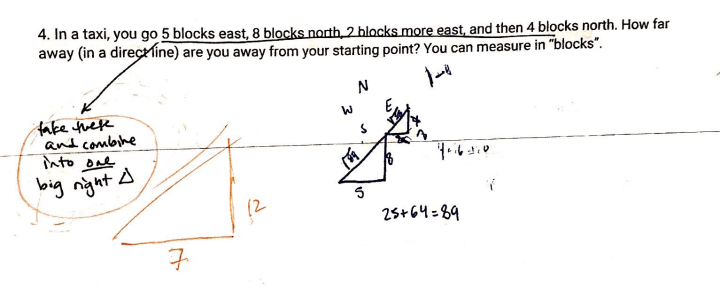
This mistake came via Bowman Dickson:

Here is the example/mistake that I came up with for sharing with students:

I’m trying to make clear what’s right, but an important part of this is students coming to understand why the procedure on the right doesn’t work. The point is that the slopes of the lines don’t match up, so the two-triangle path is longer.
These analysis questions set a teacher up to talk about that — or at least that’s what I was going for!

I would follow this up with another similar (but different) problem.
-
Faded Practice with Equations of Lines
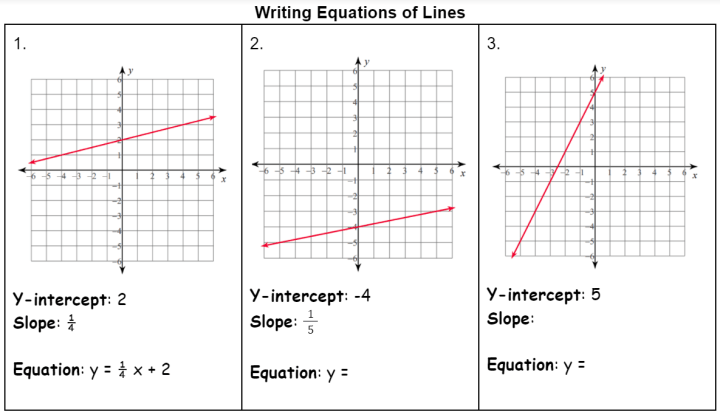
I took these images from the Kuta Software worksheets (actually the answer keys) and am turning them into some faded practice for writing equations of lines.


-
Finding the Constant of Proportionality
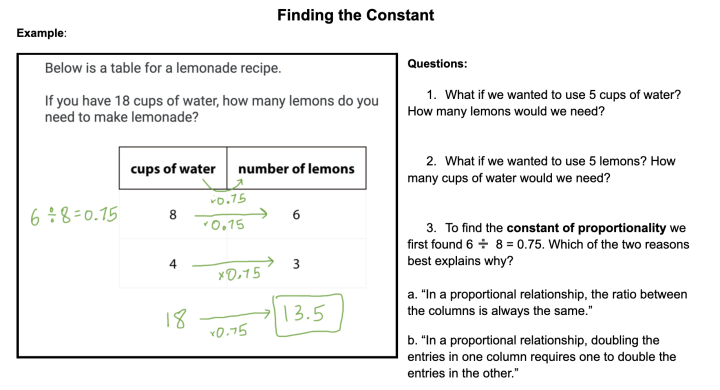
Looks like I took the table from the lesson summary from one of these lessons and wrote an example activity around it.

-
Solving Equations that have fractions
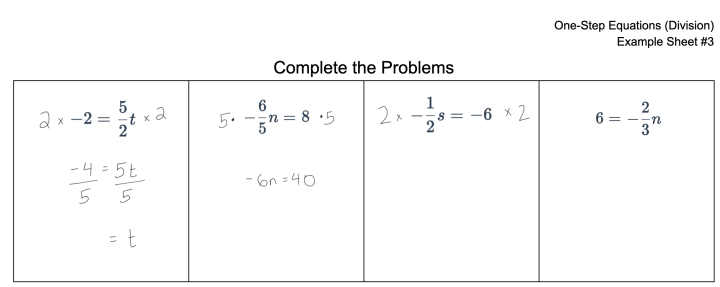
Here are two worked-out strategies, in the spirit of Compare & Discuss — a great site for worked example activities.

I followed this up with some faded practice:


-
Inscribed Angle Mistake
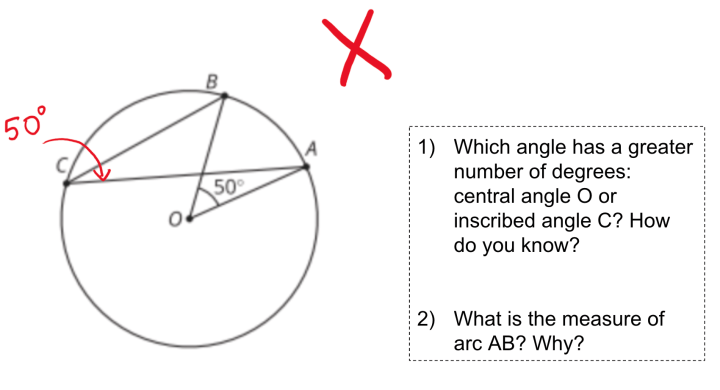
Here’s one of those mistakes that crop up every year. When I hit one of those, I try to “call it out” in a mistake analysis activity where we talk about why it’s wrong and what is less-wrong.

It is empowering and good practice to immediately use the new idea to solve a new and related problem.

From my notes, it looks like I then followed up with this very solid practice activity, which I learned about from Jo Morgan’s Resourceaholic.
-
Subscribe
Subscribed
Already have a WordPress.com account? Log in now.
 Mathematics with Worked Examples
