

Choosing the right GPU server can feel overwhelming when machine learning models or 3D renders struggle to process massive datasets on time. For AI researchers and developers in Central Europe, the demand for high-performance solutions is real. GPU servers deliver extraordinary computational acceleration by distributing workloads across thousands of processing cores, transforming workflow efficiency and scalability. This guide clarifies misconceptions, breaks down core server types, and highlights the essential hardware factors to help you select infrastructure that aligns with your most demanding projects.
Key Takeaways
| Point | Details |
| Understanding GPU Servers | GPU servers excel in parallel processing, making them essential for AI, machine learning, and advanced simulations. |
| Deployment Models | Different server types, such as on-premise, cloud, and hybrid solutions, significantly impact scalability and cost-effectiveness. |
| Performance Evaluation | Focus on workload-specific performance metrics to ensure optimal efficiency rather than just core count. |
| Strategic Planning | Comprehensive planning and continuous skills development are crucial for successfully navigating GPU infrastructure challenges. |
Core Definition and Common Misconceptions
GPU servers represent specialized computing infrastructure designed to handle parallel processing tasks with extraordinary computational efficiency. Unlike traditional CPU-based systems, GPU servers leverage graphics processing units to accelerate complex mathematical computations across multiple cores simultaneously, making them critical for demanding workloads like artificial intelligence, machine learning, and high-performance rendering.
At their core, GPU servers differ fundamentally from standard computing architecture by offering massively parallel processing capabilities. The key distinctions include:
Thousands of smaller, more specialized processing cores compared to traditional CPUs
Ability to execute thousands of computational threads concurrently
Optimized architecture for matrix and vector calculations
Significantly higher floating-point performance for specific computational tasks
Many professionals mistakenly believe GPU servers are exclusively for graphics rendering, which represents a critical misconception. While visual computing remains an important application, modern GPU infrastructure supports far broader computational domains:
Scientific simulations
Cryptographic calculations
Molecular dynamics modeling
Deep learning neural network training
Financial risk modeling
GPU servers aren’t just powerful – they’re transformative computational platforms that redefine what’s possible in high-performance computing environments.
The complexity of GPU server technology often leads to several common misunderstandings among technology professionals. Some erroneously assume that more GPU cores automatically translate to better performance, overlooking critical factors like memory bandwidth, clock speed, and architectural design. Advanced GPU architectures require nuanced understanding beyond raw core count.
Pro tip: When evaluating GPU servers, focus on workload-specific performance metrics rather than generalized specifications to ensure optimal computational efficiency.
Types of GPU Servers and Key Differences
The landscape of GPU server architecture encompasses multiple configurations designed to meet diverse computational requirements. Different GPU server types offer organizations flexible solutions for handling intensive processing tasks across various technological domains.
GPU servers can be categorized into several distinct deployment models:
On-Premise GPU Servers: Physically owned and managed internally
GPU Cloud Servers: Virtualized resources accessed through cloud platforms
Hybrid GPU Servers: Combining on-premise and cloud infrastructure
Specialized Compute Servers: Tailored for specific computational workloads
The architectural variations between these server types significantly impact performance, scalability, and cost-effectiveness. Cloud-based GPU server configurations provide remarkable flexibility for organizations seeking dynamic computational resources without substantial upfront hardware investments.
Moreover, the server types can be further classified based on GPU quantity and deployment strategy:
Single-GPU Servers (ideal for entry-level research)
Multi-GPU Servers (supporting complex computational tasks)
Virtualized GPU Servers (enabling resource sharing)
Edge GPU Servers (optimized for low-latency applications)
Dedicated High-Performance Computing Servers
GPU server selection is not just about hardware – it’s about matching computational architecture to specific organizational requirements.
Technical professionals must carefully evaluate their computational needs, considering factors like memory bandwidth, processing cores, and workload complexity when selecting an appropriate GPU server configuration. The right infrastructure can dramatically accelerate computational performance while optimizing resource utilization.
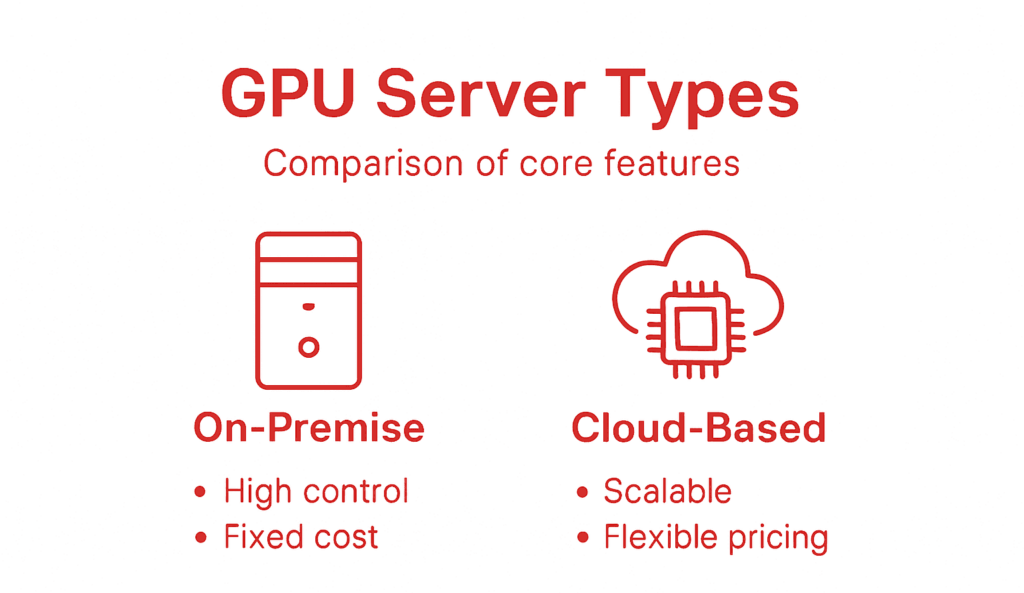
Here’s a concise comparison of GPU server deployment models and their business implications:
| Deployment Model | Scalability | Cost Structure | Typical Use Case |
| On-Premise | Limited by hardware | High upfront investment | In-house research and sensitive data |
| Cloud-Based | Flexible, on demand | Pay-as-you-go | AI model training and scalable workloads |
| Hybrid | Customizable | Mixed (capex + opex) | Balancing compliance and burst workloads |
| Specialized | Application-specific | Variable based on customization | Industry-specific high-performance tasks |
Pro tip: Conduct a comprehensive workload analysis before selecting a GPU server type to ensure maximum computational efficiency and cost-effectiveness.
Essential Components and How GPU Servers Work
GPU servers represent sophisticated computing platforms engineered to deliver extraordinary computational performance through specialized hardware architecture. Advanced server configurations leverage multiple interconnected components to accelerate complex processing tasks across various computational domains.
The core components of a GPU server include:
Graphics Processing Units (GPUs): Specialized parallel processing engines
Central Processing Units (CPUs): System resource management and sequential task handling
High-Speed Interconnects: PCIe and NVLink for rapid data transfer
Memory Systems: Large capacity RAM and GPU-specific VRAM
Storage Solutions: High-performance NVMe SSDs for quick data throughput
At the heart of GPU server functionality lies the extraordinary ability to distribute computational workloads across thousands of specialized processing cores. GPU architecture enables massive parallel processing, allowing simultaneous execution of thousands of computational threads that dramatically outperform traditional CPU-only systems.
The operational mechanism of GPU servers involves complex task distribution:
Initial task allocation by the CPU
Workload segmentation into parallel processing units
Simultaneous execution across GPU cores
Results aggregation and system integration
Final output generation
GPU servers transform computational complexity into streamlined, efficient processing capabilities.
Technical professionals must understand that GPU servers are not simply faster computers, but fundamentally different computational architectures designed to handle massively parallel processing requirements. The intricate interplay between GPUs, CPUs, memory, and interconnect technologies enables unprecedented computational acceleration for AI, scientific simulations, and rendering workloads.
Pro tip: Prioritize GPU server configurations that offer balanced hardware specifications matching your specific computational workload requirements.
For quick reference, here’s how GPU server components impact performance and operational priorities:
| Component | Primary Role | Performance Impact | Business Priority |
| GPU | Parallel processing | Maximizes throughput | Essential for AI and rendering |
| CPU | Task orchestration | Coordinates workloads | Critical for system stability |
| Memory | Data handling | Reduces bottlenecks | Important for large datasets |
| Storage | Data access speed | Improves loading times | Key for high-volume data |
| Interconnects | Data transfer | Enables fast communication | Necessary for multi-GPU setups |
Primary Applications: AI, Rendering and Simulations
GPU servers have revolutionized computational capabilities across multiple high-intensity technological domains, enabling breakthrough performance in artificial intelligence, complex rendering, and advanced scientific simulations. Machine learning technologies increasingly depend on GPU infrastructure to process massive datasets and train sophisticated neural networks with unprecedented speed and efficiency.
The primary application domains for GPU servers encompass:
Artificial Intelligence: Deep learning model training
3D Rendering: High-resolution graphics production
Scientific Simulations: Complex computational modeling
Molecular Dynamics: Advanced research computations
Financial Modeling: Quantitative risk analysis
In artificial intelligence, GPU servers enable revolutionary capabilities by supporting:
Large-scale neural network training
Real-time machine learning inference
Natural language processing algorithms
Computer vision model development
Generative AI model creation
GPU servers transform computational limitations into opportunities for groundbreaking technological innovation.
Rendering workflows benefit dramatically from GPU server architectures, particularly in industries like animation, visual effects, and architectural visualization. These platforms can dramatically reduce rendering times from hours to minutes, providing artists and designers with near-instantaneous visual feedback and accelerated production cycles.
Scientific simulations represent another critical domain where GPU servers demonstrate extraordinary computational prowess. Researchers can now model complex systems across disciplines like climate science, particle physics, and biomedical research with unprecedented accuracy and computational depth.
Pro tip: Select GPU server configurations specifically optimized for your primary computational workload to maximize performance and cost-effectiveness.
Costs, Pricing Models, and Performance Implications
GPU server investments require strategic financial planning and comprehensive understanding of complex pricing dynamics. GPU performance optimization involves balancing multiple cost factors including hardware expenses, energy consumption, and long-term operational requirements.
The primary cost considerations for GPU server deployments include:
Initial hardware procurement expenses
Power and cooling infrastructure investments
Ongoing maintenance and upgrade costs
Software licensing and compatibility
Energy consumption metrics
Pricing models for GPU servers typically encompass several strategic approaches:
Dedicated hardware purchase
Cloud-based GPU rental
Hybrid infrastructure solutions
Managed service subscriptions
Pay-per-use computational resources
Total cost of ownership extends far beyond initial hardware investment, encompassing infrastructure, operational, and performance optimization expenses.
Cloud-based GPU solutions offer remarkable flexibility, allowing organizations to scale computational resources dynamically. These models enable businesses to access high-performance computing without substantial upfront capital expenditures, transforming infrastructure investments from fixed costs to operational expenses.
Performance implications directly correlate with computational efficiency and workload-specific requirements. Technical teams must carefully evaluate GPU configurations, considering factors like core count, memory bandwidth, clock speeds, and specialized computational capabilities to ensure optimal price-to-performance ratios.
Pro tip: Conduct comprehensive workload analysis and benchmark testing before finalizing GPU server investments to align technological capabilities with specific organizational requirements.
Pitfalls, Limitations, and How to Avoid Them
GPU infrastructure deployment involves complex technological challenges that require strategic planning and proactive management. GPU computing challenges emerge from multiple technical, operational, and organizational dimensions that demand sophisticated mitigation strategies.
The primary pitfalls organizations encounter in GPU server environments include:
Software stack fragmentation
Hardware compatibility issues
Inefficient workload distribution
Complex thermal management requirements
Security vulnerabilities in shared computing environments
Technical professionals must navigate several critical limitations:
Insufficient expertise in heterogeneous system management
High energy consumption challenges
Complex software and driver compatibility
Scalability constraints
Performance optimization difficulties
Successful GPU infrastructure requires more than technological investment — it demands comprehensive strategic planning.
Computing infrastructure challenges can be mitigated through systematic approaches. Organizations must invest in continuous skills development, implement robust monitoring tools, and maintain flexible architectural designs that accommodate evolving computational requirements.
Additionally, security remains a paramount concern in GPU computing environments. Technical teams must implement multi-layered security protocols, regularly update software and firmware, and establish strict access control mechanisms to protect sensitive computational resources from potential vulnerabilities.
Pro tip: Develop a comprehensive GPU infrastructure strategy that prioritizes ongoing skills training, adaptive architectural design, and proactive performance monitoring.
Unlock the Full Potential of GPU Servers with MaxCloudON
The article highlights how GPU servers deliver transformative performance for intensive workloads like AI training, 3D rendering, and scientific simulations. Yet many organizations struggle with challenges such as matching GPU architectures to specific workloads, managing complex configurations, and optimizing costs without sacrificing performance. If you aim to overcome these hurdles and harness GPU computing efficiently, MaxCloudON offers tailored cloud solutions that put you in control. Our dedicated GPU servers provide flexible, scalable resources with full root access, ensuring your compute-intensive tasks run smoothly and cost-effectively.
Explore our Guide to Nvidia Products, Features and Tutorials to deepen your understanding of GPU technologies powering today’s workloads. Then visit MaxCloudON to deploy high-performance GPU servers optimized for your needs. Whether you are an AI researcher, rendering professional, or simulation expert, start leveraging dedicated cloud servers that guarantee consistent performance and personalized support today.
