Friday, January 23, 2026

Geometry Problems of the Day (Geometry Regents, June 2025 Part I)


This exam was adminstered in June 2025.

More Regents problems.

June 2025 Geometry Regents

Part I

Each correct answer will receive 2 credits. No partial credit.


9. A candle can be modeled by a pyramid with a square base, as shown below. The height of the candle is 10 cm, and each side of the base measures 6 cm.

Image

If the candle wax burns at a rate of 3.5 cubic centimeters per hour, what is the approximate number of hours this candle could burn?

(1) 103
(2) 51
(3) 34
(4) 11

Answer: (3) 54


A two-part problem because first you need to know how many cubic centimeters are in the candle before you can answer the question.

The volume of a square pyramid is 1/3 (side)2 times height, which is (1/3) (6)2 (10) = 120 cm3.

If it burns at a rate of 3.5 cm3/hr, then divide 120 / 3.5 = 34.2857..., or about 34.

Choice (3) is the correct answer.

If you forgot the (1/3), you would've gotten choice (1). Oops.


10. In the diagram below, tangent SR and secant STU are drawn to circle O from external point S.

Image

If TU ≅ RU and mTR = 68°, what is m∠S?

(1) 22°
(2) 34°
(3) 39°
(4) 78°

Answer: (3) 39°


The measure of angle S is one half of the difference of arc RU and arc TR. You need to find the size of RU.

Since TU ≅ RU, and TU + RU + TR = 360, then 2(RU) + 68 = 360, and 2(RU) = 292, and RU = 146.

One half of the difference of RU and TR is 1/2(146 - 68) = 39, which is Choice (3).


11. Triangle RST has m∠S = 33°, RS = 7, and ST = 12. What is the area of △RST, to the nearest tenth?

(1) 22.9
(2) 27.3
(3) 35.2
(4) 45.7

Answer: (1) 22.9


Use the Law of Sines: A = 1/2 ab sin C = (1/2)(7)(12)sin(33) = 22.87...


12. Triangle ABC, with vertices whose coordinates are A(–3,–2), B(–1,2), and C(4,1), is graphed on the set of axes below.

Image

Triangle A'B'C', whose vertices have coordinates A'(–6,–2), B'(–2,2), and C'(8,1), is the image of nABC. The transformation that maps △ABC onto △A'B'C' is a

(1) dilation
(2) translation
(3) vertical stretch
(4) horizontal stretch

Answer: (4) horizontal stretch


It is not a dilation because the y-coordinates don't change. On the other hand, the x-coordinates of the image are double the original.

Choice (4) is the correct answer.


13. Which equation represents a line parallel to the line represented by y = 4x + 6 and passing through the point (–3,2)?

(1) y - 2 = 4(x + 3)
(2) y + 3 = 4(x - 2)
(3) y - 2 = -1/4(x + 3)
(4) y + 3 = -1/4(x - 2)

Answer: (1) y - 2 = 4(x + 3)


Parallel lines have the same slope so the answer must have a slope of 4. Eliminate choices (3) and (4).

The answers are given in point-slope form. The x-coordinate of the given point goes with the x variable, and the y-coordinate goes with the y variable.

Choice (1) is the correct answer.


14. Which two-dimensional figure is always formed when a plane intersects a right cylinder perpendicular to its base?

(1) circle
(2) triangle
(3) rhombus
(4) rectangle

Answer: (4) rectangle


If you slice a round cake down the center and separate the two pieces, you will see two rectangles, composed of the top, bottom and the sides of the cake.

Choice (4) is the correct answer.


15. In △KMP below, CE is drawn parallel to MP.

Image

If KC = 8, CM = 3, and CE = 12, what is the length of MP?


(1) 24
(2) 16.5
(3) 15
(4) 4.5

Answer: (2) 16.5


The sides of the two triangles are proportional, but first you need to find KM = KC + CM = 8 + 3 = 11.

So 8/12 = 11/MP.

Then MP = 11 * 12 / 8 = 16.5

The correct answer is Choice (2).


16. A parallelogram must be a rectangle if its diagonals

(1) are perpendicular
(2) bisect each other
(3) bisect its angles
(4) are congruent

Answer: (4) are congruent


What do you know about parallelograms and rectangles?

The diagonals of parallelograms and rectangles are not perpendicular unless they are also rhombuses. Eliminate Choice (1).

The diagonals of both parallelograms and rectangles are bisect each other, so that is not enough information. Eliminate Choice (2).

The diagonals of parallelograms and rectangles only are bisect each other is they are also rhombuses. Eliminate Choice (3).

The diagonals of parallelograms are only congruent if the parallelogram is a rectangle. Choice (4) is the answer.


More to come. Comments and questions welcome.
Image


MY NEWEST BOOK IS OUT


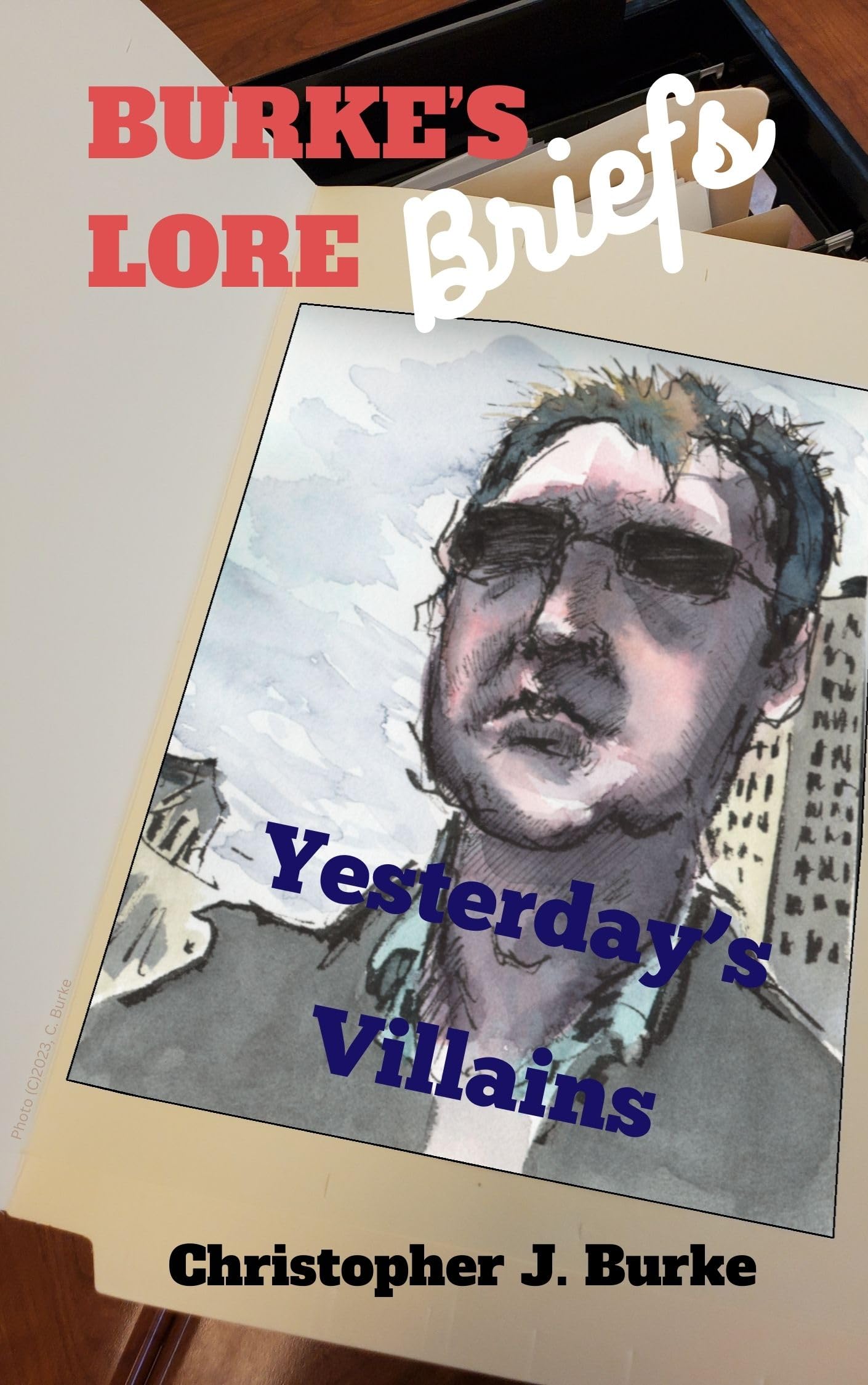
Burke's Lore Briefs: Yesterday's Villains, the following to Tomorrow's Heroes is now available on Amazon and Kindle Unlimited.

If Heroes who don't die live long enough to become the villain, what happens to Villains who live long enough? When do schemes of global conquest become dreams of a quiet place away from all those annoying people you once wanted to subjugate? And does anyone really want to rule over the world's ashes if it means we can't have nice things?

Image Image

My older books include three more books in my Burke's Lore Briefs series, and the anthologies A Bucket Full of Moonlight and In A Flash 2020.

Vampires, werewolves, angels, demons, used-car salesmen, fairies, superheroes, space and time travel, and little gray aliens talking to rock creatures and living plants.

Plus pirates, spies, horror, and kindergarten noir!

If you enjoy my books, please consider leaving a rating or review on Amazon or on Good Reads. Thank you!
Image Image
Image Image Image


Thursday, January 22, 2026

Geometry Problems of the Day (Geometry Regents, June 2025 Part I)


This exam was adminstered in June 2025.

More Regents problems.

June 2025 Geometry Regents

Part I

Each correct answer will receive 2 credits. No partial credit.


1. The perimeter of a triangle is 18. What is the perimeter of a similar triangle after a dilation with a scale factor of 3?

(1) 6
(2) 18
(3) 54
(4) 162

Answer: (3) 54


The perimeter of a dilated triangle is the perimeter of the original times the scale factor, so 18 times 3 equals 54, which is Choice (3).

It is not the scale factor squared -- that would be the area, which has two dimensions being expanded.


2. The Washington Monument, shown below, is in Washington, D.C. At a point on the ground 200 feet from the center of the base of the monument, the angle of elevation to the top of the monument is 70.19°.

Image

What is the height of the monument, to the nearest foot?

(1) 188
(2) 213
(3) 555
(4) 590

Answer: (3) 555


If you've ever been there, then you might know that it is 555 feet tall, and they did NOT change this fact for this problem. If you didn't know that, you can calculate it using the tangent ratio, because you have the angle and the adjacent side and you are looking for the opposite side.

tan 70.19 = x / 200
x = 200 tan 70.19 = 555.217...,


which is about 555, which is Choice (3).


3. On the set of axes below, △EQA and △SUL are graphed.

Image

Which sequence of transformations shows that △EQA ≅ △SUL?

(1) Rotate △EQA 90° counterclockwise about the origin and then translate 9 units right and 1 unit down.
(2) Rotate △EQA 90° counterclockwise about the origin and then reflect over the line x = 4.
(3) Reflect △EQA over the x-axis and then rotate 90° clockwise about the origin.
(4) Translate △EQA 10 units right and then reflect over the line x = -1.

Answer: (1) Rotate △EQA 90° counterclockwise about the origin and then translate 9 units right and 1 unit down.


Make sure you are going the correct direction: you want to go from the top left to the bottom right. There are multiple methods of getting there, so check the choices one by one.

In Choice (1), EQA goes to Quadrant III with E'(-5,-2), Q(-1,-2), A'(-1,-5), which is facing the same direction as SUL. A transformation of T9,-1 brings AEQ to SUL. This is the correct answer.

In Choice (2), EQA goes to Quadrant III with E'(-5,-2), Q(-1,-2), A'(-1,-5), which is facing the same direction as SUL. A reflection would change the orientation and would not map onto SUL. Eliminate Choice (2).

In Choice (3), EQA goes to Quadrant I but changes its orientation. When E'Q'A' is rotated 90 degrees, it will not map ontol SUL because the orientations are different. Eliminate Choice (3).

In Choice (4), EQA goes to Quadrant IV but will be oriented with point E pointing up. A reflection will not rotate the triangle to look like SUL. Eliminate Choice (4).


4. If two sides of a triangle have lengths of 2 and 8, the length of the third side could be

(1) 10
(2) 7
(3) 6
(4) 4

Answer: (2) 7


The Triangle Inequality Theorem states that the sum of the lengths of any two sides of a triangle must be greater than the length of the third side.

If two sides are 2 and 8, then then third side must be less than 10. If two sides are 2 and 8, then the third side must be greater than 6, because 6 + 2 = 8.

This eliminates Choice (1), (3), and (4).

Choice (2) 7 is between 6 and 10, so it is a reasonable length. This is the correct answer.


5. A regular octagon is rotated about its center. Which angle measure will carry the octagon onto itself?

(1) 36°
(2) 90°
(3) 144°
(4) 160°

Answer: (2) 90°


A full rotation is 360°. During that rotation, the octagon will carry onto itself 8 times at increments of 360°/8 = 45°.

Of the four choices, only 90 is a multiple of 45, so the correct answer is Choice (2).


6. The equation of a circle is x2 + y2 - 6x + 2y = 14. What are the coordinates of the center and the length of the radius of this circle?

(1) (-3,1) and r = 5
(2) (3,-1) and r = 5
(3) (-3,1) and r = √(24)
(4) (3,-1) and r = √(24)

Answer: (4) (3,-1) and r = √(24)


A reminder that old exams not only show you the type of problems you may see but sometimes THE SAME NUMBER QUESTION will have THE SAME TYPE OF QUESTION. This was the same question that was asked in January with slightly different numbers, and it was Question #6 then, too.

To find the center of the circle, you need to complete the squares, twice, and find the square root of the polynomials.

x2 + y2 - 6x + 2y = 14
x2 - 6x + y2 + 2y = 14
x2 - 6x + (3)2 + y2 + 2y + (1)2 = 14 + 9 + 1
(x - 3)2 + (y + 1)2 = 24
(x - 3)2 + (y + 1)2 = (√(24))2

The correct answer is Choice (4) (3,-1) and r = √(24).


7. In △HSF below, m∠S = 90°, HF = 30, and FS = 23.

What is m∠F, to the nearest degree?


(1) 53°
(2) 50°
(3) 40°
(4) 37°

Answer: (3) 40°


You are looking for an angle in a right triangle and you are given the adjacent side and the hypotenuse, so you need to use the cosine ratio.

cos F = 23/30

F = cos-1(23/30) = 39.94°

Choice (3) is the correct answer.


8. In △CAB below, midsegments DE, EF, and FD are drawn.

Image

If CA = 14, CB = 20, and FB = 9, what is the perimeter of quadrilateral DEFA?


(1) 26
(2) 32
(3) 44
(4) 52

Answer: (2) 32


Midsegments are half the length of the side of the triangle that they are parallel to. Therefore, AD = 7 and EF = 7. Since FB = 9, then AF = 9 and DE = 9.

Thus the perimeter of DEFA is 9 + 7 + 9 + 7 = 32, which is Choice (2).

Not that they asked by DEFA is also a parallelogram.


More to come. Comments and questions welcome.
Image


MY NEWEST BOOK IS OUT


Burke's Lore Briefs: Yesterday's Villains, the following to Tomorrow's Heroes is now available on Amazon and Kindle Unlimited.

If Heroes who don't die live long enough to become the villain, what happens to Villains who live long enough? When do schemes of global conquest become dreams of a quiet place away from all those annoying people you once wanted to subjugate? And does anyone really want to rule over the world's ashes if it means we can't have nice things?

Image Image

My older books include three more books in my Burke's Lore Briefs series, and the anthologies A Bucket Full of Moonlight and In A Flash 2020.

Vampires, werewolves, angels, demons, used-car salesmen, fairies, superheroes, space and time travel, and little gray aliens talking to rock creatures and living plants.

Plus pirates, spies, horror, and kindergarten noir!

If you enjoy my books, please consider leaving a rating or review on Amazon or on Good Reads. Thank you!
Image Image
Image Image Image


Wednesday, January 21, 2026

Algebra Problems of the Day (Algebra Regents, August 2025 Part I)


The Problems of the Day are BACK! Let's see for how long. Life, y'know?

This exam was adminstered in August 2025.

More Regents problems.

August 2025 Algebra Regents

Part I

Each correct answer will receive 2 credits. No partial credit.


17. The formula for the area of a trapezoid is A = (1/2)h(b1 + b2). The height, h, of the trapezoid may be expressed as

(1) 2A / (b1 + b2)
(2) (1/2)A(b1 + b2)
(3) (b1 + b2) / (2A)
(4) (1/2)A - (b1 + b2)

Answer: (1) 2A / (b1 + b2)


Inverse operations to isolate h in terms of the other variables.

A = (1/2)h(b1 + b2)
2A = h(b1 + b2)
2A / (b1 + b2) = h

Choice (1) is the correct answer.


10. Three functions are given below.

Image

Which functions have the same y-intercept?

(1) f(x) and g(x)
(2) g(x) and h(x
(3) f(x) and h(x)
(4) The functions all have different y-intercepts.

Answer: (1) f(x) and g(x)


The y-intercept of h(x) is in the table -- when x = 0, h(x) = -3. Now calculate f(0) and g(0), or graph them.

f(0) = -|0 + 2| + 7 = -2 + 7 = 5, so f(x) and h(x) have different y-intercepts.

g(0) = (0 - 3)2 - 4 = 9 - 4 = 5, which is the same as f(0).

Therefore, the correct answer is Choice (1).


19. The sum of (x + 7)2 and (x - 3)2 is

(1) 2x2 + 58
(2) 2x4 + 58
(3) 2x2 + 8x + 58
(4) 2x4 + 8x2 + 58

Answer: (2) -3.75


The sum of two quadratics is also a quadratic (unless the x2 terms cancel out for some reason, in which case the order of lower, but it'll never be higher.) Eliminate Choices (2) and (4).

It should also be obvious that Choice (1) is incorrect because there is no reason why the middle term should be missing.

(x + 7)2 + (x - 3)2

x2 + 14x + 49 + x2 - 6x + 9

2x2 + 8x + 58

Choice (3) is the correct answer.


20. The product of 2√(10) and 3√(2) is

(1) 12√(5)
(2) 5√(20)
(3) 24√(5)
(4) 5√(12)

Answer: (1) 12√(5)


Multiply the coefficients and multiply the radicands.

So (2√(10)) * (3√(2)) = 6√(20), which is not one of the choices. However, the radical can be simplified.

6√(20) = 6√( (4)(5) ) = 6√(4)&sqrt;(5) = 12√(5)

This is Choice (1).

This problem could've been solved by putting all four choices and the original question into a calculator.


21. When 6x3 - 2x + 8 is subtracted from 5x3 + 3x - 4, the result is

(1) x3 - 5x + 12
(2) x3 + x + 4
(3) -x3 + 5x - 12
(4) -x3 + x + 4

Answer: (3) -x3 + 5x - 12


The most important word in this problem is FROM. The 5x3 polynomial is on top (or on the left) and the 3x3 polynomial is on the bottom (or on the right).

Next, be careful with subtracting signed numbers.

(5x3 + 3x - 4) - (6x3 - 2x + 8) = -x3 + 5x - 12, which is Choice (3).


22. Three relations are shown below

Image


Which relations represent a function?
(1) I and II, only
(2) I and III, only
(3) II and III, only
(4) I, II, and III

Answer: (4) I, II, and III


A relation is a function if none of the x-values repeat.

In function I, the domain is {0,1,2,3}, which makes I a function.

In function II, the domain is {3,4,5,6}, and no member of the domain has two arrows coming outwhich makes II a function.

In function III, the graph passes the vertical line test because every closed circle is over an open circle, so III is a function.

The correct answer in Choice (4).


23. The method of substitution was used to solve the system of equations below:

4x - 7y = 7
x - y = -1

Which equation is a correct first step when using this method?

(1) x = y - 1
(2) y = x - 1
(3) 3x - 6y = 8
(4) 5x - 8y = 6

Answer: (1) x = y - 1


This can be solved using substitution. The first step would be to solve for x or solve for y.

Given x - y = -1, then x = y - 1 and y = x + 1.

This means that Choice (1) is correct and Choice (2) can be eliminated.

Choices (3) and (4) are found by subtracting or adding the two equations. Neither eliminates a variable, so it isn't helpful.

Note that you can subtract the second equation four times to eliminate the x term, but that would not be using Substitution.


24. In 2009, Usain Bolt, a sprinter from Jamaica, set the world record in the 100-meter dash with a time of 9.58 seconds. His approximate speed, in kilometers per hour, can be found using which conversion?

Image

Answer: (4) [SEE IMAGE]


I love using Usain Bolt references in class, particularly in semesters when I have Jamaican students.

Units are like variables in that they can be multiplied and divided. That is, feet times feet are feet2 or square feet. And miles/hour times hours gives you miles because hours divided by hours is 1.

Look at the four choices and cancel out the units that appear in both the top and bottom of the fraction.

Here is what the four choices should look like:

Image

In Choice (1), we have hr/km not km/hr. Eliminate Choice (1).

In Choice (2), we have m2/(km*hr). Eliminate Choice (2).

In Choice (3), we have (km*hr)/sec2. Eliminate Choice (3).

In Choice (4), we have km/hr. This is the correct answer.


End of Part I. Comments and questions welcome.
Image


MY NEWEST BOOK IS OUT


Burke's Lore Briefs: Yesterday's Villains, the following to Tomorrow's Heroes is now available on Amazon and Kindle Unlimited.

If Heroes who don't die live long enough to become the villain, what happens to Villains who live long enough? When do schemes of global conquest become dreams of a quiet place away from all those annoying people you once wanted to subjugate? And does anyone really want to rule over the world's ashes if it means we can't have nice things?

Image Image

My older books include three more books in my Burke's Lore Briefs series, and the anthologies A Bucket Full of Moonlight and In A Flash 2020.

Vampires, werewolves, angels, demons, used-car salesmen, fairies, superheroes, space and time travel, and little gray aliens talking to rock creatures and living plants.

Plus pirates, spies, horror, and kindergarten noir!

If you enjoy my books, please consider leaving a rating or review on Amazon or on Good Reads. Thank you!
Image Image
Image Image Image


Tuesday, January 20, 2026

Algebra Problems of the Day (Algebra Regents, August 2025 Part I)


The Problems of the Day are BACK! Let's see for how long. Life, y'know?

This exam was adminstered in August 2025.

More Regents problems.

August 2025 Algebra Regents

Part I

Each correct answer will receive 2 credits. No partial credit.


9. The tables below show the input and output values of four different functions.

Image


(1) f(x)
(2) g(x)
(3) h(x)
(4) j(x)

Answer: (4) j(x)


The output values repeat in f(x) and g(x), so eliminate Choices (1) and (2) as they change direction and can't be linear.

The rate of change in h(x) is changing, not constant. It goes down 1, down 2, down 4, etc. Eliminate Choice (3).

The rate of change in j(x) is constant. It goes up 4 from -11 to -7, then up 4 again to -3, etc. This is the correct choice.


10. What is the solution set to the equation 3x2 = 24x?

(1) {8}
(2) {0,8}
(3) {0,-8}
(4) {0,8,-8}

Answer: (2) {0,8}


You can solve this by factoring:

3x2 = 24x
x2 = 8x
x2 - 8x = 0
x(x - 8) = 0
x = 0 or x - 8 = 0

x = 0 or x = 8

A quadratic equation can have at most two solutions, so Choice (4) could've been eliminated immediately.

Likewise, since x = 0 is "obviously" a solution, Choice (1) could have been eliminated as well.

If you didn't wish to factor, you could've checked 0, 8, and -8 in a calculator.


11. The table below shows the radioactivity level of a substance after the given time, t, in seconds.

Image

What is the average rate of change in radioactivity level over the interval 1 < t < 3?

(1) 3.75
(2) -3.75
(3) 4.6875
(4) -4.6875

Answer: (2) -3.75


Average rate of change is the slope of the line from t = 1 to t = 3.

(2.5 - 10) / (3 - 1) = -7.5 / 2 = -3.75

That is Choice (2).


12. Fred recorded the number of minutes he read each day, from Monday through Friday. His results are shown in the table.

What is the correlation coefficient, to the nearest thousandth, and strength of the linear model of these data?

(1) 0.984 and strong
(2) 0.968 and strong
(3) 0.984 and weak
(4) 0.968 and weak

Answer: (1) 0.984 and strong


This is an annoying question for the multiple-choice portion of the exam because of the work involved. You can't reason out the final answer because 0.984 and 0.968 are so close together. There's no short cut.

However, both 0.984 and 0.968 indicate strong relationship, so Choices (3) and (4) can be eliminated.

You need to put the data into Lists in your graphing calculation and run a Linear Regression.

You will then find that r2 = 0.968 and r = 0.984. You want the r value. (You'll never want the r2 value for this level of algebra.

The correct answer is Choice (1).


13. Given f(x) = x2, which function will shift f(x) to the left 3 units?

(1) g(x) = x2 + 3
(2) h(x) = x2 - 3
(3) j(x) = (x - 3)2
(4) k(x) = (x + 3)2

Answer: (4) k(x) = (x + 3)2


If you don't remember the rules, you can graph each of these and check the graphs or Tables of Values.

In Choice (1), the "+ 3" shifts the graph up 3 units. Eliminate Choice (1).

In Choice (2), the "- 3" shifts the graph down 3 units. Eliminate Choice (2).

In Choice (3), the "- 3" inside the parentheses shifts the graph to the right 3 units. Eliminate Choice (3).

In Choice (4), the "+ 3" inside the parentheses shifts the graph to the left 3 units. Choice (4) is the correct answer.


14. A class of 20 students was surveyed to determine the number of pets each student owned. The data are represented in the dot plot below.

Image


Which statement about the data is correct?
(1) The mean and the median are the same.
(2) The median and the mode are the same.
(3) The mean and the mode are the same.
(4) The mean, median, and mode are all the same.

Answer: (2) The median and the mode are the same.


The mode is 2 because it occurs the most. The median is 2 because there are 20 students and both the 10th and 11th numbers are 2.

Choice (2) says "the median and the mode are the same", which is true. Unfortunately, Choice (4) says all three are the same, so you still have to calculate the mean.

The mean is the Sum / 20, which is 50 / 20 = 2.5. So Choices (1), (3), and (4) are incorrect.


15. The range of f(x) = |x + 2| - 5 is

(1) y > -5
(2) y > 2
(3) x > -5
(4) x > 2

Answer: (1) y > -5


Range deals with the y values, so eliminate Choices (3) and (4).

The vertex of this absolute value function is (-2,-5). That is the lowest point of the function. Therefore, the range is every value of y that is greater than -5. That is Choice (1).


16. Which equation is always correct?

(1) a3 • ax = a3x
(2) (a4)x = a4 + x
(3) (ab)x = axbx
(4) ax • by = abx + y

Answer: (3) (ab)x = axbx


These are illustrating the laws of exponents, but only one of them is correct.

If you don't remember the rules, pick some prime numbers like a = 2, b = 3, x = 5 and y = 7 and check which are correct. If more than one choice is correct, pick different numbers and check again.

In Choice (1), a3 • ax = a3 + x not a3x. Eliminate Choice (1).

In Choice (2), (a4)x = a4x not a4 + x . Eliminate Choice (2).

In Choice (3), (ab)x = axbx. This is the correct answer. Both a and b will get the exponent.

In Choice (4), ax • by cannot be combined, and abx + y is just crazy. (For one thing, the exponent only applies to b while a no longer has any exponent.) Eliminate Choice (4).


More to come. Comments and questions welcome.
Image


MY NEWEST BOOK IS OUT


Burke's Lore Briefs: Yesterday's Villains, the following to Tomorrow's Heroes is now available on Amazon and Kindle Unlimited.

If Heroes who don't die live long enough to become the villain, what happens to Villains who live long enough? When do schemes of global conquest become dreams of a quiet place away from all those annoying people you once wanted to subjugate? And does anyone really want to rule over the world's ashes if it means we can't have nice things?

Image Image

My older books include three more books in my Burke's Lore Briefs series, and the anthologies A Bucket Full of Moonlight and In A Flash 2020.

Vampires, werewolves, angels, demons, used-car salesmen, fairies, superheroes, space and time travel, and little gray aliens talking to rock creatures and living plants.

Plus pirates, spies, horror, and kindergarten noir!

If you enjoy my books, please consider leaving a rating or review on Amazon or on Good Reads. Thank you!
Image Image
Image Image Image


Friday, October 24, 2025

18 Years!

(Click on the comic if you can't see the full image.)
Image
(C)Copyright 2024, C. Burke. "AnthroNumerics" is a trademark of Christopher J. Burke and (x, why?).

Some things never change. Some things change drastically. And some things change out of necessity or just basic improvement.

Moira's grown from a child. Michele was pregnant for two years. Everyone was masked for more than a year.

And Ken, for once, knew enough to keep his thoughts to himself!

HAPPY 18 Years of (x, why?)!

Yes, I'm the first one to admit that there has not been a lot of updates in the past two years. I didn't mean to bail. I didn't mean to panic.

There even came a time recently where I had to say "I used to have a webcomic..." Thankfully, I haven't gone a full year without an update. Yes, that's a low bar to set.

Why the hiatus?

There wasn't one particular reason, but a bunch of factors. There are always factors. After all, it's a Math comic, first and foremost!

Demands on my time

There are two parts to this. This comic really flourished during the years I was substituting rather than teaching full-time. And then came the lockdown, which had me home a lot more. There was no travel time. Plus, when this started, I was teaching 15 minutes from my house. Now it's more like an hour and fifteen minutes.

Also, I'm doing more with the time that I do have. I have tried to get my writing career going again, which started in 2016 and kicked up a notch in 2020. I haven't found the success I'd like, but it's amusing to think that I'd start being a writer and started by a webcomic writer. And for a while, I was okay with that. But the bug bit me again.

And before the shutdown, I really got into walking around Brooklyn. During the shutdown and immediately after, it kicked into high gear, and I was walking everywhere. I walked enough places that I started another blog dedicated to that, Walkin' in Brooklyn. (No "g" in Walkin'.)

This left little time for me to spend on creating the comics. Even with better tools, it takes longer because I've tried to raise the bar on what's acceptable. So unless I just want to publish "Minis" and "School Life" comics (and maybe not those), I couldn't churn them out as quickly.

Story Lines and Other Things

While I didn't exactly write myself into a corner, I did leave a bit of a cliffhanger with that Total Eclipse of the Sun and the Heart in 2024. I did intend to resolve that, even if it had to wait until the summer was over. But it was going to take time to write that because it was going to be too wordy. It needed edits and then I had to figure who was going to be in the intervention comic, as it were.

Slightly sillier is that the above comic is number 1989. I'm closing in on 2000. I've been thinking about 2000 comics for years now. I wanted to do them right.

I didn't want that to happen during October Math Horror Movies or December Christmas Math Carols. The comics would fit the seasons. I still want to do them, and there's only a few more left, so I need to plan them.

Personal Life

We all have things going on. But I spent too many days in the past few years visiting hospitals and cleaning up someone else's place. Mike's family is modeled somewhat after my own. To differentiate, I only gave him one sister and didn't plan on making One-to-One relationships between the families. No one was to be anyone's avatar ... even if they did occasionally take on some personality traits.

But Art imitates Life no matter how you slice it. There's only one sister but I know which one she is because the older of the two passed away many years ago. Longtime readers might remember Mike's mother, particularly on Mothers Day. However, I stopped including her when my mother passed away. (It could be the Dad in me, or maybe it's just that I appreciate the Dad and Uncle characters enough to keep them around for a while.) And then in the past few years, I lost two of my brothers. Both had had their share of health issues, and I did a lot of visiting.

By the way, ever since I was child, I've hated hospitals, and that feeling hasn't changed. But I will go to them.

Moving Forward

Okay, now that I've brought the room down, let me look to the future. Yes, I would like to get back into the habit of creating comics. Yes, I want to make it to 2000 comics and beyond. However, as you can tell from the ads below, I'd like to keep writing as well.

We'll see how this all plays out.


MY NEWEST BOOK IS OUT


Burke's Lore Briefs: Yesterday's Villains, the following to Tomorrow's Heroes is now available on Amazon and Kindle Unlimited.

If Heroes who don't die live long enough to become the villain, what happens to Villains who live long enough? When do schemes of global conquest become dreams of a quiet place away from all those annoying people you once wanted to subjugate? And does anyone really want to rule over the world's ashes if it means we can't have nice things?

Image Image

My older books include three more books in my Burke's Lore Briefs series, and the anthologies A Bucket Full of Moonlight and In A Flash 2020.

Vampires, werewolves, angels, demons, used-car salesmen, fairies, superheroes, space and time travel, and little gray aliens talking to rock creatures and living plants.

Plus pirates, spies, horror, and kindergarten noir!

If you enjoy my books, please consider leaving a rating or review on Amazon or on Good Reads. Thank you!
Image Image
Image Image Image