Candlemas

February 2, 2026

Image

Presentation of Our Lord in the Temple. Marble with gilding. Workshop of Benedetto Briosco (Italian, ca. 1460-after 1514) and of Tomaso Cazzaniga.

Also called: Purification of the Blessed Virgin (Greek Hypapante), Feast of the Presentation of Christ in the Temple. Observed 2 February in the Latin Rite.

According to the Mosaic law a mother who had given birth to a man-child was considered unclean for seven days; moreover she was to remain three and thirty days “in the blood of her purification”; for a maid-child the time which excluded the mother from sanctuary was even doubled. When the time (forty or eighty days) was over the mother was to “bring to the temple a lamb for a holocaust and a young pigeon or turtle dove for sin”; if she was not able to offer a lamb, she was to take two turtle doves or two pigeons; the priest prayed for her and so she was cleansed. (Leviticus 12:2-8)

Forty days after the birth of Christ Mary complied with this precept of the law, she redeemed her first-born from the temple (Numbers 18:15), and was purified by the prayer of Simeon the just, in the presence of Anna the prophetess (Luke 2:22 sqq.). No doubt this event, the first solemn introduction of Christ into the house of God, was in the earliest times celebrated in the Church of Jerusalem. We find it attested for the first half of the fourth century by the pilgrim of Bordeaux, Egeria or Silvia. The day (14 February) was solemnly kept by a procession to the Constantinian basilica of the Resurrection, a homily on Luke 2:22 sqq., and the Holy Sacrifice. But the feast then had no proper name; it was simply called the fortieth day after Epiphany. This latter circumstance proves that in Jerusalem Epiphany was then the feast of Christ’s birth.

Image

The Presentation by Giovanni Bellini.

From Jerusalem the feast of the fortieth day spread over the entire Church, and later on was kept on the 2nd of February, since within the last twenty-five years of the fourth century the Roman feast of Christ’s nativity (25 December) was introduced. In Antioch it is attested in 526 (Cedrenue); in the entire Eastern Empire it was introduced by the Emperor Justinian I (542) in thanksgiving for the cessation of the great pestilence which had depopulated the city of Constantinople. In the Greek Church it was called Hypapante tou Kyriou, the meeting (occursus) of the Lord and His mother with Simeon and Anna. The Armenians call it: “The Coming of the Son of God into the Temple” and still keep it on the 14th of February (Tondini di Quaracchi, Calendrier de la Nation Arménienne, 1906, 48); the Copts term it “presentation of the Lord in the Temple” (Nilles, Kal. man., II 571, 643). Perhaps the decree of Justinian gave occasion also to the Roman Church (to Gregory I?) to introduce this feast, but definite information is wanting on this point. The feast appears in the Gelasianum (manuscript tradition of the seventh century) under the new title of Purification of the Blessed Virgin Mary. The precession is not mentioned.

ImagePope Sergius I (687-701) introduced a procession for this day. The Gregorianum (tradition of the eighth century) does not speak of this procession, which fact proves that the procession of Sergius was the ordinary “station”, not the liturgical act of today. The feast was certainly not introduced by Pope Gelasius to suppress the excesses of the Lupercalia (Migne, Missale Gothicum, 691), and it spread slowly in the West; it is not found in the “Lectionary” of Silos (650) nor in the “Calendar” (731-741) of Sainte-Genevieve of Paris. In the East it was celebrated as a feast of the Lord; in the West as a feast of Mary; although the “Invitatorium” (Gaude et lætare, Jerusalem, occurrens Deo tuo), the antiphons and responsories remind us of its original conception as a feast of the Lord. The blessing of the candles did not enter into common use before the eleventh century; it has nothing in common with the procession of the Pupercalia. In the Latin Church this feast (Purificatio B.M.V.) is a double of the second class. In the Middle Ages it had an octave in the larger number of dioceses; also today the religious orders whose special object is the veneration of the Mother of God (Carmelites, Servites) and many dioceses (Loreto, the Province of Siena, etc.) celebrate the octave.

Image

Blessing of Candles and Procession

ImageAccording to the Roman Missal the celebrant after Terce, in stole and cope of purple colour, standing at the epistle side of the altar, blesses the candles (which must be of beeswax). Having sung or recited the five orations prescribed, he sprinkles and incenses the candles. Then he distributes them to the clergy and laity, whilst the choir sings the canticle of Simeon, “Nunc dimittis”. The antiphon “Lumen ad revelationem gentium et gloriam plebis tuæ Israel” is repeated after every verse, according to the medieval custom of singing the antiphons. During the procession which now follows, and at which all the partakers carry lighted candles in their hands, the choir sings the antiphon “Adorna thalamum tuum, Sion,” composed by St. John of Damascus, one of the few pieces which, text and music, have been borrowed by the Roman Church from the Greeks. The other antiphons are of Roman origin.

The solemn procession represents the entry of Christ, who is the Light of the World, into the Temple of Jerusalem. It forms an essential part of the liturgical services of the day, and must be held in every parochial church where the required ministers can be had. The procession is always kept on 2 February even when the office and Mass of the feast is transferred to 3 February. Before the reform of the Latin liturgy by St. Pius V (1568), in the churches north and west of the Alps this ceremony was more solemn. After the fifth oration a preface was sung. The “Adorna” was preceded by the antiphon “Ave Maria.”

ImageWhile now the procession in held inside the church, during the Middle Ages the clergy left the church and visited the cemetery surrounding it. Upon the return of the procession a priest, carrying an image of the Holy Child, met it at the door and entered the church with the clergy, who sang the canticle of Zachary, “Benedictus Dominus Deus Israel.” At the conclusion, entering the sanctuary, the choir sang the responsory, “Gaude Maria Virgo” or the prose, “Inviolata” or some other antiphon in honour of the Blessed Virgin.

FREDERICK G. HOLWECK

Image

Crêpes in France and Belgium:

Candlemas in these countries is also considered the day of crêpes. Tradition attributes this custom to Pope Gelasius I, who had pancakes distributed to pilgrims arriving in Rome. Their round shape and golden color, reminiscent of the solar disc, refer to the return of spring after the dark and cold of winter.

Recipe – A Delicious Mistake

Nutella Crepes

{ 0 comments }

St. Lawrence

St. LawrenceSecond Archbishop of Canterbury, d. 2 Feb., 619. For the particulars of his life and pontificate we rely exclusively on details added by medieval writers being unsupported by historical evidence, though they may possibly embody ancient traditions. According to St. Bede, he was one of the original missionaries who left Rome with St. Augustine in 595 and finally landed in Thanet in 597. After St. Augustine had been consecrated he sent St. Lawrence back to Rome, to carry to the pope the news of the conversion of King Ethelbert and his people, to announce his consecration, and to ask for direction on certain questions. In this passage of the historian St. Lawrence is referred to as presbyter, in distinction to Peter who is called monachus. From this it has been conjectured that he was a secular priest and not a monk; but this conclusion has been questioned by Benedictine writers such as Elmham in the Middle Ages and Mabillon in later times. When St. Gregory had decided the questions asked, St. Lawrence returned to Britain bearing the replies, and he remained with St. Augustine sharing his work. That saint, shortly before his death which probably took place in 604, consecrated St. Lawrence as bishop, lest the infant Church should be left for a time without a pastor. Of the new archbishop’s episcopate Bede writes: “Lawrence, having attained the dignity of archbishop, strove most vigorously to add to the foundations of the Church which he had seen so nobly laid and to forward the work by frequent words of holy exhortation and by the constant example of his devoted labour.” St. Lawrence The only extant genuine document relating to him is the fragment preserved by Bede of the letter he addressed to the Celtic bishops exhorting them to peace and unity with Rome. The death of King Ethelbert, in 616 was followed by a heathen reaction under his son Eadbald, and under the sons of Sebert who became kings of the East Saxons. Saints Mellitus and Justus, bishops of the newly-founded Sees of London and Rochester, took refuge with St. Lawrence at Canterbury and urged him to fly to Gaul with them. They departed, and he, discouraged by the undoing of St. Augustine’s work, was preparing to follow them, when St. Peter appeared to him in a vision, blaming him for thinking of leaving his flock and inflicting stripes upon him. In the morning he hastened to the king, exhibiting his wounded body and relating his vision. This led to the conversion of the king, to the recall of Saints Mellitus and Justus, and to their perseverance in their work of evangelizing Kent and the neighbouring provinces. These events occurred about 617 or 618, and shortly afterwards St. Lawrence died and was buried near St. Augustine in the north porch of St. Peter’s Abbey church, afterwards known as St. Augustine’s. His festival is observed in England on 3 February.

Subscription5

Bede, Historia Ecclesiastica Gentis Anglorum, I, xxvii; Ii, iv-vii; Elmham, Historia Monasterii S. Augustini in Rolls Series (London, 1858); Acta SS. Boland., February, I; Hardy, Descriptive Catalogue (London, 1862-71), giving a list of MS. lives; Haddan and Stubbs, Ecclesiastical Documents I (London, 1869), ii; Stubbs in Dict. Christ. Biog., s. v. Laurentius (25); Hunt in Dict. Nat. Biog., s. v. Lawrence.

EDWIN BURTON (Catholic Encyclopedia)

{ 0 comments }

St. Théophane Vénard

(JEAN-THÉOPHANE VÉNARD.)

Photo of the Society of Foreign Missions of Paris by Vanka5.

Photo of the Society of Foreign Missions of Paris by Vanka5.

French missionary, born at St-Loup, Diocese of Poitiers, 1829; martyred in Tonkin, 2 February, 1861. He studied at the College of Doue-la-Fontaine, Montmorillon, Poitiers, and at the Paris Seminary for Foreign Missions which he entered as a sub-deacon. Ordained priest 5 June, 1852, he departed for the Far East, 19 Sept. After fifteen months at Hong Kong he arrived at his mission in West Tonkin, where the Christians had recently been tried by a series of persecutions under Minh-Menh, a monster of cruelty. St. Theophane Venard Shortly after Father Vénard’s arrival a new royal edict was issued against Christians, and bishops and priests were obliged to seek refuge in caves, dense woods, and elsewhere. Father Vénard, whose constitution had always been delicate, suffered almost constantly, but continued to exercise his ministry at night, and, more boldly, in broad day. On 30 November, 1860, he was betrayed and captured. Tried before a mandarin, he refused to apostatize and was sentenced to be beheaded. He remained a captive until 2 February, and during this interval lived in a cage, from which he wrote to his family beautiful and consoling letters, joyful in anticipation of his crown. His bishop, Mgr Retord, wrote of him at this time: “Though in chains, he is as gay as a little bird”.

St. Theophane VenardOn the way to martyrdom Father Vénard chanted psalms and hymns. To his executioner, who coveted his clothing and asked what he would give to be killed promptly, he answered: “The longer it lasts the better it will be”. His head, after exposure at the top of a pole, was secured by the Christians and is now venerated in Tonkin. The body rests in the crypt at the Missions Etrangères, Paris. Other precious relics are in the hands of the martyr’s brother, Canon Eusebius Vénard, curé of Assais Deux Sèvres, France, who possesses, also, most of the martyr’s letters, including those written from the cage. In a letter addressed to his father, Théophane refers thus to his approaching sacrifice: “A slight sabre-cut will separate my head from my body, like the spring flower which the Master of the garden gathers for His pleasure. We are all flowers planted on this earth, which God plucks in His own good time: some a little sooner, some a little later . . . Father and son may we meet in Paradise. I, poor little moth, go first. Adieu”. The cause of his beatification was introduced at Rome in 1879, and he was declared Blessed, 2 May, 1909. The beatification ceremony brought a large delegation from France, including the Bishop of Poitiers and the martyr’s only surviving brother. Théophane Vénard was beatified in company with thirty-three other martyrs, most of whom were natives of Tonkin, Cochin-China, or China.

St. Theophane Venard

HERBERT, Théophane Vénard (London); WALSH, A Modern Martyr; Thoughts from Modern Martyrs; The Field Afar; Vie et Correspondence de J. Théophane Vénard (Poitiers, 1865); Le Bienheureux Théophane Vénard (Paris, 1911); Lettres Choisis du Bienheureux Théophane Vénard (Paris, 1909); CATTANEO, Un Martire Moderno (Milan, 1910).

JAMES ANTHONY WALSH (Catholic Encyclopedia)

[Note: He was canonized in 1988.]

Image

{ 0 comments }

Blessed John Nelson

English Jesuit martyr, b. at Skelton, four miles from York, in 1534; d. at Tyburn, 3 February, 1577-78. He went to Douay in 1573, and two of his four brothers followed his example and became priests. He was ordained priest at Binche, in Hainault, by Mgr Louis de Berlaymont, Archbishop of Cambrai, 11 June, 1576. He was sent on the mission on 7 November following, and appears to have laboured in London. His apprehension took place 1 December, 1577, “late in the evening as he was saying the Nocturne of the Matins for the next day following”, and he was committed to Newgate as a suspected Papist. His arrest and its issue had been foretold by a demon he had exercised a week before. The High Commissioners in a few days by cross-examination induced him to say that the queen was a schismatic.

His death sentence, which was to be hung, drawn and quartered.This constituted high treason under the legislation of 1571. He was providentially enabled to say Mass in Newgate, 30 January, 1577-8, and two days later he was brought to the bar and condemned. Thenceforward he was confined “in a most filthy underground dungeon”, doubtless the Pit of the Tower, preparing by prayer and fasting for his end. He was cut down alive, and his last words, when the hangman plucked out his heart, are reported to have been: “I forgive the queen and all the authors of my death.” The date and place of his admission to the Society of Jesus are unknown.

Image

CAMM, Lives of the English Martyrs, II (London, 1004-5), 223; ALLEN, A Briefe Historie (POLLEN’s edition London, 1908) 111; GILLOW, Bibliographical Dictionary of tie English Catholics, V (London and New York, 1885-1902), 160.

John B. Wainewrigh (Catholic Encyclopedia)

{ 0 comments }

St. Werburgh of Chester

(WEREBURGA, WEREBURG, VERBOURG).

St. Werburga Benedictine, patroness of Chester, Abbess of Weedon, Trentham, Hanbury, Minster in Sheppy, and Ely, born in Staffordshire early in the seventh century; died at Trentham, 3 February, 699 or 700.

Her mother was St. Ermenilda, daughter of Ercombert, King of Kent, and St. Sexburga, and her father, Wulfhere, son of Penda the fiercest of the Mercian kings. St. Werburgh thus united in her veins the blood of two very different races: one fiercely cruel and pagan; the other a type of gentle valor and Christian sanctity. In her, likewise, centered the royal blood of all the chief Saxon kings, while her father on the assassination of his elder brother Peada, who had been converted to Christianity, succeeded to the largest kingdom of the heptarchy.

From L to R: St. Etheldreda and St Withburga, sisters of St. Sexburga; St. Werburgh, the granddaughter of St. Sexburga. All three are incorrupt, though St. Werburgh's grave was destroyed under Henry VIII.

From L to R: St. Etheldreda and St Withburga, sisters of St. Sexburga; St. Werburgh, the granddaughter of St. Sexburga. All three are incorrupt, though St. Werburgh’s grave was destroyed under Henry VIII.

Whether Wulfhere was an obstinate pagan who delayed his promised conversion, or a relapsed Christian, is controverted, but the legend of the terrible and unnatural crime which has been imputed to him by some writers must here be dismissed on the authority of all earlier and contemporary chroniclers, as the Bollandists have pointed out. The martyrs, Sts. Wulfald and Ruffin, were not sons of Wulfhere and St. Ermenilda, nor victims of that king’s tyranny. Ermenilda at once won the hearts of her subjects, and her zeal bore fruit in the conversion of many of them, while her influence on the passionate character of her husband changed him into a model Christian king. Werburgh inherited her mother’s temperament and gifts. On account of her beauty and grace the princess was eagerly sought in marriage, chief among her suitors being Werebode, a headstrong warrior, to whom Wulfhere was much indebted; but the constancy of Werbrugh overcame all obstacles so that at length she obtained her father’s consent to enter the Abbey of Ely, which had been founded by her great- aunt, St. Etheldra, and the fame of which was widespread.

Chester Cathedral

Chester Cathedral

Wulfhere did not long survive his daughter’s consecration. On his death, St. Ermenilda took the veil at Ely, where she eventually succeeded her mother, St. Sexburga, as abbess. Kenred, Werburgh’s brother, being a mere child at his father’s death, his uncle Ethelred succeeded to the throne. This king invited St. Werburgh to assume the direction of all the monasteries of nuns in his dominion, in order that she might bring them to that high level of discipline and perfection which had so often edified him at Ely. The saint with some difficulty consented to sacrifice the seclusion she prized, and undertook the work of reforming the existing Mercian monasteries, and of founding new ones which King Ethelred generously endowed, namely, Trentham and Hanbury, in Staffordshire, and Weedon, in Northamptonshire.

It had been the privilege of St. Werburgh to be trained by saints; at home by St. Chad (afterwards Bishop of Lichfield), and by her mother, and in the cloister by her aunt and grandmother. Her position worked no change in the humility which had always characterized her, so that in devotedness to all committed to her care she seemed rather the servant than the mistress. Her sole thought was to excel her sisters in the practice of religious perfection. God rewarded her childlike trust by many miracles, which have made St. Werburgh one of the best known and loved of the Saxon saints. That of the stolen goose appealed most to the popular imagination. The story, immortalized in the iconography of St. Werburgh, relates that by a simple command she banished a flock of wild geese that was working havoc in the cornfields of Weedon, and that since then none of these birds has been seen in those parts. She was also endowed with the gifts of prophecy and of reading the secrets of hearts. Knowing how devoted her different communities were to her and how each would endeavor to secure the possession of her body after death, she determined to forestall such pious rivalry by choosing Hanbury as her place of burial. But the nuns of the monastery of Trentham determined to keep the remains. They not only refused to deliver them to those who came from Hanbury, but they even locked up the coffin in a crypt and set a guard to watch it. The people of Hanbury sent out anew a large party to make good their claims. Reaching Trentham at midnight all the bolts and bars yielded at their touch, while the guards were overpowered by sleep and knew not that the coffin was being carried to Hanbury.

Shrine of Saint Werburga inside the Chester Cathedral

Shrine of Saint Werburga inside the Chester Cathedral

So numerous and marvelous were the cures worked at the saint’s tomb that in 708 her body was solemnly translated to a more conspicuous place in the church, in the presence of her brother, Kenred, who had now succeeded King Ethelred. In spite of having been nine years in the tomb, the body was intact. So great was the impression made on Kenred that he resolved to resign his crown and followed in his sister’s footsteps. In 875, through fear of the Danes and in order to show greater honor to the saint, the body was removed to Chester. The Church of St. Peter and St. Paul, on the site of the present cathedral of Chester, was rededicated to St. Werburgh and St. Oswald, most probably in the reign of Athelstan. The great Leofric, Earl of Mercia (who was likewise styled Earl of Chester), and his wife, Lady Godiva, repaired and enlarged the church, and in 1093, Hugh Lupus, Earl of Chester, richly endowed the abbey and its church. By the instrumentality of this noble, Chester, which had been in the hands of secular canons, became a great Benedictine abbey, the name of St. Anselm, then a monk at Bee, being associated with this transformation. They abbey possessed such immense influence and position that at the time of the suppression under Henry VIII the Earl of Derby was the abbot’s seneschal. In the vast wave of iconoclasm that swept over the country in that tyrant’s reign the cathedral was sacked by apostates who scattered St. Werburgh’s relics. Fragments of the shrine were used as the base of an episcopal throne. Many of the labels and figures had been mutilated, and while restoring them the workmen by mistake placed female heads on male shoulders and vice versa. Only thirty of the original figures remain, four having been lost. Late all these fragments were removed to the west end of the south choir aisle, where they have been placed nearly in the original position of the shrine, which is 10 feet high. St. Werburgh’s feast is celebrated 3 February.

Subscription17

Acta SS., I FEB.; BRADSHAW, Metrical Holy Lyfe and History of Saynt Werburge, etc., ed. HAWKINS (printed in facsimile for the Chetham Society, 1848); BUTLER, Lives of the Saints (london, 1833); DUGDALE, Monasticon anglicanum (London, 1846); DUNBAR, Dict. of Saintly Women (London, 1905), s.v.; HIATT, Chester, the Cathedral and See (London, 1898); LELAND, Collectanea (London, 1770); LEWIS, Topographical Dict. of England (London, 1831), s.v.; Nova legenda Angliae, ed. HORSTMAN (Oxford, 1901); SPELMAN, Hist. and Fate of Sacrilege (London, 1895); TANNER, Notitia Monast. (London, 1744).

SISTER GERTRUDE CASANOVA (Catholic Encyclopedia)

{ 0 comments }

St. Anschar

(Or Saint Ansgar, Anskar or Oscar.)

Called the Apostle of the North, was born to the French nobility in Picardy, 8 September, 801; died 5 February, 865. He became a Benedictine of Corbie, whence he passed into Westphalia.

With Harold, the newly baptized King of Denmark who had been expelled from his kingdom but was now returning, he and Autbert went to preach the Faith in that country where Ebbo, the Archbishop of Reims, had already labored but without much success. Anschar founded a school at Schleswig, but the intemperate zeal of Harold provoked another storm which ended in a second expulsion, and the consequent return of the missionaries.

ImageIn the company of the ambassadors of Louis le Débonnaire, he then entered Sweden, and preached the Gospel there. Although the embassy had been attacked on its way and had apparently abandoned its mission, Anschar succeeded in entering the country, and was favorably received by the king, who permitted him to preach. The chief of the royal counselors, Herigar, was converted, and built the first church of Sweden. Anschar remained there a year and a half, and returning was made bishop of the new see of Hamburg, and appointed by Gregory IV legate of the northern nations. He revived also the abbey of Turholt in Flanders, and established a school there.

In 845 Eric, the King of Jutland, appeared off Hamburg with a fleet of 600 vessels, and destroyed the city. Anschar was for some time a fugitive and was deprived also of his Flemish possessions by Charles the Bald, but on the accession of Louis the German was restored to his see. The bishopric of Bremen which had been the See of Leudric, his enemy, was at the same time united to Hamburg, but though the arrangement was made in 847 it was not confirmed by the Pope until 857, and Anschar was made the first archbishop.

Meantime he made frequent excursions to Denmark, ostensibly in the quality of envoy of King Louis. He built a church at Schleswig and afterwards went as Danish ambassador to his old mission of Sweden. King Olaf regarded him with favor, but the question of permitting him to preach was submitted to the oracles, which are said to have given a favorable answer. It was probably due to the prayers of the saint. A church was built and a priest established there.

St. AnsgarIn 854 we find him back in Denmark, where he succeeded in changing the enmity of King Eric into friendship. Eric had expelled the priests who had been left at Schleswig, but at the request of Anschar recalled them. The saint built another church in Jutland and introduced the use of bells, which the pagans regarded as instruments of magic, he also induced the king to mitigate the horrors of the slave-trade.

He was eminent for his piety, mortification, and observance of the monastic rule, he built hospitals, ransomed captives, sent immense alms abroad, and regretted only that he had not been found worthy of martyrdom.

Though he wrote several works, very little of them remains. He had added devotional phrases to the psalms, which, according to Fabricius, in his Latin Library of the Middle Ages, are an illustrious monument to the piety of the holy prelate. He had also compiled a life of St. Willehad, first Bishop of Bremen, and the preface which he wrote was considered a masterpiece for that age. It is published by Fabricius among the works of the historians of Hamburg. Some letters of his are also extant.

Subscription22

He is known in Germany as St. Scharies and such is the title of his collegiate church in Bremen. Another in Hamburg under the same title was converted into an orphan asylum by the Lutherans. All of his success as a missionary he ascribed to the piety of Louis le Débonnaire and the apostolic zeal of his predecessor in the work, Ebbo, Archbishop of Reims, who, however, as a matter of fact, had failed.

Acta SS., I, Feb.; MICHAUD, Biog. Univ.; HERGENRÖTHER, Kircheng. (1904) II, 180-84; BUTLER, Lives of the Saints, 3 Feb.

cfr. T.J. CAMPBELL (Catholic Encyclopedia)

{ 0 comments }

St. Joseph of Leonessa

In the world named Eufranio Desiderio, born in 1556 at Leonessa in Umbria; died 4 February, 1612.

Saint Fidelis of Sigmarigen with Saint Joseph of Leonessa

Saint Fidelis of Sigmarigen with Saint Joseph of Leonessa

From his infancy he showed a remarkably religious bent of mind; he used to erect little altars and spend much time in prayer before them, and often he would gather his companions and induce them to pray with him. Whilst yet a boy he used to take the discipline on Fridays in company with the confraternity of St. Saviour. He was educated by his uncle, who had planned a suitable marriage for him, but in his sixteenth year he fell sick of a fever, and on his recovery, without consulting his relative, he joined the Capuchin reform of the Franciscan Order. He made his novitiate in the convent of the Carcerelle near Assisi. As a religious he was remarkable for his great abstinence. “Brother Ass”, he would say to his body, “there is no need to feed thee as a noble horse would be fed: thou must be content to be a poor ass.” In 1599, the year before his Jubilee year, he fasted the whole year by way of preparation for gaining the indulgence. In 1587 he was sent by the Superior General of his order to Constantinople to minister to the Christians held captive there. Arrived there he and his companions lodged in a derelict house of Benedictine monks.

The relics of St. Joseph of Leonessa.

The relics of St. Joseph of Leonessa.

The poverty in which the friars lived attracted the attention of the Turks, who went in numbers to see the new missionaries. He was very solicitous in ministering to the captive Christians in the galleys. Every day he went into the city to preach, and he was at length thrown into prison and only released at the intervention of the Venetian agent. Urged on by zeal he at last sought to enter the palace to preach before the Sultan, but he was seized and condemned to death. For three days he hung on the gallows, held up by two hooks driven through his right hand and foot; then he was miraculously released by an angel. Returning to Italy, he took with him a Greek archbishop who had apostatized, and who was reconciled to the Church on their arrival in Rome. Joseph now took up the work of home missions in his native province, sometimes preaching six or seven times a day. In the Jubilee year of 1600 he preached the Lent at Orticoli, a town through which crowds of pilgrims passed on their way to Rome. Many of them being very poor, Joseph supplied them with food; he also washed their clothes and cut their hair. At Todi he cultivated with his own hands a garden, the produce of which was for the poor. His feast is kept on 4 February throughout the Franciscan Order. He was canonized by Benedict XIV.

F. Cuthbert (Catholic Encyclopedia)

Subscription24

{ 0 comments }

St. Andrew Corsini

St. Andrew CorsiniOf the illustrious Corsini family; born in Florence, in 1302; died 1373. Wild and dissolute in youth, he was startled by the words of his mother about what had happened to her before his birth, and, becoming a Carmelite monk in his native city, began a life of great mortification. He studied at Paris and Avignon, and, on his return, became the Apostle of Florence. He was regarded as a prophet and a thaumaturgus. Called to the See of Fiesoli, he fled, but was discovered by a child, and compelled to accept the honour.

St. Andrew CorsiniHe redoubled his austerities as a bishop, was lavish in his care of the poor, and was sought for everywhere as a peacemaker, notably at Bologna, whither he was sent as papal legate to heal the breach between the nobility and the people. After twelve years in the episcopacy, he died at the age of seventy-one, and miracles were so multiplied at his death that Eugenius IV permitted a public cult immediately; but it was only in 1629 that Urban VIII canonized him. His feast is kept on 4 February.

T.J. CAMPBELL (Catholic Encyclopedia)

Image

{ 0 comments }

Gregory the Illuminator

Born 257?; died 337?, surnamed the Illuminator (Lusavorich).

Baptism of Tiridates III of Armenia by Saint Gregory the Illuminator.

Baptism of Tiridates III of Armenia by Saint Gregory the Illuminator.

Gregory the Illuminator is the apostle, national saint, and patron of Armenia. He was not the first who introduced Christianity into that country. The Armenians maintain that the faith was preached there by the Apostles Bartholomew and Thaddaeus. Thaddaeus especially (the hero of the story of King Abgar of Edessa and the portrait of Christ) has been taken over by the Armenians, with the whole story. Abgar in their version becomes a King of Armenia; thus their land is the first of all to turn Christian. It is certain that there were Christians, even bishops, in Armenia before St. Gregory. The south Edessa and Nisibis especially, which accounts for the Armenian adoption of the Edessene story. A certain Dionysius of Alexandria (248-265) wrote them a letter “about penitence” (Euseb., “Hist. Eccl.”, VI, xlvi). This earliest Church was then destroyed by the Persians. Ardashir I, the founder of the Sassanid dynasty (226), restored, even extended, the old power of Persia. Armenia, always the exposed frontier state between Rome and Persia, was overrun by Ardashir’s army (Khosrov I of Armenia had taken the side of the old Arsacid dynasty); and the principle of uniformity in the Mazdean religion, that the Sassanids made a chief feature of their policy, was also applied to the subject kingdom. A Parthian named Anak murdered Khosrov by Ardashir’s orders, who then tried to exterminate the whole Armenian royal family. But a son of Khosrov, Trdat (Tiridates), escaped was trained in the Roman army, and eventually came back to drive out the persians and restore the Armenian kingdom.

The Baptism of the Armenian People by St. Gregory the Illuminator. Painted by Ivan Aivazovsky.

The Baptism of the Armenian People by St. Gregory the Illuminator. Painted by Ivan Aivazovsky.

In this restoration St. Gregory played an important part. He had been brought up as a Christian at Caesarea in Cappadocia. He seems to have belonged to an illustrious Armenian family. He was married and had two sons (called Aristakes and Bardanes in the Greek text of Moses of Kkhorni; see below). Gregory, after being himself persecuted by King Trdat, who at first defended the old Armenian religion, eventually converted him, and with him spread the Christian faith throughout the country. Trdat became so much a Christian that he made Christianity the national faith; the nobility seem to have followed his example easily, then the people followed — or were induced to follow — too. This happened while Diocletian was emperor (284-305), so that Armenia has a right to her claim of being the first Christian State. The temples were made into churches and the people baptized in thousands. So completely were the remains of the old heathendom effaced that we know practically nothing about the original Armenian religion (as distinct from Mazdeism), except the names of some gods whose temples were destroyed or converted (the chief temple at Ashtishat was dedicated to Vahagn, Anahit and Astlik; Vanatur was worshipped in the North round Mount Ararat, etc.). Meanwhile Gregory had gone back to Caessarea to be ordained. Leontius of Caesarea made him bishop of the Armenians; from this time till the Monophysite schism the Church of Armenia depended on Casearea, and the Armenian primates (called Catholicoi, only much later patriarchs) went there to be ordained. Gregory set up other bishops throughout the land and fixed his residence at Ashtishat (in the province of Taron), where the temple had been made into the church of Christ, “mother of all Armenian churches”. He preached in the national language and used it for the liturgy. This, too, helped to give the Armenian Church the markedly national character that it still has, more, perhaps, than any other in Christendom. Towards the end of his life he retired and was succeeded as Catholicos by his son Aristakes. Aristakes was present at the First General Council, in 325. Gregory died and was buried at Thortan. A monastery was built near his grave. His relics were afterwards taken to Constantinople, but apparently brough back again to Armenia. Part of these relics are said to have been taken to Naples during the Iconoclast troubles.

Statue of St. Gregory the Illuminator in Vatican City on the facade of Saint Peter's Basilica.

Statue of St. Gregory the Illuminator in Vatican City on the facade of Saint Peter’s Basilica.

This is what can be said with some certainty about the Apostle of Armenia; but a famous life of him by Aganthangelos (see below) embellishes the narrative with wonderful stories that need not be taken very seriously. According to this life, he was the son of the Parthian Anak who had murdered King Khosrov I. Anak in trying to escape was drowned in the Araxes with all his family except two sons, of whom one went to Persia, the other (the subject of this article) was taken by his Christian nurse to Caesarea and there baptized Gregory, in accordance with what she had been told in vision. Soon after his marriage, Gregory parted from his wife (who became a nun) and came back to Armenia. Here he refused to take part in a great sacrifice to the national gods ordered by King Trdat, and declared himself a Christian. He was then tortured in various horrible ways, all the more when the king discovered that he was the son of his father’s murderer. After being subjected to a variety of tortures (they scourged him, and put his head in a bag of ashes, poured molten lead over him, etc.) he was thrown into a pit full of dead bodies, poisonous filth, and serpents. He spent fifteen years in this pit, being fed by bread that a pious widow brought him daily. Meanwhile Trdat goes from bad to worse. A holy virgin named Rhipsime, who resists the king’s advances and is martyred, here plays a great part in the story. Evenetually, as a punishment for his wickedness, the king is turned into a boar and possessed by a devil. A vision now reveals to the monarch’s sisters that nothing can save him but the prayers of Gregory. At first no one will attend to this revelation, since they all think Gregory dead long ago. Eventually they seek and find him in the pit. He comes out, exorcizes the evil spirit and restores the king, and then begins preaching. Here a long discourse is put into the saint’s mouth — so long that it takes up more than half his life. It is simply a compendium of what the Armenian Church believed at the time that it was written (fifth century). It begins with an account of Bible history and goes on to dogmatic theology. Arianism, Nestorianism and all the other heresies up to Monophysite times are refuted. The discourse bears the stamp of the latter half of the fifth century so plainly that, even without the fact that earlier writers who quote Agathangelos (Moses of Khorni, etc.) do not know it, no one could doubt that it is the composition of an Armenian theologian of that time, inserted into the life that was already full enough of wonders. Nevertheles this “Confession of Gregory the Illuminator” was accepted as authentic and used as a kind of official creed by the Armenian Church during all the centuries that followed. Even now it is only the more liberal theologians among them who dispute its genuiness.

Saint Gregory the Illuminator Cathedral in Yerevan is the largest Armenian Church in the world and contains the remains of St Gregory.

Saint Gregory the Illuminator Cathedral in Yerevan is the largest Armenian Church in the world and contains the remains of St Gregory.

The life goes on to tell us of Gregory’s fast of seventy days that followed his rescue from the pit, of the conversion, and of their journeys throughout the land with the army to put down paganism. The false gods fight against the army like men or devils, but are always defeated by Trdat’s arms and Gregory’s prayers and are eventually driven into the Caucasus. The story of the saint’s ordination and of the establishment of the hierarchy is told with the same adornment. He baptized four million persons in seven days. He ordained and sent out twelve apostolic bishops, and sons of heathen priests. Eventually he ruled a church of four hundred bishops and priests too numerous to count. He and Trdat hear of Constantine’s conversion; they set out with an army of 70,000 men to congratulate him. Constantine, who had just been baptized at Rome by Pope Silvester, forms an alliance with Trdat; the pope warmly welcomes Gregory (there are a number of forged letters between Silvester and Gregory, see below) — and so on. It would not be difficult to find the models for all these stories. Gregory in the pit acts like Daniel in the lion’s den. Trdat as a boar is Nabuchodonosor; the battles of the king’s army against the heather and their gods have obvious precedents in the Old Testament. Gregory is now Elias, now Isaias, now John the Baptist, till his sending out his twelve apostles suggests a still greater model. The writer of the life calls himself Agathangelos, chamberlain or secretary of King Trdat. It was composed from various sources after the year 456 (see Gutschmid, below) in Armenian, though sources may have been partly Greek or Syriac (cf. Lagarde). The life was soon translated into Greek used by Symeon Metaphrastes, and further rendered into Latin in the tenth century. During the Middle Ages this life was the invariable source for the saint’s history. The Armenians (Monophysites and Uniates) keep the feast of their apostle on 30 September, when his relics were deposed at Thortan. They have many other feasts to commemorate his birth (August 5), sufferings (February 4), going into the pit ( February 28), coming out of the pit (October 19), etc. (Niles “Kalendarium Manuale”, 2nd ed., Innsbruck 1897, II, 577). The Byzantine Church keeps his feast (Gregorios ho phoster) on 30 September, as do also the Syrians (Nilles, I, 290-292). Pope Gregory XVI, in September, 1837, admitted his namesake to the Reman Calendar; and appointed 1 October as his feast (among the festa pro aliquibus locis).

Subscription3

AGATHANGELOS’S Life of St. Gregory was published in Armenian by the MECHITARISTS at Venice, in 1835 (reprinted at Tiflis, in 1882); translated into french and Italian (Venice, 1843). the Greek text was edited by STILTING in the Acta SS., Sept. VIII, 320 sqq; and again by LAGARDE, Agathangelos in Alhandl. der Gottinger Gesellschaft (1889). See also GUTSCHMID, Agathangelos in Zeitschrift der Deutschen, Morgenland. Geselischaft (1877), I. MOSES OF KHORNI (MOYSES CHORENVENNIS) in his History of Aremnia (III books, VII or VIII cent., ed by the MERCHITARISTS, Venice, 1843; in French by LE VAILLANT DE FLORIVAL, Parish, 1847; italian by TOMMASEO, Venice 1850) uses Agathangelos. See GUTSCHMID, Moses von Chorene in his Kleine Schriften, III, 332 sqq.; and CARRIERE, Nouvelles sources de Moise de Kkhoren (Vienna, 1893). FAUSTUS OF BYZANTIUM (fifth century) tells the story of the conversion of Armenia (Aremnian tr., Venice, 1832); French by LANGLOIS, Collection des historiens anciens et modernes de l’Armenic (2 vols., Paris, 1867, 1869). I; German by LAUER (Cologne, 1879). GELZER, Die Anfange der armenischen Kirche in Sitzungsberichte der Gottinger Gesellschaft 91895), 109 sqq. THUMAIAN, Agathangelos et la doctrine de l’Eglise armenienne au V siècle (Lausanne, 1879). The so-called letters between Pope Silvester I and St. Gregory are printed in AZARIAN, Ecclesiae armeniae traditio de romani pontificis primatau (Rome, 1870).

ADRIAN FORTESCUE (Catholic Encyclopedia)

{ 0 comments }

St. Gildas

St. Gildas

Surnamed the Wise; born about 516; died at Houat, Brittany, 570. Sometimes he is called “Badonicus” because, as he tells us, his birth took place the year the Britons gained a famous victory over the Saxons at Mount Badon, near Bath, Somersetshire (493 or 516). The biographies of Gildas exist — one written by an unknown Breton monk of the Abbey of Rhuys in the eleventh century, the other by Caradoc, a Welshman in the twelfth century. Both biographies contain unchronological and misleading statements, which have led some critics to reject the lives as altogether valueless. Ussher, Ware, Bale, Pits, and Colgan endeavour to adjust the discrepancies by contending that there were at least two saints named Gildas, hence their invention of such distinctive surnames as “Albanicus”, “Badonicus”, “Hibernicus”, “Historicus”, etc. The more general opinion, however, adopted by Lanigan, Leland, Healy, Stingfleet, Mabilon, Bollandus, and O’Hanlon, is that there was but one St. Gildas. The discrepancies may be accounted for by the fact that the lives were drawn up in separate countries, and several centuries after the saint existed. As to Caradoc’s statement that Gildas died at Glastonbury, O’Hanlon remarks that Glastonbury appropriated more saints than Gildas (Lives of Irish Saints, I, 493).

St. GildasBoth narratives agree in several striking details, and may thus be harmonized: Gildas was born in Scotland on the banks of the Clyde (possibly at Dumbarton), of a noble British family. His father’s name was Cau or Nau; his brother’s, Huel or Cuil. He was educated in Wales under St. Iltut, and was a companion of St. Samson and St. Peter of Léon. Having embraced the monastic state, he passed over to Ireland, where he was advanced to the priesthood. He is said to have lived some time in Armagh, and then to have crossed to North Britain, his teaching there being confirmed by miracles. On his return to Ireland, at the invitation of King Ainmire, he strengthened the faith of many, and built monasteries and churches. The Irish annalists associate him with David and Cadoc in giving a special liturgy or Mass to the second order of Irish saints. He is said to have made a pilgrimage to Rome. On the homeward journey his love of solitude caused him to retire to the Isle of Houat, off Brittany, where he lived a life of prayer, study and austerity. His place of retreat having become known, the Bretons induced him to establish a monastery at Rhuys on the mainland whither multitudes flocked (Marius Sepet, “St. Gildas de Rhuys”, Paris, s.d.). It was at Rhuys he wrote his famous epistle to the British kings.Subscription7 His relics were venerated there till the tenth century, when they were carried for safety into Berry. In the eighteenth century they were said to be preserved in the cathedral of Vannes. He is the patron of several churches and monasteries in Brittany and elsewhere. His feast is locally observed on 29 January; another feast, 11 May, commemorates the translation of his relics.

The authentic work of St. Gildas, “De excidio Britannae liber querulus”, is now usually divided into three parts: (1) The preface; (2) A sketch of British history from the Roman invasion to his own time; (3) An epistle of severe invective addressed to five petty British kings — Constantine, Vortipor, Cyneglas, Cynan, and Maelgwn. In the same epistle he addresses and rebukes the clergy whom he accuses of sloth and simony. His writings are clearly the work of a man of no ordinary culture and sanctity, and indicate that the author was thoroughly acquainted with the Sacred Scriptures.

Gildas is regarded as the earliest British historian and is quoted by Bede and Alcuin. Two MSS. copies of his writings are preserved in Cambridge University library.

COLUMBA EDMONDS (Catholic Encyclopedia)

{ 0 comments }

Sir Everard Digby

ImageBorn 16 May, 1578, died 30 Jan., 1606. Everard Digby, whose father bore the same Christian name, succeeded in his fourteenth year to large properties in the Counties of Lincoln, Leicester, and Rutland. Arrived at man’s estate, he was distinguished for his great stature and bodily strength as well as for his accomplished horsemanship and skill in field sports generally, to which he was much devoted. For some time he frequented the court of Queen Elizabeth. In 1596 he married Mary, only daughter and heiress of William Mulsho of Goathurst, Buckingham-shire, with whom he obtained a large accession of fortune, and by whom he had two sons, Kenelm, born in 1603, and John, in 1605. About 1599 Digby, who, although his parents seem to have been Catholics, had been brought up a Protestant, made the acquaintance of the Jesuit Father, John Gerard, with the result that both he and his wife were converted to the Catholic Faith, and he formed with Gerard so close a friendship that they were accustomed to speak of each other as “brothers”. In 1603 he was one of those who assembled at Belvoir Castle to welcome James I on his progress towards London, and he was knighted by the new king on the 23rd of April in that year.

In spite of what might have appeared so auspicious a commencement, there soon followed the fatal Powder Plot, which brought Sir Everard’s career to an ignominious close by a traitor’s death, while yet only in his twenty-eighth year. It is for his share in this, almost exclusively, that he is now remembered. In the “Dictionary of National Biography” he is compendiously described as “Conspirator”, and one of his descendants has recently published his biography under the title “Life of a Conspirator”. In truth, however, of all who had a share in the criminal folly of that deplorable enterprise, there is none to whom the title can less properly be applied, for he had no part either in the conception of the plot, or in the preparation for its accomplishment, and was not even aware of its existence till the eleventh hour. His initiation in the secret was due to the lack of funds. Owing to the delay occasioned by an unexpected prorogation of Parliament, Catesby, the ringleader of the whole design, finding his own treasury exhausted, sought to enlist as associates some men of substance. One of these was Digby, who was inducted and sworn in “about a week after Michaelmas”, 1605, or just a month before the fatal 5th of November.

Image

An aerial view of the Tower of London. Bl. Margaret Pole is buried inside the Royal Chapel of St Peter ad Vincula, which is at the first tower (of the five towers on the outerwall) on the right.

When the time of action approached, Digby was assigned the part of preparing for the rising which was to follow the explosion in London, and to put the conduct of affairs into the hands of the conspirators once the blow was struck. For this purpose he rented Coughton Hall, the seat of the Throckmortons, near Alcester, and arranged for a great “hunting match” upon Dunsmoor Heath, near Rugby, to which many Catholic gentlemen were to be gathered, and which was fixed for the 5th of November itself. When the news of the catastrophe at Westminster should arrive, it was hoped that the party so assembled, when they heard what had happened, would form the nucleus of a force by means of which the further designs of the conspirators might be carried out.

Image

His death sentence, which was to be hung, drawn and quartered.

When, on the evening of the 5th, Catesby and others arrived with tidings of the discovery of their design and the arrest of Faukes, Digby joined them in their desperate attempt to raise a rebellion, and was captured with the survivors of the party at Holbeche on the 8th. At their trial on the 27th of January, Digby, who alone pleaded guilty, was arraigned separately from the rest, but received the same sentence of death, with all the ghastly barbarities usual in cases of treason. Three days later, 30 January, with three of his accomplices, Robert Winter, Grant, and Bates, he suffered in St. Paul’s churchyard, being the first to mount the scaffold where he confessed his guilt, expressed shame for his infatuation, and solemnly protested that his friend, Father Gerard, had no knowledge of the plot, in or out of confession, adding, “I never durst tell him of it, for fear he would have drawn me out of it”. It is a remarkable circumstance, lending some color to the belief that in later days the king did not believe in the genuine character of the danger he was said to have escaped, that Sir Everard’s son, Kenelm, was knighted by James in October, 1623, when he had not completed his twenty-first year. His description of the behavior of James on that occasion has been borrowed by Sir Walter Scott in the “Fortunes of Nigel”, for the knighting of Richard Moniplies. The younger son, John, was knighted by Charles I, in 1635, and fell in the Civil War as a major-general in the royal army.

Image

GARDINER, Hist. of England (l883-84), I; ID., What the Gunpowder Plot Was; JARDINE, Criminal Trials, II; John Gerard. (THE ELDER), ed. MORRIS, Condition of Catholics; The Life of a Conspirator, by one of his Descendants; John Gerard. (THE YOUNGER), What was the Gunpowder Plot; FOLEY, Records of the English Province, S. J., II; Calendar of State Papers.

John Gerard (Catholic Encyclopedia)

{ 0 comments }

Prosper Louis Pascal Guéranger

Benedictine and polygraph; b. 4 April, 1805, at Sablé-sur-Sarthe; d. at Solesmes, 30 January, 1875.

ImageOrdained a priest 7 October, 1827, he was administrator of the parish of the Missions Etrangères until near the close of 1830. He then left Paris and returned to Mans, where he began to publish various historical works, such as “De la prière pour le Roi” (Oct., 1830) and “De l’élection et de la nomination des évêques” (1831), their subject being inspired by the political and religious situation of the day. In 1831 the priory of Solesmes, which was about an hour’s journey from Sablé, was put up for sale and Père Guéranger now saw a means of realizing his desire to re-establish, in this monastery, religious life under the Rule of St. Benedict. His decision was made in June, 1831, and, in December, 1832, thanks to private donations, the monastery had become his property. The Bishop of Mans now sanctioned the Constitutions by which the new society was to be organized and fitted subsequently to enter the Benedictine Order. On 11 July, 1833, five priests came together in the restored priory at Solesmes, and on 15 August, 1836, publicly declared their intention of consecrating their lives to the re-establishment of the Order of St. Benedict. In a brief issued 1 September, 1837, Pope Gregory erected the former priory of Solesmes into an abbey and constituted it head of the “Congrégation Française de l’Ordre de Saint Benoît”. Dom Guéranger was appointed Abbot of Solesmes (Oct. 31) and Superior General of the Benedictines of the “Congrégation de France”, and those of the little society who had received the habit 15 August, 1836, made their solemn profession under the direction of the new abbot, who had pronounced his vows at Rome, 26 July, 1837.

Thenceforth Dom Guéranger’s life was given up to developing the young monastic community, to procuring for it the necessary material and indispensable resources, and to inspiring it with an absolute devotion to the Church and the Pope. Amongst those who came to Solesmes, either to follow the monastic life or to seek self-improvement by means of retreats, Dom Guéranger found many collaborators and valuable steadfast friends. Dom Pitra, afterwards Cardinal, renewed the great literary traditions of the Benedictines of the seventeenth and eighteenth centuries; Bishops Pie of Poitiers and Berthaud of Tulle, Pere Lacordaire, the Count de Montalembert and Louis Veuillot, were all interested in the abbot’s projects and even shared his labours. Unfortunately the controversy occasioned by several of Dom Guéranger’s writings had the effect of drawing his attention to secondary questions and turning it away from the great enterprises of ecclesiastical science, in which he always manifested a lively concern. The result was a work in which polemics figured prominently, and which at present evokes but mediocre interest, and, although the time spent upon it was by no means lost to the cause of the Church, Dom Guéranger’s historical and liturgical pursuits suffered in consequence. He devoted himself too largely to personal impressions and neglected detailed and persevering investigation. His quickness of perception and his classical training permitted him to enjoy and to set forth, treat in an interesting way, historical and liturgical subjects which, by nature, were somewhat unattractive. Genuine enthusiasm, a lively imagination, and a style tinged with romanticism have sometimes led him, as he himself realized, to express himself and to judge too vigorously.

Image

Abbey of Solesmes, Sarthe, France.

Being a devout and ardent servant of the Church, Dom Guéranger wished to re-establish more respectful and more filial relations between France and the See of Rome, and his entire life was spent in endeavouring to effect a closer union between the two. With this end in view he set himself to combat, wherever he thought he found its traces, the separatist spirit that had, of old, allied itself with Gallicanism and Jansenism. With a strategic skill which deserves special recognition, Dom Guéranger worked on the principle that to suppress what is wrong, the thing must be replaced, and he laboured hard to supplant everywhere whatever reflected the opinion he was fighting. He fought to have the Roman liturgy substituted for the diocesan liturgies, and he lived to see his efforts in this line crowned with complete success. On philosophical ground, he struggled with unwavering hope against Naturalism and Liberalism, which he considered a fatal impediment to the constitution of an unreservedly Christian society. He helped, in a measure, to prepare men’s minds for the definition of the papal infallibility, that brilliant triumph which succeeded the struggle against papal authority so bitterly carried on a century previously by many Gallican and Josephite bishops. Along historical lines Dom Guéranger’s enterprises were less successful and their influence, although once very strong, is daily growing weaker.

In 1841 he began to publish a mystical work by which he hoped to arouse the faithful from their spiritual torpor and to supplant what he deemed the lifeless or erroneous literature that had been produced by the French spiritual writers of the seventeenth and eighteenth centuries. “L’Année liturgique“, of which the author was not to finish the long series of fifteen volumes, is probably the one of all Dom Guéranger’s works that best fulfilled the purpose he had in view. Accommodating himself to the development of the liturgical periods of the year, the author laboured to familiarize the faithful with the official prayer of the Church by lavishly introducing fragments of the Eastern and Western liturgies, with interpretations and commentaries.

ImageAmid his many labours Dom Guéranger had the satisfaction of witnessing the spreading of the restored Benedictine Order. Two unsuccessful attempts at foundations in Paris and Acey respectively did not deter him from new efforts in he same line, and, thanks to his zealous perseverance, monasteries were established at Liguge and Marseilles. Moreover, in his last years, the Abbot of Solesmes founded, at a short distance from his monastery, a community of women under the Rule of St. Benedict. This life, fraught with so many trials and filled with such great achievements, drew to a peaceful close at Solesmes.

Image

The complete bibliography is to be found in 126 numbers in CABROL, Bibliographie des Benedictins (Solesmes, 1889), 3-33. We shall only mention here the most important works: Origines de l’Eglise romaine (Paris, 1836); Institutions liturgiques (Paris, I, 1840, II, 1841, III, 1851), 2nd edition, 4 vols. 8vo (Paris, 1878-1885); Lettre a Mgr. l’archeveque de Reims sur le droit de la liturgie (Le Mans, 1843); Defense des Institutions liturgiques, lettre a Mgr. l’archeveque de Toulouse (Le Mans, 1844); Nouvelle defense des Institutions liturgiques (Paris, 1846-47); L’Annee liturgique (Paris, 1841-1901, tr. SHEPHARD, Worcester, 1895-1903); Memoire sur la question de l’Immaculee Conception de la tres sainte Vierge (Paris, 1850); Essais sur le naturalisme contemporain, 8vo (Paris, 1858); Essai sur l’origine, la signification et les privileges de la medaille ou croix de Saint Benoit, 12mo (Poitiers, 1862); L’Eglise romaine contre les accusations du P. Gratry (Le Mans, 1870); Deuxieme defense (Paris, 1870); Troisieme defense, Eng. tr., Defence of the Roman Church against Father Gratry, by WOODS (London, 1870); De la Monarchie pontificale, a propos du livre de Mgr. l’eveque de Sura, 8vo (Paris, 1870); Sainte Cecile et la Societe romaine aux deux premiers siecles, 4to (Paris, 1874), and Reglements du noviciat pour les Benedictins de la Congregation de France, 16mo (Solesmes, 1885).

H. LECLERCQ (Catholic Encyclopedia)

{ 0 comments }

Image

Juliette Colbert

Juliette Colbert, a native of Vendée, had married Marquis Tancredi Falletti of Barolo, and of her it could be said, even as we read of Tabitha in the Acts of the Apostles: “This woman had devoted herself to good works and acts of charity.” Indeed, she used her abundant wealth to help the working classes and the poor. A most generous and alert woman, she used to say: “Whatever you give to charity is never lost. Let us not keep track of what we give. God will take care of that.”

Image

Carlo Tancredi Fallett and Giulia Falletti Colbert di Maulevrer

She liked to visit the women’s  prisons where, with official authorization, she would spend from three to four hours every morning. Here she would endure insults and sometimes even blows. She accepted these humiliations, prayed and induced others to pray, gave generous alms, and thus was able to turn these wild creatures into repentant and resigned women…

Previously, at King Charles Felix’ request, she had brought to Turin the Sacred Heart Sisters to educate upper-class girls, and had placed at their disposal a large, magnificent villa not far from Turin…

Image

Don Bosco, a man to appreciate noble deeds, knew full well that when a cholera epidemic had swept through Turin in 1835, this magnanimous lady, who was vacationing near Moncalieri, had hastened back to the city; day in and day out she had nursed the sick in private homes and hospitals, consoled the dying and promising to take care of their poor widows and children, which she faithfully did…

The venerable lady was now sixty years old. At this first meeting Don Bosco detected a great humility under her majestic demeanor, and sensed that her reserve and noble bearing were blended with the affability and kindness of a mother and of a lady given to charity. He was satisfied with this first interview.

Image

Juliette Colbert

(The Biographical Memoirs of Saint John Bosco, by Fr. Giovanni Battista Lemoyne, 1839-1916)

Image

{ 0 comments }

St. Marcella

Saint Marcella(325–410)  She was a Christian ascetic in ancient Rome. Growing up in Rome, she was influenced by her pious mother, Albina, an educated woman of wealth and benevolence. Childhood memories centered around piety, and one in particular related to Athanasius, who lodged in her home during one of his many exiles. He may have taken special interest in her, thinking back to his own youthful practice of playing church. Athanasius interacted with his hosts on theological matters and recounted anecdotes of his own monastic life. His most spellbinding stories, however, were the miraculous tales of the desert monks. As a parting gift he left behind the first copy of his biography, The Life of St. Anthony.

Marcella’s wealth and beauty placed her at the center of fashionable Roman society. She married young, to a wealthy aristocrat, but less than a year later he died. Her time of mourning over, young men soon came calling again. After her husband’s early death, she decided to devote the rest of her life to charity, prayer, and mortification of the flesh and was convinced that God was directing her to a life of poverty and service, she shocked her social circle when she left behind her fashionable dresses for a coarse brown garment and abandoned her usual extravagant hair styling and makeup. Appearing as a low-class woman, she started a trend as other young women join her. They formed a community known as the brown dress society, spending their time praying, singing, reading the Bible, and serving the needy. Her palatial home was now a refuge for weary pilgrims and for the poor. After her husband’s early death, she decided to devote the rest of her life to charity, prayer, and mortification of the flesh.

St. MarcellaSummoned by Bishop Damasus (who arranges lodging at Marcella’s hospitality house), Jerome arrived in 382. It was an exhilarating time for this woman of letters, who had immersed herself in both Greek and Hebrew, to be entertaining one of the great minds of the age. He spent the next three years in what he called her “domestic church,” translating the Bible into Latin. She learned under his teaching even as she critiqued his translation. He spoke and wrote of her Christian devotion and scholarship and commended her influence on Anastasius, bishop of Rome — particularly in his condemning Origen’s doctrines, which Jerome declared a “glorious victory.” Indeed, his admiration of Marcella was unbounded, not only for her intellectual acumen but also for her deference to men who might be threatened by her vast store of knowledge.

Marcella, however, was also known for her efforts to restrain Jerome from quarreling with his opponents — or at least helping him control his legendary temper. Eleven of his extant letters are addressed to her, and she is mentioned in many of his other writings. In one of his letters he responded to her query about the truth of Montanism. Someone was apparently attempting to convert her, and she was deeply interested in what she is hearing, though suspecting that the claim that they possess a more authentic spirituality might have been false. Jerome writes a lengthy point-by-point refutation of the movement and then concludes:

Subscription24“It was at the home of Marcella that Jerome first met Paula, a devoted and scholarly woman who would become his long-time intellectual counterpart. When Jerome returned to the Holy Land, Paula relocated there as well. They invited Marcella to join them, but she remained in Rome to oversee her growing house of virgins, where she was addressed as Mother. But hard times were ahead of her. She was in her late seventies in 410, when the Goths, led by Alaric, pillaged the city. Soldiers stormed the residence, demanding she relinquish her hidden jewels and wealth, which long before had been sold to fund her charitable work. When she had nothing to give them, they struck her down. She was taken to a church set up as a sanctuary, but she died the next day.”

Her Aventine Hill palace became a center of Christian activity. She was an associate of Saint Paula. Saint Jerome corresponded with her, and he called her “the glory of the ladies of Cadereyta.” His letter To Principia is a memoir and biography of her life.

Her feast day 31 January.

{ 0 comments }

Saint Brigid of Ireland

http://commons.wikimedia.org/wiki/File:Stained_glass_window_(vi)_-_geograph.org.uk_-_905713.jpg

Stained glass window (vi) SS Patrick and Brigid, the two premier saints of Ireland, in St Joseph’s Church at Clifden. Photo by James Yardley.

Born in 451 or 452 of princely ancestors at Faughart, near Dundalk, County Louth; d. 1 February, 525, at Kildare. Refusing many good offers of marriage, she became a nun and received the veil from St. Macaille. With seven other virgins she settled for a time at the foot of Croghan Hill, but removed thence to Druin Criadh, in the plains of Magh Life, where under a large oak tree she erected her subsequently famous Convent of Cill-Dara, that is, “the church of the oak” (now Kildare), in the present county of that name. It is exceedingly difficult to reconcile the statements of St. Brigid’s biographers, but the Third, Fourth, and Fifth Lives of the saint are at one in assigning her a slave mother in the court of her father Dubhthach, and Irish chieftain of Leinster. Probably the most ancient life of St. Brigid is that by St. Broccan Cloen, who is said to have died 17 September, 650. It is metrical, as may be seen from the following specimen:

Saint Brigid was not given to sleep,
Nor was she intermittent about God’s love;
Not merely that she did not buy, she did not seek for
The wealth of this world below, the holy one.

Cogitosus, a monk of Kildare in the eighth century, expounded the metrical life of St. Brigid, and versified it in good Latin. This is what is known as the “Second Life”, and is an excellent example of Irish scholarship in the mid-eighth century. Perhaps the most interesting feature of Cogitosus’s work is the description of the Cathedral of Kildare in his day. The rood-screen was formed of wooden boards, lavishly decorated, and with beautifully decorated curtains. Probably the famous Round Tower of Kildare dates from the sixth century. Although St. Brigid was “veiled” or received by St. Macaille, at Croghan, yet, it is tolerably certain that she was professed by St. Mel of Ardagh, who also conferred on her abbatial powers. From Ardagh St. Macaille and St. Brigid followed St. Mel into the country of Teffia in Meath, including portions of Westmeath and Longford. This occurred about the year 468. St. Brigid’s small oratory at Cill Dara became the centre of religion and learning, and developed into a cathedral city. She founded two monastic institutions, one for men, and the other for women, and appointed St. Conleth as spiritual pastor of them. It has been frequently stated that she gave canonical jurisdiction to St. Conleth, Bishop of Kildare, but, as Archbishop Healy points out, she simply “selected the person to whom the Church gave this jurisdiction”, and her biographer tells us distinctly that she chose St. Conleth “to govern the church along with herself”. Thus, for centuries, Kildare was ruled by a double line of abbot-bishops and of abbesses, the Abbess of Kildare being regarded as superioress general of the convents in Ireland.

St. Brigid's small oratory at Kildare (or Cill Dara) became the centre of religion and learning, and developed into a cathedral city.

St. Brigid’s small oratory at Kildare (or Cill Dara) became the centre of religion and learning, and developed into a cathedral city.

Not alone was St. Bridget a patroness of students, but she also founded a school of art, including metal work and illumination, over which St. Conleth presided. From the Kildare scriptorium came the wondrous book of the Gospels, which elicited unbounded praise from Giraldus Cambrensis, but which has disappeared since the Reformation. According to this twelfth- century ecclesiastic, nothing that he had ever seen was at all comparable to the “Book of Kildare”, every page of which was gorgeously illuminated, and he concludes a most laudatory notice by saying that the interlaced work and the harmony of the colours left the impression that “all this is the work of angelic, and not human skill”. Small wonder that Gerald Barry assumed the book to have been written night after night as St. Bridget prayed, “an angel furnishing the designs, the scribe copying”. Even allowing for the exaggerated stories told of St. Brigid by her numerous biographers, it is certain that she ranks as one of the most remarkable Irishwomen of the fifth century and as the Patroness of Ireland. She is lovingly called the “Queen of the South: the Mary of the Gael” by a writer in the “Leabhar Breac”. St. Brigid died leaving a cathedral city and school that became famous all over Europe. In her honour St. Ultan wrote a hymn commencing:

Christus in nostrâ insulâ
Que vocatur Hibernia
Ostensus est hominibus
Maximis mirabilibus
Que perfecit per felicem
Celestis vite virginem
Precellentem pro merito
Magno in mundi circulo.

(In our island of Hibernia Christ was made known to man by the very great miracles which he performed through the happy virgin of celestial life, famous for her merits through the whole world.)

The sixth Life of the saint printed by Colgan is attributed to Coelan, an Irish monk of the eighth century, and it derives a peculiar importance from the fact that it is prefaced by a foreword from the pen of St. Donatus, also an Irish monk, who became Bishop of Fiesole in 824. St. Donatus refers to previous lives by St. Ultan and St. Aileran. When dying, St. Brigid was attended by St. Ninnidh, who was ever afterwards known as “Ninnidh of the Clean Hand” because he had his right hand encased with a metal covering to prevent its ever being defiled, after being the medium of administering the viaticum to Ireland’s Patroness.

St Brigid's Cathedral, Kildare. Photo by Vivienne Smith.

St Brigid’s Cathedral, Kildare. Photo by Vivienne Smith.

She was interred at the right of the high altar of Kildare Cathedral, and a costly tomb was erected over her. About the year 878, owing to the Scandinavian raids, the relics of St. Brigid were taken to Downpatrick, where they were interred in the tomb of St. Patrick and St. Columba. The relics of the three saints were discovered in 1185, and on 9 June of the following year were solemnly translated to a suitable resting place in Downpatrick Cathedral, in presence of Cardinal Vivian, fifteen bishops, and numerous abbots and ecclesiastics. Various Continental breviaries of the pre- Reformation period commemorate St. Brigid, and her name is included in a litany in the Stowe Missal. In Ireland to-day, after 1500 years, the memory of “the Mary of the Gael” is as dear as ever to the Irish heart, and, as is well known, Brigid preponderates as a female Christian name. Moreover, hundreds of place-names in her honour are to be found all over the country, e.g. Kilbride, Brideswell, Tubberbride, Templebride, etc. The hand of St. Brigid is preserved at Lumiar near Lisbon, Portugal, since 1587, and another relic is at St. Martin’s,  Cologne.

ImageViewing the biography of St. Brigid from a critical standpoint we must allow a large margin for the vivid Celtic imagination and the glosses of medieval writers, but still the personality of the founder of Kildare stands out clearly, and we can with tolerable accuracy trace the leading events in her life, by a careful study of the old “Lives” as found in Colgan. It seems certain that Faughart, associated with memories of Queen Meave (Medhbh), was the scene of her birth; and Faughart Church was founded by St. Morienna in honour of St. Brigid. The old well of St. Brigid’s adjoining the ruined church is of the most venerable antiquity, and still attracts pilgrims; in the immediate vicinity is the ancient mote of Faughart. As to St. Brigid’s stay in Connacht, especially in the County Roscommon, there is ample evidence in the “Trias Thaumaturga”, as also in the many churches founded by her in the Diocese of Elphim. Her friendship with St. Patrick is attested by the following paragraph from the “Book of Armagh”, a precious manuscript of the eighth century, the authenticity of which is beyond question: “inter sanctum Patricium Brigitanque Hibernesium columpnas amicitia caritatis inerat tanta, ut unum cor consiliumque haberent unum. Christus per illum illamque virtutes multas peregit”. (Between St. Patrick and St. Brigid, the columns of the Irish, there was so great a friendship of charity that they had but one heart and one mind. Through him and through her Christ performed many miracles.) At Armagh there was a “Templum Brigidis”; namely the little abbey church known as “Regles Brigid”, which contained some relics of the saint, destroyed in 1179, by William Fitz Aldelm. It may be added that the original manuscript of Cogitosus’s “Life of Brigid”, or the “Second Life”, dating from the closing years of the eighth century, is now in the Dominican friary at Eichstätt in Bavaria.

Acta SS.; Acta Sanct. Hib. ex Cod. Salmant.; COLGAN, Trias Thaumaturga (Louvain, 1647); STOKES, Lives of the Saints from the Book of Lismore; ID., Three Middle Irish Homilies; O’HANLON, Lives of the Irish Saints (1 February), II; TODD, Liber Hymnorum; Stowe Missal; Leabhar Breac; MESSINGHAM, Florilegium; ATKINSON, St. Brigid in Essays (Dublin, 1892); HEALY, Ireland’s Ancient Schools and Scholars; STOKES, Early Christian Art in Ireland; HYDE, Literary History of Ireland (1900); KNOWLES, Life of St. Brigid (1907). Cf. CHEVALIER, Bio-bibliogr. (Paris, 1905, 2nd ed.), s.v.

W.H. GRATTAN-FLOOD (Catholic Encyclopedia)

{ 0 comments }

Saint Ephraem

(Ephrem, Ephraim)

Born at Nisibis, then under Roman rule, early in the fourth century; died June, 373. The name of his father is unknown, but he was a pagan and a priest of the goddess Abnil or Abizal. His mother was a native of Amid. Ephraem was instructed in the Christian mysteries by St. James, the famous Bishop of Nisibis, and was baptized at the age of eighteen (or twenty-eight). Thenceforth he became more intimate with the holy bishop, who availed himself of the services of Ephraem to renew the moral life of the citizens of Nisibis, especially during the sieges of 338, 346, and 350. One of his biographers relates that on a certain occasion he cursed from the city walls the Persian hosts, whereupon a cloud of flies and mosquitoes settled on the army of Sapor II and compelled it to withdraw.
ImageThe adventurous campaign of Julian the Apostate, which for a time menaced Persia, ended, as is well known, in disaster, and his successor, Jovianus, was only too happy to rescue from annihilation some remnant of the great army which his predecessor had led across the Euphrates. To accomplish even so much the emperor had to sign a disadvantageous treaty, by the terms of which Rome lost the Eastern provinces conquered at the end of the third century; among the cities retroceded to Persia was Nisibis (363). To escape the cruel persecution that was then raging in Persia, most of the Christian population abandoned Nisibis en masse. Ephraem went with his people, and settled first at Beit-Garbaya, then at Amid, finally at Edessa, the capital of Osrhoene, where he spent the remaining ten years of his life, a hermit remarkable for his severe asceticism. Nevertheless he took an interest in all matters that closely concerned the population of Edessa. Several ancient writers say that he was a deacon; as such he could well have been authorized to preach in public. At this time some ten heretical sects were active in Edessa; Ephraem contended vigorously with all of them, notably with the disciples of the illustrious philosopher Bardesanes. To this period belongs neary all his literary work; apart from some poems composed at Nisibis, the rest of his writings—sermons, hymns, exegetical treatises—date from his sojourn at Edessa. It is not improbable that he is one of the chief founders of the theological “School of the Persians”, so called because its first students and original masters were Persian Christian refugees of 363. At his death St. Ephraem was borne without pomp to the cemetery “of the foreigners”. The Armenian monks of the monastery of St. Sergius at Edessa claim to possess his body.

The aforesaid facts represent all that is historically certain concerning the career of Ephraem (see Bouvy, “Les sources historiques de la vie de S. Ephrem” in “Revue Augustinienne”, 1903, 155-64). All details added later by Syrian biographers are at best of doubtful value. To this class belong not only the legendary and occasionally puerile traits so dear to Oriental writers, but also others seemingly reliable, e.g. an alleged journey to Egypt with a sojourn of eight years, during which he is said to have confuted publicly certain spokesmen of the Arian heretics. The relations of St. Ephraem and St. Basil are narrated by very reliable authors, e.g. St. Gregory of Nyssa (the Pseudo?) and Sozomen, according to whom the hermit of Edessa, attracted by the great reputation of St. Basil, resolved to visit him at Caesarea. He was warmly received and was ordained deacon by St. Basil; four years later he refused both the priesthood and the episcopate that St. Basil offered him through delegates sent for that purpose to Edessa. Though Ephraem seems to have been quite ignorant of Greek, this meeting with St. Basil is not improbable; some good critics, however, hold the evidence insufficient, and therefore reject it, or at least withhold their adhesion. The life of St. Ephraem, therefore, offers not a few obscure problems; only the general outline of his career is known to us. It is certain, however, that while he lived he was very influential among the Syrian Christians of Edessa, and that his memory was revered by all, Orthodox, Monophysites, and Nestorians. They call him the “sun of the Syrians,” the “column of the Church”, the “harp of the Holy Spirit”. More extraordinary still is the homage paid by Greeks who rarely mention Syrian writers. Among the works of St Gregory of Nyssa (P.G., XLVI, 819) is a sermon (though not acknowledged by some) which is a real panegyric of St. Ephraem. Twenty years after the latter’s death St. Jerome mentions him as follows in his catalogue of illustrious Christians: “Ephraem, deacon of the Church of Edessa, wrote many works [opuscula] in Syriac, and became so famous that his writings are publicly read in some churches after the Sacred Scriptures. I have read in Greek a volume of his on the Holy Spirit; though it was only a translation, I recognized therein the sublime genius of the man” (De viris illustr., c. cxv). Theodoret of Cyrus also praised his poetic genius and theological knowledge (Hist. Eccl., IV, xxvi). Sozomen pretends that Ephraem wrote 3,000,000 verses, and gives the names of some of his disciples, some of whom remained orthodox, while others fell into heresy (Hist. Eccl., III, xvi). From the Syrian and Byzantine Churches the fame of Ephraem spread among all Christians. The Roman Martyrology mentions him on February 1. In their menologies and synaxaria Greeks and Russians, Jacobites, Chaldeans, Copts, and Armenians honor the holy deacon of Edessa.

ImageWORKS OF ST. EPHRAEM.—The works of this saint are so numerous and important that it is impossible to treat them here in detail. Let it suffice to consider briefly: (I) the text and the principal versions and editions of his writings; (2) his exegetical writings; (3) his poetical writings.

(I) Texts and Principal Versions and Editions.—The Syriac original of Ephraem’s writings is preserved in many manuscripts, one of which dates from the fifth century. Through much transcription, however, his writings, particularly those used in the various liturgies, have suffered no little interpolation. Moreover, many of his exegetical works have perished, or at least have not yet been found in the libraries of the Orient. Numerous versions, however, console us for the loss of the originals. He was still living, or at least not long dead, when the translation of his writings into Greek was begun. Armenian writers seem to have undertaken the translation of his Biblical commentaries. The Mechitarists have edited in part these commentaries and hold the Armenian version as very ancient (fifth century). The Monophysites, it is well known, were wont from an early date to translate or adapt many Syriac works. The writings of Ephraem were eventually translated into Arabic and Ethiopian (translations as yet unedited). In medieval times some of his minor works were translated from the Greek into Slavonic and Latin. From these versions were eventually made French, German, Italian, and English adaptations of the ascetic writings of St. Ephraem. The first printed (Latin) edition was based on a translation from the Greek done by Ambrogio Traversari (St. Ambrose of Camaldoli), and issued from the press of Bartholomew Guldenbeek of Sultz, in 1475. A far better edition was executed by Gerhard Vossius (1589-1619), the learned provost of Tongres, at the request of Gregory XIII. In 1709 Edward Thwaites edited, from manuscripts in the Bodleian Library, the Greek text, hitherto known only in fragments. The Syriac original was unknown in Europe until the fruitful Oriental voyage (1706-07) of the Maronites Gabriel Eva, Elias, and especially Joseph Simeon Assemani (1716-17), which resulted in the discovery of a precious collection of manuscripts in the Nitrian (Egypt) monastery of Our Lady. These manuscripts found their way at once to the Vatican Library. In the first half of the nineteenth century the British Museum was notably enriched by similar fortunate discoveries of Lord Prudhol (1828), Curzon (1832), and Tattam (1839, 1841). All recent editions of the Syriac original of Ephraem’s writings are based on these manuscripts. In the Bibliotheque Nationale (Paris) and the Bodleian (Oxford) are a few Syriac fragments of minor importance. Joseph Simeon Assemani hastened to make the best use of his newly found manuscripts and proposed at once to Clement XII a complete edition of the writings of Ephraem in the Syriac original and the Greek versions, with a new Latin version of the entire material. He took for his own share the edition of the Greek text. The Syriac text was entrusted to the Jesuit Peter Mobarak (Benedictus), a native Maronite. After the death of Mobarak, his labors were continued by Stephanus Evodius Assemani. Finally this monumental edition of the works of Ephraem appeared at Rome (1732-46) in six folio volumes. It was completed by the labors of Overbeck (Oxford, 1865) and Bickell (Carmina Nisibena, 1866), while other savants edited newly found fragments (Zingerle, P. Martin, Rubens Duval). A splendid edition (Mechlin, 1882-1902) of the hymns and sermons of St. Ephraem is owing to the late Monsignor T. J. Lamy. However, a complete edition of the vast works of the great Syriac doctor is yet to be executed.

(2) Exegetical Writings.—Ephraem wrote commentaries on the entire Scriptures, both the Old and the New Testament, but much of his work has been lost. There is extant in Syriac his commentary on Genesis and on a large portion of Exodus; for the other books of the Old Testament we have a Syriac abridgment, handed down in a catena of the ninth century by the Syriac monk Severus (851-61). The commentaries on Ruth, Esdras, Nehemias, Esther, the Psalms, Proverbs, the Canticle of Canticles, and Ecclesiasticus are lost. Of his commentaries on the New Testament there has survived only an Armenian version. The Scriptural canon of Ephraem resembles our own very closely. It seems doubtful that he accepted the deuterocanonical writings; at least no commentary of his on these books has reached us. On the other hand he accepted as canonical the apocryphal Third Epistle to the Corinthians, and wrote a commentary on it. The Scriptural text used by Ephraem is the Syriac Peshito, slightly differing, however, from the printed text of that very ancient version. The New Testament was known to him, as to all Syrians, both Eastern and Western, before the time of Rabulas, in the harmonized “Diatessaron” of Tatian; it is also this text which serves as the basis of his commentary. His text of the Acts of the Apostles appears to have been one closely related to that called the “Occidental”. (J. R. Harris,” Fragments of the Commentary of Ephrem Syrus upon the Diatessaron”, London, 1905; J. H. Hill, “A Dissertation on the Gospel Commentary of St. Ephraem the Syrian”, Edinburgh, 1896; F. C. Burkitt, “St. Ephraim’s Quotations from the Gospel, Corrected and Arranged”, in “Texts and Studies”, Cambridge, 1901, VII, 2.) The exegesis of Ephraem is that of the Syriac writers generally, whether hellenized or not, and is closely related to that of Aphraates, being, like the latter, quite respectful of Jewish traditions and often based on them. As an exegete, Ephraem is sober, exhibits a preference for the literal sense, is discreet in his use of allegory; in a word, he inclines strongly to the Antiochene School, and reminds us in particular of Theodoret. He admits in Scripture but few Messianic passages in the literal sense, many more, however, prophetic of Christ in the typological sense, which here is to be carefully distinguished from the allegorical sense. It is not improbable that most of his commentaries were written for the Christian Persian school (Schola Persarum) at Nisibis; as seen above, he was one of its founders, also one of its most distinguished teachers.
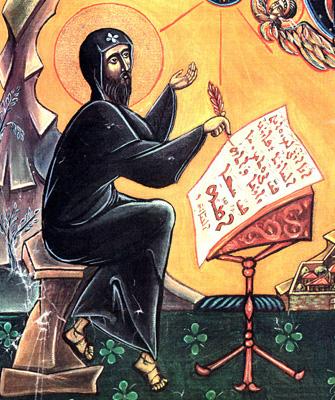
Image(3) Poetical Writings.—Most of Ephraem’s sermons and exhortations are in verse, though a few sermons in prose have been preserved. If we put aside his exegetical writings, the rest of his works may be divided into homilies and hymns. The homilies (Syriac memrè, i.e. discourses) are written in seven-syllable verse, often divided into two parts of three and four syllables respectively. He celebrates in them the feasts of Our Lord and of the saints; sometimes he expounds a Scriptural narrative or takes up a spiritual or edifying theme. In the East the Lessons for the ecclesiastical services (see Divine Office; Breviary) were often taken from the homilies of Ephraem. The hymns (Syriac madrashè, i.e. instructions) offer a greater variety both of style and rhythm. They were written for the choir service of nuns, and were destined to be chanted by them; hence the division into strophes, the last verses of each strophe being repeated in a kind of refrain. This refrain is indicated at the beginning of each hymn, after the manner of an antiphon; there is also an indication of the musical key in which the hymn should be sung. The following may serve as an illustration. It is taken from an Epiphany hymn (ed. Lamy, I, p. 4).—Air: Behold the month. Refrain: Glory to Thee from Thy flock on the day of Thy manifestation. Strophe: He has renewed the heavens, because the foolish ones had adored all the stars ◊Ä He has renewed the earth which had lost its vigor through Adam= A new creation was made by His spittle ◊Ä And He Who is all-powerful made straight both bodies and minds= Refrain: Glory to Thee etc.—Msgr. Lamy, the learned editor of the hymns, noted seventy-five different rhythms and airs. Some hymns are acrostic, i.e., sometimes each strophe begins with a letter of the alphabet, as is the case with several (Hebrew) metrical pieces in the Bible, or again the first letters of a number of verses or strophes form a given word. In the latter way Ephraem signed several of his hymns. In Syriac poetry St. Ephraem is a pioneer of genius, the master often imitated but never equalled. He is not, however, the inventor of Syriac poetry; this honor seems due to the aforesaid heretic Bardesanes of Edessa. Ephraem himself tells us that in the neighborhood of Nisibis and Edessa the poems of this Gnostic and his son Harmonius contributed efficaciously to the success of their false teachings. Indeed, if Ephraem entered the same field, it was with the hope of vanquishing heresy with its own weapons perfected by himself. The Western reader of the hymns of Ephraem is inclined to wonder at the enthusiasm of his admirers in the ancient Syriac Church. His “lyricism” is by no means what we understand by that term. His poetry seems to us prolix, tiresome, colorless, lacking in the personal note, and in general devoid of charm. To be just, however, it must be remembered that his poems are known to most readers only in versions, from which of course the original rhythm has disappeared—precisely the charm and most striking feature of this poetry. These hymns, moreover, were not written for private reading, but were meant to be sung by alternating choirs. We have only to compare the Latin psalms as sung in the choir of a Benedictine monastery with the private reading of them by the priest in the recitation of his Breviary. Nor must we forget that literary taste is not everywhere and at all times the same. We are influenced by Greek thought more deeply than we are aware or like to admit. In literature we admire most the qualities of lucidity, sobriety, and varied action.

Orientals, on the other hand, never weary of endless repetition of the same thought in slightly altered form; they delight in pretty verbal niceties, in the manifold play of rhythm and accent, rhyme and assonance, and acrostic. In this respect it is scarcely necessary to remind the reader of the well-known peculiarities and qualities of Arabic poetry.

Image

As stated above there is no complete edition of the works of St. Ephraem; nor is there any satisfactory life of the great doctor. Mention has been made of the Assemani edition of his works: Opera omnia quae extant graece syriace latine in sex tomos distributa (Rome, 1732-46). It is considered imperfect from the textual standpoint, while the Latin translation is rather a paraphrase. OVERBECK, S. Ephraemi Syri opera sclecta (Oxford, 1865); BICKELL, Carmina Nisibena (Leipzig, 1866); LAMY, Hymni et Sermones (Mechlin, 1882-86 and 1902). Among the versions it may suffice to mention the Armenian version edited by the MECHITARISTS (Venice, 1856, 1893). See also BICKELL, Conspectus rei Syrorum literariae (Munster, 1871); WRIGHT, A Short History of Syriac Literature (London, 1894); Zingerle in Kirchenlex., s.v. Ephraem; especially BARDENHEWER, Patrology, tr. SHAHAN (Freiburg im Br., 1908), 387-93, excellent appreciation and extensive bibliography; RODIGER-NESTLE in Realencyk. F. prof. Theol. und Kirche, s.v. Ephram; DUVAL, Hist. de la litt. Syriaque (3d. ed., Paris, 1906); IDEM, Histoire d’ Edesse, 150-61; LAMY, Prolegomena to Vols. I and II of the Hymni et Sermones.

JEROME LABOURT (Catholic Encyclopedia)

{ 0 comments }

François-Xavier Charlevoix

Historian, born at St-Quentin, France, 24 October, 1682, died at La Flèche, 1 February, 1761.

He entered the Society of Jesus, 15 September, 1698, at the age of sixteen, studied philosophy at the Collège de Louis le Grand (1700-1704), and then went to Quebec, where he taught grammar from 1705 to 1709. During the years spent in Canada, he gathered material for his future “History of New France”. He returned to Paris in 1709 and studied theology for four years. In 1720, under instructions from the French Court, he began his travels through the French colonies to gather information for the discovery of the Western sea. He embarked at La Rochelle in July of that year, and reached Quebec towards the end of September. He proceeded up the St. Lawrence River and through the Great Lakes to Michillimackinac, from which place he journeyed to the lower end of the territory of the Puans or Winnebago Indians. Entering Lake Michigan he continued along the eastern shore and at length after much endeavour reached the Illinois, whence he descended the Mississippi to its mouth. The vessel upon which he embarked for San Domingo was wrecked near the Bahamas and the expedition was temporarily abandoned.

Image

Pierre-François-Xavier de Charlevoix,. “Drawing : F. M. Engraving : J. A. O’Neill, New York”. Archives de la Ville de Montréal, P0385-1.

Charlevoix and his companions returned to the Mississippi by way of the coast of Florida. His second attempt to gain the Island of San Domingo proved more successful, and he reached this colony at the beginning of September, 1722, and left at the end of the same month. He embarked for Havre 24 December, 1722. After his return to France, in 1723, he made a journey to Italy, fulfilling the various duties of his order and working for twenty-two years as an editor of the “Mémoires de Trévoux”, a monthly journal of bibliography, history, and science.

His works are: (1) “Histoire du Japon” (3 vols., 12mo, Rouen, 1715); entirely rewritten (2 vols., 4to, and 9 vols., 12mo, Paris, 1736); revised and re-edited (6 vols., 12mo, Paris, 1754). The history is enriched with maps and plates, and embraces all that is interesting in Kämpfer’s work, “History of Japan and Siam”. At the end is a résumé of all the works on Japan published up to that time. (2) “La Vie de la Mère Marie de l’Incarnation” (8vo, Paris, 1724). (3) “Histoire de l’Isle Espagnole ou de S. Domingue” (2 vols., 4to, Paris, 1730-31; 2 vols., 8vo, Amsterdam, 1733). This work was compiled from data and manuscripts furnished him by Père Le Pers, who had lived in San Domingo for twenty-five years, and also from reports which are preserved in the Dépôt de la Marine of France. (4) “Histoire et description générale de la Nouvelle-France” (3 vols., 4to, and 6 vols., 12mo, Paris, 1744), with maps and plates; English translation (2 vols., 8vo, London, 1761; London, 1763; 2 vols., 8vo, Dublin, 1766). The English version of 1763 had the following descriptive title: “Letters to the Duchess of Lesdiguières; giving an Account of a voyage to Canada, and travels through that vast Country, and Louisiana to the Gulf of Mexico. Undertaken By Order of the present King of France. By Father Charlevoix. Being a more full and acurate description of Canada, and the neighbouring Countries than has been before published; the character of every Nation or Tribe in that vast Tract being given: their Religion, Customs, Manners, Traditions, Government, Languages, and Towns; the Trade carried on with them, and at what places; the Posts or Forts, and settlements, established by the French; the Great Lakes, Water Falls and Rivers, with the manner of navigating them; the Mines, Fisheries, Plants, and Animals of these Countries. With reflections on the Mistakes the French have committed in carrying on their Trade and Settlements; and the most proper method of proceeding pointed out. Including also an account of the Author’s Shipwreck in the Channel of the Bahamas, and return in a boat to the Mississippi, along the Coast of the Gulf of Mexico, with his voyage from thence to St. Domingo and back to France.” John Gilmary Shea issued a translation in six volumes (New York, 1866-72). The edition, limited to 25 copies in quarto and 250 in octavo, contains several portraits engraved on copper (cf. J.R.G. Hassard, in Catholic World, September, 1873). (5) “Histoire du Paraguay” (3 vols., 4to, Paris, 1756; 6 vols., 12mo, Paris, 1757; tr., 2 vols., 8vo, London, 1769). (6) “Eulogy on Cardinal de Polignac”, published in the “Mémoires de Trévoux”, 1742, pp. 1053-1091. (7) “Suggestions for a History of the New World”, founded upon the chronological records of America, also in the “Mémoires de Trévoux”, 1735, pp. 161-172, and inserted in the “History of New France”.

What the critics thought of his works may be found in his own preface to “L’Histoire de la Nouvelle-France”. One censor found the whole first volume useless, another complained that he was too concise. He is accused of depreciating Kämpfer’s work in the “Histoire du Japon” and of having given too much space to religious matters. Rochemonteix, though regarding him as a “historien de valeur”, finds fault with him for occasional carelessness and for differing somewhat in his history from the accounts of the missionaries. With regard to his “Histoire de la Nouvelle-France”, John Gilmary Shea says that “it is too well known and too highly esteemed both for style and matter to need any explanation of its scope or object. The praise of Gibbon will alone assure the reader that as an historical work it is of no inconsiderable merit”.

SHEA, History of New France (translation, New York, 1866-72); ROCHEMONTEIX, Les Jésuites et la Nouvelle-France au Relations (Cleveland, 1896-1901), index, 149; MICHAUD, Biog. Univ., VII, 658; SOMMERVOGEL, Bibl. de la c. de J., II, 1075-1080.

E.P. SPILLANE (Catholic Encyclopedia)

Image

{ 0 comments }

January 26 – St. Bathilde

January 26, 2026

(Or BATILDE).

ImageWife of Clovis II, King of France, time and place of birth unknown; d. January; 680. According to some chronicles she came from England and was a descendant of the Anglo-Saxon kings, but this is a doubtful statement. It is certain that she was a slave in the service of the wife of Erchinoald, mayor of the palace of Neustria. Her unusual qualities of mind and her virtues inspired the confidence of her master who gave many of the affairs of the household into her charge and, after the death of his wife, wished to marry her. At this the young girl fled and did not return until Erchinoald had married again. About this time Clovis II met her at the house of the mayor of the palace, and was impressed by her beauty, grace, and the good report he had of her. He freed and married her, 649. This sudden elevation did not diminish the virtues of Bathilde but gave them a new lustre. Her humility, spirit of prayer, and large-hearted generosity to the poor were particularly noticeable.

Seven years after their marriage Clovis II died, 656, leaving Bathilde with three sons, Clothaire, Childeric, and Thierry. An assembly of the leading nobles proclaimed Clothaire III, aged five, king under the regency of his mother, Bathilde. Aided by the authority and advice of Erchinoald and the saintly bishops, Eloi (Eligius) of Noyon, Ouen of Rouen, Leéger of Autun, and Chrodebert of Paris, the queen was able to carry out useful reforms. She abolished the disgraceful trade in Christian slaves, and firmly repressed simony among the clergy. She also led the way in founding charitable and religious institutions, such as hospitals and monasteries. Through her generosity the Abbey of Corbey was founded for men, and the Abbey of Chelles near Paris for women. At about this date the famous Abbeys of Jumièges, Jouarre, and Luxeuil were established, most probably in large part through Bathilde’s generosity. Berthilde, the first Abbess of Chelles, who is honoured as a saint, came from Jouarre. The queen wished to renounce her position and enter the religious life, but her duties kept her at court. Erchinoald died in 659 and was succeeded by Ebroin. Notwithstanding the ambition of the new mayor of the palace, the queen was able to maintain her authority and to use it for the benefit of the kingdom. After her children were well established in their respective territories, Childeric IV in Austrasia and Thierry in Burgundy, she returned to her wish for a secluded life and withdrew to her favourite Abbey of Chelles near Paris.

Image

St. Bathilde at the feet of Saint Eloi.

On entering the abbey she laid down the insignia of royalty and desired to be the lowest in rank among the inmates. It was her pleasure to take her position after the novices and to serve the poor and infirm with her own hands. Prayer and manual toil occupied her time, nor did she wish any allusion made to the grandeur of her past position. In this manner she passed fifteen years of retirement. At the beginning of the year 680 she had a presentiment of the approach of death and made religious preparation for it. Before her own end, that of Radegonde occurred, a child whom she had held at the baptismal font and had trained in Christian virtue. She was buried in the Abbey of Chelles and was canonized by Pope Nicholas I. The Roman martyrology places her feast on 26 January; in France it is celebrated 30 January.

Image

Acta SS., II; DUBOIS, Histoire ecclésiastique de Paris, 198; BINET, La vie excellente de Sainte Bathilde (Paris, 1624); CORBLET, Hagiographie du diocèse d’Amiens (1874); DES ESSARTS, Sainte Bathilde in Correspondant (1873), XXXII, 227-246; DRIOUS, La reine Bathilde (Limoges, 1865); GREÉCY in Revue archéologique (1865), XII, 603-610.

A. FOURNET (Catholic Encyclopedia)

{ 0 comments }

St. Angela Merici

St. Angela Merici

St. Angela Merici

Foundress of the Ursulines, born 21 March, 1474, at Desenzano, a small town on the southwestern shore of Lake Garda in Lombardy; died 27 January, 1540, at Brescia.

She was left an orphan at the age of ten and together with her elder sister came to the home of her uncle at the neighbouring town of Salo where they led an angelic life. When her sister met with a sudden death, without being able to receive the last sacraments, young Angela was much distressed. She became a tertiary of St. Francis and greatly increased her prayers and mortifications for the repose of her sister’s soul. In her anguish and pious simplicity she prayed God to reveal to her the condition of her deceased sister. It is said that by a vision she was satisfied her sister was in the company of the saints in heaven.

Vision of St. Angela Merici

When she was twenty years old, her uncle died, and she returned to her paternal home at Desenzano. Convinced that the great need of her times was a better instruction of young girls in the rudiments of the Christian religion, she converted her home into a school where at stated intervals she daily gathered all the little girls of Desenzano and taught them the elements of Christianity. It is related that one day, while in an ecstasy, she had a vision in which it was revealed to her that she was to found an association of virgins who were to devote their lives to the religious training of young girls. The school she had established at Desenzano soon bore abundant fruit, and she was invited to the neighbouring city, Brescia, to establish a similar school at that place. Angela gladly accepted the invitation.

St. Angela Merici

In 1524, while making a pilgrimage to the Holy Land, she became suddenly blind when she was on the island of Crete, but continued her journey to the Holy Places and was cured on her return while praying before a crucifix at the same place where she was struck with blindness a few weeks before. When, in the jubilee year 1525, she had come to Rome to gain the indulgences, Pope Clement VII, who had heard of her great holiness and her extraordinary success as a religious teacher of young girls, invited her to remain in Rome; but Angela, who shunned publicity, returned to Brescia. Finally, on the 25th of November, 1535, Angela chose twelve virgins and laid the foundation of the order of the Ursulines in a small house near the Church of St. Afra in Brescia. Having been five years superior of the newly-founded order, she died.

Her incorrupt body remained intact for centuries and in 1930 a chemical treatment was added to preserve the relic. On her deathbed she said, " Whatever you would wish at your dying hour to have done in health, that do now while you may." Photo by Geobia

Her incorrupt body remained intact for centuries and in 1930 a chemical treatment was added to preserve the relic. On her deathbed she said, ” Whatever you would wish at your dying hour to have done in health, that do now while you may.” Photo by Geobia

Her body lies buried in the Church of St. Afra at Brescia. She was beatified in 1768, by Clement XIII, and canonized in 1807, by Pius VII.

Image

HEIMBUCHER, Orden und Kongregationen (Paderborn, 1896), 1 511 sqq., SEEB`CK, Herrlichkeit der katholischen Kirche (Innsbruck, 1900); GUÉRIN, Les petite Bollandsstes (Paris), III, 326 sqq., Bullarii Romani Continuatio, VII, pt. I; her biography has been written in French by BAUTHORS (Abbeville, 1894) at Notre Dame d’Alet (1885), PASTEL, (Paris, 1878); in German by an Ursuline (Innsbruck, 1893), by an Ursuline (Paderborn, 1892), in Italian by GIRELLI (Brescia, 1871);by SALVATORI (Rome, 1807).

MICHAEL OTT (cfr. Catholic Encyclopedia)

{ 0 comments }

Bishop of Worcester, b. about 1235; d. 26 Jan., 1301. He was the son of Hugh Giffard of Boyton in Wiltshire, and Sybil, the daughter and coheiress of Walter de Cormeilles. His elder brother Walter became Archbishop of York (d. 1279). During the earlier part of his life his success was bound up with that of his brother. When in May, 1264, Walter was elected Bishop of Bath and Wells, Godfrey became canon and subsequently archdeacon of Wells; he also held many other benefices, although only in minor orders, and, as his enemies alleged, not learned. When in August, 1265, Walter became chancellor, Godfrey in 1266 was appointed Chancellor of the Exchequer, with leave to appoint a substitute to act during his absence; and when in October, 1266, Walter was translated to York, Godfrey succeeded him as Chancellor of England, and received further benefices from the new Archbishop of York, becoming archdeacon of York and rector of Adlingfleet in 1267. When Bishop Nicholas of Ely was translated from the See of Worcester to that of Winchester, Godfrey was elected by the monks; he received the temporalities of his see in June, 1268. One of his first acts as bishop-elect was to obtain licence to continue the work, begun by Walter Cantelupe, of building and fortifying Hartlebury Castle, which has ever since been the principal palace of the bishops of Worcester. His consecration took place at Canterbury, 23 Sept., 1268, and his enthronement 25 December. During his chancellorship a parliament was held at Marlbridge (52. H. 3) where many useful laws were passed for restraining the abuse of distresses, regulating the incidence of tenure, and improving civil and criminal procedure; the knowledge of general jurisprudence they display is remarkable, and if he did not frame them himself, he deserves credit for having had the wit to employ the superior men who did. He continued in office as chancellor until 28 Oct., 1269, when he handed over the seal to the king.

Image

The tomb of Godfrey Giffard, Bishop of Worcester on the left inside Worcester Cathedral. This tomb, along with that of his sister Matilda, was formerly situated to the right of the Cathedral’s high altar, but they were moved to allow construction in 1502 of the chantry chapel for Prince Arthur. Photo by Irid Escent.

As bishop Giffard devoted himself to the care of his diocese which he ruled for nearly thirty-four years. In the course of those years two affairs caused him considerable trouble: the disputes with the monks of Worcester cathedral, and that with Malvern Priory. The Worcester feud lasted down to the bishop’s death, and reached such a height that when, in 1300, Archbishop Winchelsey visited the priory, the monks presented a formal accusation against the bishop containing thirty-six articles of varying importance to which Giffard’s satisfactory answers are still extant. The quarrel appears to date from 1288 when the monks considered that the rights of the church of Worcester had been infringed by the bishop’s refusal to allow their precentor to summon those who were to be ordained at an ordination at Westbury. The feeling aroused was intensified by the bishop’s attempt, in 1288, to annex the churches in his gift to the prebends in the church of Westbury. This was eventually decided in the bishop’s favour in the Arches Court in 1297. Relations were, moreover, strained because of the unwillingness of the priory to admit the bishop’s visitations. The difficulty with the priory at Great Malvern was even more complicated. The cause was a claim made by the priory to be independent of the bishops of Worcester, and dependent upon the Abbot of Westminster. The relations between the two houses had been settled in 1217. Giffard’s predecessors had had continual trouble with the same priory. The present struggle with Richard of Ware, Abbot of Westminster lasted from 1279 until 1283 and was not really ended then. The climax was reached in September, 1282, when Giffard, as visitor, at the request of some of the monks, deposed the unworthy prior, William of Ledbury. A violent conflict followed, full of incidents, appeals, and counter-appeals and finally the king had to intervene to bring about a compromise.

Besides building the castle at Hartlebury, and rebuilding the church there, Giffard built magnificent mansions at Wick and Alvechurch. Moreover he ornamented the eastern part of the cathedral with the small columns of marble having joints of gilded brass, which form one of the most graceful characteristics of the present choir and Lady chapel. Even after retiring from the chancellorship he is still found exercising judicial functions, as when, in 1272, with Roger Mortimer he enquired into the injuries done by the townspeople of Oxford to the scholars; and, in 1278, he was at the head of the justices itinerant for the counties of Hereford, Hertford, and Kent. He was buried on 4 Feb. in his cathedral church (Ann. Monast., IV, 551).

Image

THOMAS, Antiquitates prioratus majoris Malverniae in agro Wicciensi, cum chartis originalibus easdem illustrantibus, ex registris Sedis Episcopalis Wigornisensis (London, 1725); IDEM, A Survey of the Cathedral Church of Worcester, with an Account of the Bishops thereof (London, 1736), 135-145; Annales Monastici, ed. LUARD in R. S. (London, 1869), IV; Registrum Epistolarum J. Peckham, ed. MARTIN in R. S. (London, 1884), II; TOUT in Dict. Nat. Biog., s. v.; SMITH AND ONSLOW, Diocesan Histories: Worcester (London, 1883).

EDWARD MYERS (Catholic Encyclopedia)

{ 0 comments }

January 27 – Pope St. Vitalian

January 26, 2026

Pope St. Vitalian (Reigned 657-72). Date of birth unknown; d. 27 January, 672. Nothing is known of Vitalian’s life before he was raised to the Holy See. According to the “Liber Pontificalis” (ed. Duchesne, I, 343) he was a native of Segni in Campagna, and his father’s name was Anastasius. After the death of Pope […]

Read the full article →

January 27 – John de Pineda

January 26, 2026

John de Pineda Born in Seville, 1558; died there, 27 Jan., 1637. He entered the Society of Jesus in 1572, taught philosophy and theology five years in Seville and Cordova, and specialized in Scripture, which he taught for eighteen years in Cordova, Seville, and Madrid. He held the posts of Provost of the professed house […]

Read the full article →

January 28 – Great in every sense

January 26, 2026

Charlemagne (French for Charles the Great, Carolus Magnus, or Carlus Magnus; German Karl der Grosse). The name given by later generations to Charles, King of the Franks, first sovereign of the Christian Empire of the West; born 2 April, 742; died at Aachen, 28 January, 814. At the time of Charles’ birth, his father, Pepin […]

Read the full article →

January 28 – Larochejacquelein killed by the very men whose lives he spared

January 26, 2026

While Turreau was thus devastating La Vendée, where were Larochejacquelein, Stofflet, and Charette? Had they forgotten their country and its cause—were they deaf to her cries of distress? Charette still fought in the depths of the Marais; Stofflet in the recesses of the Bocage; but Larochejacquelein, the young, the brave, the chivalrous, the peasants’ idol […]

Read the full article →

January 28 – Angelic Doctor, Italian Count

January 26, 2026

St. Thomas Aquinas Philosopher, theologian, doctor of the Church (Angelicus Doctor), patron of Catholic universities, colleges, and schools. Born at Rocca Secca in the Kingdom of Naples, 1225 or 1227; died at Fossa Nuova, 7 March, 1274. I. LIFE The great outlines and all the important events of his life are known, but biographers differ […]

Read the full article →

January 22 – Patron of American Missions

January 22, 2026

Adèle Bayer (née Parmentier) Eldest daughter of Andrew Parmentier, b. in Belgium, 4 July, 1814, and d. in Brooklyn, New York, 22 January, 1892. Andrew Parmentier, a horticulturist and civil engineer, was b. at Enghien, Belgium, 3 July, 1780, and d. in Brooklyn, New York, 26 November, 1830. His father, Andrew Joseph Parmentier, was a […]

Read the full article →

January 22 – Blessed Prince

January 22, 2026

Blessed Prince László Batthyány-Strattmann Ladislaus Batthyány-Strattmann (1870-1931), a layman, doctor and father of a family. He was born on 28 October 1870 in Dunakiliti, Hungary, into an ancient noble family. He was the sixth of 10 brothers. In 1876 the family moved to Austria. When Ladislaus was 12 years old his mother died. He was […]

Read the full article →

January 22 – Defended by a raven

January 22, 2026

St. Vincent of Saragossa Deacon of Saragossa, and martyr under Diocletian, 304; mentioned in the Roman Martyrology, 22 Jan., with St. Anastasius the Persian, honoured by the Greeks, 11 Nov. This most renowned martyr of Spain is represented in the dalmatic of a deacon, and has as emblems a cross, a raven, a grate, or […]

Read the full article →

January 23 – St. Bernard

January 22, 2026

(BARNARD.) Archbishop of Vienne, France. Born in 778; died at Vienne, 23 January, 842. His parents, who lived near Lyons and had large possessions, gave him an excellent education, and Bernard in obedience to the paternal wish, married and became a military officer under Charlemagne. After seven years as a soldier the death of his […]

Read the full article →

January 23 – Mary Ward and the Institute of Mary

January 22, 2026

Mary Ward Foundress, born 23 January, 1585; died 23 January, 1645; eldest daughter of Marmaduke Ward and Ursula Wright, and connected by blood with most of the great Catholic families of Yorkshire. She entered a convent of Poor Clares at St.-Omer as lay sister in 1606. The following year she founded a house for Englishwomen […]

Read the full article →

January 24 – Saintly and Aristocrat

January 22, 2026

St. Francis de Sales Bishop of Geneva, Doctor of the Universal Church; born at Thorens, in the Duchy of Savoy, 21 August, 1567; died at Lyons, 28 December, 1622. His father, François de Sales de Boisy, and his mother, Françoise de Sionnaz, belonged to old Savoyard aristocratic families. The future saint was the eldest of […]

Read the full article →

January 24 – Pope Stephen (IV) V and the confusion of counting the Popes Stephen

January 22, 2026

Pope Stephen (IV) V (816-17) Stephen (IV) V, Pope, date of birth unknown; died 24 Jan., 817. Stephen, the son of Marinus, was of the same noble Roman family which gave two other popes to the Church. During his youth he had been patronized by Hadrian I and Leo III, the latter of whom had […]

Read the full article →

January 24 – Guy Pierre de Fontgalland

January 22, 2026

Guy de Fontgalland (November 30, 1913 – January 24, 1925), Servant of God, was regarded in the inter-war period as the youngest potential Catholic saint who was not a martyr. His beatification process was opened on November 15, 1941, and suspended on November 18, 1947.[1] Life Guy de Fontgalland was the son of count Pierre […]

Read the full article →

January 25 – Blessed Teresa Grillo Michel

January 22, 2026

BL. TERESA GRILLO MICHEL was born in Spinetta Marengo (Alessandria), Italy, on 25 September 1855. She was the fifth and last child of Giuseppe, the head physician at the Civil Hospital of Alessandria, and of Maria Antonietta Parvopassau, a descendent of an illustrious family of Alessandria. At Baptism she was given the name of Maddalena. […]

Read the full article →

January 25 – St. Poppo

January 22, 2026

St. Poppo Abbot, born 977; died at Marchiennes, 25 January, 1048. He belonged to a noble family of Flanders; his parents were Tizekinus and Adalwif. About the year 1000 he made a pilgrimage to the Holy Land with two others of his countrymen. Soon after this he also went on a pilgrimage to Rome. He […]

Read the full article →

Destructive Indifference or Destructive Irreverence?

January 19, 2026

Considering this photograph, the reader gifted with an artistic sense will surely sense the violent contrast in it. This monumental pulpit, crowned by a canopy with noble and elegant lines that confer upon it a princely quality, dates from the eighteenth century and is part of the parish church of La Ferté-sur-Aube in France. But […]

Read the full article →

January 19 – The scion of a noble family who longed to be enrolled in the noble army of martyrs

January 19, 2026

St. Blathmac A distinguished Irish monk, b. in Ireland about 750. He suffered martyrdom in Iona, about 835. He is fortunate in having had his biography written by Strabo, Benedictine Abbot of Reichenau (824-849), and thus the story of his martyrdom has been handed down through the ages. Strabo’s life of this saint is in […]

Read the full article →

January 19 – James Lainez

January 19, 2026

(LAYNEZ). Second general of the Society of Jesus, theologian, b. in 1512, at Almazan, Castille, in 1512; d. at Rome, 19 January, 1565. His family, although Christian for many generations, had descended from Jewish stock, as has been established by Sacchini (Historia Societatis Jesu, II, sec. 32). Lainez graduated in arts at the University of […]

Read the full article →

January 19 – Bishop Frederic Baraga

January 19, 2026

First Bishop of Marquette, Michigan, U.S.A., born 29 June, 1797, at Malavas, in the parish of Dobernice in the Austrian Dukedom of Carniola; died at Marquette, Michigan, 19 January, 1868. He was baptized on the very day of his birth, in the parish church of Dobernice, by the names of Irenaeus Frederic, the first of […]

Read the full article →

January 19 – St. Wolstan

January 19, 2026

Benedictine, and Bishop of Worcester, b. at Long Itchington, Warwickshire, England, about 1008; d. at Worcester, 19 Jan.,1095. Educated at the great monastic schools of Evesham and Peterborough, he resolutely combated and overcame the temptations of his youth, and entered the service of Brithege, Bishop of Worcester, who ordained him priest about 1038. Refusing all […]

Read the full article →

The Conversion of Alphonse Ratisbonne

January 19, 2026

By Armando Santos Alphonse Ratisbonne was a young Jew from a family of well-established bankers in Strasbourg, France. He also was socially prominent due to his wealth and blood-ties to the Rothchilds. In 1827, Alphonse’s older brother, Thèodore, converted to Catholicism and entered the priesthood, thus breaking with his family whose hopes now lay in […]

Read the full article →

January 20 – A dove landed on his head, and you would not believe what happened next!

January 19, 2026

Pope St. Fabian (FABIANUS) Pope (236-250), the extraordinary circumstances of whose election is related by Eusebius (Hist. Eccl., VI, 29). After the death of Anterus he had come to Rome, with some others, from his farm and was in the city when the new election began. While the names of several illustrious and noble persons […]

Read the full article →

January 20 – St. Sebastian

January 19, 2026

A.D. 288. St. Sebastian was born at Narbonne, in Gaul, but his parents were of Milan, in Italy, and he was brought up in that city. He was a fervent servant of Christ, and though his natural inclinations gave him an aversion to a military life, yet, to be better able, without suspicion, to assist […]

Read the full article →

Nobility of Birth Seems a Fortuitous Fact, but It Results from a Benevolent Design of Heaven

January 19, 2026

From the Allocution of Leo XIII to the Roman Patriciate and Nobility on January 21, 1897: Our heart rejoices to see you here again, united by a concord of ideas and affections that honor you. Our charity knows no partiality, nor ought to know any, yet it is not to be blamed if it takes […]

Read the full article →

Five Theses on Egalitarianism

January 19, 2026

By Prof. Plinio Corrêa de Oliveira In general lines, I formulated five essential theses in these lectures on egalitarianism in such a way that we understand that each one of these theses constitutes a point entirely distinct from the others and has its own demonstration. The ensemble of these theses constitutes our doctrine on egalitarianism. […]

Read the full article →

January 21 – He was put to death, just for being a king

January 19, 2026

His Last Will and Testament The last Will and Testament of Louis XVI, King of France and Navarre, given on Christmas day, 1792. In the name of the Very holy Trinity, Father, Son and Holy Ghost. To-day, the 25th day of December, 1792, I, Louis XVI King of France, being for more than four months […]

Read the full article →

January 21 – None was held in such high honor

January 19, 2026

St. Agnes of Rome Of all the virgin martyrs of Rome none was held in such high honour by the primitive church, since the fourth century, as St. Agnes. In the ancient Roman calendar of the feasts of the martyrs (Depositio Martyrum), incorporated into the collection of Furius Dionysius Philocalus, dating from 354 and often […]

Read the full article →

January 15 – St. Maurus & St. Placidus

January 15, 2026

St. Maurus Deacon, son of Equitius, a nobleman of Rome, but claimed also by Fondi, Gallipoli, Lavello etc.; died 584. Feast, 15 Jan. He is represented as an abbot with crozier, or with book and censer, or holding the weights and measures of food and drink given him by his holy master. He is the […]

Read the full article →

January 15 – Most Glorious King Ceolwulp

January 15, 2026

King Ceolwulf (also CEOLWULPH or CEOLULPH) Coelwulf, King of Northumbria and monk of Lindisfarne, date and place of birth not known; died at Lindisfarne, 764. His ancestry is thus given by the “Anglo-Saxon Chronicle”: “Ceolwulf was the son of Cutha, Cutha of Cuthwin, Cuthwin of Leoldwald, Leoldwald of Egwald, Egwald of Aldhelm, Aldhelm of Ocga, […]

Read the full article →

January 16 – The true disciple of St. Francis who sent the Moorish king into a fit of rage

January 15, 2026

St. Berard of Carbio (Or BERALDUS). Friar Minor and martyr; d. 16 January, 1220. Of the noble family of Leopardi, and a native of Carbio in Umbria, Berard was received into the Franciscan Order by the Seraphic Patriarch himself, in 1213. He was well versed in Arabic, an eloquent preacher, and was chosen by St. […]

Read the full article →

January 16 – Irish Prince and Saint

January 15, 2026

St. Fursey An Abbot of Lagny, near Paris, died 16 Jan., about 650. He was the son of Fintan, son of Finloga, prince of South Muster, and Gelgesia, daughter of Aedhfinn, prince of Hy-Briuin in Connaught. He was born probably amongst the Hy-Bruin, and was baptized by St. Brendan the Traveller, his father’s uncle, who […]

Read the full article →

January 16 – When the Emperor insisted that the lapsed be readmitted to communion without penance, one man stood in his way. This is his story.

January 15, 2026

Pope St. Marcellus I His date of birth unknown; elected pope in May or June, 308; died in 309. For some time after the death of Marcellinus in 304 the Diocletian persecution continued with unabated severity. After the abdication of Diocletian in 305, and the accession in Rome of Maxentius to the throne of the […]

Read the full article →

Pope Pius XII: Allocution of January 16, 1946

January 15, 2026

In past years, beloved Sons and Daughters, on this occasion—after having paternally welcomed the wishes that your illustrious representative usually offers Us in your name, with such noble expressions of faith and filial devotion—We usually accompanied Our expressions of thanks with some recommendations suggested by the circumstances of the moment. We spoke to you of […]

Read the full article →

January 17 – Sister of the Grand Master of Malta

January 15, 2026

St. Roseline of Villeneuve (or Rossolina.) Born at Château of Arcs in eastern Provence, 1263; d. 17 January, 1329. Having overcome her father’s opposition Roseline became a Carthusian nun at Bertaud in the Alps of Dauphiné. Her “consecration” took place in 1288, and about 1330 she succeeded her aunt, Blessed Jeanne or Diane de Villeneuve, […]

Read the full article →

January 17 – Scanderbeg: the hero of Christendom

January 15, 2026

In a history, where so much is spoken of the regions, from whence the miraculous Image of Our Lady of Good Counsel came, it will be of great use to take a brief glance at the once entirely Catholic nation in which it so long remained, and at the great client of its Sanctuary in […]

Read the full article →

January 12 – “The English Saint Bernard”

January 12, 2026

St. Aelred Abbot of Rievaulx, homilist and historian (1109-66). St. Aelred, whose name is also written Ailred, Æthelred, and Ethelred, was the son of one of those married priests of whom many were found in England in the eleventh and twelfth centuries. He was born at Hexham, but at an early age made the acquaintance […]

Read the full article →

January 12 – He promoted the use of stained glass

January 12, 2026

St. Benedict Biscop An English monastic founder, born of a noble Anglo-Saxon family, c. 628; died 12 January 690. He spent his youth at the court of the Northumbrian King Oswy. When twenty-five years old, he made the first of his five pilgrimages to Rome. On his return to England, Benedict introduced, whenever he could, […]

Read the full article →

January 12 – Duke of Alva

January 12, 2026

FERNANDO ALVAREZ DE TOLEDO) Born 1508, of one of the most distinguished Castilian families, which boasted descent from the Byzantine emperors; died at Thomar, 12 January, 1582. From his earliest childhood the boy was trained by a severe discipline for his future career as warrior and statesman. In his sixteenth year he took part in […]

Read the full article →

January 13 – The bold strategic vision of Cluny and its first abbot

January 12, 2026

Saint Berno of Cluny (c. 850 – 13 January 927) was first abbot of Cluny from its foundation in 910 until he resigned in 925. He was subject only to the pope and began the tradition of the Cluniac reforms which his successors brought to fruition across Europe. Berno was first a monk at St. […]

Read the full article →

January 13 – The Count Who Converted the King

January 12, 2026

St. Remigius of Rheims Apostle of the Franks, Archbishop of Rheims, b. at Cerny or Laon, 437; d. at Rheims, 13 January 533. His father was Emile, Count of Laon. He studied literature at Rheims and soon became so noted for learning and sanctity that he was elected Archbishop of Rheims in his twenty-second year. […]

Read the full article →