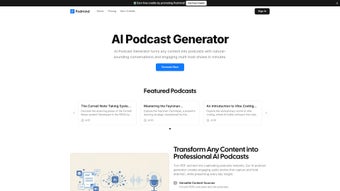

Download PodMind – AI Podcast Generator, Convert Text to Audio, Free Trial Available
Overview of PodMind
PodMind is a cloud‑based AI podcast generator designed to turn any written material—whether it’s a blog post, a lengthy article, a PDF whitepaper, or a weekly newsletter—into a polished, ready‑to‑publish audio episode. The platform is built for creators, marketers, educators, and businesses that want to expand their content strategy into the rapidly growing podcast market without investing in expensive recording studios or hiring professional voice talent. By leveraging state‑of‑the‑art natural‑language processing and advanced text‑to‑speech models, PodMind automatically parses the structure of your document, identifies headings, bullet points, and quotations, and then applies appropriate pacing, intonation, and emphasis. The result is a natural‑sounding narration that respects the original tone and intent of the source material.
PodMind supports more than 30 hyper‑realistic AI voices, each capable of delivering emotional nuance, and it offers multilingual capabilities for languages such as English, Spanish, French, German, Mandarin, Japanese, and many others. The service operates on a subscription model with a 7‑day free trial that grants full access to the voice library and up to two hours of audio generation. Because the entire rendering process happens on secure cloud servers, users benefit from consistent quality regardless of their local hardware. Whether you are a solo blogger looking to repurpose content, a corporate communications team aiming to produce internal audio briefings, or an educator seeking to create accessible learning materials, PodMind provides a scalable, secure, and cost‑effective solution that turns text into engaging audio at the click of a button.
Key Features and Compatibility
Core Features that Power PodMind
- AI‑Powered Voice Library: Over 30 realistic voices with gender, accent, and age variations, each fine‑tuned for natural breath pauses and emotional expression.
- Multilingual Support: Full text‑to‑speech conversion for more than 15 languages, enabling creators to reach global audiences without additional tools.
- Structure‑Aware Pacing: Automatic detection of headings, lists, and quoted text ensures the AI adjusts speed and emphasis to match the logical flow of the source.
- One‑Click Export Options: Export generated audio in MP3 (128‑320 kbps), AAC, or lossless WAV formats, all optimized for major podcast hosting platforms.
- Batch Processing Engine: Convert multiple documents in a single workflow, saving time for large‑scale projects such as ebook series or corporate newsletters.
- Integrated Analytics Dashboard: Real‑time listener metrics, drop‑off points, and geographic breakdowns help you refine future scripts.
- Secure Cloud Storage: End‑to‑end encryption protects uploaded files; you can choose automatic deletion after conversion or retain files in a private vault.
- Collaboration & Review Tools: Team members can comment, suggest edits, or replace specific voice segments before final export.
- API & Zapier Integrations: Trigger podcast generation directly from WordPress, HubSpot, or custom CMS workflows, enabling fully automated content pipelines.
- Custom Branding Features: Add intro/outro music, custom sound effects, and dynamic ad slots to maintain brand consistency across episodes.
Compatibility and System Requirements
PodMind is a 100 % web‑based service, which means it runs on any modern browser—including Chrome, Edge, Firefox, and Safari—on Windows, macOS, Linux, Android, and iOS devices. No download or local installation is required; simply navigate to the dashboard, log in, and start converting. For optimal performance, we recommend a stable broadband connection of at least 5 Mbps, a recent browser version with JavaScript enabled, and a screen resolution of 1024 × 768 px or higher. Because all audio rendering occurs on PodMind’s high‑performance cloud infrastructure, users experience consistent output quality even when processing large PDFs or multi‑chapter e‑books. The platform also supports dark mode for comfortable use during long editing sessions and offers keyboard shortcuts for power users who prefer a faster workflow.
Installation, Setup, and How to Use PodMind
Getting Started – No Download Required
Since PodMind operates entirely online, the “installation” process is simply creating an account. Visit the official website, click the “Sign Up” button, and select either the free 7‑day trial or a paid subscription tier that matches your expected usage volume. After confirming your email address, you are taken to a clean, dashboard‑style interface where the conversion workflow begins. The onboarding wizard walks you through basic configuration steps, such as selecting a default voice, setting your preferred export format, and connecting any podcast hosting services you already use.
Step‑by‑Step Conversion Process
- Upload Your Source File: Drag‑and‑drop a blog URL, Word document, PDF, or plain‑text file into the upload area. PodMind’s engine extracts the text, preserves formatting, and displays a preview with detected headings and list items highlighted.
- Select a Voice and Language: Browse the voice library, listen to 10‑second samples, and pick the one that best matches your brand tone. Choose a language if your content isn’t in English; the system automatically selects the appropriate voice model.
- Customize Settings (Optional): Adjust speaking speed (0.75× to 1.5×), enable “Emotional Mode” for storytelling, add intro/outro music from the built‑in library, or insert custom pauses for dramatic effect.
- Generate the Podcast: Click “Create Podcast.” The cloud engine renders the audio in seconds for short articles and a few minutes for longer documents. A waveform preview appears, allowing you to listen to a short segment before finalizing.
- Review and Edit: Use the integrated audio editor to trim silences, re‑record specific sentences, or swap a voice segment. All changes are versioned, so you can revert to earlier drafts with a single click.
- Export and Publish: Download the final MP3, AAC, or WAV file, or push the episode directly to hosting platforms such as Anchor, Libsyn, Spotify, or Apple Podcasts via the one‑click integration panel.
Tips for Maximizing Quality and Efficiency
To achieve the best results, ensure your source text follows a clear hierarchy: use H1/H2 headings, keep paragraphs concise, and avoid overly technical jargon unless you select a voice that handles complex terminology well. For multi‑language documents, split each language into separate files so the AI can apply the correct voice model without confusion. Take advantage of the “Batch Processing” feature when you have a series of blog posts to convert; this reduces manual effort and guarantees a consistent audio style across episodes. Finally, monitor the analytics dashboard after publishing—track listener retention, drop‑off points, and geographic data to continuously refine your scriptwriting and voice selection strategies.
Pros, Cons, Frequently Asked Questions, and Final Verdict
Pros
- Fast, automated conversion eliminates hours of manual recording and editing.
- Extensive library of realistic AI voices with emotional nuance and multilingual support.
- Completely web‑based—no software download, works on any device with a modern browser.
- Secure cloud processing with end‑to‑end encryption protects sensitive content.
- Integrated analytics and collaboration tools streamline team workflows.
- One‑click export to MP3, AAC, or WAV ensures compatibility with every major podcast platform.
- API and Zapier integrations enable fully automated content pipelines.
- Free 7‑day trial provides full access to features, allowing risk‑free evaluation.
Cons
- Requires a constant internet connection; offline usage is not possible.
- Subscription pricing may be higher than basic text‑to‑speech tools for occasional users.
- Customization options, while robust, still have limits compared with a professional voice actor.
- Audio quality is dependent on the structure and clarity of the source text.
- Advanced branding features (custom intros/outros, ad slots) are only available on higher‑tier plans.
Frequently Asked Questions
Can I use PodMind for commercial podcasts?
Yes. All subscription plans include commercial‑use rights, allowing you to monetize your podcasts on platforms like Apple Podcasts, Spotify, and Google Podcasts.
Is there a free trial or free tier?
PodMind offers a 7‑day free trial with access to all voice libraries and up to 2 hours of audio generation. No credit card is required to start the trial.
Which audio formats can I export?
Export options include MP3 (128‑320 kbps), AAC, and lossless WAV, ensuring compatibility with any podcast hosting service.
How does PodMind handle copyrighted material?
PodMind does not host or distribute copyrighted text. Users must have the rights to the source material they upload. The platform encrypts files during processing and deletes them after conversion unless you choose to store them in your account.
Can I integrate PodMind with my existing CMS?
Yes. PodMind provides API endpoints and Zapier integrations that let you trigger podcast generation directly from WordPress, HubSpot, or custom CMS workflows.
Conclusion – Is PodMind Worth the Investment?
For content creators who already produce written material and want to tap into the rapidly growing podcast market, PodMind offers a compelling blend of speed, quality, and convenience. Its AI‑driven voice engine produces natural‑sounding audio that rivals human narration, while the web‑based interface removes any barriers related to operating systems or hardware. Although the subscription cost may be a consideration for hobbyists, the productivity gains—saving hours of recording, editing, and post‑production—often justify the expense for professionals, marketers, and educators. If you’re looking to repurpose existing blogs, newsletters, or research papers into an engaging audio format without hiring voice talent, start with the free trial and experience how quickly PodMind can expand your content’s reach.
Download PodMind now and transform your written words into captivating podcasts in just a few clicks.



.png)