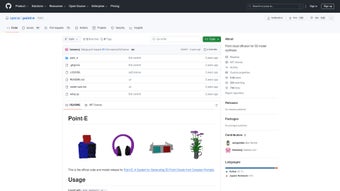

Download PointE – AI‑Powered 3D Model Generator from Point Clouds
Overview
PointE is an innovative, open‑source AI tool that transforms raw point clouds into high‑quality 3‑D models with just a few clicks. Built on state‑of‑the‑art diffusion algorithms, the web‑based application lets developers, designers, and researchers generate realistic meshes from complex spatial data without writing a single line of code. Because PointE is released under the permissive MIT license, you can freely download, modify, and integrate the software into any pipeline—whether you’re building a VR experience, a CAD workflow, or an autonomous‑driving perception stack. The project leverages GitHub Actions and Codespaces to automate builds, run tests, and provide instant development environments, meaning you can focus on creativity instead of infrastructure.
The architecture is deliberately modular: a lightweight FastAPI backend handles model inference, while a React‑based front‑end provides an intuitive drag‑and‑drop interface. This separation allows you to replace the UI with a custom dashboard or embed the API into existing enterprise systems without breaking the core synthesis engine. Security is baked in through HTTPS endpoints, token‑based authentication, and automated dependency scanning via Dependabot, ensuring that the software remains safe for production use.
Beyond the technical core, PointE fosters a vibrant community. Contributors regularly publish new diffusion checkpoints, texture‑mapping extensions, and post‑processing scripts on the repository’s “examples” folder. The community forum on GitHub Discussions serves as a hub for troubleshooting, feature requests, and showcase projects—from drone‑mapped terrain models to medical imaging reconstructions. By joining this ecosystem, you gain access to a wealth of shared knowledge, regular updates, and the ability to influence future roadmap decisions. In short, PointE isn’t just a tool—it’s a collaborative platform for anyone looking to convert point‑cloud data into production‑ready 3‑D assets quickly, securely, and at no cost.
Key Features of PointE
- Diffusion‑Based 3‑D Synthesis: Utilizes cutting‑edge diffusion models to generate detailed meshes directly from point clouds.
- Web‑Ready Interface: No local installation required for basic use; simply open the browser and start converting.
- Open‑Source MIT License: Free to download, modify, and redistribute for commercial or academic projects.
- GitHub Actions Automation: Continuous integration pipelines automatically test new commits and create release builds.
- Codespaces Support: Spin up a pre‑configured development environment in seconds, eliminating setup friction.
- IDE Compatibility: Works seamlessly with Visual Studio Code, Xcode, and GitHub Desktop for code editing and debugging.
- Built‑in Code Review & Issue Tracking: Keeps the codebase high‑quality and encourages community contributions.
- Cross‑Platform Export: Export models in OBJ, STL, GLTF, and PLY formats for use on Windows, macOS, Linux, Android, and iOS.
- Scalable Architecture: Supports GPU acceleration on cloud providers or local machines for faster rendering.
- Extensive Documentation: Step‑by‑step guides, API references, and sample notebooks to help beginners get started.
Each of these features is designed to make the workflow from raw sensor data to production‑ready 3‑D assets as smooth as possible. The diffusion engine, for example, learns to fill in missing geometry, turning sparse LiDAR scans into watertight meshes that can be directly imported into game engines or CAD tools. Meanwhile, the web UI provides an intuitive drag‑and‑drop area where you can upload point cloud files (CSV, PCD, or LAS) and watch the model emerge in real time. Because PointE is fully open source, you can also fork the repository and add custom post‑processing steps—such as texture mapping or physics simulation—tailoring the tool to niche industry needs.
Another standout is the seamless integration with modern DevOps practices. GitHub Actions not only builds and tests the codebase on every pull request but also publishes Docker images to the GitHub Container Registry, enabling one‑click deployments to Kubernetes or serverless platforms. For developers who prefer a fully managed environment, Codespaces provisions a container with all dependencies pre‑installed, allowing you to start coding from any browser without worrying about local Python versions or CUDA drivers.
The export capabilities deserve special mention. PointE supports OBJ for general‑purpose pipelines, STL for rapid prototyping and 3‑D printing, GLTF for web‑based visualizations, and PLY for scientific workflows that require per‑vertex attributes. This breadth ensures that the generated models can be consumed by virtually any downstream application, from Unity and Unreal Engine to Blender and SolidWorks. Coupled with the robust documentation, which includes Jupyter notebooks demonstrating batch processing and API usage, PointE equips both novices and seasoned professionals with a complete end‑to‑end solution.
Installation & Usage Instructions
Getting started with PointE is straightforward, whether you prefer a cloud‑based approach or a local development setup. Below is a step‑by‑step guide that covers both scenarios.
Option 1: Quick Web Demo (No Installation)
- Visit the official PointE demo page at pointe-demo.github.io.
- Click the “Upload Point Cloud” button and select a .pcd, .las, or .csv file.
- Adjust optional parameters such as resolution and sampling density to balance quality and processing time.
- Press “Generate Model”. The AI backend will process the data and display a preview of the 3‑D mesh.
- Download the result in your preferred format (OBJ, STL, GLTF, or PLY).
This method is ideal for quick experiments, classroom demos, or evaluating PointE’s capabilities before committing to a full install.
Option 2: Local Installation via GitHub
- Clone the Repository: Open your terminal and run
git clone https://github.com/openai/point-e.git. - Set Up a Development Environment:
- Using GitHub Codespaces: Click the “Code” button on the repository page and select “Open with Codespaces”. A pre‑configured container with all dependencies will launch automatically.
- Or, locally with Docker: Run
docker compose up -dafter navigating to thedockerfolder.
- Install Dependencies: Inside the dev container, execute
pip install -r requirements.txt(Python 3.9+ recommended). - Run the Server: Start the FastAPI backend with
uvicorn app.main:app --reload. The UI will be reachable athttp://localhost:8000. - Upload Your Point Cloud: Use the web UI or send a POST request to
/api/generatewith your file and optional JSON payload for settings. - Export the Model: The API returns a downloadable link; you can also retrieve the mesh directly via Python using the provided client library.
Best Practices for Efficient Usage
- GPU Acceleration: Install NVIDIA CUDA Toolkit (≥11.4) and ensure PyTorch detects the GPU (run
torch.cuda.is_available()). - Data Pre‑Processing: Clean noisy points and normalize coordinates to the unit cube before feeding them to the model.
- Batch Processing: For large datasets, script a loop that calls the API asynchronously to maximize throughput.
- Version Control: Keep your fork updated with upstream changes using
git pull upstream mainto benefit from the latest model improvements. - Logging & Monitoring: Enable FastAPI’s built‑in logging or integrate with Prometheus to track inference times and resource usage.
By following these steps, you can download PointE securely, set up an instant development environment, and start generating high‑fidelity 3‑D models in minutes. Whether you are a hobbyist experimenting with point‑cloud data or an enterprise integrating AI‑driven geometry pipelines, PointE offers a flexible and scalable solution.
Compatibility, Pros & Cons, and Frequently Asked Questions
Supported Platforms
PointE is built with cross‑platform compatibility in mind. The core Python library runs on any OS that supports Python 3.9+ and PyTorch, including:
- Windows 10/11 (x64)
- macOS 12 Monterey and later (Intel & Apple Silicon)
- Linux distributions such as Ubuntu 20.04+, Debian, Fedora
- Docker containers for cloud‑native deployments
- Remote execution on GPU‑enabled instances (AWS, GCP, Azure)
While the web UI works on any modern browser (Chrome, Edge, Firefox, Safari), heavy‑weight processing benefits from a dedicated GPU. Mobile platforms (Android, iOS) can interact with the API via REST calls, but the on‑device generation is not yet supported due to resource constraints.
Pros
- Free and open‑source under MIT license.
- State‑of‑the‑art diffusion models produce high‑quality meshes.
- Instant development environments via GitHub Codespaces.
- Extensive export options for downstream pipelines.
- Active community with regular updates and issue tracking.
- Robust CI/CD integration through GitHub Actions.
- Comprehensive documentation and example notebooks.
Cons
- GPU acceleration is recommended for reasonable processing times; CPU‑only runs can be slow.
- Large point‑cloud datasets may require pre‑processing to fit memory limits.
- Mobile on‑device generation not available yet.
- Current UI is functional but minimalistic; some users may desire a richer desktop client.
- Initial learning curve for diffusion model parameters.
Frequently Asked Questions
Is PointE truly free to use for commercial projects?
Yes. PointE is released under the MIT license, which permits unrestricted commercial use, modification, and redistribution without royalty fees.
What file formats can I upload as input point clouds?
The web interface and API accept .pcd, .las, .laz, .csv, and .ply files. Ensure the point coordinates are normalized or scale them to a unit cube for best results.
Do I need a powerful GPU to run PointE?
While PointE will run on CPU, model inference is significantly faster on a GPU (NVIDIA RTX 3060 or higher is recommended). Cloud GPU instances can be used if local hardware is limited.
Can I integrate PointE into my existing CI/CD pipeline?
Absolutely. PointE’s GitHub Actions workflows can be customized to run model generation as part of a build step, and the Docker image makes containerized deployments straightforward.
How do I contribute improvements or bug fixes?
Fork the repository, create a new branch, make your changes, and submit a pull request. The project uses GitHub’s built‑in code review system, so reviewers will provide feedback before merging.
These FAQs address the most common concerns from newcomers and enterprise users alike. For deeper technical queries, consult the “Issues” tab on GitHub or join the Discussion board where the core maintainers actively participate.
Community Review
Review Summary: PointE offers a cutting‑edge diffusion model for 3‑D synthesis, a seamless web UI, and robust open‑source tooling, making it an excellent choice for developers who need fast, high‑quality mesh generation from point clouds.
Pros Highlighted by Users
- Fast inference on modern GPUs.
- Easy integration with existing data pipelines.
- Transparent licensing and no hidden costs.
Cons Highlighted by Users
- CPU‑only performance can be a bottleneck.
- UI customization requires additional development effort.



.png)