
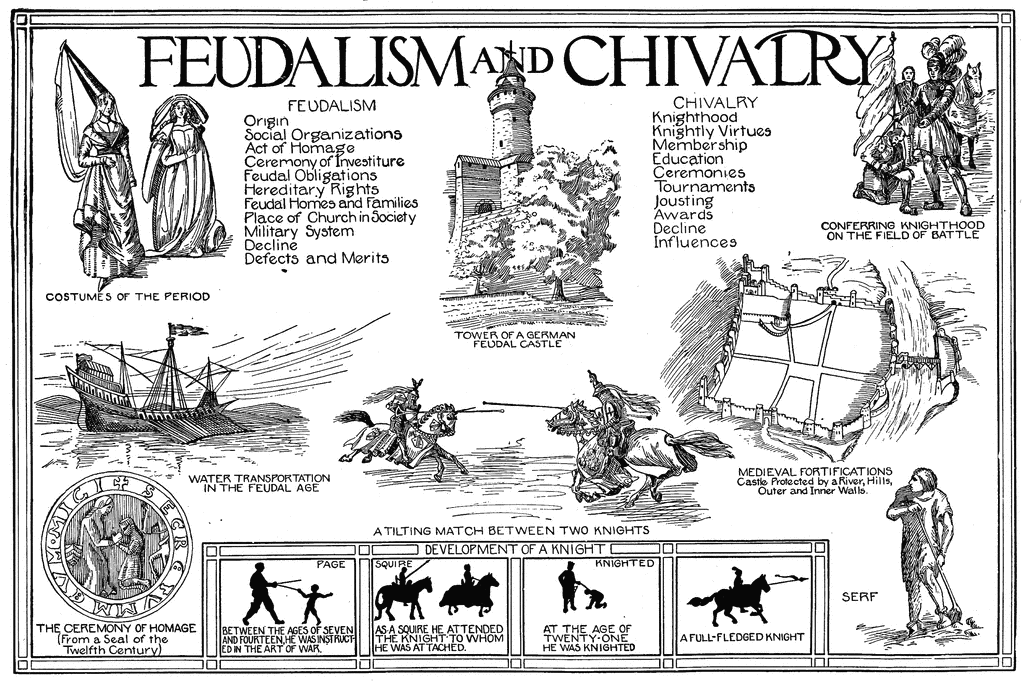
In Chapter 2 of Book III of The Wealth of Nations (available here), Adam Smith surveys the most dominant social, political, and economic system that arose in Western Europe after the collapse of the Roman Empire: feudalism. But Smith doesn’t waste any time on trivial matters, like knights, jousts, or the feudal code of chivalry. Instead, his focus is on the economics of feudalism, on why this medieval system stunted economic growth and development for centuries. For Smith, feudalism is synonymous with concentrated power and slavery. Indeed, both of these features of the feudal system — large landed estates, most of which is uncultivated, and slave labor — are closely connected, if not intertwined.
According to the Scottish political economist, feudalism is an economically inefficient system for two reasons. One is feudal law: institutions like primogeniture and entails prevent land from being freely sold or divided into smaller plots. As a result, land — the most valuable capital asset of all in Smith’s day — is not only concentrated in the hands of a small cabal of powerful landowners or lords; these rigid legal restrictions also prevent the land from being put to its highest-valued use. (See WN, III.ii.2-7.) Worse yet, the power and wealth of feudal landowners are built on slave labor, and as Smith explains in Paragraphs 9-13 of Chapter 2 of Book III of The Wealth of Nations, slavery is an inefficient and unjust system that impedes economic growth and development. Smith’s economic critique of slavery and coercion is timeless and thus bears repeating in full:
“But if great improvements are seldom to be expected from great proprietors, they are least of all to be expected when they employ slaves for their workmen. The experience of all ages and nations, I believe, demonstrates that the work done by slaves, though it appears to cost only their maintenance, is in the end the dearest of any. A person who can acquire no property, can have no other interest but to eat as much, and to labour as little as possible. Whatever work he does beyond what is sufficient to purchase his own maintenance can be squeezed out of him by violence only, and not by any interest of his own. In ancient Italy, how much the cultivation of corn degenerated, how unprofitable it became to the master when it fell under the management of slaves, is remarked by both Pliny and Columella. In the time of Aristotle it had not been much better in ancient Greece. Speaking of the ideal republic described in the laws of Plato, to maintain five thousand idle men (the number of warriors supposed necessary for its defence) together with their women and servants, would require, he says, a territory of boundless extent and fertility, like the plains of Babylon.” (WN, III.ii.9; my emphasis)
In other words, incentives matter! Enslaved persons are less productive and efficient than freemen and proprietors not because they are morally or genetically inferior but because their labour is coerced — slaves do not get to keep the fruits of their labour — or in the immortal words of Adam Smith: “Avarice and injustice are always short-sighted ….” (WN, III.ii.16) But Smith’s timeless critique of slavery — and of feudalism more generally — begs the question, How did some parts of Europe transition from the feudal system to the Age of Enlightenment? (To be continued …)
















 prior probability
