
Download Rasgo – Generative AI Analytics Tool for Secure Self‑Service Insights
Overview of Rasgo
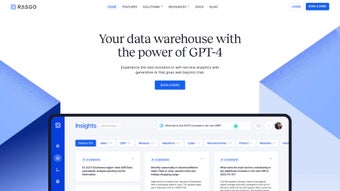
Rasgo is a generative‑AI‑driven analytics platform that turns natural‑language questions into instant, actionable insights. Powered by GPT‑4, the system interprets plain‑English queries and automatically generates the underlying SQL, visualizations, and concise narrative explanations. This eliminates the need for users to learn SQL or master complex BI tools, allowing anyone in an organization—from sales managers to product analysts—to explore data in real time. Security is baked into the core of Rasgo: every request is tied to a verified user identity, logged with immutable audit trails, and encrypted in transit with TLS 1.3. Role‑based access controls let administrators restrict visibility at the table, column, or row level, ensuring that sensitive data never leaves its authorized context. Autonomous AI agents continuously monitor usage patterns and surface proactive alerts, such as “Inventory turnover is dropping below the 12‑month average,” helping teams stay ahead of emerging trends. Whether the goal is to identify revenue leaks, forecast churn, or simply answer “What were our top‑selling products last quarter?” Rasgo delivers a secure, self‑service experience that scales across the enterprise while maintaining strict governance.
Key Features, Benefits, Pros & Cons
Feature List
- Natural‑Language Query Engine – type or speak queries and receive instant results.
- AI‑Generated Visualizations – auto‑creates charts, maps, and tables based on data context.
- Automated Insight Narratives – concise business‑focused summaries with recommendations.
- Enterprise‑Grade Security – end‑to‑end encryption, role‑based access, immutable audit logs.
- Autonomous Insight Agents – proactive alerts and suggestions driven by usage patterns.
- Continuous Learning – models improve from user feedback and interaction history.
- Multi‑Source Connectivity – native connectors for Snowflake, Redshift, BigQuery, Azure Synapse, PostgreSQL, SQL Server, and on‑premise warehouses.
- Collaboration Hub – share queries, dashboards, and AI‑generated reports with teammates securely.
Why Business Users Love Rasgo
The biggest friction point in most data‑driven organizations is the gap between data availability and data usability. Rasgo bridges that divide by removing the technical barrier of query writing and visual design. Users can ask “Which marketing channel delivered the highest ROI in Q2?” and receive a ready‑to‑use bar chart, a narrative explanation of the drivers, and a downloadable CSV—all within seconds. The platform’s autonomous agents continuously scan for anomalies, delivering proactive insights that keep decision‑makers informed before issues become crises. Because the AI learns from each interaction, the relevance of suggestions improves over time, creating a virtuous cycle of faster insight generation and higher user confidence.
Pros
- Intuitive natural‑language interface reduces learning curve dramatically.
- Robust security and audit capabilities meet strict enterprise compliance.
- AI‑driven visualizations and narratives accelerate insight consumption.
- Proactive agents provide value‑adding alerts without manual prompting.
- Scalable architecture supports large data volumes and concurrent users.
Cons
- Initial configuration may require coordination with IT for data‑warehouse connectivity.
- Heavy reliance on stable internet connectivity for cloud‑based AI processing.
- Limited visual theme customization compared with dedicated BI suites.
Installation, Setup & Everyday Use
Getting Started – Download and Account Creation
Rasgo is delivered as a SaaS solution, so there is no client‑side installation. To begin, visit the official Rasgo portal and click the Download button, which redirects you to a secure sign‑up page. After entering a corporate email address, you receive a verification link. Once verified, you can select a subscription tier (Free trial, Professional, or Enterprise) and configure your organization profile. The onboarding wizard guides you through connecting your enterprise data warehouse by providing connection strings, authentication credentials (OAuth, Kerberos, SSO), and selecting the schemas you wish to expose to the AI engine.
Configuration and Data Governance
During the connection step, Rasgo automatically scans the warehouse for metadata, builds a data catalog, and prompts you to define granular access policies. You can assign role‑based permissions at the table, column, or row level, ensuring that personally identifiable information (PII) remains protected. Every query is logged with a timestamp, user ID, and the exact SQL generated behind the scenes—crucial for audit compliance. Data lineage visualizations are also available, helping stewards understand how each insight is derived.
Day‑to‑Day Workflow
After the connection is live, users open the Rasgo dashboard in any modern browser (Chrome, Edge, Firefox, Safari). The central “Ask Anything” bar invites natural‑language questions. The AI processes the request, shows a progress indicator, then presents a results pane containing an auto‑generated chart, a concise narrative, and download options (CSV, PDF). Users can refine results with filters, switch chart types, or ask follow‑up questions such as “Break this trend down by month.” All interactions are saved automatically, enabling easy revisiting of past analyses or sharing via secure links. Power users can also build a “Prompt Library” of reusable query templates and embed them into internal portals or Slack bots for even faster access.
Compatibility, FAQ, and Final Thoughts
Rasgo is a cloud‑native platform that runs on any operating system capable of launching a modern web browser. Whether you work on Windows 10/11, macOS Ventura, Linux distributions, or mobile devices (iOS 16+ or Android 12+), the experience remains consistent. Minimum client requirements include Chrome ≥ 94, Edge ≥ 94, Firefox ≥ 92, Safari ≥ 15, a 5 Mbps internet connection (15 Mbps recommended for heavy visualizations), and a screen resolution of at least 1366 × 768.
Frequently Asked Questions
Is Rasgo suitable for non‑technical users?
Absolutely. Rasgo’s natural‑language interface allows anyone who can type a question in plain English to retrieve complex analytics without writing a single line of code.
How does Rasgo ensure data security and compliance?
All traffic is encrypted with TLS 1.3, role‑based access controls restrict visibility, and every query is logged with immutable audit trails. Rasgo also integrates with enterprise IAM solutions such as Okta, Azure AD, and SAML.
Can Rasgo connect to multiple data warehouses simultaneously?
Yes. You can add several data sources in the admin console, and the AI will reference the appropriate warehouse based on the context of the user’s query.
What support options are available?
Enterprise customers receive 24/7 chat and email support, a dedicated onboarding specialist for the first 90 days, and access to a comprehensive knowledge base, video tutorials, and community forums.
Is there a free trial or free tier?
A 14‑day free trial provides full access to Professional features. After the trial, a limited free tier remains available for up to five users with basic query capabilities.
Conclusion – Why Rasgo Is the Future of Enterprise Analytics
In today’s data‑centric landscape, speed, security, and accessibility are non‑negotiable. Rasgo merges conversational AI with enterprise‑grade governance, turning every employee into a self‑service analyst. Its proactive agents, auto‑generated visualizations, and continuous learning engine keep organizations ahead of market shifts without inflating IT budgets. While initial setup requires coordination with data‑warehouse teams, the payoff—faster decision cycles, democratized analytics, and reduced reliance on specialized BI developers—is unmistakable. If you’re ready to move beyond static dashboards to a dynamic, AI‑powered insight engine, Rasgo is ready for download today.
Start your free trial of Rasgo now and experience secure, instant analytics powered by generative AI.
Pros: Natural‑language querying, strong security, proactive insights, multi‑warehouse support.
Cons: Requires initial IT coordination, limited visual theme customization.



.png)