

















I'm learning Python for my job. My specific application is focused on data science and rote task automation.
Before getting this book, I had picked up a copy of "Automate the Boring Stuff With Python" and "Python for Data Analysis". Both books do a solid job of introducing you to the areas of interest, but neither do a very good job of teaching a novice like myself how to start programming in Python (in my humble opinion). In those two books, I would struggle to get through the end-of-chapter test programs, because they required a lot of information that either wasn't addressed, or wasn't discussed until later in the book.
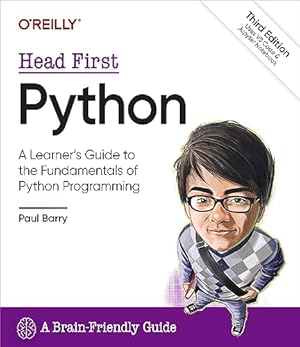
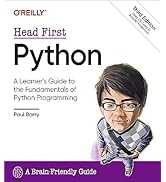
That's where this book comes in. The explanations are intuitive, easy to follow, and the topics are covered in a way that facilitates (successful) user experimentation. Right now, I'm using all three books in tandem and things are starting to click and my code is starting to work with a lot less Googling and a little more tinkering on my part. Head First Python is a pretty quick read because of all of the graphics and generous spacing. Although I tend to prefer a sense of order, the cartoonish-looking page layouts really do aid the learning process. I believe that there is a psychological effect experienced by some people, wherein turning a page imparts a sense of progress. You will certainly turn a lot of pages quickly when reading this book, because of the layouts. This may give some people the fuel to keep going for longer stretches than they would if they were reading 50-page chapters of dense, verbose material.
At the end of the day, I highly recommend this book, especially if you want to supplement it with something that pushes you a little more toward a specific application of Python. In my spare time over the last three weeks, I've cleared about 200 pages of each of the 3 books and I've written around 20 or 30 little programs (on top of dozens of hours in the iPython shell). By the end of week 4, I expect to start producing code for some of my medium-scope projects, and I'll continue to build on it as I learn.
Customers who viewed this item also viewed
FREE delivery Monday, February 9

FREE delivery Monday, February 9

FREE delivery February 13 - 18
FREE delivery February 13 - 18

Download the free Kindle app and start reading Kindle books instantly on your smartphone, tablet, or computer - no Kindle device required.
Read instantly on your browser with Kindle for Web.
Using your mobile phone camera - scan the code below and download the Kindle app.

Follow the author
Get new release updates & improved recommendations
Something went wrong. Please try your request again later.
There is a newer edition of this item:
Frequently bought together

This item: Head First Python: A Brain-Friendly Guide
$58.18
Get it as soon as Monday, Feb 9
Only 1 left in stock - order soon.
+
$27.53
Get it as soon as Monday, Feb 9
In Stock
+
$30.86
Get it as soon as Saturday, Feb 28
Sold by Hemmenity and ships from Amazon Fulfillment.Total price: $00
To see our price, add these items to your cart.
Choose items to buy together.
Deals on related products
Page 1 of 1Start over
From the brand

-

Explore the full series
-
Brain-Friendly Guides
-
Brain-Friendly Guides
-
Explore the full series
-
Learning isn't something that just happens to you. It's something you do. Learning means building more mental pathways, bridging connections between new and pre-existing knowledge, recognizing patterns, and turning facts and information into knowledge (and ultimately, wisdom).
Based on the latest research in cognitive science, neuro-biology, and educational psychology, Head First books get your brain into learning mode.
From the Publisher

About 'Head First' Books
We think of a Head First Reader as a Learner
Learning isn't something that just happens to you. It's something you do. You can't learn without pumping some neurons. Learning means building more mental pathways, bridging connections between new and pre-existing knowledge, recognizing patterns, and turning facts and information into knowledge (and ultimately, wisdom). Based on the latest research in cognitive science, neurobiology, and educational psychology, Head First books get your brain into learning mode.
Here's how we help you do that:
We tell stories using casual language, instead of lecturing. We don't take ourselves too seriously. Which would you pay more attention to: a stimulating dinner party companion, or a lecture?
We make it visual. Images are far more memorable than words alone, and make learning much more effective. They also make things more fun.
We use attention-grabbing tactics. Learning a new, tough, technical topic doesn't have to be boring. The graphics are often surprising, oversized, humorous, sarcastic, or edgy. The page layout is dynamic: no two pages are the same, and each one has a mix of text and images.
Metacognition: thinking about thinking
If you really want to learn, and you want to learn more quickly and more deeply, pay attention to how you pay attention. Think about how you think. The trick is to get your brain to see the new material you're learning as Really Important. Crucial to your well-being. Otherwise, you're in for a constant battle, with your brain doing its best to keep the new content from sticking.
If you answer 'yes' to all of these, this book is for you
- Do you already know how to program in another programming language?
- Do you wish you had the know-how to program Python, add it to your list of tools, and make it do new things?
- Do you prefer actually doing things and applying the stuff you learn over listening to someone in a lecture rattle on for hours on end?

Here's what we do:
We use pictures, because your brain is tuned for visuals, not text. As far as your brain's concerned, a picture really is worth a thousand words. And when text and pictures work together, we embedded the text in the pictures because your brain works more effectively when the text is within the thing the text refers to, as opposed to in a caption or buried in the text somewhere.
We use redundancy, saying the same thing in different ways and with different media types, and multiple senses, to increase the chance that the content gets coded into more than one area of your brain.
We use concepts and pictures in unexpected ways because your brain is tuned for novelty, and we use pictures and ideas with at least some emotional content, because your brain is more likely to remember when you feel something.
We use a personalized, conversational style, because your brain is tuned to pay more attention when it believes you're in a conversation than if it thinks you're passively listening to a presentation.
We include many activities, because your brain is tuned to learn and remember more when you do things than when you read about things. And we make the exercises challenging-yet-do-able, because that's what most people prefer.
We use multiple learning styles, because you might prefer step-by-step procedures, while someone else wants to understand the big picture first, and someone else just wants to see an example. But regardless of your own learning preference, everyone benefits from seeing the same content represented in multiple ways.
We include content for both sides of your brain, because the more of your brain you engage, the more likely you are to learn and remember, and the longer you can stay focused. Since working one side of the brain often means giving the other side a chance to rest, you can be more productive at learning for a longer period of time.
We include challenges by asking questions that don't always have a straight answer, because your brain is tuned to learn and remember when it has to work at something.
Finally, we use people in our stories, examples, and pictures, because, well, you're a person. Your brain pays more attention to people than to things.
About the author

Related products with free delivery on eligible orders
Sponsored | Try Prime for unlimited fast, free shipping
Page 1 of 1Start over
Customers say
Customers find the book effective for learning Python, with one mentioning it takes them from beginner to advanced levels. Moreover, the material is easy to understand and fun to read, with one customer noting it includes interesting programs right away. However, the explanations receive mixed feedback, with some finding them intuitive while others say the exercises lack good explanation. Additionally, the writing style is well-received, though opinions on programming knowledge are mixed.
AI Generated from the text of customer reviews
Select to learn more
38 customers mention learning material, 34 positive, 4 negative
Excellent introduction to Python. The book focuses on being fun to read and providing a real understanding of why things work the way they do....Read more
...But I would say this is the best way to learn Python.Read more
Was such a valuable resource for me when I was beginning to learn to code. Would highly recommend to new comers looking to learn the basics of python.Read more
Easy to follow, great learning resourceRead more
21 customers mention ease of reading, 19 positive, 2 negative
...That's where this book comes in. The explanations are intuitive, easy to follow, and the topics are covered in a way that facilitates (successful)...Read more
...This is really well written. Easy to understand and keeps your attention. I'm only part way through but I have learned so much already.Read more
Very useful and clear book.Read more
I like that the explanations are clear. The book is very readable; great for people who are new to learning this computer language.Read more
17 customers mention enjoyment, 14 positive, 3 negative
Excellent introduction to Python. The book focuses on being fun to read and providing a real understanding of why things work the way they do....Read more
...First books is that they take the usual 101 textbook format and make it fun, interesting, and dialectically unique, in a common format....Read more
...This book was so much fun I burned through it in 3 days, and feel like I have a really sound base to build on....Read more
...Just delivered today and so excited to read..Read more
8 customers mention writing style, 7 positive, 1 negative
Very well written and informative. I haven't finished it all yet, but as far as programing books go it is enjoyable.Read more
...This is really well written. Easy to understand and keeps your attention. I'm only part way through but I have learned so much already.Read more
...This book has you start programming right away. It's written in a readable style and teaches you the stuff you want to know to get rolling....Read more
This book is well written and very clear in how to approach learning python programming. I highly recommend it.Read more
13 customers mention explanation quality, 9 positive, 4 negative
Excellent Well Planned Instruction in Python 3....Read more
I like that the explanations are clear. The book is very readable; great for people who are new to learning this computer language.Read more
The exercises lack good explanation....Read more
...Excellent explanations, often repeated in different ways so that it is hammered home. Can't recommend any other book as much as this one....Read more
6 customers mention programming knowledge, 3 positive, 3 negative
...Lists, Dictionaries, Sets, Tuples Before Control and Object-Oriented Programming....Read more
...this book is for beginners to Python in particular, but not to programming in general. Just a note of caution.Read more
...Okay if you want a reference. This book has you start programming right away....Read more
...Too many personality games and not enough attention to principles of programming.Read more

Easy to pick up
Finished the first chapter today. I went to college for computer science and they shoved C++ down our throats. Always wanted to learn python - although I do not use python in my day job I wanted to learn it , but not in a very school book driven way. This def meets that mark. Very interactive programs and I’m flowing through it with already knowing C++ abs JavaScript
Top reviews from the United States
There was a problem filtering reviews. Please reload the page.
- Reviewed in the United States on March 30, 2019


Top reviews from other countries
- Himanshu ModiReviewed in the United Kingdom on January 15, 2020
Really good primer for beginners
Format: PaperbackVerified Purchase - KaitoReviewed in Singapore on July 27, 2021
Highly recommended, well-rounded learning aid.
Format: PaperbackVerified Purchase -
-
José Huerta IbarraReviewed in Mexico on September 23, 2021
Está elaborado a partir de principios didácticos