

   __ __         __            ___
  / // /__ _____/ /__  ___ _  / _ \___ ___ __
 / _  / _ `/ __/  '_/ / _ `/ / // / _ `/ // /
/_//_/\_,_/\__/_/\_\  \_,_/ /____/\_,_/\_, /
retro edition                         /___/
Now optimized for embedded devices!!
| About | Successes | Retrocomputing guide | Email Hackaday |
this is us. come say hi and get free stuff.
me (vince)
him (eliot)


There are too many jokes to be made about this one. It’s a quadcopter made out of a dead cat. [Bert Jansen], the artist behind this, calls him Orville. He died from natural causes, and what better way to remember a feline friend that liked chasing birds?

That thirty year old computer in your parent's attic isn't going to clean itself, is it? [Todd] put up a series of videos tearing down a 1982 Apple ][ plus, cleaning everything along the way, and doing a very nice demo of AppleSoft BASIC. This is where the revolution started, people.

Cross stitch isn't for grandmothers anymore. Adafruit put up a cross stitch tutorial to go along with their resistor color code cross stitch kit. Now down to Hobby Lobby to find black cross stitch cloth and make the 'ol skull 'n wrenches.

Boing Boing found an amazing cyberpunk photo spread that appeared in the Mondo 2000 'zine back around 1992 or 1993. Even when keeping in mind that this is a self-parody, it's still incredible. Hackers have laser pointers? And pagers?
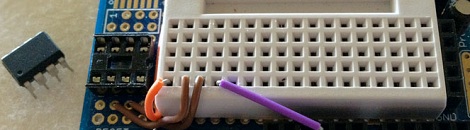
[Scott] caught wind of a way to shrinkify Arduino projects, so he turned an Arduino protoboard into an ATtiny85 programmer. As a neat bonus, [Scott] can use the attached breadboard to build circuits around the ’85.
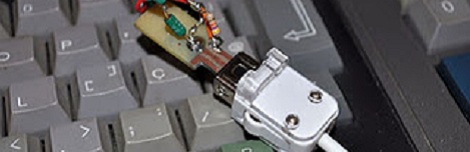
For a computer that debuted in the early 80s the MSX was a very respectable machine. Of course these were the days that superimposing graphics over a video was an amazing feat, but [Danjovic] and [Igor] are still having fun with their boxen. They designed a software interface for the Wii Nunchuck (translation) on their trusty MSX computer.
The plug coming out the back of a standard Wiimote is just a simple I2C bus. Many things can be done with this port from plugging in ancient controllers to controlling robots. [Danjovic] and [Igor] managed to write a routine in Basic that converts the I2C data coming out of the Nunchuck to data the MSX can understand without any modification of the hardware whatsoever.
All the guys needed to plug the Nunchuck into the MSX was a voltage divider and a few pull-up resistors between the computer and controller. They got data from both buttons, the joystick and the accelerometer in the Nunchuck and made a small program to display some sprites on the screen to demonstrate this. Check that out after the break.

In August we covered a wireless electricity presentation from the TED conference. Now Sony has put out a press release on their wireless flat panel television prototype. The device is capable of operating without audio, video, or power cables connected to it. This is possible at distances up to 50cm at efficiencies as high as 80%.
As was talked about in the comments of the other article, the efficiency compared to that of a cable doesn’t blow our socks off. But this does show mainstream development of this technology. We hope to see advances in both efficiency and distance. We also look forward to that small black box (which we presume facilitates the energy transfer) being integrated into the TV’s body.
[via Gizmodo]
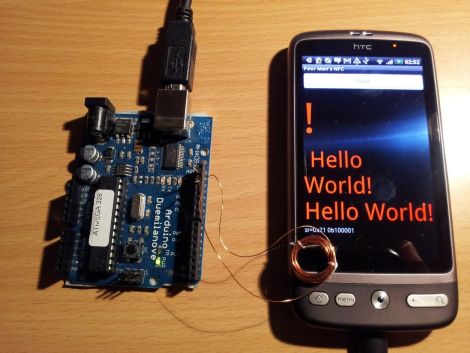
[Joe] was experimenting with his Arduino when he started thinking about how he could get it to communicate wirelessly with his Android phone. Bluetooth is an option, but it requires some extra components, and Google’s ADK works as well – just not wirelessly.
Instead, he thought it would be neat to see if he could get the two devices to communicate with a simple magnetic coil. He constructed a small 1cm diameter coil, connecting it to the Arduino via a resistor and diode. Using the Android Tricorder app, he was able to locate his phone’s magnetometer, after which he ran some tests to narrow down the best sample rate and frequency range for communications.
To transfer data between the two devices, he had to bit bang the signal in software, since the Arduino’s UART has a lower limit far faster than the 7 bps data rate he was able to achieve with the magnetometer.
While his wireless Arduino to Android bridge isn’t likely to win any awards for throughput, it is a great proof of concept project. Be sure to check out the video below to see his “poor man’s NFC” in action.
