Sunday, 1 February 2026

TSR's module A2, Secret of the Slavers' Stockade (Fort Level)

TSR Module A2: Secret of the Slavers' Stockade

Harold Johnson with Tom Moldvay

At a couple of climactic points in module A1, Slave Pits, the adventurers can find documents that will lead them to the next adventure in the series. Moving away from the chaotic half-ruined town, you find a self-contained fortress in the wilderness, a staging point for the slavers' operations. This stockade is bounded by four intact walls, less of a ruin than the Highport temple. But inside, it's a fixer-upper, with ungoverned areas that continue the theme of the unruly stronghold. The troops are mainly goblins and hobgoblins, not orcs and half-orcs. Two independent bosses with powerful assistants run the place, one in the fort above ground, and two in the dungeons. 

Like A1, A2 was originally run as two parallel tournament adventures, with the above- and below-ground levels as the respective settings. The module's maps shade in the paths of each tournament version. It''s not hard to see how the requirements of each one-track, twisty gauntlet got in the way of realistic defensive architecture. However, even in the limited tournament mode, the fort level threatens the kind of barracks-clearing pitched battle I mentioned in the opening essay as a catastrophic failure for a fort infiltration. As always, full spoilers ensue.

Greyhawk Musings: Thoughts on A2 Secret of the Slavers Stockade
Sure, go ahead, spoil one new monster on the front cover ...

FORT LEVEL: MOATHOUSE

The tournament starts with an easy if improbable way in. Just like in A1, an escaped slave, "Lady Morwin Elissar," shows you the route of her escape - an open window in the outer wall of the moathouse, with a convenient rope left dangling. This device is more interesting because the slave is an NPC who might go with you but is kind of unreliable. Still, it is only the first instance of a repetitive tendency that crops up throughout the module.

This moathouse is one of three buildings on the flat hill where the stockade sits, all held together with outside walls. It's also, you guessed it, an unruly stronghold. Garrisoned by a couple of hobgoblin squads, half of one floor is home to a haunt - more of a Victorian-story ghost than an undead monster. It's the haunting that keeps the troops scared of this area, justifying the lack of attention paid by the garrison. The challenge with this entity must have felt fresh at the time. But by now, dealing with a ghost's past-life obsession and present-day possession is part of 5th edition, and quite a few supplements have extended the Gothic notion into an adventure genre (link, link, link).

In this unruly zone, we are introduced to an unfortunate theme: the defender love silly traps. Here, they have acquired some fancy glassware and alchemy to blind intruders and trip them up with hundreds of glass marbles underfoot. Arguably, these traps sit at the outer limit of plausibility, but worse is to come.

One good point of the writing throughout this module shows up here. As in Albie Fiore's early White Dwarf adventure "The Lichway," each bivouac of troops throughout the fort has some kind of action ongoing, be it eating, gambling, or less wholesome sport. I've described this approach before as the "diorama encounter," but it seems to be a priority of the Johnson/Moldvay authorial team that gives welcome flavor. 


FORT LEVEL: GATEHOUSE

The next building along the railroad is a gatehouse on the far side of a courtyard where a wild anhkheg will pop out pf a patch of mud and attack. Why do the defenders allow a powerful monster to sit athwart the only line of communication from moathouse to gatehouse (the walls connecting them have no walkway)? Here's the greed for variety, any fight that's not with hobgoblins, at the expense of naturalism. Other hard-to-believe premises: the fight can go on without the guards on the walls noticing, until the monster lets out a dying screech; and in fighting, the party will become so caked with mud that they suffer a -2 to hit until they can wash it off in a fountain some way down the railroad.

The gatehouse itself was only developed for campaign play. Its inner buildings are more hobgoblin guardposts and barracks, again with diorama activities going on. Beyond the gate that the anhkheg guards, there is another courtyard, which the players can gauntlet-run or sneak across, while guards patrol the walls above. A couple of patrols come with another new monster, an oil-sweating Gollum-like wretch known as a boggle, whom we see on the front cover, Here there's little opportunity to use the boggles' weird abilities. They are just being led around as sniffer dogs, bringing to mind another Tolkien character, the orc tracker Snaga of Isengard. Then on to the keep's courtyard garden where carnivorous apes and hobgoblin archers jump the party. A dead end -- unless they can open the locked door that leads into the keep proper.

FORT LEVEL: MAIN KEEP

The position of this building in the hill fort is beyond absurd. The ramparts have no connection to its interior, even though that's where many of the troops and leaders make their home. What's more, the ramparts loom over the keep - the better to shoot at the roof, allegedly -- but vision to the outside world is blocked by tall palisades cut through with infrequent arrow slits. It's as if the fort is prepared for an infiltration, more so than an attack; but even that goal is bungled in the execution, so that a dungeon-crawling party can take on one group of enemies at a time. For example, if the players make it to the courtyard, there's no line of sight to the fight there from archers on the walls, only to the roof.

The interior layout is also absurd and not remedied in the campaign version. A single path spirals around, kinking up a few times, before ending up in the central room where the main leaders and troops are found. Cut a single door to break the spiral, and the leaders would have easy access to the entrance and be able to reinforce the defense. But where's the fun in that, compared to dungeon crawling?

Worse yet, the dungeon crawl is fixed up with tricks and traps worthy of a Scooby Doo haunted house. You have the stuffed bear rolling down a ramp to frighten you backwards into a pit. Then the hobgoblin ambush where some of the troops dress as mummies and run at an angled mirror so you'll waste spells and missiles on their reflections. Not just silly, these traps make no sense placed across the only route of reinforcement in an active stronghold.

Off the tournament track, there is another haunted area shunned by the soldiers. But this ghost is just a set of gimmicky manifestations engineered by the escaped slave who lives in the rafters. All these hijinks aside, the final encounter area has a memorable leader in Icar. He's a fire-loving blind warrior who fights with super-senses, taking after Daredevil or Zatoichi. Some of the diorama encounters in the central area are likewise good, and there's a new monster, the cloaker, whose hypnotic droning works as an opiate of the masses for the enslaved. In the boss area, whose defense the module illustrates with an innovative (at the time) tactical map, are a couple of ways down to the dungeons.

No photo description available.
.. and on the back cover, let's have a spoiler for this guy

Can we fix the fort? Maybe, but extensive changes to the map would have to be made. And then the module becomes something different. Raising the alarm no longer causes a temporary pressure situation before the party can scoot on to the next isolated area. It activates the whole beehive of the garrison, acting all together in a mass of close to 100 hobgoblins and powerful leaders, and certain to overpower the mid-level party it is rated for.

Next: The dungeon level

Sunday, 25 January 2026

TSR's module A1, Slave Pits of the Undercity

TSR module A1, Slave Pits of the Undercity, is the first and the most coherent of the Slavers modules: inventive and challenging while being the most sensibly drafted of these disorderly villain lairs.

The history of the series further emerges from a thread on Dragonsfoot remembering the specifics of the GenCon tournament that gave rise to the four A series modules. The temple and dungeon levels of A1 and A2 each were a single, linear adventure. Player groups in the first round were randomly assigned into one of these four qualifiers or a fifth one corresponding to the early section of A3.  From these five, the best-scoring made it to the semifinal and final rounds, which respectively used versions of the later (city) part of A3, and all of A4.

From such a genesis we can trace the design of Slave Pits of the Undercity (and here, perforce, the spoilers begin). Helpfully for our archaeology, the module includes the original tournament railroad maps for the top and dungeon levels.

Wayne's Books - Sales Site - RPGs, Sci-Fi & Fantasy
New monsters, meant as a surprise, were regularly "spoiled" on the A series covers - here, the aspis


TEMPLE LEVEL

The tournament scenario gives the players inside information about a secret door in the wall of the temple. This door is trapped but not guarded - such is the security protocol of a disorderly fortress - and leads to a twisting corridor through an abandoned area of the building. The "railroad" takes the party past some well-set fights, and other situations that act like puzzles without seeming contrived, such as a deceptive plank over a pit, or a combat dilemma involving a new plant monster, the giant sundew, that becomes much easier if the party realizes how the fortress forces manage this menace in its midst. After this gauntlet, the party will run into the actual slaver forces, and these encounters are devised with the same art, combining trickery, interesting combat problems, and traps.

That's the end of the railroad; but even the tournament scenario has a couple of distractions and dead-ends. One of them, a roughly patched wall that if broken through leads to a face-to-face encounter with a basilisk, had the distinction of taking out a player-character in my own 5th edition campaign.  And in the campaign version of the module, more areas are added branching from the tournament path - a stable guarded by slaver forces, a haunted cemetery and a garrison of terrified orcs, and a spacious courtyard, possibly a shortcut, but where more undead lurk. The reissue of the module in 1986 added a gate from this courtyard into the midst of the organized opposition area, further adding options for the attack.

This expansion allows different approaches to the temple complex. Jason Thompson's cartoon walkthrough of the module shows two of these: one party sneaking in through the tournament entrance, the other masquerading as slave-buying customers to go through the front door. Entering by the stables, by the graveyard orc door, or simply climbing the wall in an unguarded spot are also possibilities.

DUNGEON LEVEL

There are ways down from the temple, most obviously at the end of the final boss fight of the temple railroad; but the full module places two more descents to vary play in the dungeon level. This underground jams together four quite different areas: the eponymous slave pits, with slaves, slavers, and minions; a set of caves that hosts a tribe of orcs allied with the slavers; another set of caves that hosts a population of another new monster, the fearsome four-armed insectoid aspis folk; and a network of wet and filthy sewer passages that ties the whole place together.

The railroad version of the dungeon has the players first encountering some nasty larvae in the acidic spawning pool of the aspis; then crossing the sewer to muscle through a protracted fight with most of the orc tribe; then finally engaging the slavers, including some of their aspis allies, before confronting the slaver leader - who, it has to be said, is less formidable and treacherous than the final encounter of the temple. 

The open version develops the aspis zone and has more connections to approach the bad guys. While the temple is infested with ghouls and a wight, the underground is only semi-unruly - these are groups cooperating with the slavers for now, but if a way can be found to communicate, faction bargaining in the classic big-dungeon style can happen.

BEST OF THE SERIES

My current party cleared out most of A1, using a conversion to 5th edition. Running it was a delight -- the combat challenges tough and packed with surprises, but not in a way that felt forced or unfair. The tricks and traps have a gritty, naturalistic feel to them, and the different areas of the complex are balanced between abandoned/haunted, main bad guys, and side factions. We see how the garrison of orcs, half-orcs, and evil humans deals with the unruly forces in their midst - finding a way to tame the sundew, cringing in fear from the haunted cemetery, hiring some of the aspis. This was also the deadliest module of my campaign, claiming two PCs. Probably, this is just due to incautious player mistakes snagging on two of 5th edition's few remaining teeth. One, doppelgangers have an absolutely deadly surprise attack if they can catch a party member alone; two, even with two saves, there is no easy answer to petrification until characters hit ninth level.

As we'll see in the pieces to come, the other A-series modules, in my opinion, are less deft at presenting an unruly stronghold: A2 is ambitious but strained, A3 a mess, and A4 returns to better form but famously hangs on a railroading premise that may not sit well with new-old-school values.

Friday, 21 November 2025

TSR's "A" series of adventures in unusually unruly strongholds: Introduction

Image
Illustration from Slave Pits of the Undercity (1980) by David S. LaForce

D&D was born in the castle. The Castle and Crusade Society of wargamers brought Gygax and Arneson together over miniature battles fought at Bodenburg, a scale model of a medieval fortress. Castle sieges were one suggested scenario for the Man-to-Man section of Perren and Gygax's Chainmail rules, the predecessor to D&D's combat system. But despite the genesis of Gygax's and Arneson's dungeons as the cellar levels of castles, it was these underworlds and not the upper rooms that captured the imagination of generations going forward.

Indeed, it's not hard to see how attacks on fully manned fortresses can fall flat as an adventure. The horn is blown, the defenders stream forth from their barracks. Pitched battle on unfavorable terrain ensues. One might, perhaps, set up a night-time infiltration. But then the play only becomes catastrophic: one failure to sneak takes you to the pitched battle again. The appeal of the dungeon environment is precisely its disorganization. There, the adventurers control the tempo of exploration, deciding whether to push their luck, encamp, or retreat.

Still, TSR's first published adventure module was a stronghold assault, the enemy being hill giants (G1, Steading of the Hill Giant Chief), and the next two continued on to fortresses run by frost and fire giants. This choice joins the wargaming castle instinct with a wish to recreate the adventures of De Camp and Pratt's protagonist Harold Shea, guest and prisoner in the stronghold of the frost giant Utgardaloki. Also, the high character levels capable of taking on multiple giants at the same time can access the kind of magic - invisibility, illusions, distractions, knock spells, and the like - that'll support effective infiltration. 

In aid of this goal, the steading is not exactly on a war footing. Giants are drunk, feasting, asleep, on errands: plenty of gaps in the defenses for smaller folk to exploit. As well, the cellars play  more like a classic dungeon - one retrospective has called the lower level a "monster motel" -  - a pattern  followed in the Frost and Fire sequels. If they win through to the underground, the party can take back control of the tempo, switching to the more usual room-by-room exploration.

But let's turn to the next major series of campaign modules after the high adventure of the G-D-Q series. The A series was based on four adventures that made up the AD&D tournament at GenCon XIII in 1980, run on consecutive days as qualifier rounds, semi-finals and finals, at huge scale: 40 tables to start with. Each adventure had a different authorship, but the connecting plot was simple enough: you were mid-level characters infiltrating and attacking the bases of a ring of slavers in the failed state of the Pomarj, World of Greyhawk. 

A word about tournament play. Although this style has largely fallen out of favor these days, it was a well-subscribed activity at early conventions, an answer to the question, "How do I win at D&D?" Tournament mode differed from home-campaign D&D in design choices that equalized experiences across tables, so that in theory, the most skilled player groups could prevail. In the 1980 tournament, each group ran the same set of pre-generated player characters; the adventures were linear, presenting the same challenges in the same order; and sometimes, DMs were told to apply a standard amount of damage from traps and the like, instead of rolling dice. To determine winners, each run was scored by awarding points for dealing with enemies, bonus points for discoveries or anticipated clever solutions, and points deducted for party casualties along the way.

The linearity in these adventures, in particular, deserves comment. It's an innovation that appeared at Origins 1979 with the Hidden Shrine of Tamoachan; the previous year's tournament module, the aforementioned Giants series, was more open-plan. TSR realized that what was good for the tournament might not be good for campaign play, so when the A series was published, some alternative paths were added to give players more of a sense of agency. For the most part, these revisions work, although the final chapter still presumes an escape from having been thrown in prison -- a plot fiat that shines notoriously in the gallery of Railroading Through the Ages.

In reviewing these A adventures, I'll examine how each one spices up the organized stronghold concept by presenting it as an unruly place -- factions that chafe, distracted guards, abandoned areas that follow their own rules, and clever defensive tricks that sometimes try a little too hard. The quality of this series, unfortunately, falls off from A1 to the later modules. It's not that the creativity is lacking. Rather, the idea of the unruly stronghold starts to repeat itself and challenge the limits of plausibility.

Sunday, 14 September 2025

Pergamino Barocco Kickstarter!

Uncountably many years ago, I was kicking around a selection of weird old woodcuts from alchemical manuscripts, and got the idea to write up a Baroque (in the sense of elaborate, symbolically fraught, and ideologically opposed to a simplifying tendency) set of spells based on them. Paolo (Lost Pages) aided in design and publishing and lo, the original Pergamino (scroll) was born.

With newly acquired levels in bookbinding, Lost Pages has put out a Kickstarter for a new edition that is accordion-bound, like a real folding scroll. We've made our goal and have already got new content planned: a couple of new and reworked spells, material for the back of the accordion such as a magic system based on historical Baroque-era mnemonic devices.

Curious fact: the first one of these spells I personally used in a campaign was the Appeal to the Seven Worthy Elders, which my players bought at a magic market in the Fey Paths.

Check out the promo video here:


Saturday, 26 July 2025

52 Pages at Canterbury (UK) Gaming Con

 For my followers who can easily get to Canterbury in the southern UK on August 8-10, the local game shop is hosting a convention on the University of Kent campus and I will be running multiple sessions of Jennell Jaquays' Thracia using 52 Pages rules and pregen characters, including classes from the Next 52 expansion.

Image

Register for the convention here. For my sessions, you can sign up using Warhorn here.

That is all, carry on!

Tuesday, 8 April 2025

The Next 52 (26?) Pages

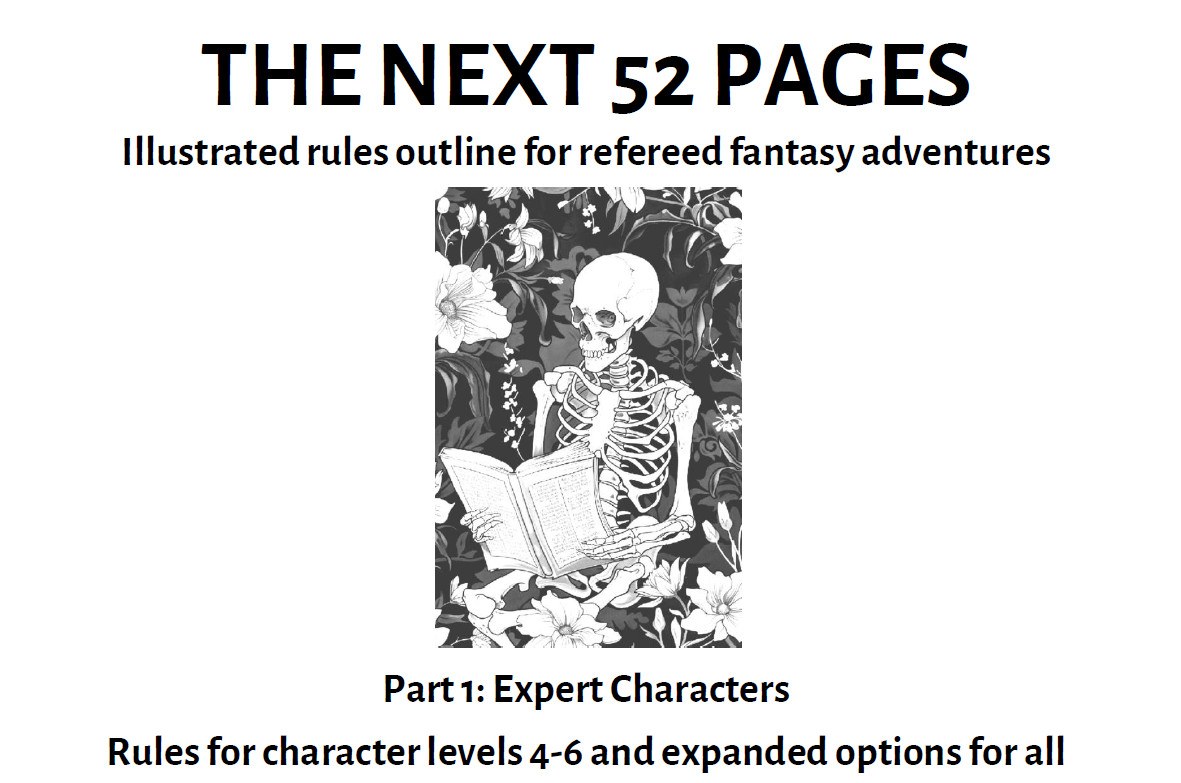
As promised, here is the pdf of the first 26 of the Next 52 pages. It's an expansion to my preferred homebrew adventure game system that, like the Expert set of yore, covers level 4-6 with new powers and spells. Also, like the Advanced edition of yore, it puts in a dozen or more new class options for both established and starting characters. And there are a few extra goodies - a summoning table for the new set of summoning spells; a way to promote hirelings into henchmen.

Image

[Download here]

You will see that the second 26 pages of Next are somewhat of an ideal outline for new types of adventure, new monsters and treasures. While nice to have, I don't think filling this part out is my first priority. Based on a couple of campaigns that made it to 7th level, there is a full list of spells to level 10, a take on advanced skill possibilities once the skill boxes begin to completely fill, and the framework of a game that has an ultimate win condition at level 10. Adding more character options and a kind of "domain game" to this, and you have a 26-page Beyond supplement that I will be looking to work on more this year.

Wednesday, 2 April 2025

The 52 Pages 3.0

Image

Prodded on by a satisfied player's long delayed post after a minicon one-shot game last year, I have finally gotten around to finishing my revised 52 Pages, a graphically enhanced rules outline for a heartbreaker based mostly on the Basic and 3rd editions of the world's most cautiously-referenced roleplaying game.

The most obvious update is in the fonts, at the same time calling back to the roots with a Futura-clone in the text and letting go of Berlin, the Papyrus that nobody talks about, in favor of the classier Alegreya. The main "lore" change is a clearer definition between characters' hit points - now called "hero points" with a lower-case hp, and serve to shield characters from physical damage and injury effects - and monster hit points (HP), which represent physical damage more abstractly.

The main change to play is a reordering of the combat sequence so that melee no longer goes first, and "run up to your face and hit you" is now intuitively supported. This has been a long time coming, seeing that  whenever I have run the game in one-shots, melee-first was the hardest thing to remember and implement. The solution was easy - a second move after attacks that counts as an attack and may be made by the engaged (skip attack to disengage, but you must survive melee).

Here's the link, also available in the bar to the right. I realize that the game is much more viable when you add rules dealing with levels 4 to 6 and I have those mostly written, with a load of additional spells and classes/races. By the end of April you should see another post with the 52 Pages Next!