Posts Tagged ‘UN’
The United Nations General Assembly & Burma
This is grabbed from Burma Campaign UK on Facebook.
Burma Briefing No: 2
Comment, Briefing & Analysis From Burma Campaign UK
The United Nations General Assembly & Burma
Key points:
19 Resolutions on Burma by the General Assembly have been ignored by the dictatorship ruling the country.
Since 1992, 18 years ago, the General Assembly has been calling on the dictatorship in Burma to respect the Geneva Conventions, but it is still failing to do so.[1]
Language used in past General Assembly Resolution relates to 15 possible war crimes and crimes against humanity.
In 2002, 8 years ago, the General Assembly called for an independent international investigation into abuses of civilians.
Despite 17 calls for inquiries since 1997, the General Assembly has failed to exercise its power to establish its own inquiry into abuses, including possible war crimes and crimes against humanity.
On grounds of international law and justice, political reality, and morality, ‘elections’ due in Burma later this year should not be used as a reason not to, or to delay, the establishment of a UN Commission of Inquiry.
The 20th United Nations General Assembly resolution on Burma is an opportunity to build on and start to enforce previous resolutions. The General Assembly must take the next logical step and establish a Commission of Inquiry into war crimes and crimes against humanity in Burma.
Summary
United Nations General Assembly, made up of all members of the United Nations, has been adopting resolutions on the situation in Burma since 1991. In late 2010 it is expected to adopt its 20th Resolution on Burma.
The Resolutions, which are not binding under international law, have made many requests to the dictatorship ruling Burma, the overwhelming majority of which have been completely ignored. Indeed, the Resolutions themselves have frequently referred to the fact that previous resolutions have been ignored.
The nineteen Resolutions which the General Assembly have passed on Burma have expanded from a few paragraphs in 1991 to a few pages in 2009.[2] They now refer to a wide range of human rights abuses and other issues, which is a welcome step forward. However, they have not progressed in terms of responding in a practical way to the fact that the Resolutions are being ignored. Nor have they responded in a logical and responsible way to the increased seriousness of the abuses revealed by United Nations reports, and then referred to in the General Assembly Resolutions.
With regards to the continued refusal by the dictatorship to act on General Assembly Resolutions, the logical step for the Assembly, given the seriousness of the abuses, and failure of the dictatorship to act, would be referring the situation in Burma to the United Nations Security Council, which has binding powers, and calling on the Council to adopt a binding resolution enforcing General Assembly requests. The General Assembly resolutions regularly refer to Burma as causing problems for neighbouring countries and as meeting the general criteria as a non-traditional threat to the peace. Resolutions also refer to abuses which constitute possible war crimes and crimes against humanity, which the Security Council has a duty to act on. In addition, the Security Council, in placing Burma on its formal agenda, has already agreed the situation in Burma meets the criteria for its engagement. For the General Assembly to call on the Security Council to act is a practical and sensible next step.
– First reference by General Assembly to international law relating to war crimes: 1992
– First reference by General Assembly to abuses that are now classified by the Rome Statute as possible crimes against humanity: 1992
The most serious failure of the General Assembly regarding Burma is in relation to international law, including war crimes and crimes against humanity. The United Nations General Assembly has consistently referred to abuses which could qualify as war crimes and crimes against humanity. It has also repeatedly called on the dictatorship to abide by the Geneva Conventions. However, it has failed to use language such as war crimes – which is what breaches of the Geneva Conventions amount to, or crimes against humanity, which many of the other abuses it refers to amount to. The failure to use such language assists the dictatorship in avoiding the international action that its actions should entail.
The General Assembly has also frequently called for independent investigations into the serious human rights abuses taking place. The General Assembly has called for several different kinds of investigations, including investigations by the dictatorship, independent investigations, investigations in cooperation with the dictatorship but led by the United Nations Special Rapporteur, and even an independent international investigation.
Despite the fact that none of these investigations, which the General Assembly has now been calling for since 1997, have ever taken place, the General Assembly has failed to take the next logical step of establishing its own investigation, which it has the power to do.
In March 2010, the UN Special Rapporteur on Burma called for a UN Commission of Inquiry into war crimes and crimes against humanity in Burma. He stated that the abuses were: ‘a state policy that involves authorities in the executive, military and judiciary at all levels’. He further stated: ‘According to consistent reports, the possibility exists that some of these human rights violations may entail categories of crimes against humanity or war crimes under the terms of the Statute of the International Criminal Court.’ … ‘UN institutions may consider the possibility to establish a commission of inquiry with a specific fact finding mandate to address the question of international crimes.'[3]
As governments start to consult on the contents of the 20th General Assembly resolution on Burma, they should now ensure that the establishment of a UN Commission of Inquiry be part of the Resolution. Continuing to comment on abuses that may constitute war crimes and crimes against humanity, but failing to use language which describes them as such, and also failing to take action within the power of the General Assembly to investigate those abuses, can only add to the sense of impunity which the dictatorship enjoys. The General Assembly has itself repeatedly called for an end to this impunity.
The argument that the establishment of such an inquiry should not go ahead at the present time because of ‘elections’ due in Burma later this year is flawed legally, politically and morally.
Whether or not elections are taking place in Burma, the establishment of a Commission of Inquiry is related to international law and ending impunity in Burma. It is a question of international law and justice, and should not be a political decision.
Even if it were a decision to be made on a tactical political basis, which would go against accepted good legal practice anywhere in the world, the prospect of elections gives no hope for any significant change in terms of Burma’s political and human rights situation, and no government expects any immediate significant change.
None of the requests the General Assembly has made regarding making the dictatorship’s roadmap, elections and constitution fair and credible have been met. And the General Assembly in its 2009 resolution left no doubt on the matter, stating that the human rights situation in Burma is deteriorating, and will continue to do so unless international demands to the dictatorship, including investigations into abuses and an end to impunity, are met. They haven’t been. Nor can they be once elections have taken place.
Following elections, it becomes impossible for any investigation to take place in Burma, so the establishment of a UN Commission of Inquiry is the only way that war crimes committed by the dictatorship can be investigated, as the General Assembly has said must happen seventeen times since 1997.
The new constitution of Burma, which is due to come into force after the elections, has a clause granting anyone from the dictatorship and government immunity from prosecution for ‘…any act done in the execution of their respective duties.’
In direct defiance of repeated UN General Assembly resolutions for investigations and an end to impunity, Article 445 of the Constitution states:
‘All policy guidelines, laws, regulations, notifications and declarations of the State Law and Order Restoration Council and the State Peace and Development Council, or actions, rights and responsibilities of the State Law and Order Restoration Council and the State Peace and Development Council shall devolve to the Republic of the Union of Myanmar. No proceeding shall be instituted against the said councils or any member thereof or any member of the Government, in respect of any act done in the execution of their respective duties.’
If the repeated demands of the UN General Assembly regarding investigations and an end to impunity are ever to be realised, they will have to come from the General Assembly itself establishing a Commission of Inquiry.
When previous UN General Assembly resolutions on Burma are viewed in detail, it becomes clear that the establishment of a Commission of Inquiry by the General Assembly would not be the dramatic step it is perceived to be by some governments and observers.
A brief summary of United Nations General Assembly resolutions relating to possible war crimes and crimes against humanity
The 1991 General Assembly Resolution:
In its first Resolution in 1991 the General Assembly referred to ‘substantive available information indicating the grave human rights situation in Myanmar.’
The 1992 General Assembly Resolution:
In the second Resolution passed on 18th December 1992, almost 18 years ago, the General Assembly first called on the dictatorship to respect international law. Paragraph 10 of the Resolution: ‘Also calls upon the Government of Myanmar to respect fully the obligations under the Geneva Conventions of 12th August 1949, in particular the obligations under article 3 common to the conventions and to make use of such services as may be offered by impartial humanitarian bodies.’
Article 3 of the Geneva Conventions specifically refers to conflict not of an international nature, and includes treatment of non-combatants as well as those engaged in military actions.
The General Assembly detailed some of the abuses taking place; ‘…torture and arbitrary execution, continued detention of a large number of persons for political reasons, the existence of important restrictions on the exercise of fundamental freedoms and the imposition of oppressive measures directed in particular at ethnic and religious minorities.’ It also stated that; ‘the human rights situation in Myanmar has resulted in massive flows of refugees to neighbouring countries.’
In areas of conflict some of these abuses qualify as war crimes.
Arbitrary execution, if widespread and systematic, was later defined by the Rome Statute, which came into force in 2002 as a possible crime against humanity.
Persecution of an identifiable group of the basis of ethnicity or religion can also be a crime against humanity.
Torture can also qualify as a crime against humanity.
In summary, the 1992 General Assembly resolution in Burma made reference to two possible war crimes and four possible crimes against humanity.
The 1993 General Assembly Resolution:
In 1993 the General Assembly again described the abuses in its 1992 Resolution, but this time also included reference to ‘abuse of women’, ‘enforced disappearances’ and ‘forced labour’.
This brings to seven the number of possible abuses referred to by the General Assembly which could constitute crimes against humanity.
The 1994 General Assembly Resolution:
In 1994 the General Assembly again referred to the abuses which are now classified as possible crimes against humanity, and again called on the dictatorship to respect its obligations under the Geneva Conventions.
The General Assembly also expressed its concern about an attack the Burmese Army made on a refugee camp in Thailand in 1994. Such an attack could also be classified as a war crime.
The 1995 General Assembly Resolution:
In 1995 the General Assembly again referred to the abuses which are now classified as possible crimes against humanity, and again called on the dictatorship to respect its obligations under the Geneva Conventions. Specific reference was made to: ‘..the attacks by Myanmar Army soldiers on the Karens and Karennis during the past year, resulting in further refugee flows to a neighbouring country.’
The 1996 General Assembly Resolution:
In 1996 the General Assembly again referred to the abuses which are now classified as possible crimes against humanity. However, it went further than previous Resolutions in relations to calling on the dictatorship to respect its obligations under the Geneva Conventions. It called on the dictatorship to: ‘…halt the use of weapons against the civilian population, to protect all civilians, including children, women and persons belonging to ethnic or religious minorities, from violations of humanitarian law…’
Specifically using language regarding use of weapons against civilians amounts to describing a war crime under the Geneva Conventions.
The 1997 General Assembly Resolution:
In 1997 the General Assembly repeated the language on human rights abuses and the Geneva Convention in the previous year’s Resolution, but in addition referred to forced labour and abuse of children by government agents.
In this resolution for the first time the General Assembly called for an investigation into the abuses taking place, and end to impunity: ‘Also strongly urges the Government of Myanmar…to fulfil its obligation to end the impunity of perpetrators of human rights violations, including members of the military, and to investigate and prosecute alleged violations committed by government agents in all circumstances.’
The 1998 General Assembly Resolution:
In 1998 the General Assembly repeated the language on human rights abuses, abiding by the Geneva Conventions and on an investigation into abuses. In addition, it referred to the International Labour Organisation Commission of Inquiry into forced labour, and how it: ‘indicates a widespread and systematic use of forced labour imposed by the military on the civilian population.’ For an abuse to qualify as a crime against humanity it has to be widespread and systematic. This is the first occasion the General Assembly used this language.
The 1999 General Assembly Resolution:
The 1999 General Assembly Resolution repeated the language of the 1998 Resolution with regards to abuses, international law and calls for an investigation.
The 2000 General Assembly Resolution:
The 2000 General Assembly Resolution repeated the language of the 1999 Resolution with regards to abuses, international law and calls for an investigation.
However, it went further in using stronger language, and referring to new abuses which could constitute possible war crimes and crimes against humanity.
Enforced displacement was referred to as systematic for the first time, which carries legal significance.
Trafficking was also referred to for the first time, which in certain circumstances could constitute a crime against humanity.
The use of child soldiers was also referred to, with the Resolution stating it: ‘Deplores the recruitment of children as soldiers, in particular children belonging to ethnic minorities, and strongly urges the government of Myanmar and all other parties to the hostilities in Myanmar to end the abuses of children as soldiers.’
The 2001 General Assembly Resolution:
The 2001 General Assembly Resolution generally repeated language in previous resolutions.
The 2002 General Assembly Resolution:
The 2002 General Assembly Resolution generally repeated language in previous resolutions.
However, it also called on the dictatorship to; ‘…ensure the provision of humanitarian assistance and to guarantee that it does reach the most vulnerable groups of the population.’ Blocking humanitarian assistance could qualify as a crime against humanity as an inhumane act intentionally causing great suffering, or serious injury to body or to mental or physical health.
By the time of the 2002 Resolution, passed on 18th December, the Rome Statute had come into force. By now in 12 separate Resolutions the General Assembly had either referred to or called for action on matters that could constitute nine possible crimes against humanity and five possible war crimes.
Under the Rome Statute these possible crimes cannot be investigated if they took place before July 2002. However, in this Resolution the General Assembly:
‘Expresses its grave concern at:
(a) The ongoing (bold our emphasis) systematic violation of the human rights, including civil, political, economic, social and cultural rights, of the people of Myanmar
(b) Extrajudicial killings; rapes and other forms of sexual violence carried out by the members of the armed forces; torture; renewed instances of political arrests and continuing detentions, including of prisoners who have served their sentences; forced relocation; destruction of livelihoods; forced labour; denial of freedom of assembly, association, expression and movement; discrimination on the basis of religious or ethnic background; wide disrespect for the rule of law and lack of independence of the judiciary; deeply unsatisfactory conditions of detention; systematic use of child soldiers; and violations of the right to an adequate standard of living, in particular food and medical care, and to education;’
Here, five months after the Rome Statute has come into force, the General Assembly describes ten possible crimes against humanity under the Rome Statute.
For the first time the General Assembly called on the dictatorship: ‘to facilitate and cooperate fully with an independent international investigation of charges of rape and other abuse of civilians carried out by members of the armed forces in Shan and other states.’
The 2003 General Assembly Resolution:
Again used similar language to previous Resolutions regarding abuses taking place, but additionally calls for an independent investigation with international cooperation into the Depayin incident. This incident was an attack by a pro-dictatorship political militia on a convoy that Aung San Suu Kyi was travelling in. Many of her supporters were beaten to death.
The 2004 General Assembly Resolution:
The 2004 General Assembly Resolution repeated previous language, but also described enforced displacement as ‘systematic’, language which has legal significance.
The 2005 General Assembly Resolution:
The 2005 General Assembly Resolution repeated previous language, including for investigations into abuses, but additionally specifically called on the dictatorship: ‘To ensure that government forces do not engage in food and land requisition or the destruction of villages.’ Additional language on unhindered delivery of humanitarian assistance was added which specifically referred to international law and international humanitarian law.
The 2006 General Assembly Resolution:
The 2006 General Assembly Resolution repeated previous language, but included new and stronger language, repeatedly describing abuses as systematic or widespread. Attacks on villages in Karen State were specifically referred to.
In addition, language regarding impunity and investigations was expanded and strengthened:
(e) To end impunity, and to this end:
– To investigate and bring to justice any perpetrators of human rights violations, including members of the military and other government agents in all circumstances;
– To facilitate a genuinely independent investigation of continuing reports of sexual violence, in particular against women belonging to ethnic nationalities, and other abuse of civilians carried out by members of the armed forces in Shan, Karen, Mon and other States;
– To facilitate a genuinely independent investigation into the attack perpetrated near Depayin on 30th May 2003;’
The 2007 General Assembly Resolution:
Similar language to previous Resolutions used again, and much stronger language on international law. The Resolution expressed grave concern at:
‘The major and repeated violations of international humanitarian law committed against civilians, as denounced by the International Committee of the Red Cross in June 2007;’
It also called on the dictatorship to: ‘Put an immediate end to the continuing recruitment and use if child soldiers, in violation of international law, by all parties, to intensify measures to ensure the protection of children in armed conflict…’
Specific reference to the targeting of civilians in military operations was also made:
To take urgent measures to put an end to the military operations targeting civilians in ethnic areas, and to the associated violations of human rights and humanitarian law….
The wording of the 2007 Resolution builds on and takes forward previous resolutions in relation to the dictatorship’s obligations under international law. Abuses are increasingly described in the context of international law, and specific reference is being made to that law being broken. The General Assembly is clearly moving closer to viewing the situation in Burma in the context of international law, including war crimes and crimes against humanity, even though it does not actually use those words.
The 2008 General Assembly Resolution:
The 2008 General Assembly Resolution again increased specific language relating to international law, calling on the dictatorship:
‘To take urgent measures to put an end to violations of international human rights and humanitarian law, including the targeting of civilian by military operations, rape and other forms of sexual violence persistently carried out by members of the armed forces, and the targeting of persons belonging to particular ethnic groups;’
Here for the first time the General Assembly specifically state that there are violations of international human rights law, and then goes on to list some of those violations.
Again the General Assembly calls for abuses to be investigated. This time the General Assembly calls on the dictatorship: ‘To allow a full, transparent effective impartial and independent investigation, primarily by the Special Rapporteur on the situation of human rights in Myanmar…’
The 2009 General Assembly Resolution:
The last Resolution on Burma from the General Assembly again repeated much from previous resolutions, describing abuses which could meet the criteria of war crimes and crimes against humanity, using language relating to these as systematic, and referring to international law. The General Assembly also repeated its call for abuses to be investigated.
The Resolution also raised concerns about the new constitution of Burma which is due to come into force after the elections expected before the end of 2010:
‘Calls upon the Government of Myanmar to undertake a transparent and comprehensive review of compliance of the Constitution and all national legislation with international human rights law…’
The Resolution reaffirmed previous Resolutions and stated that the General Assembly was:
‘Deeply concerned that the urgent calls contained in the above mentioned resolutions, as well as statements of other United Nations bodies concerning the situation of human rights in Myanmar, have not been met, and emphasising that, without significant progress towards meetings these calls of the international community, the situation of human rights in Myanmar will continue to deteriorate.’
In its last Resolution on Burma:
The General Assembly is clearly stating that the human rights situation in Burma is deteriorating, and will continue to do so unless international demands are met.
The General Assembly also acknowledges that requests made in eighteen previous General Assembly resolutions have not been met.
The General Assembly continues to describe abuses which could constitute war crimes and crimes and against humanity, specifically using language on international law.
The General Assembly continues to call for independent investigations into abuses taking place. It also says the United Nations should have a role in investigations. By 2009 the General Assembly made a total of seventeen calls for various kinds of investigations.
In the context of this and 18 previous Resolutions, for the General Assembly to establish a Commission of Inquiry is not a major departure from previous positions. It is a comparatively small but logical next step based on previous resolutions.
It is also an essential next step if the credibility and relevance of the resolutions and General Assembly is to be maintained. For the General Assembly to continue to describe and condemn possible war crimes and crimes against humanity, to continue to state that international law is being broken, and continue to call for abuses to be investigated when it is capable of, and indeed has a duty, to establish an investigation itself, is an abrogation of responsibility, and reinforces the sense of impunity with which the dictatorship in Burma operates.
The 20th United Nations General Assembly Resolution on Burma is an opportunity to take the first step towards ending impunity in Burma and seeing the reductions in human rights abuses for which the Assembly has called in vain for 20 years.
………………..
[1] UNGA Resolution 47/144 Situation in Myanmar 17th December 1992, Progress report of the Special Rapporteur on the situation of human rights in Myanmar 10th March 2010: http://www2.ohchr.org/english/bodies/hrcouncil/docs/13session/A-HRC-13-48.pdf, and, Progress report of the Special Rapporteur on the situation of human rights in Myanmar 21st September 2006
[2] UNGA Resolutions can be accessed at: http://www.un.org/documents/resga.htm
[3] Progress report of the Special Rapporteur on the situation of human rights in Myanmar 10th March 2010: http://www2.ohchr.org/english/bodies/hrcouncil/docs/13session/A-HRC-13-48.pdf
UK Favors Sending Myanmar to ICC, China Says It’s Sovereign, UN’s Ban Defers

UK Favors Sending Myanmar to ICC, China Says It’s Sovereign, UN’s Ban Defers
By Matthew Russell Lee
UNITED NATIONS, March 24 — Amid calls to refer the military government of Myanmar to the International Criminal Court, like Sudan was referred, UK Ambassador Mark Lyall Grant told the Press on Wednesday that his country would support such a referral. But, he said, the Security Council lacks the unanimity necessary for such a referral. Video here.
Inner City Press asked China’s new Ambassador to the UN Li Baodong what his country thinks of the Council discussing Myanmar’s election laws. “General elections in a country is a matter of sovereign states,” he replied, “and should be respected.” This principle, he said, applies to Myanmar. Video here, from Minute 2:50.
When Lyall Grant emerged to speak about Myanmar, or Burma, Inner City Press asked him about China position. We disagree, he said, noting that Myanmar is on the agenda of the Security Council, that it can instability that is a threat to international peace and security.
But when Secretary General Ban Ki-moon addressed the media, Inner City Press asked him about Aung San Suu Kyi’s call on her National League for Democracy to not register for the upcoming elections, given how flawed the election laws are.
“Let me answer tomorrow afternoon,” Ban Ki-moon told Inner City Press. Video here from Minute 7:34, UN transcript below. There will be a meeting of Ban’s Group of Friends on Myanmar, to be addressed by Ban’s chief of staff Vijay Nambiar. We’ll be there.

UN’s Ban and China’s Li Baodong, Friends on Myanmar
Footnotes: On March 23, Inner City Press asked Ban’s spokesman to confirm or deny that Ban proposed a former Indonesian foreign minister to replace Ibrahim Gambari as his envoy to Myanmar, but that Than Shwe vetoed it. Nesirky said, “that’s the first I hear of it,” despite the report being included in an article Nesirky said was the only story alleging that Nambiar secretly traveled to Myanmar earlier this year.
Inner City Press asked the UK’s Lyall Grant if the UK believe that a permanent replaced for Gambari should be named. His reply noted that Nambiar is only in the position on an “interim” basis. As Inner City Press has previously reported, the U.S. has said it prefers not naming a permanent replacement until after the elections, so that the person is “not stained” by the elections.
From the March 24 UN transcript:
Inner City Press: I wanted to ask in the run-up to this meeting with the Group of Friends of Myanmar, Aung San Suu Kyi has said that her party, the NLD [National League for Democracy], and other opposition parties, shouldn’t even register for the poll, that the election laws are flawed. I’m wondering; you convened the meeting, what’s your thinking of what the UN can do, given that the main opponent now wants to boycott it?
SG Ban: let me answer tomorrow afternoon after I have convened the meeting of the Group of Friends of Myanmar. I need to discuss this matter with the ambassadors participating in that meeting. I will have a clearer answer, if you excuse me.
* * *
As London Calls for Myanmar Elections Meeting, UN Denies Nambiar Trip, His Replacement Vetoed?
By Matthew Russell Lee
UNITED NATIONS, March 16, updated — Responding to the election laws proclaimed by Myanmar’s military government, excluding Aung San Suu Kyi and other political prisons from running for office, UK Prime Minister Gordon Brown said he has requested an emergency meeting at the UN in New York. But what kind of meeting?
As the UK’s Permanent Representative to the UN Mark Lyall Grant walked into the Security Council on Tuesday morning, he was asked about his prime minister’s statement: would the UK be asking for a Security Council meeting? He paused, then replied, “Uh, no comment on that, I’ll get back to you.”
While one might expect the UK Mission to the UN to be able to, and to be eager to, explain a letter to the UN from Prime Minister Gordon Brown, further inquiry by Inner City Press indicates that Brown’s request is for a meeting of the Group of Friends of the Secretary General on Myanmar, which includes among others former Council member Indonesia.
A former UN correspondent now in Washington reports that “the Burmese military junta is understood to have ‘vetoed’ the name of Noer Hassan Wirajuda, the former Indonesian foreign minister, as the new UN Envoy for Burma.” The UN has denied another portion of this report.
Update: at the conclusion of his March 16 press conference, Inner City Press asked Ban Ki-moon if he had received a letter from Gordon Brown requesting a meeting of his Group of Friends on Myanmar. There may soon be a meeting of the Group of Friends, Mr. Ban answered, but said twice that he has not received a letterfrom Gordon Brown.
The UK-MFA press release quotes Gordon Brown that “I have today written to the UN Secretaty General to call for an urgent meeting in New York to discuss these developments.” So can the UK not deliver a letter?
Some said that Brown, if and when his letter is delivered, has only requested a meeting with Secretary General Ban Ki-moon, whose chief of staff Vijay Nambiar has replaced previous UN envoy on Myanmar Ibrahim Gambari, at least on an interim basis. On March 15, Inner City Press asked Mr. Ban’s spokesman Martin Nesirky:
Inner City Press: did Vijay Nambiar travel to Myanmar? There are some reports that the letter described by the Secretary-General some time ago at his stakeout was in fact delivered by Mr. Nambiar. Can you confirm or deny that?
Spokesperson Nesirky: Well, I have seen one report, not some reports. I’ve seen one report, and I have been in touch with Mr. Nambiar, and he says it’s not true.
At a reception for the press corp in Nesirky’s office Monday evening, Mr. Ban and his deputy chief of staff Kim Won-soo appeared, but not Mr. Nambiar.

Gordon Brown in NY by TV, UK Mission and Nambiar not shown
Footnotes: Talk at the reception turned to the Non Aligned Movement’s letter to Ban chastising him for announcing he will appoint a panel to advise himself about accountability for possible war crimes in Sri Lanka, a topic on which we hope to have more later today. [Update: Inner City Press asked Ban, click here.]
And perhaps on the UK request, too. Just after 11 a.m., with the Security Council still meeting about the stage leaks Somalia Sanctions report, the UK’s Lyall Grant left the Council, deep in conversation with an aide about “the letter.” Did the UK Mission to the UN not get the memo?
Finally, some note long standing reports that the UK is either dissatisfied with Mr. Nambiar’s performance or wants the chief of staff post it previously occupied via Mark Malloch Brown, or both. But, the reasoning goes, to move Nambiar out of the chef de cabinet post but keep him as (India’s) Under Secretary General, he would need the Myanmar envoy post. If it is being filled by another, how might this game of musical chairs end? Watch this site.
http://www.innercitypress.com/ukch1myan032410.html
World focus on Burma (11-12-2009)
.
Does Burma need another UN envoy?
Mizzima.com –
While he was able to have talks with the junta officials and detained opposition leader Aung San Suu Kyi, he failed to facilitate a process of political …
Obama Outlines a Vision of Might and Right
New York Times – David E. Sanger –
He seemed to be thinking of Darfur, Somalia, Rwanda’s 1994 genocide and perhaps the long-running cases of North Korea’s gulags and Myanmar’s repression. …
Australia urged to blacklist MOGE
Mizzima.com –
… the Australian government to include the state-owned Myanmar Oil and Gas Enterprise (MOGE) in its list of sanctions. Burma Campaign Australia (BCA) in a …
Report: Burma, Yemen and Vietnam Hardest Hit by Extreme Weather in 2008
Democracy Now –
And Burma, or Myanmar, Yemen and Vietnam were the three countries which were most affected in 2008. But then, we also have looked to the period from 1990 to …
Waffle Wildly, and Carry A Big Speech: Obama’s Meandering Nobel Road Trip
Huffington Post (blog) –
… that Barack Obama, Martin Luther King, Gandhi, John F. Kennedy, George Bush, The Chinese Government, the UN, the World Court, Aung San Suu Kyi, …
Chinese Vice-President to visit Burma
Mizzima.com –
He said the situation along the Sino-Burma border is still unstable following the clash between the ethnic Kokang Army also known as Myanmar Nationalities …
Family worried over detained Burmese-American’s health
Mizzima.com –
The state-run media, New Light of Myanmar, reported that he had visited Burma eight times in the past to instigate public unrest. But the charge-sheet filed …
The joy of the envoy
The Age –
”Certainly easier than Myanmar [Burma].” She bursts into laughter, straightening a fold in her saffron-coloured sari as she gets to the sighing stage of …
Dialogue helps overcome difference in atomised world

The Age – Martin Flanagan –
Their organisation, Global Reconciliation, counts Archbishop Desmond Tutu and Burmese democracy leader Aung San Suu Kyi, as well as Australian Sir William …
British govt launches innovative Burma campaign
Democratic Voice of Burma – Francis Wade -
Elections in Burma will have no credibility or legitimacy until these prisoners are released.” Burma’s most famous political prisoner, Aung San Suu Kyi, …
Chinese, Burmese Military Leaders Discuss Border Security
The Irrawaddy News Magazine – Wai Moe –
… the state-run newspaper The New Light of Myanmar reported on Friday. Chinese Vice President Xi Jinping is scheduled to visit Burma in the near future, …
Dissident Groups Urge UN Not To Recognize 2010 Myanmar Election
RTT News –
On the occasion of International Human Rights Day (December 10), three dissident Burmese groups–All Burma Monks’ Alliance, 88 Generation Students, …
UN Urged to Investigate Junta’s Crimes Against Humanity
The Irrawaddy News Magazine – Lalit K Jha –
US Congressman Joseph Pitts in a statement, “This letter demonstrates that the eyes of the world are on Burma, and that we will call attention to the …
UN Security Council Criticized for Failure to Act Against Abuses in Burma

CNSNews.com – Patrick Goodenough –
Protesters in the Philippines call for the release of political prisoners in Burma, outside the Burmese Embassy …
UN asked not to recognise 2010 Myanmar election
Press Trust of India – Lalit K Jha –
… dissident Burmese groups have asked the United Nations and the international community not to recognise the scheduled 2010 elections in Myanmar unless …
Why the daughter of jailed activist continues his fight
Daily Gazette –
Burma, officially the Union of Myanmar, is just one of the countries highlighted by students at Wivenhoe Park, with many able to tell personal stories of …
Lawmakers worldwide urge Myanmar probe
CNN International –
“The longer the council waits, the more people in Burma will die,” the letter concludes. The military junta has ruled Myanmar, also known as Burma, …
Testing Obama’s Foreign Policy
 Korea Times – Joseph S. Nye, Jr –
Critics charge that these accomplishments, as well as efforts to unblock the stalemates in Sudan and Myanmar (Burma), have been achieved at the price of …
US president accepts the Nobel Peace Prize
Aberdeen Press and Journal – Matt Williams –
America, he said, would continue to bear witness to the struggle of people such as Aung San Suu Kyi in Burma, reformers in Zimbabwe and protesters in Iran. …
President accepts Nobel Peace Prize
AZ Central.com – Christi Parsons –
The president praised the dignity of Burmese activist Aung San Suu Kyi, the bravery of Zimbabweans who insisted on the right to vote despite threat of …
‘Judiciary system’, junta’s arm for abuses: Rights group
Mizzima.com –
The charge, the trial and sentence of the Nobel Peace Laureate Aung San Suu Kyi attracted international attention to the flaws of the Burmese judiciary,…
BOOK OF THE WEEK

Financial Mail (subscription) – Richard Steyn, Timothy Garton –
… to Aung San Suu Kyi in Burma, to the laptop-wielding mullahs of Iran, to the US of Bush the Younger, and to most outposts of his beloved Europe. …
President reiterates his call for the release of Aung San Suu Kyi

Miadhu –
President Mohamed Nasheed has reiterated his call for the release of Burma’s Opposition Leader Aung San Suu Kyi. In a letter sent to the President of Burma …
BURMA: Exiled Media Brace for 2010 Election Challenge
Inter Press Service – Marwaan Macan-Markar -
But in truth, the military leaders of Burma, officially called Myanmar, have still to formally announce two important laws that will make the promised poll …
World’s parliamentarians petition UN on Burma
Radio Australia –
More than 440 members of parliament from 29 countries have petitioned the United Nations Security Council, calling for immediate action on Burma’s …
Iranian regime weakening, forum told
Irish Times – Jamie Smyth –
… UN human rights day with a demonstration outside Leinster House to protest against the house arrest of prominent rights campaigner Aung San Suu Kyi. …
Pelosi: On Human Rights Day, We Rededicate Ourselves to the Cause of …
PR Newswire (press release) –
In Burma, democracy activist Aung San Suu Kyi still languishes in detention. In China and Tibet, people are imprisoned for only expressing their ideas and …
Lalin’s Coloumn: Military men as heads of state (HOS)
Asian Tribune – Lalin Fernando –
In Asia the rot started in Burma with the killing of Premier General Aung San (father of Aung San Suu Kyi) and 6 cabinet ministers inside parliament. …
With Guinea’s Strongman Speechless, Burkina Pauses, France Snarks, UN-Democracy?
Inner City Press – Matthew Russell Lee –
… Council asking for them to setup a commission of inquiry on what the call crimes against humanity committed by the military government of Myanmar/Burma. …
Rights Group: New Report Shows UN Rights Council Shielding Worst Abusers …
GlobalPost (blog) –
Of the 20 worst violators on Freedom House’s annual survey, the council censured only Burma (Myanmar) and North Korea. While it did adopt two resolutions on …

Sri Lanka Falls Off Radar of UN and US, Despite Rapp Report and Disappearances
Inner City Press – Matthew Russell Lee –
… Council asking for them to setup a commission of inquiry on what the call crimes against humanity committed by the military government of Myanmar/Burma. …
UN USA – Remarks by Ambassador Susan E. Rice, US Permanent Representative to …
ISRIA –
… Council asking for them to setup a commission of inquiry on what the call crimes against humanity committed by the military government of Myanmar/Burma. …
Radovan Karadzic genocide trial begins at UN tribunal
.

Radovan Karadzic genocide trial begins at UN tribunal

World focus on Burma (26 July 2009)
.
Clinton’s Asia Travels Underscore Diplomatic Skills
Korea Times – Arthur I. Cyr –
North Korean freighter Kang Nam 1, believed to be carrying contraband cargo to Myanmar (Burma), recently turned back after generating global headlines. …
Suu Kyi trial enters final phase in Myanmar
英文中國郵報 –
Myanmar, also known as Burma, has been under military rule since 1962. Suu Kyi’s opposition party won national elections in 1990, but Myanmar’s generals …
Older refugees find struggles in new land
San Antonio Express –
A member of the Karen people of Myanmar, formerly Burma, she fled soldiers who burned her village. She survived in a refugee camp in Thailand. …
PhD student studies Burmese gender battle
UQ News –
In researching for her PhD thesis, The University of Queensland’s Dr Jessica Harriden battled gender inequity and military rule in Burma (Myanmar), …
Clinton urges N. Korea to return to 6-way talks
 Yonhap News – Hwang Doo-hyong –
Clinton last week expressed “growing concerns” over “military cooperation between North Korea and Burma, which we take very seriously.
North Korea Should Return to Negotiating Table, Clinton Says
Bloomberg – Tony Capaccio, Janine Zacharia –
Clinton illustrated her point about North Korea’s isolation by noting that even allies such as Burma, or Myanmar, have said they would enforce United …
US mission in Asean: foil to Nokor, Burma
Business Mirror – Estrella Torres –
US Secretary of State Hillary Clinton earlier raised concern over the possible transfer of nuclear arms technology from North Korea to Burma/Myanmar.
Burmese refugees find home in Buffalo
Buffalo News – Gene Warner –
And they’re adamant that their native land is Burma, not Myanmar, the recent name favored by the military government. They’re new Buffalonians, …
Myanmar state media accuses Clinton of interference
AFP –

YANGON — Myanmar’s state media Sunday accused US Secretary of State Hillary Clinton of interfering with the internal affairs of Southeast Asia and said …
Knowing what it’s like
Times of Malta –
It has not escaped anyone’s attention that the election in Burma is due next year and that this legal mechanism is just an excuse to extend her detention. …
Myanmar criticizes Clinton following ASEAN meeting
9&10 News –
YANGON, Myanmar (AP) — A state-run newspaper in Myanmar says Secretary of State Hillary Rodham Clinton is meddling in the affairs of the Association of …
Myanmar criticizes Clinton following ASEAN meeting

The Associated Press –
Myanmar, also known as Burma, has been under military rule since 1962. Suu Kyi’s opposition party won national elections in 1990, but Myanmar’s generals …
Forget swine flu, catch U2 fever

Irish Independent – Barry Egan –
… during which dozens of kids walked around the perimeter of the stage wearing masks bearing the image of Burmese leader Aung San Suu Kyi, …
Billings man to exhibit grandfather’s black jade at gem, mineral show
Billings Gazette – Donna Healy –
Jadeite, often used in Pacific Rim carvings, typically comes from Burma, now known as Myanmar. Nephrite jade, which is Wyoming’s state gemstone, …
Should ASEAN expel Myanmar? Did Clinton’s suggestion effect Aung …

Examiner.com –
“If Myanmar is expelled it will further isolate (the regime) and would that solve the problem?” [Emphasis added.] Would it? Which way forward for Burma: …
From Picayune to Peshawar: A Cold War adventure, part 1
Picayune Item – John Hawkins Napier III –
They partitioned it into Hindu, India and Muslim Pakistan while Ceylon (now Sri Lanka) and Burma (now Myanmar). In 1965, East Pakistan broke away to become …
Calcutta Telegraph –

… a bridge across the river that defines the people and their lives in the little Thai town of Kanchanaburi, tucked away near the Myanmar (Burma) border. …
UN: Political lows amidst economic, social highs
 Sunday Times.lk – Thalif Deen –
… the Democratic Republic of Congo, Zimbabwe, Myanmar (Burma) and the genocide in Rwanda and Srebenica– the remarkable successes of the 65-year-old world …
Phew! What a week it was
The Times –
Nobel Peace Prize winner and imprisoned Burmese freedom fighter Aung San Suu Kyi received the inter-national award, an irony considering our government’s …
Result a downer for Brown
The Times –
Lawyers for jailed pro-democracy Burmese leader Aung San Suu Kyi presented their closing arguments on Friday in the case in which she is charged with …
Triumphant return for U2 in Dublin on 360 tour
Irish Central –
The band also highlighted the plight of Burmese political prisoner Burmese Aung San Suu Kyi over the course of the concert. The foursome played songs from …
UN’s North Korea Sanctions Include Kevlar, Staged by US Amid Free Lunch Accusations
UN’s North Korea Sanctions Include Kevlar, Staged by US Amid Free Lunch Accusations
Byline: Matthew Russell Lee at the UN: News Muse
UNITED NATIONS, July 16 — Four days after what was said to be its deadline, the UN’s North Korea Sanctions Committee on July 16 imposed asset freezes on five companies and five individuals, and prohibited providing North Korea with certain graphite products and, strangely, Kevlar. This last is usually associated with bullet proof vests.
Inner City Press asked the Charge d’Affaires of the Republic of Turkey Mr. Fazli Corman, the Acting Chairman of the Sanctions Committee, why Kevlar was on the list. He said it was too technical to answer. Later, Googling, some connections were found.
The star of the stakeout was Japanese Ambassador Yukio Takasu, who called it a historic day. Inner City Press asked if there had been any discussion of taking action on banks which might enable North Korea’s arms trade or program, such as the bank in Malaysia regarding which the U.S. reportedly recently contacted Kuala Lumpur. Takasu replied that all banks — “not only in Malaysia” — have a duty of not assisting Pyongyang’s programs.
Several journalists asked Takasu about the Kang Nam 1 ship which left North Korea, reportedly for Myanmar, then turned back. One reporter yelled, what was on it? I am not comfortable discussing that in public, Takasu answered. Undeterred, Inner City Press asked if Takasu thought or knew it was heading for Myanmar. Takasu did not answer.
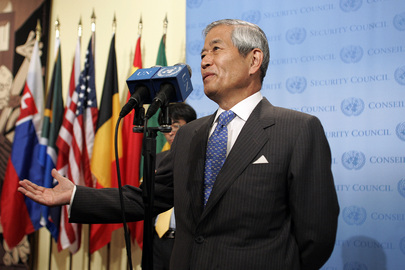
Japan’s Takasu at a stakeout, with US flag but not speaker
While the Committee met in the UN’s basement, this Q & A took place upstairs before UN TV camera, in the second floor stakeout in front of the Security Council. Earlier on Thursday, after an ill-attended stakeout by Stephen Rapp, current Special Court for Sierra Leone Prosecutor now nominated for the U.S.’s top war crimes post, a representative of the US Mission to the UN asked UN TV to not take apart its camera, to stay waiting “for an hour.”
More than an hour later, the Turkish and Japanese Ambassadors came up to talk, along with at least two US Mission staffers. No one spoke for the US, however. Some wonder if the Obama Administration, eager for dialogue, does not want to be too closely associated, at least on camera, with the the imposition of sanctions. On the other hand, Japan is clearly the most threatened — except South Korea….
Footnote: in full disclosure, just as the Sanctions Committee meeting was getting out in the UN basement at 1:15 p.m., a meeting began on “applying sustainable development to arms-transfer decisions,” complete with free sandwiches.
Several reporters including this one picked up one of the free sandwiches — roasted red pepper on thick black bread — but did not attend the arms control event, rather followed Takasu up to the second floor stake out. One US Mission staffer called this “ghetto,” and vowed to blog about it. To echo George W. Bush and Pyongyang, on peppers but not Kevlar: bring it on.
As Security Council Meets on N. Korea, Malay Bank, Ban and Kang Nam 1 in UN Penumbra
Byline: Matthew Russell Lee of Inner City Press at the UN: News Analysis
UNITED NATIONS, July 6, updated — As the UN Security Council mechanically convened days after North Korea fired seven missiles into the Sea of Japan, the mystery grew around the Kang Nam 1 ship with its reputed cargo of weapons for Myanmar, and the unnamed Malaysian bank reportedly pegged to process Burmese payments.
The place of a middleman between the regimes in North Korea and Myanmar is called by some the vortex of evil. Others apparently call it good business.
Reports — and photos — emerged Monday of tunnels in Myanmar designed by North Korean advisers. DVB reports that
“five Burmese companies – Htoo Trading, Kambawza, Asia World, Aden and Shwe Thanlwin – are known however to have provided machinery for the digging of the tunnels… A secret visit by General Thura Shwe Mann, the Burmese regime’s third-in-command, along with 18 other high ranking military officials to North Korea in November 2008, is another indicator of how the two countries have been cooperating. During the visit, Shwe Mann and North Korean Army Chief General Kim Gyok-sik signed an Memorandum of Understanding on further cooperation plans. The Burmese delegation also visited an underground military hardware factory near Pyongyang.”
But it is Pyongyang’s threats to Japan and Seoul which trigger UN action. Myanmar gets a free pass.
In front of the Security Council late Monday afternoon, Japanese media converged as they did after the last launch by Pyongyang. South Korea’s Ambassador came and said they expect the Council to react. Inner City Press asked a Council diplomat when Ban Ki-moon’s envoy to Myanmar Ibrahim Gambari is slated to brief the so-called Group of Friends on Myanmar.
This is what Ban said when empty handed he left Myanmar: that Gambari would return to New York and brief the Friends while he traveled on to Geneva — click here for Inner City Press’ UNCTAD story — Ireland and then the G-8 meeting in Italy.

N. Korea’s Kang Nam 1, returning home in Ban’s penumbra?
The diplomat said Ban would have been expected to do the briefing himself, but perhaps with so little accomplished, Gambari would have to do.
A strange theory justifying Ban’s apparently fruitless trip to Myanmar began to circulate in the UN on Monday: that it was due to Ban’s presence that the Kang Nam 1 did not dock in Myanmar. Since Ban has already claimed on the Charlie Rose television program that he saved 500,000 people in Myanmar, taking credit for the Kang Nam 1’s return to North Korea may not be far off.
While the Malaysian bank at issue has so far gone unnamed, one wonders if the UN committee set to finger companies for sanctions this coming Friday might not name the Malay bank. Watch this space.
Update of 5:40 p.m. — the Council has “suspended” its consultations on North Korea until 6 p.m..
Update of 6:06 p.m. — a Council diplomat tells the Press that whatever will happen today will happen soon. The crowd of mostly Japanese media expresses a collective desire to leave.
Update of 7:05 p.m. — First, the Chinese delegation strode out, telling the Press, the President will have a statement for you. Then the U.S. squad, with Susan Rice, Alejandro Wolff and at least two bodyguards, came out, the bodyguards between Ms. Rice and the press. Finally the Ugandan Ambassador, Council president for July, emerged and read out what he called an “oral statement,” that the Council condemns the missiles, finding them a violation of resolutions. He was followed by Japan’s Ambassador Yukio Takasu, who called the “oral statement” — less even than a formal Press Statement, which in turn is less than a Presidential Statement which is less than a resolution — “clear and strong.”
Inner City Press asked Amb. Takasu to comment on the Kang Nam ship. Takasu said that Japan had spoken with other neighboring countries about their duty to search such North Korea ships if they came to port. Inner City Press asked, did Japan speak to Myanmar, and what does Japan think of Ban Ki-moon’s recent two day trip to Myanmar: success or failure?
Takasu said Japan spoke “bilaterally” to countries in Asia “but not necessarily to Myanmar.” He said it was too early to judge Ban’s trip, she spoke with Ban and Gambari “during” the trip and would be briefed upon Ban’s return to New York. He called the current outcome of the Kang Nam trip a demonstration of the value of UN resolutions. But the Ugandan Ambassador told Inner City Press that the Kang Nam didn’t even come up during the consultations, and another Council diplomat confirmed this. Go figure. Watch this site.
* * *
To read more – http://www.innercitypress.com/unsc1may7dprk071609.html
World focus on Burma (10 July 2009)
.
Closed-door Suu Kyi trial resumes in Myanmar
Reuters – Aung Hla Tun, Martin Petty –
“The trial fails to meet the most basic standards of Burmese law and international practice. The military regime has taken up powers that allow them to …
Yettaw Admitted to Prison Hospital
The Irrawaddy News Magazine – Lawi Weng –
Khin Maung Oo said that when Suu Kyi discovered Yettaw outside her home she told him to respect and comply with the rule of law in Burma. …
Suu Kyi trial resumes

Straits Times –
But the UN chief failed to secure any concessions from the government and was not allowed to meet with Ms Aung San Suu Kyi, leading human rights…
groups to
Obama iconographer finds beauty in Suu Kyi

AFP –
Fairey was approached to make the poster by prominent human rights activist Jack Healey, who met Aung San Suu Kyi a decade ago and promised to help her. …
Burmese junta should heed UN Secretary-general proposal
Shan Herald Agency for News –
During his two days visit, Ban proposed the usual, much needed reconciliation process through dialogue, adherence of universal human rights and …
Aung San Suu Kyi trial resumes after UN chief’s failed attempt to …
guardian.co.uk –
Human rights groups further condemned Ban for telling the head of the junta, General Than Shwe: “I appreciate your commitment to moving your country forward …
Foreign Investment in Burma: Analysing the statistics
Mizzima.com – Derek Tonkin –
The Joint Venture in Burma with Union of Myanmar Economic Holdings, Rothmans of Pall Mall Myanmar, remained essentially unchanged and licensed production of …
Burma junta ‘unwilling’ to aid opium eradication
Democratic Voice of Burma – Francis Wade –
The United Wa State Army (UWSA) and the Myanmar National Democratic Alliance Army (MNDAA) received support from aid agencies and governments to kick start …
China labor straining neighborly ties
Asia Times Online – Peter J Brown –
In Burma [Myanmar] and Laos – also Cambodia to a lesser extent – there are hundreds of thousands of Chinese workers building infrastructure, ports, roads, …
Burma confirms second H1N1 victim
Democratic Voice of Burma – Francis Wade, Thurein Soe –
… the New Light of Myanmar newspaper reported. Echoing the case of the 13-year-old girl who last month become Burma’s first A/H1N1 victim, the newspaper …
G8 leaders respond to Burma intransigence
Democratic Voice of Burma – Francis Wade –
“We reiterate our call on the Government of Myanmar [Burma] to release all political prisoners, including Daw Aung San Suu Kyi, whose continued detention …
..
World top news: UN chief gambles on Burma breakthrough
BBC News
UN chief gambles on Burma breakthrough
Page last updated at 12:27 GMT, Friday, 3 July 2009 13:27 UK
BBC South East Asia correspondent

Ban Ki-moon is not a man known for taking risks. Yet his decision to visit Burma and meet its secretive military rulers – at a time when the rest of the world is outraged by their decision to put opposition leader Aung San Suu Kyi on trial – is quite a gamble.

Mr Ban has been criticised for his unassertive style of diplomacy
|
The visit was requested by the Burmese government.
The generals are rarely graced by the presence of figures of Mr Ban’s international stature in their bunker-like capital Nay Pyi Taw.
If the secretary-general gets nothing in return, he will be assailed by his detractors for being naive, for allowing the status of his high office to be used by a pariah regime.
Critics have already argued that a UN secretary-general’s visit should be a prize, to be awarded after significant concessions have been made, not before.
But if Mr Ban’s visit can revive a dialogue between the military and the opposition that has been dead for six years, he can chalk up the greatest achievements at the UN to date.
So what are his prospects?
Previous UN envoys have generally had little success in Burma.
 |
 Burma’s rulers are prepared to sit in splendid isolation if they feel threatened by international pressure Burma’s rulers are prepared to sit in splendid isolation if they feel threatened by international pressure   |
The one exception was Razali Ismail, a distinguished Malaysian diplomat, who was appointed UN Special Envoy to Burma in April 2000.
He helped broker talks between the government and Aung San Suu Kyi that resulted in her release from house arrest in May 2002.
But after she was detained again a year later, Mr Razali was repeatedly denied entry to the country, and he resigned in frustration at the end of 2005.
His successor, Ibrahim Gambari, has led eight missions to Burma, but has little to show for them.
He arrived there right after the army’s violent suppression of mass anti-government protests in September 2007, and thought he had been given assurances by Senior General Than Shwe that the military would be lenient with the protesters.
Since then, in a seemingly calculated snub to international opinion, military-dominated courts have imposed harsh sentences on hundreds of political prisoners.
Election risk
Ban Ki-moon’s position as secretary-general may make it easier for him to deal with the notoriously reclusive and stubborn military ruler.
It may be that his oft-criticised unassertive diplomatic style strikes a chord with Than Shwe.
Mr Ban certainly seems to feel he has a rapport with him, a big claim to make after just one meeting over a year ago – but a claim nonetheless that few other international figures can rival.
|
 |
What we do know is that Burma’s rulers are prepared to sit in splendid isolation if they feel threatened by international pressure – the networks of tunnels being constructed underneath the new capital, with North Korean help, are testimony to that.
But they do care about their legitimacy and respectability in the world.
Why else take the risk of holding elections next year, albeit elections which will leave the military in a dominant position?
Mr Ban must seduce them with offers of respect away from the comfort zone of their bunkers.
The few people who have any contact with top Burmese officials say they have been genuinely caught off-guard by the storm of international protest over Aung San Suu Kyi.
That the trial has been repeatedly delayed suggests they have concerns – dissident trials are usually rushed through with little due-process – so there is some willingness to acknowledge world reaction.
Dialogue test
Measuring the success of Mr Ban’s mission will be difficult.
He may win the release of a number of political prisoners. Some will dismiss this as a mere token, but such concessions do matter.
Mr Ban has a list of those of greatest concern to the UN; some are being held in very harsh conditions. Dozens of political prisoners have died in custody over the years.

Aung San Suu Kyi’s NLD party was brutally suppressed by the army
..
|
He almost certainly will not obtain Ms Suu Kyi’s release. The real test will be what happens over the next few months – whether a real dialogue can be restarted with the opposition.
Another test will be whether next year’s election can be made more inclusive.
At the moment the main opposition party, Ms Suu Kyi’s National League for Democracy, says it will only consider taking part if the military government meets a series of demands including the release of political prisoners and changes to the military-drafted constitution.
As it stands, the election result is likely to be dismissed by many countries around the world as too unrepresentative and too tightly controlled by the military to be recognised officially.
Yet Than Shwe clings to the hope that the election will give his rule international legitimacy.
The election will, though, make meaningful changes to the arbitrary way Burma is ruled by a small cabal of military men.
If it can be improved, if the military can be persuaded to allow the opposition a greater role – these are very big ifs – it could offer the country a way out of its current dire predicament.
This is a prize Ban Ki-moon clearly thinks is worth pursuing.
http://news.bbc.co.uk/2/hi/asia-pacific/8132723.stm
……
Ban Ki-moon speaks in Burma (ITN news)
……
UN Chief Ban Ki-moon’s visit to Burma (3-7-2009)
.


UN Secretary-General Ban Ki-moon spoke with Gen. Than Shwe (r.) of Burma (Myanmar) on Friday in Naypyidaw. On Mr. Ban’s agenda were upcoming elections and a visit with Aung San Suu Kyi. It wasn’t clear if he would be allowed to meet the detained opposition leader before leaving Saturday.
Louis Charbonneau/Reuters
Myanmar Muddle
Khaleej Times –
The generals of what was formerly known as Burma are difficult to deal with. Ban himself did not sound very positive and had called the visit, …
The World Today – July 3. UN Secretary-General meets Burmese generals.
Vancouver Sun – Jonathan Manthorpe –
United Nations Secretary-General Ban Ki-moon (L) holds a meeting with Myanmar’s junta supremo …
Myanmar denies UN chief’s request to see Suu Kyi
The Associated Press – John Heilprin –
NAYPYITAW, Myanmar (AP) — UN Secretary-General Ban Ki-moon could leave Myanmar empty-handed after apparently failing to win any concessions Friday from the …
Ban on a mission to Myanmar
euronews –
But after talks with Burmese leader Than Shwe on Friday, Ban has earned himself a second meeting on Saturday. Ban has asked to see democracy campaigner Aung …
UN chief on tough trip to Burma
Channel 4 News –
UN Secretary-General Ban Ki Moon still does not know if he will meet political prisoner Aung San Suu Kyi following talks with Burma’s top general. …
Myanmar stalls on UN chief’s talks with Suu Kyi
AFP –
… aid following Cyclone Nargis in May 2008, which killed around 138000 people. Myanmar, formerly known as Burma, has been ruled by the military since 1962.
UN Chief´s visit in Myanmar: How effective it will be?
American Chronicle – Joe Fleishman –
UN Secretary General Ban Ki Moon has arrived in Myanmar to have talks with their military leaders. Secretary General is expected to lobby Myanmar´s Junta to …
Ban Ki-moon o pressure Myanmar generals
Open Democracy – Oliver Scanlan –
Ban Ki-moon pressures Myanmar’s junta to release imprisioned activist Suu-Kyi. The Israelis demonstrate their strategic reach with nuclear-armed submarines. …
UN head meets with Burmese junta
Australia Network News –
The United Nations Secretary-General, Ban Ki-moon, has met with the head of Burma’s military junta for talks aimed at securing the release of political …
Ban to Burma
UN Dispatch – Mark Leon Goldberg –
Secretary General Ban Ki Moon is en route to Burma/Myanmar to press for the release of Nobel Laureate Aung San Suu Kyi. Evelyn Leopold, a long time United …
UN Chief To Meet Myanmar Junta Chief Again Saturday
EasyBourse.com –
NAYPYIDAW (AFP)–UN Secretary General Ban Ki-moon is to hold an unscheduled second meeting with the leader of Myanmar’s military junta on Saturday, …
Un Chief Asks Burmese Junta For Meeting With Aung San Suu Kyi
Journal of Turkish Weekly –
Ban Ki-moon briefs journalists outside Bayint Naung Yeiktha, in Naypyidaw, Burma, 03 Jul 2009U.N. Secretary-General Ban Ki-moon says the head of Burma’s …
Ban gets second meeting with Burmese chief
The Standard –
… with regime leader Than Shwe today in which the Burmese leader stalled on allowing the head of the world body to visit democracy icon Aung San Suu Kyi. …
World focus on Burma (3 July 2009)
.
PM urges Myanmar to halt Suu Kyi trial
Reuters South Africa –
Suu Kyi, who has spearheaded a campaign for democracy for two decades in the former Burma, is currently on trial for breaching a security law, which critics …
Myanmar’s new generation shy away from political activism, look …
Minneapolis Star Tribune –
Two decades ago, it was very difficult to emigrate from the country then called Burma. Today it’s much easier, and every day long lines of people, …
A legacy of mismanagement: the state of Burma’s economy
Mizzima.com –
The government has long had a policy of having just one monopoly provider of rural credit in the form of the Myanmar Agricultural Development Bank, or MADB, …
Could YouTube Have Stopped Hitler?
On Faith – –
In 2009, regimes like Myanmar (Burma) nip the problem of potential protest on the Internet in the bud by outlawing the web: no Medium-no Message. …
Myanmar junta stalls on Ban request to see Suu Kyi
Reuters – Louis Charbonneau –
Suu Kyi, who has spearheaded the campaign for democracy for two decades in the former Burma, is currently on trial for breaching a security law, …
Ban Ki Moon demands release of Aung San Suu Kyi
 Times Online – Richard Lloyd Parry –
Ban Ki Moon, the UN Secretary-General, asked the leader of Burmese junta to release the detained democracy leader, Aung San Suu Kyi, today but was refused …
UN chief gambles on Burma breakthrough
BBC News – Jonathan Head –
Yet his decision to visit Burma and meet its secretive military rulers – at a time when the rest of the world is outraged by their decision to put …
UN’s Ban “Appreciates” Than Shwe’s Actions in Burma, Scam Election …
Inner City Press –
UNITED NATIONS, July 3 — With news of his airplane’s touch-down in Yangon, the carefully stage managed visit to Myanmar of UN Secretary General Ban Ki-moon …
UN chief presses Suu Kyi release

Aljazeera.net –
Ban Ki-moon, the United Nation’s secretary-general, has met Myanmar’s military chief to demand the release of Aung San Suu Kyi, the country’s imprisoned …
Ban Ki-Moon On Risky Mission To Burma Seeking Political Prisoners …
Free Internet Press –
I will convey exactly what the international community expects and wishes (regarding) the way they want to see changes in Myanmar (Burma). …
UN chief wants access to Suu Kyi
ABC Online –
(APTN) UN Secretary General Ban Ki-moon pressed the reclusive leader of Burma’s ruling junta to free democracy icon Aung San Suu Kyi and to allow him to …
UN’s Ban meets with Myanmar’s junta supremo
Reuters South Africa – Louis Charbonneau –
NAYPYIDAW, Myanmar (Reuters) – Myanmar junta supremo Than Shwe smiled briefly but gave nothing away as he listened Friday to UN chief …
UN Chief Begins Talks with Burmese Military Rulers
Voice of America –
By VOA News UN Secretary-General Ban Ki-moon is in Burma to press the ruling military government to release all political prisoners, including pro-democracy …
Ban Ki-moon meeting with jailed Suu Kyi a no go
 CBC.ca –
Ban met with junta chief Than Shwe, the senior general in Burma, also known as Myanmar, on Friday and requested a meeting with Suu Kyi face-to-face. …
Burma rejects Ban’s plea to meet Suu Kyi
IrishExaminer.com –
UN secretary-general Ban Ki-moon said Burma’s military leader today rejected his initial request to meet jailed opposition leader Aung San Suu Kyi. …
Myanmar rejects initial UN attempt to see Suu Kyi
The Associated Press – John Heilprin –
NAYPYITAW, Myanmar (AP) — UN Secretary-General Ban Ki-moon said Friday that Myanmar’s junta chief rejected his initial request to meet jailed opposition …
Can Ban Ki-moon Make A Difference?
The Irrawaddy News Magazine – Htet Aung –
Burma’s cloudy political atmosphere is turbulent with concern, doubt and hope regarding the United Nations Secretary General Ban Ki-moon visit …
‘The Philanthropist’ is mind-blowingly good
Buffalo News – Jeff Simon –
… between the oppressive military junta that wants to call a country Myanmar and the democratic liberationists who want to return to calling it Burma? …
Absence of rain delays cultivation in Chin state
Mizzima.com –
The degree of certainty is 80 per cent,” said the weather forecast in Burma’sMyanmar on Tuesday. Cultivation of paddy has … state newspaper the New Light of
Strength and dishonor
Asia Times Online – Maung Aung –
There is almost universal puzzlement as to the enduring staying power of the Myanmar military regime. With such widespread fear, distrust and outright …
UN chief meets Myanmar junta leader on Suu Kyi
New Straits Times –
… huge failure,” said Kenneth Roth, New York-based hrw’s executive director. Myanmar, formerly known as Burma, has been ruled by the military since 1962.
UN chief in Myanmar mission to free Suu Kyi
New Straits Times –
… New York-based hrw’s executive director, said in a statement. Myanmar, formerly known as Burma, has been ruled by the military since 1962.
Southeast Asia to Somerdale
Cherry Hill Courier Post – Joseph Gidjunis –
Analysis: Why sanctions aren’t working in Myanmar
CNN – Pauline Chiou –
Workers at TOTAL’s project in Burma unload pipe for the 1996 construction of the Yadana pipeline. Consider the Southeast Asian nation of Myanmar. …
UNSC expresses concern over reports of NKorean missile launch
Business Standard –
Briefing reporters on the agenda of the Security Council for the month of July, Rugunda said Middle East, Somalia, Honduras and Burma are other issues, …
Burma expands military ties with North Korea
Telegraph.co.uk – Malcolm Moore –
Mr Ban is in Burma for negotiations over the release of a group of political prisoners and could also be granted access to Aung San Suu Kyi, who is on trial …
Burma, North Korea Said To Expand Military Ties

Salem-News.Com –
Burma has meanwhile brought a bizarre criminal case against detained opposition leader and Nobel Peace laureate Aung San Suu Kyi and renewed a military …
Friday, July 10
eTaiwan News –
1995 – Opposition leader and Nobel Peace Prize laureate Aung San Suu Kyi is freed from house arrest in Rangoon, Burma, now known as Yangon, Myanmar, …
VIEW: Asia’s hour? —Jamie F Metzl
Daily Times –
Moreover, if China, India, and the ASEAN states take the lead in promoting a just resolution for the people of Burma/Myanmar, or if China proves more …
Burmese Exiles Rights Groups Hold Hope For Un Chief’s Visit
Journal of Turkish Weekly –
United Nations Secretary-General Ban Ki-moon visits Burma Friday to push for the release of political prisoners and national reconciliation. …
Blind Karen farmer harvests dignity as well as extra income
Reuters AlertNet – Kitty McKinsey –
Even after the 52-year-old Karen farmer came to a Thai refugee camp from his native Myanmar more than 20 years ago, he attempted to support his family by …


 Save Burma
