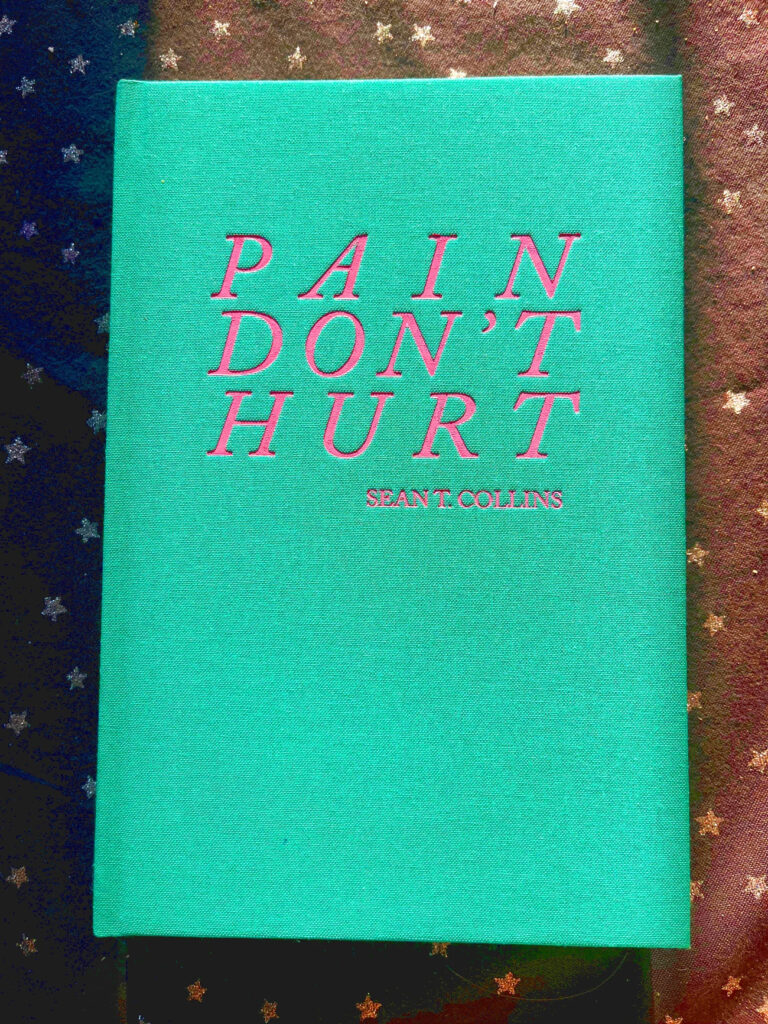
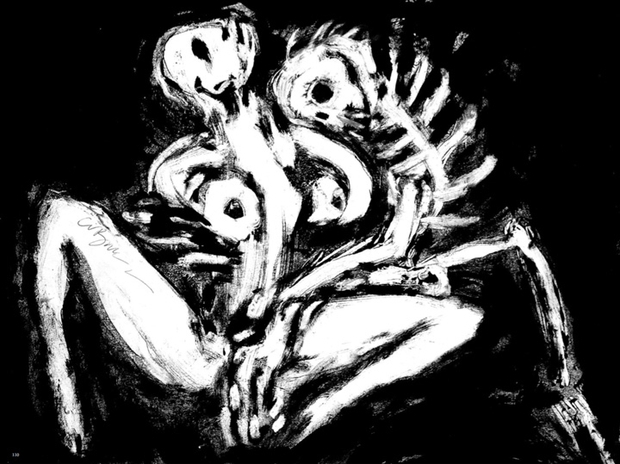
I’m happy to report that Julia Gfrörer and I once again have copies of our horror/erotic/gothic comics and art anthology Mirror Mirror IIavailable for sale at her Etsy shop. It’s an absolute murderer’s row of artists; if you like our sensibilities at all, you’ll like this book.
“Don’t think of them as human beings. Think of them as Americans.”
When the creators of the Fallout games forcibly annexed Canada into their dystopian-future United States, they did so when this was a parody of American imperialism. How could they have known that before too long, American imperialism would be beyond parody? The incorporation of Canada as “the 51st State” is now an explicit, stated policy goal of the American government, to the extent that any of the demented synapse-firings of our pedophile protector president and the psychosexual fixations of his cadre of mutant Nazi viziers can be considered “policy” as we have historically understood the term. We live, and in an increasing number of cases we die, under the exact same kind of rule by demented billionaires Fallout presented as a worst-case scenario. A cheery thought, isn’t it?
It was right around the time that his beautiful wife engineered a threesome with his equally beautiful assistant that I started to feel bad for Henry Muck. I watched this peer of the realm joylessly slam his marble-carved body into Hayley, an eager, gorgeous woman 15 years his junior. I watched his wife Yasmin — who made it happen, then oversaw it all with approval while languidly smoking a cigarette — order Hayley to spread her legs so Yasmin could suck “something that belongs to my husband, and therefore to me” directly out of her body. I watched all that, and I thought this poor bastard.
Although we’re only two short episodes into the season’s brief six-episode run, “A Knight of the Seven Kingdoms” is already a significant shift from the somber grandeur and Grand Guignol horror of “Game of Thrones” and “House of the Dragon.” Its tone is light. Its threats are decidedly less than world-shaking. Its protagonist is a commoner, not a noble. Its editing is positively zippy in places.
Moreover, while the show relies on the interplay of Peter Claffey’s decent but dense Dunk and Dexter Sol Ansell’s precocious problem child, Egg, the result is less a “Lone Wolf and Cub”/“The Last of Us” survival story than a mismatched buddy comedy. Ser Duncan may be the only contestant in the tourney dopey enough not to realize that there is more to his suspiciously knowledgeable and headstrong squire than meets the eye.
The final surprise? Like his boss, Antonio loves him some yacht rock. In another American Psycho riff, he defends the artistic legacy of Christopher Cross at length, decrying the image-first MTV era for tanking the average-looking singer-songwriter’s career. “The world is cruel to people who aren’t beautiful,” says the murderer-for-hire.
But he only says this after he sings the entire first verse and chorus of Cross’s smash hit single, the definitive yacht rock song, “Sailing.” And I mean the whole thing, every note, for approximately one minute and forty seconds of screentime — all while Jeremy, who’s both a) not a fan of Christopher Cross, and b) convinced this man is going to kill him at any moment, watches in perplexed horror.
And dude, Anthony Ramos sings that song. He puts his heart and soul into it the way you do when you really want to kill it at karaoke. The funny, pop-culture-referencing hitman is an old archetype now — Pulp Fiction is over thirty years old — but rarely have I seen it done with this kind of cheerful gusto. Between this and his fine work on Marvel’s Ironheart, the guy plays a great villain precisely because he doesn’t really read as villainous.
“The Pitt” is not a show for the cynical. The show is full to bursting with heartfelt declarations of devotion, moving rapprochements between estranged loved ones, copious tears of both sadness and joy, and celebrations of cooperation and community. This sweet stuff can be hard to swallow when you’ve been weaned on a bitter diet of prestige antihero dramas like “The Sopranos.”
But “The Pitt” is not a show about normal circumstances. Every patient who arrives in the E.R. introduces a new set of potentially life-or-death stakes for the core cast to handle. Even cases that aren’t potentially fatal often reveal some horrible defect in the American health care system.
The friends and family members by the bed sides of their loved ones are alternately terrified, furious, confused, devastated and grateful beyond belief. Why wouldn’t they be? A group of competent medical professionals just healed the person they care about — or failed to. Emotions run hot and close to the surface. Apply enough pressure, as circumstances in the Pitt do, and those emotions explode with volcanic force.
In essence, the hospital setting of “The Pitt” is a cheat code. It allows us to access our deepest, most profound emotions without embarrassment because those big emotions match the scale of the triumphs and tragedies we witness on an hour-by-hour basis.
“I think everything that we do, from the minute we hit puberty to the second we die, is about sex. We go to the gym, we work on our bodies, we cut our hair, we fix our teeth, our tits, torturing ourselves for some promotion — and everything that we do is about our universal, unquenchable thirst to all be considered attractive enough to get laid.” —Agent Cooper Madsen
Put a pin in that speech. We’re gonna come back to it.
The series premiere of The Beauty, co-created, co-written, and directed by Ryan Murphy, depicts a deranged model played by Bella Hadid going on a killcrazy rampage at a Balenciaga runway show, embarking on a high-speed motorcycle chase on the streets of Paris, resuming her killcrazy rampage with bone shards sticking out of her leg, then exploding like a blood-filled water balloon, while the Prodigy’s “Firestarter” plays.
There. I’ve now told you everything you need to know to determine whether or not you’ll enjoy The Beauty. It’s a Ryan Murphy joint through and through, from the high-profile cameo by a beautiful famous woman to the emphasis on sensation over substance. Of course, sensation can be its own kind of substance, and your mileage on whether Murphy ever makes it so may vary. I find all this work in the true-crime genre to be excellent, for what it’s worth. The crimes going on here, however, are very much not true.
Telling this story to her husband, Cooper Howard, when he confronts her with what he knows about the plan to drop the bombs does not have the effect Barb intended. When he asks her how she could sentence millions, billions of people just like them and their daughter to death to protect their daughter herself, she asks, wouldn’t he? I don’t think he would, at least not in this pre-Ghoul incarnation.
But plenty of people not only would, they’d jump at the chance. Just the other day I saw a viral post in which father of a newborn boast he’d wipe out whole continents just to see his baby daughter smile. Odds are that this asshole doesn’t even change the kid’s diaper without being asked, but here he is, champing at the bit to commit genocide to show what a good dad he is.
Remind you of anyone? “Some things just never change,” Hank MacLean tells his daughter Lucy in the present. “People just wanna kill each other, don’t they? I think it’s the only way that people feel safe. It’s ironic, isn’ tit? To feel safe they have to kill each other.” It’s the raison d’être of the fascism we see playing out on American streets in 2026: In order to assuage our baseless fears, we must inflict terror on others.
When presented with a banquet, an absolute feast of an episode like this one, the temptation is to try to swallow it all in one go. The challenge is to resist that temptation. An episode like “The Commander and the Grey Lady,” the second in Industry’s fourth season, is a meal you can return to for seconds, thirds, and leftovers. Once again written and directed by series co-creators Mickey Down and Konrad Kay, it’s the kind of episode that makes you ask the host for the recipe — or the help, as the case may be. Best to sample a few delicacies at a time rather than try to gobble it all down.
The following story is intended for mature readers.
The hammer fell for the last time. Its bronze face drove the spike home deep, its head now flush with the wood. The craftsman stood back, wiped the sweat from his brow with the back of the corded arm that held the hammer, and looked at what he’d built. Truth be told, on a project this unconventional he wasn’t sure what he was looking for.
After a moment he exhaled sharply and turned to the workbench, laying the hammer down. He picked up a plane and faced his construction once more. Nodding to himself, he stepped forward and gently scraped the plane against the wood, moving up and over the crest of its curved surface. He did this more out of habit than necessity: The object’s exterior was already smooth to the point of seamlessness, every joint and crevice fitted perfectly. But in all his years of renown his’ habits had yet to fail him, and he trusted them like friends.
Daedalus walked to the rack near the wall of his workroom and took down the hide hanging from it. Being careful to keep it off the sawdust-covered floor, he slung it over the structure. It was always the structure, the object, the construction in his mind, and never what it so clearly looked like, never what it was intended to deceive its intended recipient into believing it was in truth. Never the cow.
The next little while he spent tacking the hide into place, light work he was in no particular hurry to finish. I’m covering up that beautiful smooth surface, he thought to himself. Shame. But the effort had not been wasted, he knew. Perfecting even such parts of the project as would never meet the eye was the key to craftsmanship. People sense the work even if they can’t see it, he’d told his nephew long ago. It shines through in what they can. His nephew—
“Is it finished?”
A woman’s voice shook Daedalus from his reverie. He realized he’d been resting his forehead against the rear of the object, eyes closed. He had been working very hard without respite, and he’d long found the afternoon sun to be a natural soporific, as many an unplanned nap at the drawing table could attest. Snapping to, he turned to look at the figure in the doorway — and immediately bowed his head. Pasiphaë, Queen of Crete, stood there, her gown yellow as the sun.
“My Queen!” Daedalus’ exclamation was apologetic. “I— ”
“Oh.” The Queen’s voice silenced his. “It is finished.” She was gazing, wide-eyed, at what he only now found himself thinking of, first and foremost, as the cow.
Pasiphaë approached the wooden animal. Extending a delicate hand the color of golden sand, she touched the cover of cowhide, her fingers gliding over the fine fur. She traced the features of its wooden head, its likeness to one of Minos’ own herd impeccable. From there she caressed the simulacrum’s neck, its flank, its haunches. “And it’s wonderful.”
The Queen turned to Daedalus, the jewels on her diadem gleaming in the golden sun. “How does it work?”
She is your client, he reminded himself. And with Athens closed to you, she is your Queen.
“Ah.” He walked to creature’s right side, standing between it and the Queen. He reached down and lifted a panel of the hide he hadn’t tacked down. There, in a flank of otherwise unblemished wood, could be discerned the faint outline of a small, square door. “You pull up the flap,” he said, “and press here…” He pressed his fingers against a small panel next to the door, which opened with a click.
The Queen approached the entrance, stooping to gaze inside. “I see,” she said. She turned to look at Daedalus. “And…?”
“Of course,” he replied. He gestured toward the back of the cow, where he’d been dozing when she first came in. Now she could see what his body had obscured: a hole, in the lower rear of the body, between its sturdy hind legs. The hole’s edges were rounded smooth and upholstered in leather.
“Once inside, turn to face the front of the edifice and ease backwards. The opening is…” He froze momentarily. “…enough to accommodate,” he said at last.
Pasiphaë reached out a hand and traced the edge of the orifice with her jewel-encrusted fingers. Slowly they curled around the lip of the opening. Extending her arm, she inserted her hand in the hole, which swallowed her up to the elbow. While she was distracted, Daedalus dared a glance at her eyes. The gaze he found there was warm, and dark. He looked away.
“You’ve grown quiet,” the Queen said. She withdrew her hand from the hole. Try as he might, Daedalus could not cloak the dismay on his face — no, not even he who’d dissembled his way through meetings with countless clients who thought they knew better, until he showed them otherwise. “What’s wrong, Architect?” Her pretty brow lifted in concern.
“I fear this whole business, my Queen,” he said honestly, scratching his beard without realizing he was doing so, an old tic. “I’ve feared since first the king refused the sacrifice. I fear it will go ill for all of us.”
Paisphaë put her hand on Daedalus’ bare shoulder. He tensed, despite himself. She was a beautiful woman.
“Architect,” she said, “your crime is behind you.”
And there it was. All it once, everything he now realized he’d been trying to forget by burying himself in this mad project came rushing back. Perdix was his nephew — just his nephew! — but his craft had already outmatched that of the great Daedalus. They had quarreled, well really he had attacked the lad, and there was a window, and…
He started to speak, but Pasiphaë shushed him. “Ah, ah. The goddess of that city saw fit to give young Perdix new life as a bird to spare him the fall, did she not? And with his flight so too departed your guilt. Take heart, sir. You are in Crete now, and you are free.”
He watched as she turned her eyes on the cow. There’s that look again. “As am I.”
Pasiphaë removed her diadem. “I am the daughter of the Sun, the white bull a gift of the Sea,” she said, setting it down on the crowded workbench. “How could our union go ill?”
Daedalus was in his own head, where his thoughts had grown dark. He busied himself by straightening the cowhide, which was already straight. “As you say, my Queen.”
“Now, let’s give this a try.”
“Let’s—?” Daedalus realized he’d only been half paying attention to the wife of King Minos and blinked, turning. Then he saw Pasiphaë, her gown a yellow pool around her tanned feet. Her hair flowed from her head, rippling down her bare body like the reflection of the sun in wavy water.
Before the craftsman could say anything, the Queen walked back to the door in the side of the wooden cow and began climbing inside as he watched. When she reached the halfway mark, her soft belly bisected by the portal, she shifted her weight for better access. Daedalus saw the muscles within her ass and thighs clench, moving the flesh of her lower body around them. As he stared, she stood on her toes and pushed upward, sliding inside with one final motion.
“Does it close from the in—oh, there it is” she said. The door slid shut with another click.
Suddenly chastened, Daedalus averted his gaze from the cow. You had no right. “You should find padding inside,” he said without facing it, his voice thick in his throat. “Reach into the head to—”
“Show me how it works,” came the muffled voice inside the cow.
“My Queen?” Daedalus was confused. “I’m sorry, but I’ve already shown you how it—” He heard the wooden beast creak as if it had been jostled and turned to see the source of the noise.
There in the hole between the thing’s legs, he could see the Queen’s cunt.
Show me how it works.
When he realized what she wanted of him the fear he felt only grew…but so did another feeling, hungry and hot. He leaned his head against the cowhide and closed his eyes. But the apertures of his other senses widened accordingly. He heard the Queen — or rather he heard the Queen’s body, the Queen’s naked body — wrlggling inside the cow. He felt his cock stiffening against his clothes. And even amid the aromas of sawdust and cowhide, he smelled, faint and rich and slightly maddening, the scent of her arousal.
He began to undress. He tossed his robe onto the workbench, then his undergarment, the plain fabric of which obscured the Queen’s diadem entirely. Turning, his cock throbbing as it rose to full stiffness, he walked forward and touched the cow. The cow. Now I can say it. He made a full circuit of it, his hands making a study of all he’d built. He needed it to be real to him, as it would have to be for the sacred animal that was, in the end, his true client.
When his hands finished their tour, he found himself behind the cow once more. He was ready now. He licked his hand and stroked the shaft of his cock, wetting it. He positioned it at the opening in the cow, the opening in the Queen, and — hhhhh — slid inside.
How hot she burned!
He knew right away he would not be long in climaxing. Not out of pleasure, though it was intense — forbidden and perverse and as keen and sharp as ever he’d known it. No, it was as if his body felt a sense of duty. He was demonstrating the efficacy of his creation, nothing more. If he allowed himself to savor this, how could he look himself in the mirror and adjudge himself an honest craftsman?
The Queen moaned within, grunted, sounding muffled and animal from inside the cow’s hide-covered carapace. His arms wrapped around the cow, stretching forward. He clung to it — to her. He bent his head to it one more time and covered it with desperate, delicate kisses.
The sensation of her cunt spasming around his shaft shook him loose. He looked down and saw her jeweled fingers sticking through the opening in the cow, rubbing her swollen clitoris amid a cloud of golden hair as she brought herself off. It was too much for him at last, then. Paisphaë, the cow, the job, all of it, too much.
“My Queen,” he gasped as her own cries faded. “I’mthere…”
“Not in me!” came the muffled command from inside. “Spill it on the floor.”
Had he been able to think clearly Daedalus could have foretold this outcome, which instead took him by surprise. No matter. It was all too far along now. The machine would serve its function.
“Ahhh…” He pulled himself out of her and began stroking furiously, his hand sliding up his cunt-slick foreskin up and down. Swooning, he leaned hard to his left, his shoulder bracing him against the cow as he turned to face the workbench. “Ahhh!” His climax overtook him then. He forced his eyes open, the muscles of their lids wavering, and watched his own semen gush out of his pulsating cock to the sawdust-strewn floor.
As it ended, he leaned back and slid down, his ass colliding with the floor as he leaned back against the beast’s legs. His semen lay in a puddle between his knees.
He felt the cow shake from within, heard the click and whoosh of the door unlocking and sliding open. In seconds, the Queen was by his side, naked and sweaty as he was.
“Oh, good,” she said, looking down beteween Daedalus’ splayed legs. She stuck out one finger and swirled it through his spunk, drawing patterns in the sawdust. “It works.”
Without another word she stood. He looked up and saw her smear her cummy finger against the cowhide, then turn to the workbench. Tossing his clothes to the floor, she retrieved her diadem. It sat there in her hands for a moment, then another.
She looked back at Daedalus. “I love him, you know. I do. I can’t expect anyone else to understand what I myself cannot, but I love him.”
Pasiphaë put the crown back on her head began to dress. “And so I thank you, Architect, for what you have done for me today.” He knew what she meant, and what she didn’t.
She was already leaving. “Have it brought to the pens,” she said. It was a command, not a request.
Daedalus was still sitting naked against the leg of the cow. “Yes, my Queen,” he said.
After a minute, maybe two, he stood, wiped the sawdust from his ass, and began cleaning up.
—
The servants scampered out of the pens, leaving the wooden cow behind. In the shadows stirred a massive shape the color of sea foam in the light beyond. The bull approached the cow slowly, warily even, the tips of its ivory horns parallel to the earth below, but already its excitement was evident.
The white bull of Poseidon reared up and mounted the cow. From his window, Daedalus watched its engorged cock stop, thwarted, then push forward and disappear within the hide-covered container he’d built.
Daughter of Helios, by Aphrodite accursed, I beg of you, he thought. Gods of Olympus, architects of existence, I pray of you. Please, turn not my invention to evil. But even as he thought this, his cock was hard.
He ran his hand through his hair, higher up his forehead with each passing year, and turned from the window. The drawing board awaited, and with it the designs he’d been working on since he’d finished the cow. The Queen had inspired it, in more ways than the obvious.
He was just pressing his reed pen to paper when he heard small footsteps approaching. “Papa!” His son appeared in the doorway of his study, grinning ear to ear, as if privy to a wonderful secret he would soon share.
Daedalus felt the yoke of care that bound him begin to fall away. He put down his pen, arresting his study of his nephew in flight — not as the mere bird into which Athena had transformed him, no, but as the man himself, full grown and yet wingéd still, soaring nigh unto the Sun.
“Yes, Icarus,” he said, returning the boy’s smile. He stood and abandoned his work, for now. “I’m right here.”
The motorcycle parked outside the Palmer house lets you know who’s inside. James Hurley and his girlfriend Donna Hayward have come to visit Maddy Ferguson, the out-of-town cousin of their beloved friend Laura Palmer. In fact, they’ve come to record a love song, using a tape recorder, an old-fashioned microphone, and James’s acoustic guitar. While Maddy and Donna sit side by side on the floor and coo their dreamy backing vocals, James takes lead. His tremulous voice sings a song called “Just You,” which sounds like something you might have slow-danced to at the 1961 Spring Fling.
Donna’s mistake is believing that the song is for her. It might have been when he wrote it. It might even have been when he started singing it. But as the song continues, the dynamic shifts. As Maddy’s eyes seek out James with increasingly obvious hunger, and he responds by looking back at her instead of Donna, Donna’s own eyes grown desperate, pleading, and finally tearful. Eventually it’s too much, and she gets up and runs off.
“I’m trembling, James,” she says when he comes to comfort her. “You made me.” It’s true, but not in the heated way she intends it to sound. The thought of losing James has rocked her.
Maddy just sits there looking uncomfortable for this bit.
Then something happens. As she looks absently into the depths of the Palmer family’s first floor, a man emerges into view. Slowly he approaches, crawling over the sofa, scrambling over the coffee table, staring straight into the camera until he’s right in our faces. Maddy screams uncontrollably, even as Donna and James rush to her side to comfort her. She’s seen Laura’s killer. She’s seen Bob.
These few short minutes of screentime begin with a song so sugary sweet it passes through camp and back around into to dead-serious sincerity. There’s just no denying the passion and pain in the glances exchanged between the three singers. Add in Donna’s attempt to kiss James back into loving her and you’ve got something desperately romantic, in line with the star-crossed relationships of Blue Velvet or Mulholland Drive. But then, after some brief comic relief courtesy of Maddy’s third-wheel awkwardness, comes what remains one of the scariest shots ever aired on television: Frank Silva’s Bob, coming for all of us.
You don’t hear whistling in Westeros very often. The warring kings, the scheming viziers, the occasional incursion by angry dragons or ice zombies — there’s just not a whole lot to feel cheerful about in the Seven Kingdoms. It’s hard to whistle while you work when the work is a Hobbesian war of all against all, unless you’re being a real Joffrey about it.
But in “A Knight of the Seven Kingdoms,” the new HBO show set in the same world as “Game of Thrones” and “House of the Dragon,” there’s whistling on the soundtrack. Lots of it, in fact. Jaunty, carefree whistling, atop a bed of folksy acoustic guitar. The work that composer Dan Romer does here is a world removed from the dramatic, swirling score provided by Ramin Djawadi for this show’s predecessors. Only once does the music hint at that familiar, rousing theme song … and it is immediately cut off by a shot of the show’s hero violently moving his bowels.
In other words, you can literally hear that this is a different kind of show than the previous Westerosi epics. (The episodes are near-sitcom shortness, too.) “A Knight of the Seven Kingdoms” is adapted from the author George R.R. Martin’s novella “The Hedge Knight,” a far more compact and straightforward story of bravery and villainy than his epic “A Song of Ice and Fire” series of novels. Ira Parker, who created the series with Martin and oversees it as showrunner, is not telling a story that determines the fate of nations or the future of humanity in this fantasy world. (Not so far, anyway.) No wonder the music sounds less like “The Lord of the Rings” and more like “Harold and Maude.”
Why does Avatar endure but still feel like vaporware, even to people, like me, who basically like it? Blending dazzling technical achievement, breathless action, elbow-throwing but self-contradictory politics, and just plain goofy writing, Avatar is the most confounding franchise in Hollywood history, especially given the outsize nature of its financial success. With Avatar: Fire and Blood — my favorite film in the series! — fresh in our minds, Stefan Sasse and I look at James Cameron’s ongoing magnum opus in the latest subscriber-exclusive Boiled Leather Audio Hour podcast!
Maggots feasting on a living man’s arm. A bone poking through a bloody wound before getting forcibly shoved back into place. A man smiling happily as his distended stomach is drained of liter after liter of fluid. A syringe drawing blood from a fully visible and erect penis.
Normally, you’d have to turn to the work of purveyors of the extreme such as Clive Barker, Takashi Miike or Lars von Trier to see such sights. This week, they’re on America’s favorite weekly medical drama. Who says Hollywood is risk-averse?
What impresses me most about this episode is the amount of pathos Walton Goggins is able to generate under an inch of prosthetic makeup and with a digitally erased nose. The moment the Ghoul sits down at that bar, it’s like he’s a different person than the one we knew — ruminative, disappointed in himself, just plain sad about it all. Of course we learn later he’s wrestling with handing Lucy over to her insane father, which he reveals was the whole reason he stuck with her all this time: She wasn’t his friend or his ally, she was his bargaining chip.
But her presence in his life is changing him, as surely as she’d never have killed someone before meeting him in turn. It may not seem like much, but being kind to that dog and feeling any kind of way at all about Lucy are huge steps for the subhuman piece of shit we met last season. Especially as the flashbacks draw us closer to…well, whatever happened with him and Barb and House and the bombs, who knows what kind of human being the Ghoul will turn out to be.
Industry is a freefall into the moral void, as thrilling as it is terrifying. It’s the only show that dares to depict our world today as it is: an elevator shaft without a bottom to hit. I’m so glad this miserable, wonderful show is back.
If you called Twin Peaks Season 2, Episode 1 one of the greatest season premieres of all time, you’d be telling the truth. You’d also be lying by omission.
I love Desmond’s debut down the Hatch at the start of Lost Season 2 (a show whose creators never made any bones about the debt they owed Twin Peaks). I love the knife’s-edge suspense between Walt, Jesse, Mike, and Gus at the beginning Breaking Bad Season 4. Shit, I love Sam drinking and whoring his way through getting left at the altar by Diane to kick off Cheers Season 3. But to compare these excellent episodes of television to these revolutionary 90 minutes is to damn what Mark Frost and David Lynch did here with faint praise. Those episodes have surprises, shocks, bittersweet laughs. This episode has the waiter, the Giant, Leland’s musical numbers, Audrey Horne’s prayer, Gersten Hayward’s recital, Major Briggs’s vision, Laura Palmer’s murder. They are not the same.
When people toss the word “Lynchian” around, it’s usually either as a very specific subgenre of surrealism, or as a way too broad synonym for “weird.” But the opening scene of this episode is a whole different flavor of Lynch, one every bit as important to his overall project. FBI Special Agent Dale Cooper, you’ll recall, was shot three times at point-blank range by a still-unidentified assailant to end Season 1. (We learn from the insufferable but brilliant Agent Rosenfield, back on the scene to bully everyone within the Twin Peaks city limits, that his would-be assassin was of average height, hardly narrowing it down.) When we rejoin Coop this episode, we can see that only one of the bullets penetrated his body, right where he’d lifted up the bulletproof vest he’d been wearing beneath his shirt while undercover at One-Eyed Jack’s. He was hunting for a pesky wood tick, you see; the bullet found the little bugger, and his torso, instead.
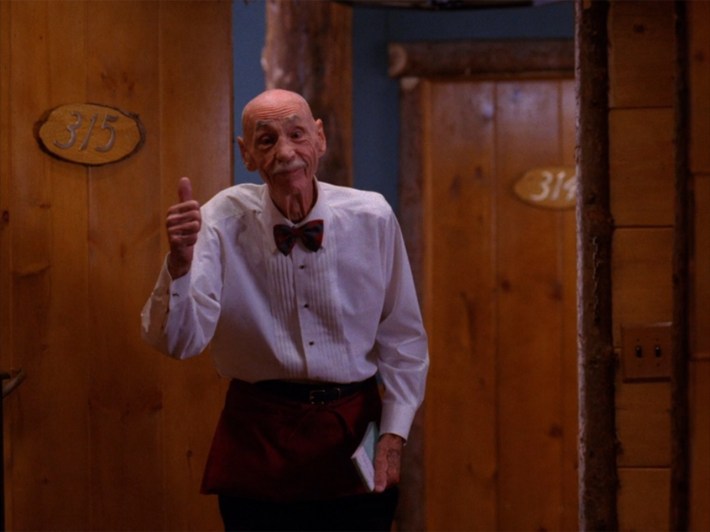
At great length, an elderly room service waiter (Hank Worden) slooooooooooooooooooooooooooooooooooooooooooooooooooowly delivers Cooper a glass of warm milk, hangs up the phone on a panicked Deputy Andy rather than call a doctor, and gives Coop — whose reputation apparently precedes him among the staff, if the waiter’s nearly giddy repetition of “I heard of you!” is any indication — several encouraging thumbs up and eye winks before shuffling away. The waiter also has him sign the room service bill. (Gratuities are included.)
Experiments in comedic tedium like this have been a Lynch hallmark since Eraserhead. I’d argue that on Twin Peaks in particular, as we’ll see later this episode with Leland Palmer, they’re a form of proto–cringe comedy, predating Steve Coogan and Armando Ianucci’s creation of Alan Partridge in 1991, Garry Shandling and Dennis Klein’s The Larry Sanders Show in 1992, and Mike Lazzo and Keith Croffod’s Space Ghost Coast-to-Coast (the most Peaksian of these early examples) in 1994. Scenes like these (fire) walk the fine line of boredom, discomfort, and silliness. It’s astonishing to think that in this case, they’ll lead to the absolute horror we see at episode’s end.
It’s all in a day’s work at the Pitt. (A long day: Like the show’s first outing, Season 2 will tell the story of 15 consecutive hours in the E.R., played out across 15 weekly episodes.) But “The Pitt” isn’t, or isn’t just, a workplace drama. Certainly the friendships and flirtations, the alliances and rivalries, the infuriating inconveniences and the “man, I love this job” moments will feel familiar to anyone who has worked hard with the same group of people in the same place, day in and day out.
But what Wyle, the creator R. Scott Gemmill and the director John Wells achieve here is more than a recreation the past glories of their stints on “ER,” which before the New Golden Age of TV ushered in by “The Sopranos” represented the cutting edge. More germane points of comparison for the world of “The Pitt” include the teeming city of King’s Landing in “Game of Thrones” and “House of the Dragon,” or the fully realized and lived-in sci-fi environments of “Andor.” “The Pitt” is an act of world-building first and foremost.
That starts with the show’s formal aspects: one contiguous set, filled with all different kinds of people, filmed by two hand-held cameras, set in what is meant to feel like real time. After even one episode in that crucible, you start to see it as a place you could hang out in and explore, even get lost in. “The Pitt” shares a sense of repleteness with the grand fantasy epics — the feeling that they’re teeming with life, which continues whether you’re watching or not.
As important to that parallel, though, are the staffers of the Pitt. They are heroes, drawn from all walks of life to serve their collective mission to save that lives. Neither addiction, nor immigration status nor autism spectrum disorders prevent them from doing their jobs. Indeed, their wide variety of life experiences are crucial to their ability to help as many people as possible.
The personal struggles of the medical staff, the intriguing — and often gory and disgusting — cases of the patients, the dazzling you-are-there production: These are the hooks that get you watching. But beneath it all is a message. Rock-star Robby may be the main attraction, but “The Pitt” is a full-throated celebration of expertise, competence, cooperation, science and diversity, at a time when those values are under widespread attack. In “The Pitt,” at least, those values are still alive and kicking.