Most teams think of slow systems as annoying. For accounting and finance teams, they’re something more serious.
When systems slow down during busy periods, people change how they work just to get the job done. That’s when shortcuts happen, records get messy, and audit trails break. Not because anyone did anything wrong — but because the system couldn’t keep up.
That’s not an IT issue. That’s a compliance risk.
And it doesn’t show up on quiet days.
It shows up during tax deadlines, month-end close, audits, payroll runs, and anytime a lot of people need access at once — exactly when accuracy, documentation, and availability matter most.
The quiet hour trap: “Works fine… until it doesn’t”
Most of the time, everything feels fine. Logins are quick. Reports run fast enough. Files open without issue. Then the rush hits. Suddenly:
- Screens lag or freeze
- Files lock unexpectedly
- Applications time out
- People wait… then work around the problem
Pressure doesn’t create these problems. It exposes them.
How performance failures become compliance failures
1. People work around slow systems
That can look like:
- Sharing logins so someone else can get in
- Downloading files locally to keep working
- Approving things offline and “fixing it later”
- Skipping steps that usually work — but don’t under load
These aren’t bad decisions. They’re survival moves. But each one weakens controls you’re expected to rely on.
2. Audit trails get incomplete
Busy periods are when auditors pay the most attention — and when systems are under the most strain. Under heavy use:
- Session logs can be incomplete
- File history can be unclear
- Approval timestamps may be missing or delayed
Intent doesn’t matter here. If the record isn’t clean, it’s a problem.
3. Availability is part of compliance
Deadlines don’t move just because systems are slow. If systems are unavailable — or unreliable — during filing windows, audits, or payroll, you risk:
- Missed deadlines
- Delayed filings
- Inability to produce records when asked
That’s not just frustrating. It’s a real operational and compliance issue.
The Cycle of Compliance Failure
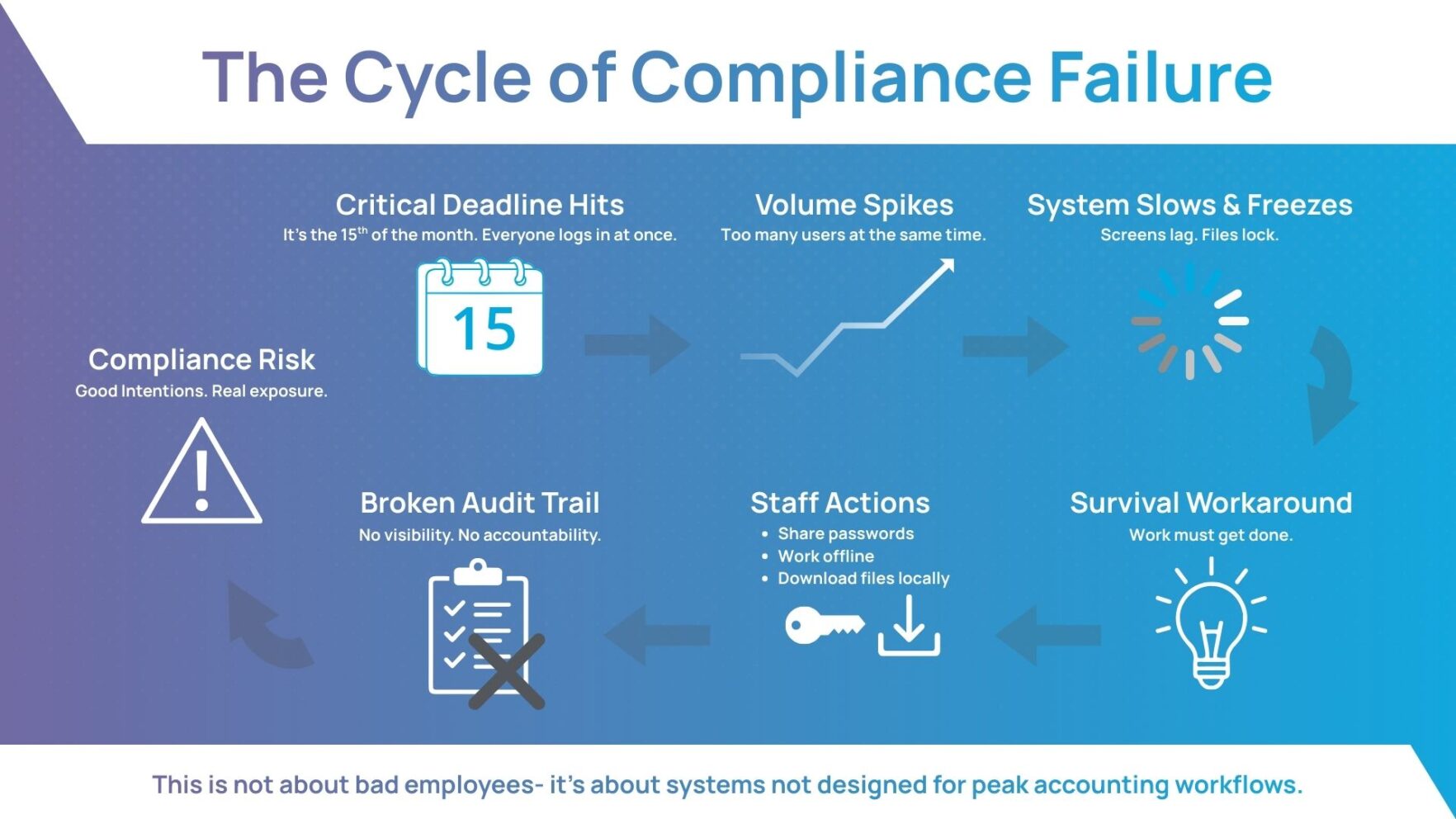
The Trigger: It's the 15th of the month. Everyone logs in at once.
The Friction: The system wasn’t built for this many users at the same time. Screens freeze. Files lock. Work slows down.
The Workaround: Your team can’t wait. To meet the deadline, they download files locally or share access to keep moving.
The Risk: The work gets done — but now the audit trail is broken.
Good intentions. Real exposure..
Why “modern” doesn’t always mean “ready for busy season”
Many cloud systems are built for average days, not peak ones. They work well when:
- Usage is steady
- Fewer people are logged in
- Workloads are predictable
- But accounting and finance don’t work that way.
Tax season, close, audits, and payroll create sharp spikes in activity. If the system wasn’t designed for that pressure, performance and controls start to crack at the same time.
What systems built for busy season do differently
Resilient environments are designed for pressure — not just uptime. They:
- Keep approvals and workflows working even when everyone’s logged in
- Preserve complete logs and records, even during spikes
- Enforce logins and security consistently — no “temporary exceptions”
- Scale capacity without forcing people to change how they work
- Handle large files, reports, and audits without slowing down
- The goal isn’t perfection.
- It’s reliability when it matters most.
60-Second “Busy-Season Readiness” Check
Use this quick gut check now — then pair it with our Tax Season Readiness Self-Assessment for a deeper look.
- Can approvals and timestamps still work when everyone’s logged in?
- Are logs complete during peak activity, not just quiet hours?
- Do logins and security rules stay enforced under pressure?
- Can capacity scale without telling people to work offline or wait?
- Are recovery plans realistic for close, audits, and payroll — not just normal days?
If any of these feel uncertain, it’s worth a closer look.
FAQ
Q: Isn’t this just an uptime issue?
No. Being “up” isn’t enough. Controls and records have to stay accurate while everyone’s working.
Q: We’re already in the cloud — aren’t we covered?
Not always. Many cloud setups are fine on average days but struggle during real-world peaks.
Q: What does a busy-season check actually test?
How systems behave when everyone logs in: approvals, logs, security, recovery times, and whether people need workarounds to keep moving.
Before the next deadline hits
Ask yourself this:
What happens to our controls when everyone logs in at once?
If the answer is “we hope it holds” or “people figure it out,” that’s not just a performance issue — it’s a compliance risk waiting to surface.
Two easy next steps:
1) Download the Tax Season Readiness Self-Assessment
Quick, practical, and designed for accounting teams — not IT departments.
2) Take our 6-question Tax Readiness Quiz
A fast way to spot early warning signs before busy season pressure hits.
Summit Team
We're the Summit team – cloud geeks, tech tinkerers, and security sleuths on a mission to keep your business running smoothly in and out of the cloud.