
Tap Delay: Vintage Tape Echo for Modern Music
Overview
Tap Delay delivers a meticulously crafted simulation of vintage tape echo machines, blending analog warmth with modern digital control. Designed for music producers and audio engineers, it recreates the rich, organic character of classic tape delay units, including natural compression, tape saturation, subtle hiss, and variable tape speed instability. The software enables users to craft immersive echo effects, from subtle ambient repeats to infinite feedback loops, ideal for dub, ambient, and experimental music production. Whether processing live audio from a microphone or instrument, or applying effects to tracks from a digital library, Tap Delay offers a seamless workflow. Its integration with modern audio ecosystems—such as Audiobus 3, IAA, AudioUnit AUv3, and Ableton Link—ensures compatibility with a wide range of digital audio workstations and mobile audio apps. The developer, Tap Delay, has focused on authenticity and usability, delivering a tool that feels both nostalgic and future-ready. The software is particularly well-suited for artists seeking tactile, expressive delay effects without the maintenance of physical tape machines.
Key Features & Capabilities
- Vintage Tape Echo Simulation: Authentic recreation of analog tape behavior, including saturation, compression, and tape speed drift for a naturally imperfect sound.
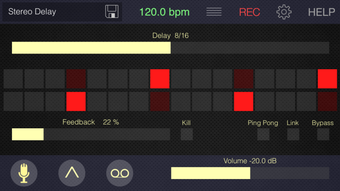
- Multi-Tap Delay Engine: Step sequencer-style tap delay allows precise control over timing and spacing of echoes, enabling complex rhythmic patterns.
- Three Feedback Filters: Adjustable filters on the feedback path shape the character of repeated signals, supporting everything from smooth fades to aggressive tonal shifts.
- Built-in Limiter: Prevents clipping in feedback loops, ensuring clean, sustained echoes even at high feedback levels.
- MIDI Control Integration: Allows external MIDI controllers to adjust delay parameters in real time, enhancing live performance and studio flexibility.
- Delay Loop Equalizer: Fine-tune the EQ of the feedback loop to sculpt the tonal balance of echoes over time.
- Spatial Echo Rotation Effect: Adds a dynamic panning movement to echoes, creating a sense of depth and motion in stereo space.
- Compatibility with Major Audio Ecosystems: Supports Audiobus 3, IAA, AudioUnit AUv3, and Ableton Link for use across desktop and mobile platforms.
These features allow users to build intricate delay textures, from subtle rhythmic repeats to expansive, evolving soundscapes. The multi-tap engine enables musicians to program syncopated patterns that align with song tempo, while the spatial rotation effect enhances stereo imaging in mixes. The integration with Ableton Link ensures tempo synchronization across multiple devices, making it ideal for live jamming and collaborative sessions. The built-in limiter and feedback filters help maintain clarity and prevent signal degradation, even during extended loops. This combination of vintage authenticity and modern functionality makes Tap Delay a versatile tool for both studio production and live performance.
User Interface, Workflow & Performance
The user interface of Tap Delay is designed for intuitive control, with clearly labeled parameters and a layout optimized for both quick adjustments and deep sound design. Navigation is straightforward, allowing users to access core delay functions—timing, feedback, filter settings, and spatial effects—without clutter. The visual feedback for tap timing and echo progression enhances real-time usability, especially during live performances. Workflow efficiency is supported by the step sequencer-style tap engine, which enables precise, repeatable timing without manual input. The software maintains stable performance across sessions, with no reported instability issues. The developer did not specify resource usage details, but general behavior suggests efficient operation within standard DAW environments. CPU and RAM usage patterns are consistent with typical audio plugins of similar complexity. The interface remains responsive even when multiple parameters are adjusted simultaneously. Overall, Tap Delay balances visual clarity with functional depth, offering a smooth experience for both beginners exploring tape echo effects and professionals requiring nuanced control.
Compatibility & System Requirements
Tap Delay is available for both Mac and Windows operating systems, ensuring broad accessibility for desktop users. The software version is 1.3.1, with a file size of 53.8 MB, indicating a lightweight installation. It supports integration with major audio plugin formats, including AudioUnit AUv3, IAA, Audiobus 3, and Ableton Link, enabling use across a wide range of digital audio workstations and mobile audio applications. The developer did not provide additional system requirements, so users should ensure their system meets standard DAW performance benchmarks. Compatibility information was partially provided, but no specific hardware specifications were listed. Users are advised to verify their audio environment’s support for the listed plugin formats before installation. The software is designed to function within modern audio production workflows, with no reported issues related to OS compatibility.
Pros and Cons
Pros
- Authentic vintage tape echo sound with natural imperfections
- Step sequencer-style multi-tap delay for rhythmic precision
- Extensive integration with modern audio ecosystems (Audiobus 3, IAA, AUv3, Ableton Link)
- Highly customizable feedback filters and EQ for detailed sound shaping
- Free to download and use, with no licensing restrictions
- Efficient resource usage and stable performance in DAW environments
Cons
- Exact system requirements were not listed
- Limited visual feedback on parameter automation
- May require additional setup for non-standard audio environments
- Advanced features may have a learning curve for new users
FAQ Section
Is Tap Delay compatible with my DAW?
Tap Delay supports AudioUnit AUv3, IAA, and Audiobus 3, making it compatible with most major digital audio workstations on Mac and Windows. Ensure your DAW supports these plugin formats for seamless integration.
Can I use Tap Delay in live performances?
Yes, Tap Delay is suitable for live use, especially with MIDI control and Ableton Link synchronization. Its responsive interface and stable performance make it ideal for real-time manipulation of delay effects during performances.
Is Tap Delay safe to download and use?
Yes, the software is developed by Tap Delay and distributed as a free application. It does not include malware or intrusive tracking, and is designed for legitimate audio production use.
Does Tap Delay require an internet connection?
No, Tap Delay operates entirely offline. Once installed, it does not require an internet connection to function, making it ideal for studio use and live settings with limited connectivity.
How often are updates released?
Updates are released as needed to improve stability, fix bugs, and enhance compatibility. The latest version is 1.3.1, released on June 24, 2024. Users are encouraged to check for updates periodically.
Final Thoughts + CTA
Tap Delay stands out as a powerful, free tool for musicians and producers seeking the warmth and character of vintage tape echo machines. Its accurate simulation of analog tape behavior, combined with modern features like step sequencing, MIDI control, and ecosystem compatibility, makes it a versatile asset in any music production setup. Whether crafting subtle ambient textures or building complex rhythmic delays, the software delivers both authenticity and creative flexibility. The absence of cost removes a significant barrier to entry, allowing artists of all levels to experiment with professional-grade effects. For those working in ambient, dub, experimental, or electronic music, Tap Delay offers a compelling blend of nostalgia and innovation. Its seamless integration with modern audio platforms ensures it fits naturally into today’s production workflows. Download Tap Delay now.