
Download TemplateAI – Fast, Secure, Full‑Stack AI App Builder
Overview
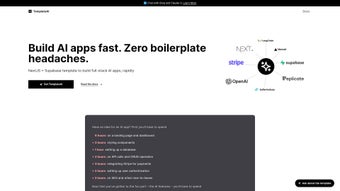
TemplateAI is a cloud‑native, web‑based development platform that dramatically shortens the time required to build full‑stack AI applications. By marrying the modern React‑driven front‑end framework NextJS with the powerful, real‑time backend service Supabase, TemplateAI eliminates the repetitive boilerplate that traditionally consumes weeks of a developer’s schedule. Whether you are an experienced full‑stack engineer looking to prototype a new AI‑driven product or a front‑end specialist eager to dip your toes into server‑side logic, the platform provides a ready‑made foundation that includes landing pages, dashboards, API routes, authentication flows, and even payment integrations—all pre‑configured and instantly usable. The UI follows a dark‑mode friendly design language, which not only reduces eye strain during long coding sessions but also showcases the aesthetic polish that modern SaaS products demand. Integrated AI utilities such as Stable Diffusion for image generation and OpenAI’s GPT‑4 for text generation empower you to experiment with cutting‑edge models without leaving the development environment. Detailed, step‑by‑step documentation, lifetime updates, and an “Essentials Suite” for visual database management further reinforce TemplateAI’s claim as a one‑stop shop for rapid AI app development. Community feedback consistently highlights massive time savings—many users report cutting development cycles from several weeks down to a few days—because the platform abstracts away the heavy lifting of infrastructure, security, and third‑party service integration, letting you focus on the unique AI features that differentiate your product in the market.
Key Features & Benefits
- Pre‑configured Full‑Stack Boilerplate: Ready‑made NextJS pages, Supabase tables, and API routes accelerate project kickoff.
- Integrated Authentication & Payments: OAuth, email‑magic links, Stripe, and PayPal are set up with minimal configuration.
- AI Utilities: Built‑in image generation (Stable Diffusion) and text generation (OpenAI GPT‑4) modules let you prototype AI features instantly.
- Dark‑Mode Theme Support: A modern UI that automatically switches to dark mode for better developer ergonomics.
- Essentials Suite for Database Management: Visual table editors, role‑based access control, and real‑time subscriptions simplify data handling.
- Lifetime Updates & Detailed Docs: Continuous improvements, security patches, and a comprehensive knowledge base keep your app future‑proof.
- Responsive Design & SEO Ready: Templates are mobile‑first, ensuring your AI app looks great on any device and ranks well on search engines.
- Extensible Architecture: Plug‑in support for additional AI models, third‑party APIs, and custom middleware.
Beyond the raw feature list, TemplateAI’s greatest advantage lies in the productivity boost it delivers. By abstracting the tedious setup of authentication, payment, and database layers, developers can redirect hours of work toward refining AI models, improving user experience, or expanding market reach. The platform’s secure, cloud‑native foundation means you inherit best‑in‑class security practices—such as HTTPS‑only communication, HTTP‑only cookies for session handling, and OWASP‑aligned defaults—without writing a single line of security code. Moreover, the seamless integration with popular AI services enables rapid experimentation, ideal for startups that need to iterate quickly or enterprises looking for a reliable baseline for internal tools. The architecture is deliberately modular; you can replace the default Supabase backend with another PostgreSQL provider, swap out OpenAI for a self‑hosted LLM, or extend the UI with custom React components. All of this flexibility is delivered while maintaining a developer‑friendly experience that feels both powerful and approachable, allowing you to launch AI‑driven products faster, safer, and at a lower total cost of ownership.
Installation & Usage Instructions
Getting started with TemplateAI is straightforward, even for developers who are new to the NextJS‑Supabase stack. Follow these steps to download, install, and launch your first AI app:
- Sign up for an account: Visit the official TemplateAI website, click “Get Started,” and create a free account using your email or a supported OAuth provider.
- Clone the starter repository: After logging in, you’ll receive a unique Git URL. Open your terminal and run
git clone https://github.com/templateai/starter.git. - Install dependencies: Navigate to the project folder and execute
npm install(oryarn install) to pull in NextJS, Supabase client, and AI SDKs. - Configure environment variables: Copy
.env.exampleto.env.localand fill in your Supabase URL, anon key, Stripe secret, and any API keys for AI services (e.g., OpenAI). - Run the development server: Execute
npm run dev. The application will be available athttp://localhost:3000, showcasing a ready‑made landing page, dashboard, and authentication flow. - Deploy to production: When you’re ready, push your code to a Git provider (GitHub, GitLab, or Bitbucket) and connect it to Vercel or Netlify. Both platforms support automatic builds for NextJS and will provision Supabase resources with a single click.
- Start integrating AI: Use the pre‑built
/api/generate-imageor/api/generate-textendpoints as templates. Replace the placeholder logic with your own prompts, model parameters, or custom inference pipelines. - Monitor and scale: The Supabase dashboard provides real‑time metrics for database usage, while Vercel’s analytics give you insight into request latency and server‑less function execution. Adjust your plan or enable auto‑scaling as traffic grows.
The documentation includes a step‑by‑step video walkthrough, a troubleshooting guide, and best‑practice recommendations for scaling AI workloads. Because TemplateAI is delivered as a SaaS‑based tool, updates are applied automatically—no manual patches or version mismatches to worry about. The local development environment works uniformly on Windows, macOS, or Linux, as long as Node.js 18+ is installed, ensuring a consistent, secure experience across all platforms.
Compatibility, Pros & Cons, FAQ, and Final Thoughts
Compatibility & System Requirements
TemplateAI is a cloud‑first solution, meaning the heavy lifting happens on remote servers. However, the local development environment must meet a few baseline requirements to ensure smooth operation:
- Operating Systems: Windows 10/11, macOS 10.15+ (Catalina), and major Linux distributions (Ubuntu 20.04+, Debian, Fedora).
- Node.js: Version 18.x LTS or newer.
- Package Manager: npm 8.x+ or Yarn 1.22+.
- Browser Support: Modern browsers (Chrome 108+, Firefox 107+, Edge 108+, Safari 15+) for the admin dashboard and UI previews.
- Internet Connection: A stable broadband connection is required to interact with Supabase, AI APIs, and the deployment platform (Vercel/Netlify).
- Optional Tools: Docker can be used for containerized development, though it is not mandatory.
Because TemplateAI runs on top of NextJS, it inherits the framework’s cross‑platform compatibility. The generated code is pure JavaScript/TypeScript, so you can develop on Windows, macOS, or Linux without any loss of functionality. Supabase’s hosted Postgres service is accessed via HTTPS, making the back end platform‑agnostic as well. Security updates are applied automatically to both the front‑end hosting and the Supabase backend, ensuring that your production environment remains up‑to‑date without manual intervention. In short, TemplateAI delivers a seamless, secure development experience across all major operating systems, allowing you to focus on building AI features rather than wrestling with compatibility issues.
Pros
- Rapid project kickoff with zero boilerplate.
- Secure, production‑ready authentication and payment integrations.
- Built‑in AI utilities for image and text generation.
- Lifetime updates and comprehensive documentation.
- Responsive, dark‑mode ready UI that works on all devices.
- Extensible architecture for custom AI models and third‑party APIs.
Cons
- Relies on external services (Supabase, Stripe, OpenAI) which may incur additional costs.
- Learning curve for developers unfamiliar with NextJS or Supabase.
- Limited to web‑based deployments; no native mobile app scaffolding.
- Deep customizations beyond provided templates may require substantial code changes.
FAQ
Is TemplateAI free to use?
TemplateAI offers a free tier with core features, including the starter boilerplate and basic AI utilities. Premium plans unlock advanced integrations, higher API quotas, and priority support.
Can I deploy my TemplateAI app to my own server?
Yes. While Vercel and Netlify provide one‑click deployments, you can also export the NextJS app as a static site or run it on any Node.js‑compatible server, including your own VPS or Docker container.
What AI models are supported out of the box?
TemplateAI includes wrappers for OpenAI’s GPT‑4, Stable Diffusion for image generation, and supports any REST‑compatible AI service via custom endpoints.
How does TemplateAI handle security and data privacy?
All communication with Supabase and third‑party APIs uses HTTPS. Authentication tokens are stored securely using HTTP‑only cookies. The platform follows OWASP best practices, and regular security patches are delivered automatically.
Do I get lifetime updates with the purchase?
Yes. Once you acquire a license, you receive all future feature releases, security updates, and documentation improvements at no extra cost.
Conclusion & Call to Action
TemplateAI stands out as a purpose‑built platform that bridges the gap between rapid prototyping and production‑grade AI applications. By removing the repetitive setup of authentication, payments, and database layers, it empowers developers to spend more time innovating on the AI side of their projects. The combination of NextJS’s performance, Supabase’s real‑time capabilities, and built‑in AI utilities delivers a flexible yet secure foundation that scales with your product’s growth. While reliance on external services can add marginal costs, the overall reduction in development effort, the built‑in security posture, and the promise of lifetime updates make TemplateAI a compelling investment for both startups and larger enterprises.
Ready to accelerate your AI product roadmap? Download TemplateAI today, spin up your first project in minutes, and experience the productivity boost that thousands of developers are already raving about.
Review
TemplateAI delivers an impressive balance of productivity and power. The pre‑configured stack eliminates weeks of setup work, while the AI utilities let you experiment without building integrations from scratch. Minor drawbacks include reliance on third‑party services and a learning curve for newcomers to NextJS, but these are outweighed by the platform’s speed, security, and lifetime update promise.



.png)