In her book Holy Personal: Looking for Small Places of Worship, Laura Chester tells the inspiring story of artist Michael Dowling.
Dowling had loved art for as long as he could remember, but it made its first profound impression on him in the first grade.
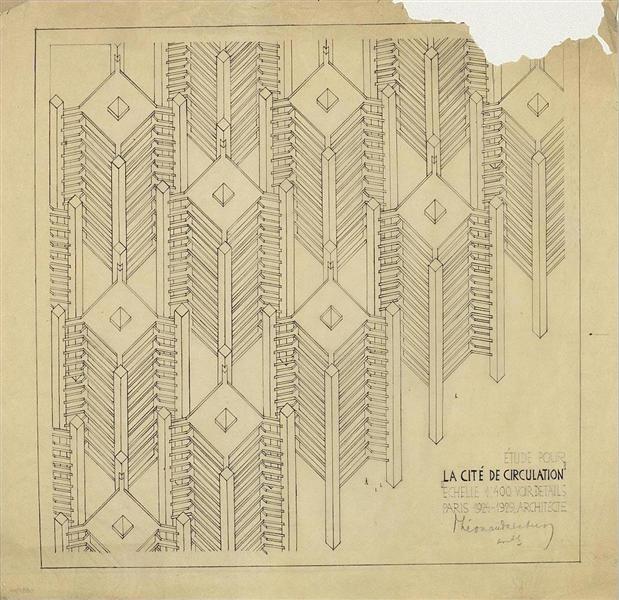
“When I was six,” Dowling recalls, “I made a pattern of a checkerboard grid, a purple square, then a yellow square with a purple flower. I had no idea what I was doing, but for some reason I took it to my next door neighbor’s house, Mrs. Strong, and she said, ‘Oh, that’s so beautiful. I’d love to have wallpaper made out of that.’”
When he took his pattern to school the next day, though, his work was ridiculed and rejected by his teacher and classmates.
He continues, “I recently remembered this–for now I’m working on this tile floor piece, and the tiles, it turns out, are based on early Celtic designs that are exactly the same grid as the grid I did when I was six, the 64 squares, which is really a checkerboard or chess board–very big in Celtic mythology.”
“I was in my studio recently, contemplating these tiles, and I had a vision of the checkerboard I had painted when I was six years old. That same day my twin nieces invited me to come to their school as a visiting artist. […] I gave them all tiles to paint on, and I told them the story of Mrs. Strong.”
“Later that afternoon, when I was dropping my nieces off, my sister showed me Mrs. Strong’s obituary. We discovered that the wake was being held right around the corner, so we both went, and I was able to tell her children, my childhood friends, this story.
“I love that kind of drawstring that pulls various events of your life together.”
Laura Chester, Holy Personal, pp. 10-12.
finding god in the root cellar
When we’re born with gifts, many times our parents overlook or fail to recognize them. Children must then find parental surrogates among accessible adults such as teachers. In this story, Michael Dowling’s gift for art was overlooked by his parents and teachers alike. In fact, when he brought his gift into the classroom, as so often happens, it was not merely ignored, but also ridiculed. This is the fate of so many artistic, creative, and brilliant children.
Michael Dowling was born with a gift. From the earliest age he could remember, his calling was to do art. His journey must have taken many twists and turns between third grade and adulthood, but eventually, it led him to a decision–to transform a root cellar into a personal place of worship, where he rediscovered art.
It is no mistake, I think, that he had to go underground to carve out a place for the Divine–and for his real Self.
halves of the whole
As Dowling worked on the tiles for his chapel, he suddenly recalled the checkerboard he had drawn at six years old. Within hours of making the connection between his present self, tiling the chapel floor, and his childhood self, creating the checkerboard, he was invited to be the visiting artist at his twin nieces’ school. To me, the twins also seemed to symbolically represent the two halves of a whole–one that Michael Dowling felt had been ‘split in two’ the day his teacher mocked his art. The day this all came together for Michael Dowling, there was no more, “right and left, light and dark, wet and dry, visible and invisible.” All was one with him the day the artist took residence.
Michael Dowling’s story reminded me to remember. It reminded me to think back to the times during my childhood when I knew the world was magical, mysterious, and frighteningly powerful.
I know what it’s like to tremble in awe.
I have known long, lazy hours of living in tiny villages made of pebbles,
of being a wild girl running through shoulder-high wheat,
of running naked in the rain through a field;
of wearing moccasins and hunting the antelope.
I’ve been a soldier, an Arctic explorer, a blind and mute girl,
a gypsy, and a princess.
I wrote poems by the hundreds,
and I’m still trying to find them.
But I know about Michael Dowling’s gift, because I know about my own.
How about you? Do you remember your magic?
Do you know what’s happened to your gift?

references & resources
Chester, Laura. Holy Personal: Looking for Small Places of Worship. Indianapolis, IN: Indiana University Press, 2000.
Hollis, James. The Middle Passage: From Misery to Meaning in Midlife. Toronto, Canada: Inner City Books, 1993.
SPOKE (formerly Medicine Wheel Productions), the arts organization and nonprofit founded by Michael Dowling.


Leave a Reply